 Louis Simond was a French emigre who lived in America. He spent over 6 months in London in 1810, describing the customs and manners of the British in a book that is now entitled An American in Regency England.
During his tour of England, Louis met and talked to people from all walks of life. He observed every day and momentous events of that era, and visited the countryside, describing with a keen mind what he saw and ate and who he met.
Here is Louis’ description of a typical London Townhouse:
Each family occupy a whole house, unless very poor. There are advantages and disadvantages attending this custom. Among the first, the being more independent of the noise, the dirt, the contagious disorders, or the dangers of your neighbour’s fires, and having a more complete home. On the other hand, an apartment all on one floor, even of a few rooms only, looks much better, and is more convenient. These narrow houses, three or four stories high – one for eating, one for sleeping, a third for company, a fourth under ground for the kitchen, a fifth perhaps at top for the servants – and the agility, the ease, the quickness with which the individuals of the family run up and down, and perch on the different stories, give the idea of a cage with its sticks and birds.
Typical touches were bow fronts, Palladian windows, symmetry, graceful lines and neoclassical touches — the hallmarks of the Regency town house. This example of grand townhouses is of the Circus in Bath.
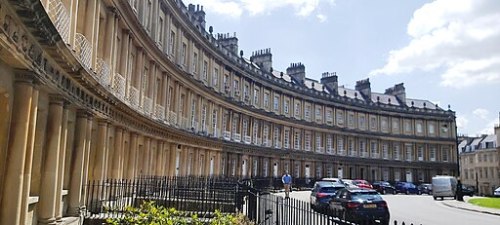
The Circus in Bath. Excellent example of Regency era town houses. Image: Wikipedia. Image taken by Anthony Parkes.







 Jane Austen's World