A Book Review by Brenda S. Cox
Austen’s Endings
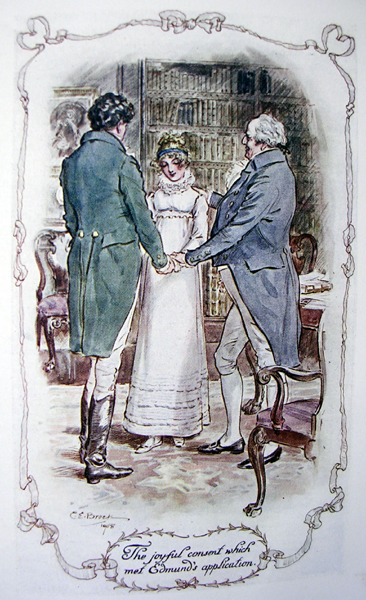
A major complaint that readers have about Austen is her endings. In both Sense and Sensibility and Mansfield Park, we have a sudden romance that is practically a footnote to the last chapter—Marianne marries Colonel Brandon with just, “Marianne found her own happiness in forming his,” and Fanny marries Edmund once he learns “to prefer soft light eyes to sparkling dark ones.” Northanger Abbey introduces a new character, Eleanor’s viscount, to facilitate Henry and Catherine’s marriage.
In Emma and Persuasion we do get some romantic talk (or writing) from the hero. However, in response, Emma says “just what she ought” (which is??), and Anne receives Wentworth’s look “not repulsively.” Then they talk, but we don’t hear their words.
Darcy, of course, simply tells Elizabeth his “affections and wishes are unchanged,” perhaps not willing to risk another disastrous proposal, and Elizabeth “immediately, though not very fluently, gave him to understand that her sentiments had undergone so material a change, since the period to which he alluded, as to make her receive with gratitude and pleasure his present assurances.” But what exactly did she say?
In all cases we have more author commentary than demonstrations, more of what writers call “telling” rather than “showing.”
Movie-makers have had to put words to all these proposals, and fill in some blanks. For example, they show Colonel Brandon rescuing Marianne from the rain, and wooing her with music. But why didn’t Jane Austen, who gave us so many delightful conversations and events, show us all those details herself?
Jane Austen & the Price of Happiness

When I listened to Jane Austen and Her Endings: A Visit with Inger Brodey on Austen Chat, I was intrigued by Inger’s thoughts on analyzing those endings of Austen’s novels and trying to figure out why Austen didn’t give us all the details we want. Recently I finally got to buy (at JASP, from Jane Austen Books), and read, Jane Austen & the Price of Happiness by Inger Sigrun Brodkjær Brodey.
It’s a fascinating book, and written quite accessibly. (I found only a couple of unfamiliar academic terms*; in general it’s written in everyday English.) The illustrations are fun, including cartoons, images from movies, and more.
Each chapter analyzes one of the novels, in the order they were written, so we see the development of Austen’s techniques. Brodey looks at various aspect of each novel with new insights and considers the impact of the ending. Then she looks at some popular adaptations of that novel, mostly films plus a few books. She considers how they handle the ending and whether their endings fit Austen’s goals.
Her chapter titles give you some idea of her thoughts:
- Introduction: “Perfect Felicity”
- Chapter 1: “Commonplace Happiness” (Northanger Abbey)
- Chapter 2: “Expecting Literary Justice” (Sense and Sensibility)
- Chapter 3: “The Limits of Romance” (Pride and Prejudice)
- Chapter 4: “The Thin Veil of Comedy” (Mansfield Park)
- Chapter 5: “The Art of English Happiness” (Emma)
- Chapter 6: “Resources for Solitude” (Persuasion)
- Conclusion: “Coauthoring Happiness”
Brodey says that, for one thing, Austen is trying to show readers that their expectations of romantic idealism come from the sort of sensibility she satirizes. Austen disrupts those expectations. She shows us that the romantic outcomes we want, expect, and demand are not inevitable: this is fiction. Her stories are realistic, with characters operating in ordinary, everyday life, but the “happily ever afters,” the “perfect happiness,” may or may not happen in real life.
There are other reasons for Austen’s nuanced endings, which I’ll leave you to discover from Inger’s book. However, I’ll share a few highlights from the chapter on Mansfield Park, as an example of some of the many insights in the book.
“The Thin Veil of Comedy” Chapter on Mansfield Park
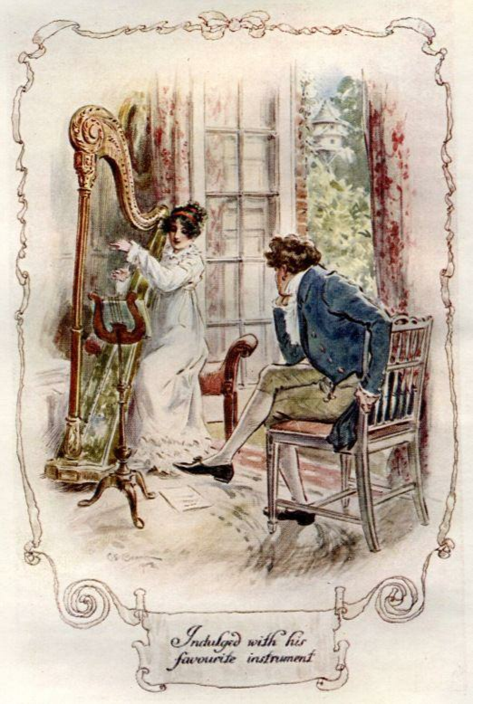
Mansfield Park was published after the light, bright, and sparkling Pride and Prejudice. It deals with harder truths. Brodey claims Austen’s “novels alternate between the bright and witty heroines whose primary obstacles are internal, and the more understated, misunderstood, and wiser heroines whose primary obstacles are external” (p. 138). I had to think about this one, but it’s true—Catherine Morland is not witty, but she does face internal obstacles of her own credulousness and illusions; Elinor Dashwood is wise and misunderstood; Elizabeth Bennet, obviously bright and witty, needs to overcome her pride and prejudices; Fanny Price is also wise but understated and faces external challenges; Emma is again bright and witty and needs to overcome her own pride; Anne Elliot is quiet but wise.
Austen shows, especially in Mansfield Park, that charm can be dangerous. Mary Crawford is lively and charming like Elizabeth Bennet. She and her brother Henry charm Edmund, Maria, and Julia, as well as readers, just as Wickham charmed Elizabeth. However, charm without a strong moral foundation leads to disaster. Austen is challenging her readers “to love the less prepossessing characters and see beyond the false power of charm.”
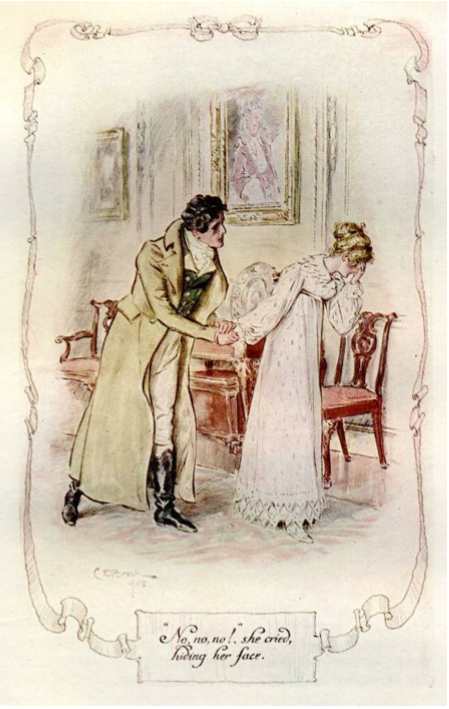
The final chapter of Mansfield Park tells us outcomes for many characters, who are apparently as important as Edmund and Fanny. We see the reformation of some, such as Tom Bertram and Sir Thomas Bertram. Austen reveals the sad but not completely tragic endings of those who were not willing to change, including Henry and Mary Crawford. Henry could even have had an alternate ending, with a happy marriage to Fanny, if he had been willing to persevere in his resolutions of self-improvement. Brodey says, “It somewhat diminishes [Fanny’s] marriage to Edmund to know that a marriage to Henry would not have been disastrous. Once again, Austen surprises the reader out of extravagant expectations of the novel. We get shades of gray where we hope for black and white, realism where we crave romance” (p. 148).
As in other endings, Austen intrudes in the first person, saying “My Fanny indeed at this very time, I have the satisfaction of knowing, must have been happy in spite of everything.” Austen reminds us that this is fiction and that she, as the author, is controlling the ending. She also refers to Fanny as a living human being, though. In showing her own attachment to Fanny (“my Fanny”), she “models the attachment that she believes Fanny deserves” (p. 147).
She challenges our readerly expectations of fantasy endings, including a sense that “second attachments are degrading for romantic heroines” (p. 149); shades of Marianne Dashwood! We believe that Edmund and Fanny will be happy together, even though it is Edmund’s “second attachment.” They do not need some intense eternal passion to experience happiness.
I hope these brief points pulled from one chapter might give you a little more understanding and appreciation of Mansfield Park. I encourage you to read all of Jane Austen & the Price of Happiness. I think you will find it fascinating and illuminating, as I did!
*Here’s one word I learned from this book: apophasis. It means “raising an issue by claiming not to mention it,” or, as Brodey puts it, “tell[ing] the reader what will not be told.” Austen’s endings often use this technique. For example, near the end of Mansfield Park: “But there was happiness elsewhere which no description can reach. Let no one presume to give the feelings of a young woman [Fanny] on receiving the assurance of that affection of which she has scarcely allowed herself to entertain a hope.” As Brodey says, it’s an annoying technique. But Austen has her reasons.
Brenda S. Cox is the author of Fashionable Goodness: Christianity in Jane Austen’s England. She also blogs at Faith, Science, Joy, and Jane Austen.







 Jane Austen's World
Thank you, Brenda, for this interesting review. We would know more of what Austen thought about happy endings and quick romance in general if Cassandra hadn’t destroyed so many letters. She deprived generations of readers of understanding Austen’s candid thoughts about love and I believe that she was evil. The new Miss Austen TV series, about Cassandra and the letters, was so untruthful and the acting so amateurish that I couldn’t get past episode 1. Jane being a vivid brunette but with a bland timid personality was also a stretch. She had to have been an entertaining conversationalist.
Hi, Patty! It is sad that so many of Austen’s letters were lost. On the other hand, it seems like Cassandra was doing what she thought her sister would want her to; perhaps Jane didn’t want posterity to know quite so much about her. We can only guess. But the guessing can be fun!
Thanks for this thoughtful review, Brenda! I actually love that “annoying” technique of apophasis; through it, Austen allows us, as readers, to exist in multiple planes at once. We experience her wit and social commentary, as well as the unfolding of the story, without being told exactly how to feel about it. We are given space to imagine for ourselves that happiness “no description can reach.”(I think Austen recognized how, if she had given more details about Fanny’s happiness, she would have lessened it. What a brave assertion for an author to make: that words are not, in fact, always up to the task of capturing life!)
Ironically, it’s this space to imagine that allows those of us who dabble in variations and adaptations to thrive, even if we ought not “presume to give feelings” to her characters. :) Sorry, Miss Austen: I do presume, but I also acknowledge the superiority of your writing and your approach to narrative!
By the way, I had the chance to attend JASP this June, and when someone pointed you out from a distance (“That’s Brenda Cox!”), I felt as if I was in the presence of celebrity! (Sorry that I didn’t get a chance to say hello in person.) What a great gathering of intelligent, insightful people that was! Certainly it was wonderful to hear from Dr. Brodey and so many other great scholars. I was grateful to Brodey and all the people involved in JASP for making such a gathering possible.
Happy reading to you, and thanks again for sharing your thoughts on this book!
Thanks, Christina! I wish I’d gotten to meet you at JASP! If you’re at the AGM, I’d love to get together. Blessings to you.
enjoyed your review.
Fascinating! Thank you for sharing this, Brenda!