Feeds:
Posts
Comments

Posts Tagged ‘Beau Brummell’

Another Version of Beau Brummell’s Demise

In this YouTube clip about George Brummell, find a discussion about this fascinating man and the Prince Regent and how their relationship ended in an entertaining monologue by George Stuart, artist and raconteur.

Mr. Stuart sculpts historical figures using art historical sources to guide him. Then he speaks about the personages in different venues around California, including Ventura County Museum, using the information he researched. Much of what Mr. Stuart says rings true in this Teapots and Tyrants account, but there are enough deviations with which an historian might find reason to quibble. Regardless, the clip is entertaining and provides one with a pleasant way to spend seven minutes.

Learn more about Beau Brummell and Mr. Stuart at these sites:

  • Learn a wealth of information about George Brummell at Dandyism.net

  • Stroll through St. James’s here and view a statue of Beau Brummell on Jermyn Street. Find also a photo of the window of Lock’s, the hatters.

Read Full Post »

Beau Brummell’s Gambling


Beau Brummel’s gambling addiction spelled his eventual downfall in Society. His passion for betting on everything under the sun was shared by his set, who in some instances gambled and lost fortunes overnight. One can still trace these bets, many of them personal, in the betting book at White’s, a gentleman’s club in London. In this book a gentleman recorded his private wagers, no doubt to aid his memory in case alcohol had befuddled his brain. Bets ranged from speculating on the date of a birth or death, the sex of an expected child, who would marry whom, appointments to a position, scandals, who murdered whom, and more. Here then, are a few of Mr. Brummel’s wagers:

Mr Brummel bets Mr. Irby one hundred guineas to ten that Buonaparte returns to Paris (Decr. 12th, 1812)

Mr. Brummel bets Mr. Methuen 200 gs to 20 gs that Buonaparte returns alive to Paris, (Decr. 12th, 1812)

A Capain Capel placed the following wager with Beau:

Capt. Capel bets Mr. Brummell 5 gs that Napoleon is not at the head of the French government in Paris within ten days from this day. March 15th, 1815

Even as Beau’s fortunes took a drastic turn for the worse, he managed to hide his indebtedness for a number of years. But he could not keep debt at bay forever, particularly not after his relationship with the Prince Regent soured. Eventually he was unable to pay off even the gentleman’s debts he had made. Beau’s final bet at White’s in March, 1815, “that the Bourbons are on the throne of France on May 1st next,” was marked “not paid, 20th January, 1816. (Donald A. Lowe, The Regency Underworld, p. 137.)

In 1816, Beau fled to Calais to escape his debtors. Donald A. Lowe writes,

As was customary in the period, an auction was held of the property of a ‘certain gentleman of fashion lately gone to the Continent’. Some came to watch, with no intention of buying, as is the way in every age. This marked the point of no return for Brummell, although he continued for many years to nurse false hopes of being restored to his old haunts and his former glory. In 1819 his star had sunk so low that a scion of the minor nobility at White’s – the very type of Englishman who had once treated him with such respect – wrote in the betting book,

Ld Yarmouth gives Lord Glengall five guineas to receive one hundred guineas if Mr. G. Brummell returns to London before Buonaparte returns to Paris.
To read more about Mr. Brummell on this blog, click here.

To read more about gaming houses and gentleman’s clubs, click here.

Read Full Post »

It is an historical fact that the Prince Regent and Beau Brummel had a falling out. The actual events are not known for sure, but here are two knowledgeable sources that speculate as to the nature of the rift.In The Most Polished Gentleman, Cynthia Campbell writes, “There had been frequent minor quarrels in the past; one was in the Pavilion, when, as Captain Gronow recounts, Brummell had thrown his snuffbox onto the fire after the Bishop of Winchester had unthinkingly helped himself from it. The Regent, who, Gronow said, had a great reverence for Bishops, considered this action an unforgivable insult. They were never close after this, although they continued to meet.” p.133

In The Wits and Beaux of Society, Grace Wharton and Philip Wharton write,”A quarrel did take place between George the Prince and George the Less, but of its causes no living mortal is cognizant: we can only give the received versions. It appears, then, that dining with H.R.H. the Prince of Wales, Master Brummell asked him to ring the bell. Considering the intimacy between them, and that the Regent often sacrificed his dignity to his amusement, there was nothing extraordinary in this. But it is added that the Prince did ring the bell in question—unhappy bell to jar so between two such illustrious friends!—and when the servant came, ordered ‘Mr. Brummell’s carriage!’ Another version palms off the impertinence on a drunken midshipman, who, being related to the Comptroller of the Household, had been invited to dinner by the Regent. Another yet states that Brummell, being asked to ring the said bell, replied, ‘Your Royal Highness is close to it.’ No one knows the truth of the legend, any more than whether Homer was a man or a myth. It surely does not matter. The friends quarrelled, and perhaps it was time they should do so, for they had never improved one another’s morals; but it is only fair to the Beau to add that he always denied the whole affair, and that he himself gave as the cause of the quarrel his own sarcasms on the Prince’s increasing corpulency…”

Carlton House


Cynthia Campbell goes on the say, “There was a final encounter. While waiting for their carriages after the opera, in a great crush, they came close. An eyewitness reported that Brummell was about to bump into the Regent. “In order to stop Brummel, therefore, and prevent an actual collision, one of the Prince’s suite tapped him on the back, when he immediately turned sharply round, and saw there was not more than a foot between his nose and the Prince of Wales’. I watched with intense curiosity, and observed that his countenance did not change in the slightest degree nor did his head move; they looked straight into each other’s eyes, the Prince evidently amazed and annoyed. Brummell, however, did not quail or show the least embarrassment. He receded quite quietly, and backed slowly step by step till the crowd closed between them, never once taking his eyes off those of the Prince….

By 1816 Brummell had such heavy gambling losses that he had to leave England to escape arrest for debt. He lived for many years in Calais, and later in Caen. With sad irony, the old age of the prince of dandies, the paragon of cleanliness, was one of imbecility, decrepitude, and disease. “His habits were so loathsome that an attendant could hardly be found for him.” He died in a Caen asylum in 1840.

For a humorous doggerel recounting the rift, click on the link below:

Prince Regent According to Albert Igginbottom

Read Full Post »

One of my favorite descriptions of the Regency dandy, and one that I contributed to Wikipedia, is the following in which author Venetia Murray quotes an excerpt from An Exquisite’s Dairy, from The Hermit in London, 1819:

Took four hours to dress; and then it rained; ordered the tilbury and my umbrella, and drove to the fives’ court; next to my tailors; put him off after two years tick; no bad fellow that Weston…broke three stay-laces and a buckle, tore the quarter of a pair of shoes, made so thin by O’Shaughnessy, in St. James’s Street, that they were light as brown paper; what a pity they were lined with pink satin, and were quite the go; put on a pair of Hoby’s; over-did it in perfuming my handkerchief, and had to recommence de novo; could not please myself in tying my cravat; lost three quarters of an hour by that, tore two pairs of kid gloves in putting them hastily on; was obliged to go gently to work with the third; lost another quarter of an hour by this; drove off furiously in my chariot but had to return for my splendid snuff-box, as I knew that I should eclipse the circle by it.

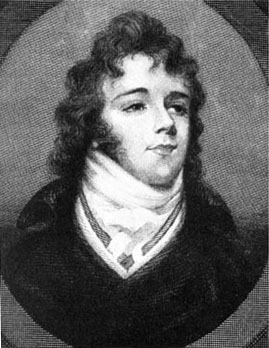
Beau Brummell, image from the British Library

Beau Brummell was the quintessential dandy of the era. Dandies are described in Prinny’s Set on the Georgian Index.

Find a short history of Brummell’s most famous sartorial contribution on the The White Satin Cravat.

Here is another quote about Brummell: “George Bryan “Beau” Brummell, then, must qualify as the most committed dandy of them all. Not only was he an enthusiastic, lifelong slave to his mirrors, he also polished them with champagne. His outrageously flamboyant, nascent rock’n’roll lifestyle, decadent splurging, shameless narcissism and meticulous attention to vanity and wardrobe has set the gold standard for dandies ever since.” (From All Mouths and Trousers)

Click on the following links to learn more about Mr. Brummell:

Beau Brummell: The Dandy

George Brian Brummell: Biography

The Sartorial Dandy

Lesson Two: The Gentleman’s Wardrobe

Upon My Word! Regency Fact and Figures

The Emergence of the Dandy

Dandyism: Andrew Solomon


Also on this blog: Male Bastions: The Clubs of St. James’s

Dandy Clubs for Research

Read Full Post »


Found on the Internet, an abstract of the following article:

The Clubs of St. James’s: places of public patriarchy – exclusivity, domesticity and secrecy, Jane Rendell

The male clubs of St. James’s, specifically the four at the top of St. James’s Street; Boodle’s, Brooks’s, Crockford’s and White’s, were frequented by men of the same class who used their control of space to assert social and political allegiances and rivalries between men. The exclusivity of the first floor gambling room, a place of secrecy and privacy, is contrasted with the ground floor bow window, a site of public display and exclusivity. Male leisure pastimes, such as drinking, sporting, gambling, are explored as social and spatial practices which, by establishing shared codes of consumption, display and exchange, represent public masculinities.”

During the period of his greatest popularity and influence, Beau Brummell (depicted above) held court in the Bow Window at White’s in full view of the public. White’s was founded in 1693 as a Chocolate House. By the end of the 18th Century, the popularity of chocolate houses declined, and many of the exclusive chocolate houses became Gentleman’s Clubs.

Find more information about Gentlemens Clubs in the following:

Read Full Post »

« Newer Posts