 My review of Masterpiece Classic’s Tess of the D’Urbervilles (2008 ), Part One, was rather benign considering all the horrible events the poor girl had to endure. Tess, having weathered as much misfortune in two years as most people experience in a lifetime, weds her Angel and confesses her sin. Now here’s where the plot became problematic for me: As a woman living in the modern world, I cannot like Angel. Yes, he’s young and idealistic and has already bent the rules by marrying Tess, sacrificing a bit of the family honor in the process, but his actions smack too much of high school,
  where a boy will pursue a girl, then drop her because she’s a slut. “The woman that I love is not you,” he said after hearing her out, and I know this is the point author Thomas Hardy was trying to make. Different worlds. Different manners. Different mores. Clash of cultures. Regardless, I cannot forgive Angel for abandoning Tess after she’s revealed that she’s carried another man’s child. Angel’s attitude remained prevalent well into the 1960’s, and I thank my lucky stars to be living in this enlightened, more forgiving time. Without this crucial plot development, we’d be staring at a happy ending, but the viewer still has almost half of this two-part film to watch.
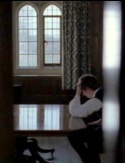 Eddy Redmayne and Gemma Arterton were splendid in this scene. Gemma as Tess is at first brimming with hope, then crestfallen as she begs for Angel’s forgiveness. Redmayne manages to show conflicting feelings – anger, hurt, and love – as he bids Tess goodbye, unable to accept from his rigid, puritanical upbringing that she’s a fallen woman.

Groby
Tess returns home, having failed once again. Explaining her decision to reveal her secret, she says simply to her mother: “I love him. It would have been a sin to deceive him,”demonstrating her purity of heart and innate goodness. With Angel heading for Brazil, Tess prepares to find employment … and jumps from the frying pan straight into the fires of hell. In her new position as a farm girl on bleak Flintcombe-Ash farm, Tess remeets an evil enemy from her time on the D’Urberville estate. Groby, the farm manager, shows her no pity and cuts her no slack during a harsh winter. Worse, Tess will not be paid until after a year’s hard labor.
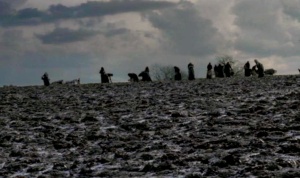
Bleak Farm
Coincidentally (for the plot now depends on many such twists) Tess finds Marion, her milkmaid friend, working at this inhospitable place. Not surprisingly, Izz joins them too. And when the two former milkmaids ask questions about her marriage, Tess’s replies: “No pity. No questions either. I’m just plain Tess Durbeyfield, just as before.”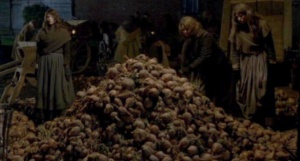
One cannot help to continue watching this trainwreck of a plot as the melodrama keeps churning. It is human nature, after all, to stand still and observe another’s misfortune. Tess goes to visit Angel’s family to ask them for help, but changes her mind. Returning to the farm, she stumbles upon a revival tent with Alec inside it. One must suspend disbelief and suppose that everyone lived within walking distance of each other, and that frequent encounters out of the blue did not seem coincidental.

Alec, the preacher
After his mother’s death and a tussle with his soul, Alec becomes a preacher, but one look at Tess and all the faith is knocked out of him. Alec then leaves his new calling … just like that. Hans Matheson and the film’s writer try their best to interject some reality into Alec’s scenes and solicit sympathy for his character, but at this point I felt it was best just to watch the film and not make logical sense out of events as they unfolded.
Tess was put on this earth to suffer, and suffer she does, with misfortune rolling her way every time she turns around. She forfeits a year’s wages for her backbreaking work when she returns home to visit her ill father. After his death, the family must leave their leased house because, while her mother and siblings are respectable, Tess is not. The persistent Alec follows the family as they seek another lodging, stalking Tess and pressuring her to be with him. With no money, house, job, or prospects, Tess finally succumbs to his relentless advances. She has given up on Angel, believing he will never return.
 Meanwhile Angel has been sick in Brazil and has undergone a sea change in attitude. After recovering from yellow fever, he returns home and goes on a quest to find Tess. He pays a heavy penance as he learns of her life after he abandoned her, realizing what misery she’s experienced. When he locates her in the resort town of Sandbourne, looking like the scarlet woman she’s become, she begs him to leave, crying out: “It is too late for me now, I’m already dead!” Portentous words. After coming such a long way to find her, he seems to give her up rather quickly, but Tess is made of sterner stuff.
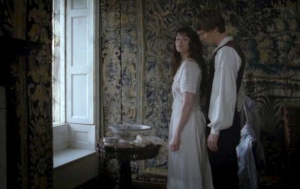
Moment of bliss
Gemma’s beautiful features flit from innocent to worldly to distressed and angry as she convincingly plays an older and wiser Tess. She confronts Alec, who is nasty, spiteful, and possessive, and kills him. One can imagine how scandalized the Victorian reading public was with this turn of events. According to the PBS press release, “Tess of the D’Urbervilles was so shocking that Hardy had to withhold selected chapters during its first appearance in serial form.These chapters were later restored in the published volume.”
 Tess and Angel share only two days of tender bliss as he tries to help her escape from the law. Angel is now completely on her side and will not abandon her, but Tess knows it’s too late. Instead of leaving their shelter she begs him for one more night as man and wife: “Why put an end to all this joy?” Why indeed?
Poor Tess. Poor, doomed Tess. Hunted as fugitives, she and Angel spend their last night together at Stonehenge. This stone age monolith is an appropriate setting for the denouement of a tale that is all about a clash of  cultures in a changing age. The death imagery is a bit heavy handed in these scenes, but at this point the viewer has given up on subtletly. As the law closes in on her, Tess tearfully embraces Angel: “It couldn’t have lasted,” she said, “Too much happiness.” Which is when I drew out my hanky and bawled.
Thomas Hardy felt passionate about this novel. “To him, Tess was a symbol of rural Britain, a pagan goddess at odds with the social and technological change sweeping across England’s West Country in the late 19th century.” 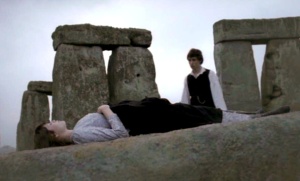 (PBS Press Release) To me, her story is heart breaking. I agree with her friend Izz Huet, who concluded after speaking with Angel, “Whatever she’s done, she doesn’t deserve this.”
For sheer gut wrenching entertainment value, I give this production high marks, but as a Janeite, I can only give Hardy’s soap opera plot a grade that barely passes.
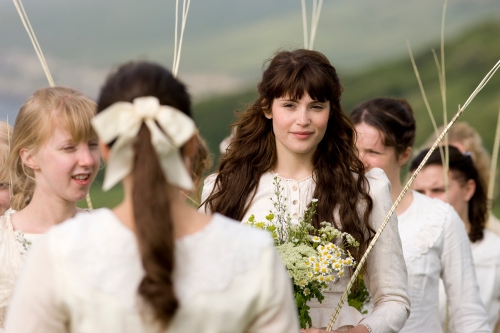

 The film opens with the parson informing Tess’s drunken father that he believes the family is descended from the aristocratic D’Urbervilles family. Life is never the same for the Durbeyfields again, for the knowledge that they might be descended from one of the finest families in the land goes to the parents’ heads.We then meet 17-year-old Tess at a May Day Dance. She is on the threshold of life and we discover that her desire is to lift herself out of the working class life by becoming a teacher. She briefly meets a lad named Angel Clare (Eddy Redmayne) during that dance and their first sight of each other is electrifying.

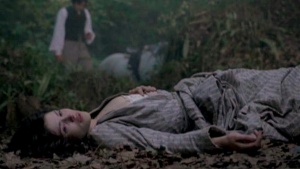 Thomas Hardy does not make it clear in his novel if Tess is seduced against her will or raped, but this film version strongly hints at rape in a nightmarish scene that ends with Tess crying on the forest floor, her bodice ripped open. Tess spurns Alec. She might have lost her virginity, but her honor remains intact. She returns home and gives birth to a bastard child whom she names Sorrow. Her father, angry that Tess has brought shame to the family name, refuses to have the child baptised. The child (a boy) dies, and when the pastor does not give Tess permission to bury her baby in consecrated ground she leaves the village.
 By this time the viewer has been reeling with Tess from one awful event to the other, wondering if luck will ever brighten her life. Her only supportive family member is her sister, Liza-Lu, who is too young to do more than lend a sympathetic ear. Even Tess’s mother gives her little support. The scene in which Gemma/Tess cries out to her mother, asking her “Why did you not warn me?” is unforgettably sad, though it is not in the novel. I had watched Gemma only as Lizzy Bennet in Lost in Austen and had no idea how affecting her performance could be. The weight of this film production rests on her shoulders and she carries her burden well.
 After Tess leaves her home village, she finds a position as a milkmaid at the Talbothays dairy farm and for the first time is among friends. This relief from constant and oppressive bad luck is a welcome one and prevents the production from completely descending into a tearjerking melodrama. Thomas Hardy wrote serialized novels, which meant that each installment offered a cliffhanger ending in order to lure the reader into purchasing the next serialized chapter and Tess of the D’Urbervilles has a tendency to tug too hard at one’s heartstrings for sympathy.
 Meanwhile, Angel, the son of a gentleman, returns home to his parents to make a case for marrying Tess, a working class girl. During their discussion the viewer learns that purity, above all, is the quality that Angel and his parents seek in his bride, casting a foreboding of doom over Angel’s and Tess’s chance at happiness. Tess and the viewer know that she can never live up to his expectation. And so the story turns once again, with Tess realizing just hours before her wedding that Angel never read her letter in which she confesses that she had born Alec D’Urberville’s child. She will wed him with her secret intact.







 Jane Austen's World