With the love of nature and classical statuary, the young male body became prized. British tailoring enabled better fit and thus could reveal the new athletic ideal. The lower body was encased in extremely fitted coverings that left little to the imagination.
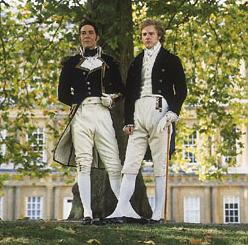 The above quote comes from the Kent State University Museum website, which features the following links to an exhibition entitled “Of Men and Their Elegance”: 1780’s – 1830’s: Sir, You Have Forgot Your Horse! and 1840’s to 1880’s: From Undress to Full Dress. To completely experience this site, click on the headings under the images, and you will be taken to an explanatory page.
The Dandy, Regency Life. Find a short history and description of dandies on this informative site.
Brassiere Pattern, circa 1800: Click on the photos for details. It comes from this amazing living history site. Click on Civilian Clothing, and go to women’s clothing
Comment about dyeing cloth . Unfortunately, no citations were quoted in this informative comment, written by syntenin_laulu. However, I found a source related to the topic, which includes the history of dyeing cloth: How to Dye Cloth, by Sophronia Gallop
There wasn’t really much specific gender distinction in colour (certainly not for small children). Ladies’ riding habits particularly (worn not only for riding, but for every kind of outdoor activity, travel and informal winter wear) occupied pretty much the identical colour range to men’s coats. There was far more of an age distinction – the older you got, the darker and more subdued were the colours you wore.
Strong and bright shades of all colours were expensive and therefore desirable, either because the dyestuff itself was costly (e.g. the cochineal used to make true scarlet) or because it took repeated dyeings to make the colour take well (e.g. a really good navy blue), or because they could only be got by skilled over-dyeing with more than one colour (e.g. bright green) . Good black was expensive and stylish; cheap black dye did – and still does – quickly fade to grey, or go patchy or rusty.
Printed fabrics in more than one colour had been expensive until the end of the 18th century as they had to be hand-blocked. With the rapid development of roller-printing, they now came within the price-range even of the working classes. Printed fabrics were still fashionable, and the latest and nicest prints still much sought after; but the mere fact of wearing printed fabric no longer signalled luxury.
In women’s fashion, the “must-have” colour changed from season to season, and in modish circles a colour such as poppy red or celestial blue might be a sign of (relative) poverty simply because it was obviously “last year’s colour”.
One wrinkle you might use is re-dyeing. Very few outer clothes were launderable, partly because of the non-fastness of the dyes of the period but also because the different fabrics used for the outer layer and the lining would shrink differentially. Coats, habits and gowns could be brushed, aired, sponged, and treated with things like fuller’s earth and hot sand to draw out grease-marks; but sooner or later your good garment would acquire a conspicuous stain, or just become incurably grubby-looking. The solution was to send it to the dyer (many launderers were also dyers) and have it re-dyed a stronger colour. That would give your coat or gown a new lease of life, but I bet a sharp-eyed person could always tell (“That redingote Miss Bates is wearing isn’t new, it’s her old one dyed”).








 Jane Austen's World