Feeds:
Posts
Comments

Posts Tagged ‘regency dress’

Ingres Portrait of Bernier, 1800

Detail of a portrait by Ingres of Bernier, 1800

The cravat rose in popularity during an an age when cleaning dirty linen and ironing clothes presented an enormous challenge. Influenced by Beau Brummell’s penchant for wearing simple clothes and snowy- white cravats, these intricately-tied neckcloths became all the rage among the gentleman of the upper crust. The lower classes, for lack of servants and resources, wore a simpler version of the neckcloth in the form of a square folded and tied around the neck.

Men’s neckcloths hark back to ancient traditions in Egypt, China, and Rome where these pieces of cloth denoted a man’s social status. During the Elizabethan period a high ruffed neckline forced a stiff posture and confined movement, which only the leisure class could afford to adopt. Servants, tradesmen and laborers had to wear more functional clothing in order to perform their duties. During the mid-17th century the French adopted the fashion of neckerchiefs after seeing Croatian mercenaries wear them. The French courtiers began sporting neckcloths made of muslins or silk and decorated with lace or embroidery. These soft cloths were wrapped around the throat and loosely tied in front.

The cravat as seen in Regency portraits attained its distinctive appearance under Beau Brummell’s expert fingers and experimentation with his valet. Brummell’s philosopy of simple menswear was in stark contrast to the dandified Macaroni who pranced about in wigs, lace, and embroidered waistcoats.  In Beau Brummell, His Life and Letters (p 50), Louis Melville writes:

“Brummell’s greates triumph was his neck-cloth. The neck-cloth was then a huge clinging wrap worn without stiffening of any kind and so bagging out in front. Brummell in a moment of inspiration decided to have his starched. The conception was, indeed, a stroke of genius. But genius in this case had to be backed by infinite pains. What labour must Brummell and his valet, Robinson – himself a character – have expended on experiment to discover the exact amount of stiffening that would produce the best result, and how many hours for how many days must they have worked together – in pivate – before disclosing the invention to the world of fashion. Even later, most morning could Robinson be seen coming out of the Beau’s dressing room with masses of rumpled linen on his arms – “Our failures” – he would say to the assembled company in the outer room.

Two examples of cravat styles

Two examples of cravat styles

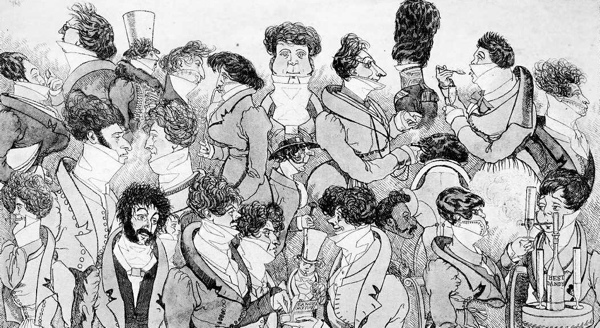
Regency dandies who wore enormous cravats that prevented movement of their necks – similar to the effect Elizabethan ruffs had – were known as les incroyables or the “incredibles”. Can you spot them in the contemporary cartoon below? To learn about the social implication of extreme fashion in pre-Napoleonic France, click on this link and read Les Incroyables et Merveilleusses: Fashions as Anti-Rebellion.

More links on the topic:

  • Regency Reproductions: Scroll down to read about neck cloths. Includes a free cravat pattern and illustrations of how to tie a neckcloth.
  • Francis Morris, “An Eighteenth Century Rabat”, The Metropolitan Museum of Art Bulletin, Vol. 22, No. 2 (Feb., 1927), pp. 51-55   (article consists of 5 pages)

Middle illustration from H. Le Blanc’s The Art of Tying the Cravat.
Read Full Post »

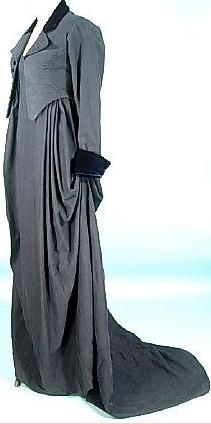
Antiques and Vintage Dress Gallery features beautiful close up photographs of a riding costume designed for Mansfield Park, 1999. “The jumper gown can be worn buttoned up at the sides as you see, or just unbutton to wear straight. The jacket has violet-blue velvet collar, cuffs and buttons”. Francis O’Connor, who played Fanny Price, did not wear this costume. Click on the link to see 15 images of the gown.

Read Full Post »

Estimating lace and muslin: dress and fashion in Jane Austen and her world, by Jeffrey A. Nigro is a fabulous article about fashion in Jane’s day. This conference paper was published in Persuasions: The Jane Austen Journal in 2001. Some of Mr. Nigro’s observations include:

Convenience was another reason for the increasing simplicity in dress beginning in the 1780s. Dry cleaning was not invented until the middle of the nineteenth century, and did not become commonplace until the twentieth. In Austen’s time, a silk dress that got dirty was essentially ruined. The fabrics that started to become fashionable from the 1780s onward (muslin and other cotton fabrics, linen, lawn) were much easier to care for, which was part of their appeal. Nevertheless, given the absence of modern appliances, the care and maintenance of clothing still meant much work for the servants in upper- and middle-class households.

Outerwear garments included the spencer, a long-sleeved jacket that extended only to the raised waistline. Worn by both men and women, it was named for the 2nd Earl Spencer, who, according to one version of the story, cut off the coattails of his jacket after wagering that he could invent a new fashion. For colder weather, there was the pelisse, a skirt-length overcoat, often lined and trimmed with fur, which originated in Hungary as a part of military dress. Bonnets became fashionable, essentially smaller versions of the straw hats of the 1780s, but now pulled in to frame the face. Bonnets, like shawls, would become staples of feminine dress until at least the middle of the nineteenth century.

Click here for more links about fashion:

* Jane Austen Pellise coat

* A Quilted Regency Spencer Jacket

* The Spencer Jacket

* The Importance of Wearing White, Jane Austen Centre Magazine

* Kyoto Costume Institute

* Bonnets, Caps, Turbans, and Hats

Images:

Muslin dress, Vintage Textile (top)
Jane Austen’s Pellisse Coat (middle)
Kyoto Costume Institute, Spencer Jacket (bottom)

    Read Full Post »

    Illustration from Modes et Manieres Du Jour, 1798 – 1808

    I have changed my mind, & changed the trimmings on my Cap this morning, they are now much as you suggested, – I felt as if I should not prosper if I strayed from your directions, & I think it makes me look more like Lady Conyngham now than it did before, which is all that one lives for now. Jane Austen to Cassandra, December 18-19, 1798

    Women during the Regency period wore headdresses outdoors as a matter of course. When a woman married, or if she was a spinster in her late twenties, she would also take to wearing a cap indoors. This image from Wikipedia shows Mme. Seriziat wearing a bergere, or shepherdess-style straw bonnet over a cap, as was the custom back then. When her child was a baby, he might have worn a simple bonnet, as infants still do today.

    Aside from sheltering delicate skin from the sun or hair from the elements, or protecting one’s head in drafty rooms, headdresses took on many other functions. They denoted class and economic status, as well as fashion sense and one’s marital state. Hats were also worn as a sign of respect, inside a church, for instance, and this custom remained widely popular until well into the 20th-century.

    Lace caps, mob caps, or draped caps, were made of lace, white linen or delicate muslin, and trimmed with ribbon. They could be ruffled, embroidered, or plain, depending on who wore them and their status. A housekeeper, for example, would wear a more elaborate cap than a scullery maid, whose mob cap was simple by comparison. In Pride and Prejudice 1995, Mrs. Bennet wore such frilly caps with so many ruffles and trimmings that they complimented her image as a silly woman. One can imagine how much fancier her caps were than her maid’s!

    Trimming and redecorating old bonnets provided a topic of conversation for women of all ages and social strata. In her novels and letters, Jane Austen frequently mentioned trimming new hats and making over old bonnets as a female activity. According to Penelope Byrde in A Frivolous Distinction, it was quite the fad during the last decade of the 18th century to adorn hats and bonnets with artificial fruits and flowers. As Jane Austen wrote Cassandra in June, 1799 (tongue in cheek we suspect):

    Flowers are very much worn, & Fruit is still more the thing – Eliz: has a bunch of Strawberries, & I have seen Grapes, Cherries, Plumbs & Apricots – There are likewise Almonds& raisins, french plums & Tamarinds at the Grocers, but I have never seen any of them in hats.

    In addition to professional milliners and modistes, there was quite a large cottage industry for making caps, hats, and turbans from home, which provided a meager salary for women who needed the income. The materials used in making headdresses were as varied as their styles: straw (chip or strip), beaver, velvet, silk, crape, satin, muslin or cloth (Byrde, p 6). Trims included ribbons, the above mentioned artificial fruits and flowers, veils, net, lace, or feathers, and even beads, pins, and brooches.

    For a more detailed explanation of the headdresses worn during this era and to view additional illustrations, please click on the following links.

    • Hats and Bonnets, Victoriana: Scroll to the bottom of this page to see illustrations from 1811 and 1812.
    • Fileblogs, Regency Caps, Linore Rose Burkhart: Linore describes the various hat styles in this link, along with materials and trims.

    For people interested in ordering their own Regency caps, or in trying their hand at making a bonnet, the following links will lead you to patterns, suppliers, and resources:

    • Louise MacDonald Millinery (link suggested by Laurel Ann, see above image). Louise created the caps for Pride & Prejudice 1995, and describes making them for the movie.

    Byrde, Penelope, A Frivolous Distinction: Fashion and Needlework in the works of Jane Austen, Bath City Council, 1979.

    Four Hundred Years of Fashion, Victoria and Albert Museum, edited by Natalie Rothstein, V&A Publications, 1984.

    Read Full Post »

    Vintage Textiles is featuring two lovely items of hand-embroidered baby’s clothing: A dress c. 1815-1820 and a bonnet circa 1800. Note the exquisite details on the dress, including white on white embroidery, tiny tucks, and fine Van Dyke’s pointed trim edging.

    The baby’s bonnet is made of fine sheer cotton muslin with insets of needle-run tulle.

    Read Full Post »

    « Newer Posts

