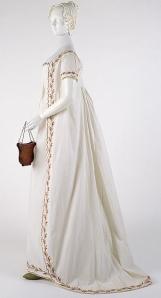
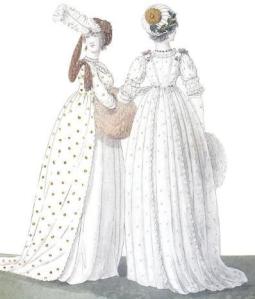
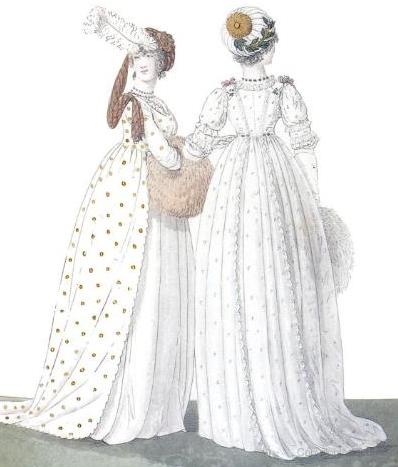
 The popularity of the high-waisted regency gown is due to both to French influence in fashion and the Neoclassical rage that swept Europe during the 18th Century. Marie Antoinette is said to have inspired the round gown of the 1790’s, which is essentially a dress and robe joined together and tied in the front (view a rotating video of an early example at the V&A Museum or click on this link to view a typical round gown of the era). Later, Josephine Bonaparte who reigned supreme in her position as a fashion icon, influenced the slim, high-waisted, gossamer thin chemise dress of the early 19th Century.
The round gown, a precursor of the Empire gown, had a soft, round silhouette, with full gatherings and a train, and straight, elbow-length sleeves. These gowns were in stark contrast to the stiff, brocaded or rigid silk dresses of the roccoco period. The round gown’s train, which was common for a short time for day wear and lasted until 1805-06 for the evening, would be pinned up for the dance, as Katherine and Isabella did for each other in Northanger Abbey. One must question how practical these long white muslin dresses with their trailing trains were in England, a country renowned for wet weather and muddy roads.
 In England especially, daytime dresses were more modest than their evening counterparts. A few French images depict young ladies wearing day gowns with plunging decolletes, but this was not generally the case, and it is a point that cinema costume makers frequently miss. Until 1810, a fichu or chemisette would fill in the neckline. At first, embroideries on hems and borders were influenced by classical Greek patterns. After Napoleon’s return from Egypt in 1804, decorative patterns began to reflect an eastern influence as well.
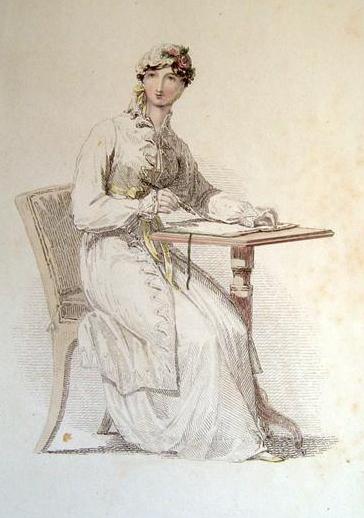
Around 1808, the soft gathered gowns gave way to a slimmer and sleeker silhouette. Darted bodices began to appear and hemlines started to rise. Long sleeves and high necklines were worn during the day, while short sleeves and bare necklines were reserved for evening gowns. The sleeves were puffy and gathered, but the overall silhouette remained sleek, with the shoulders narrow. The shape of the corset changed to reflect the looser, draped, shorter waisted style.
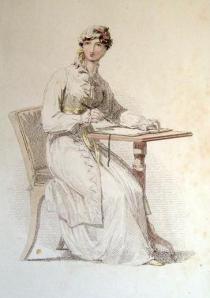 Due to the war between England and France, and the restrictions of travel to the Continent, the designs of English gowns began to take on a character of their own, as French influence waned. Between 1808 and 1814, English waistlines lengthened and decorations were influenced by the Romantic movement and British culture. Dresses began to exhibit decorations that echoed the Gothic, Renaissance, Tudor, and Elizabethan periods. Ruffled edges, Van Dyk lace points, rows of tucks on hems and bodices, and slash puffed sleeves made their appearance. The length of the gown was raised off the ground, so that dainty kid slippers became quite visible.
After the 1814 peace treaty, English visitors to France began to realize just exactly how much British fashion had split from its French counterpart. Parisian waists had remained higher, and skirt hems were wider and trimmed with padded decorations, resulting in a cone-shaped look. English fashion quickly realigned itself with the French, and the silhouette changed yet again.
Dresses now boasted long sleeves, high necks, and a very high waist, The simple classical silhouette was replaced by a fussier look. Ruffles appeared everywhere, on hems, sleeves, bodices, and even bonnets. In 1816-1817, the waistline fell just under a woman’s breasts, and could go no higher. There was only one way that waistlines could go, and by 1818, they began to drop by about an inch a year.
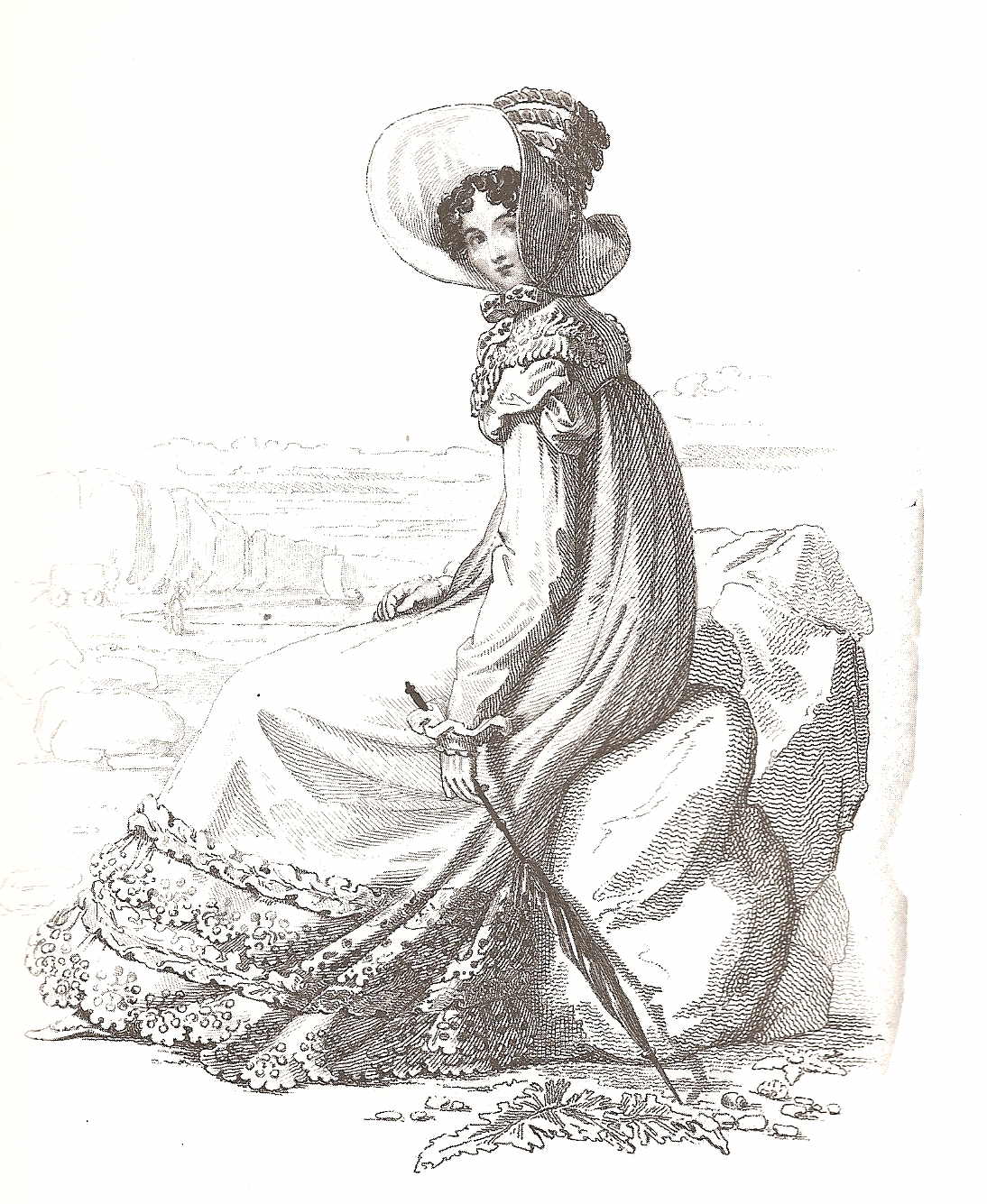
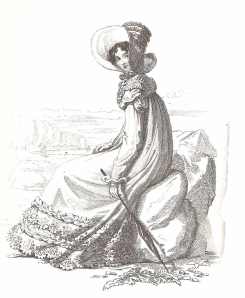 By 1820 the simple classic lines of the chemise dress had disappeared and completely given way to a stiffer, wider silhouette with a quite short hem. New corsets were designed to accommodated the longer waistline. Remarkably, Anglomania hit France, and the French began to copy the English fashion.
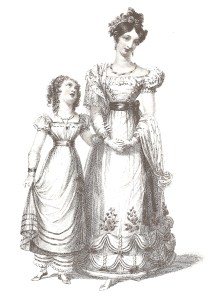
The rows of ruffles, pleats, appliques, and horsehair-padded decorations stiffened the skirt into a conical shape, creating a puffy silhouette. Big hats were worn to counterbalance the broad shoulders, much as big hair balanced wide shoulder pads during the 1980’s. By 1825 the waist had reached a woman’s natural waistline in fashion plates, but according to evidence in museums it would take another five years before this fashion caught up with the general public.
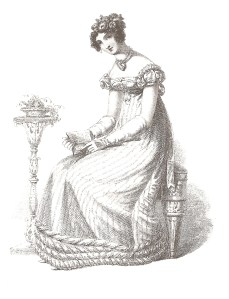 Leg of lamb sleeves (gigot sleeves) appeared, and dress decorations became intricate and theatrical.
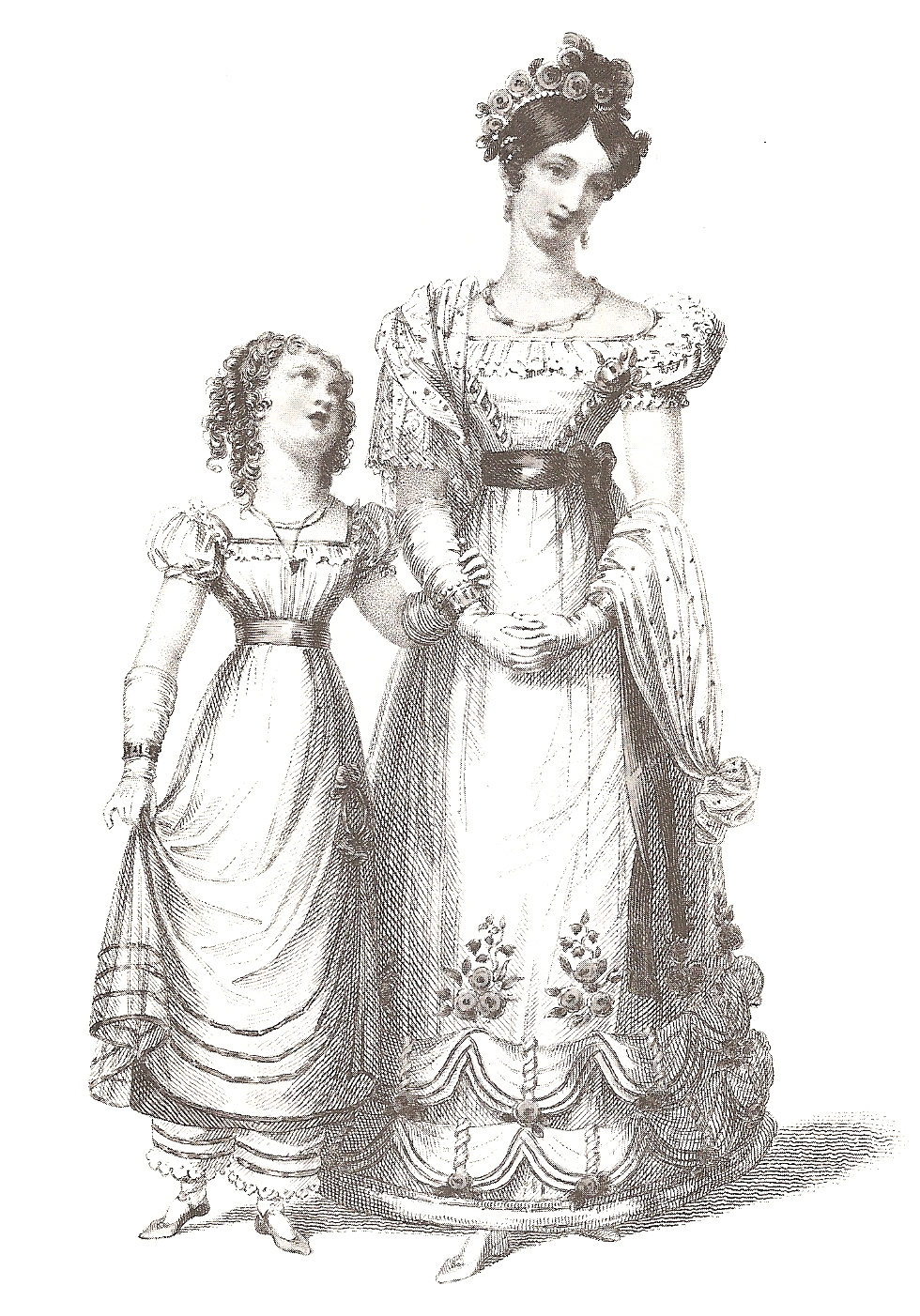
By 1820 the basic lines were almost submerged in ornamentation. The romantic past held a treasure trove of ideas for adorning a lady’s costume. From the sixteenth and seventeenth centuries came puffs bursting through slashed and the revival of the Spanish ruff. collars and cuffs developed points a la Van Dyke and sleeves could be a la Babrielle (after Garielle d’Estrees, mistress of Henry IV of France). Skirts were festooned with roses or made more flaring with crokscrew rolls … Fantasy seemed to now no bounds. (Ackermann’s Costume Plates, Stella Blum, page vi)
Read more about regency fashion trends in the links below:
Kathy Decker’s Regency Style, year by year
Jessamyn’s Regency Costume Companion
The Regency Fashion Page
1800s-1820s: Thumbnails
Ackermann’s Costume Plates
Regency Open Robe: 1795
Fashion Prints: Walking Dresses, 1806-1810
Museum Links to Clothing Images
Two Dresses, 1810, French
Images:
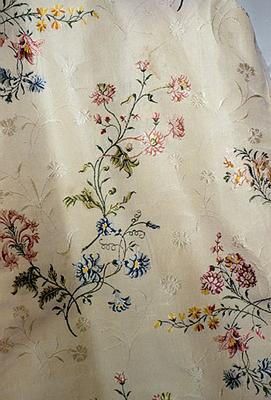
First image: Round gown, 1798, Metropolitan Museum
Second image: Round gowns, Heideloff Gallery of Fashion, 1794
Third image: Ackermann plate of a walking dress, 1818
Fourth image: Ackermann plate of an evening dress, 1820
Fifth image: Ackerman plate of a ball dress and young lady’s dress, 1826
Read Full Post »











 Jane Austen's World