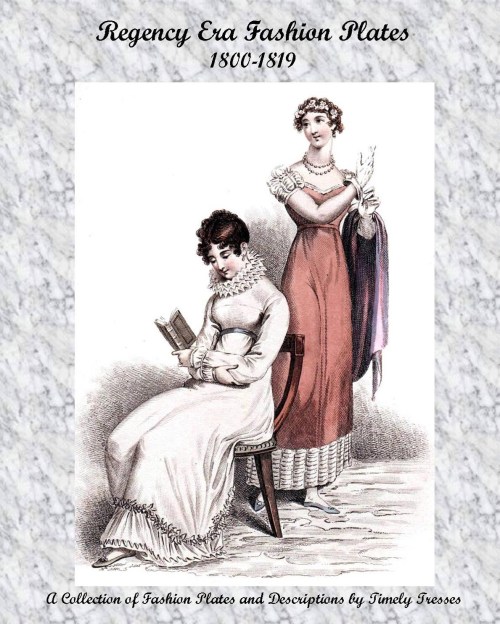
The moment I learned of Regency Era Fashion Plates, 1800-1819: A Collection of Fashion Plates and Descriptions by Timeless Tresses, I ordered it. Available in the U.K. through the Jane Austen Centre and at Amazon.com in the U.S., the book is not inexpensive. (My copy cost $44.) When it arrived I immediately tore open the package and began to peruse the book, which contain pages upon pages of colored fashion plates almost full copier paper size. That’s the good news. Compiled from the personal collections of Timely Tresses, the book is the joint venture of Mandy Foster and Dannielle Perry, two participants in living history who research fashion and create costumes based on the plates of a particular historic era. This is not the team’s first compilation. If you visit their site, you can choose from a variety of fashion plate books. But as I went through the book I was disappointed to find out that, while the fashion plates are arranged in date order, very few come with descriptions, nor are they identified by the season for which the dresses were designed. The plates are so large that in some instances they are blurred, and except for the cover, their colors are washed out.
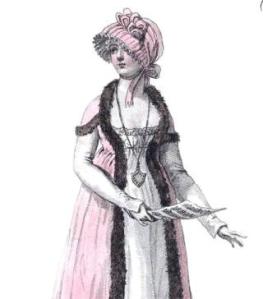
Detail of a plate in the book, Costume Parisien, 1799
For those who are new to Regency fashion, it would have been helpful if these two seasoned collector/historians had shared some pertinent information about their fashion plates, helping the reader to “see” the changes in the silhouettes and styles of the gowns, where the fashion influences came from, and the difference between British fashion of the era and French fashion. Over half the plates are from Le Journal des Dames et des Modes Costumes Parisien or Costumes Parisien. The Journal des Dames et des Modes was published in Paris from 1797 to 1803 and called Costume Parisien from 1803 to 1839. Until about 1825 the plates were drawn by Horace Vernet, which means that all of the Parisien plates in this book were drawn by him.
Before the Napoleonic wars, there had been a “pan-European” approach to dressing in which the rich and fashionable from countries across Europe largely wore similar fashions influenced by Parisian designs. But because of the war between the two countries, Britain and France took distinctly different approaches to dress design between 1808-1814. During this time period, very little information about fashion trends was shared. French waistlines remained high as British waistlines were lowered. Except for a few Ackermann plates, Regency Era Fashion Plates, 1800-1819, largely ignores British fashion during this 6-year time span, with most of the plates coming from Costumes Parisien. Since the book aims to be a resource for those desiring to make accurate costumes of the era, these differences need to be pointed out. A costumer for a film or play might mistakenly use a French fashion plate to create a gown for a British character, for example. When British women were finally allowed to visit Paris after the war, they saw a stark difference between their British designed gowns and Parisian high fashion. In no time the French influence took over once more and British waistlines crept up again. After 1820, French designers looked across the Pond for inspiration and English-inspired motifs became all the rage.
The most obvious differences between British and French fashion would have been in the use of lace. Through a decree by Napoleon, French ladies were forbidden to use British fabrics, resulting in the revival of the French Valenciennes lace industry. British dresses began to be heavily influenced by Romantic motifs, such as the Gothic, whose embellishment looked ridiculous and cumbersome to the French. I had hoped that these trends would have been pointed out clearly in the book and discussed at some length by the authors, but the annotations were sorely lacking, and only the end plates and a very few plates at the beginning describe the details of cloth and trim that the gowns were made of. Even the simple expedient of sorting the plates according to year AND season would have made the plates easier to understand. (It is hard to tell whether the dresses were to be worn in fall or spring, for example.) Thankfully we can turn to the Ladies Monthly Museum on Cathy Decker’s site for some of the descriptions, but, frankly, this is a lot of work that the book could have saved us. One other point: the book concentrates solely on women’s fashion. Anyone looking for examples of men’s or children’s clothes of the era must look elsewhere.
 For the number of fashion plates, I give the book 3 out of three Regency fans. For overall impact and usefulness, I give it 2 out of three.
More links:
From Classic to Romantic: Changes in the Silhouette of the Regency Gown







 Jane Austen's World