To the unrefined or underbred, the visiting card is but a trifling and insignificant bit of paper; but to the cultured disciple of social law, it conveys a subtle and unmistakable intelligence. Its texture, style of engraving, and even the hour of leaving it combine to place the stranger, whose name it bears, in a pleasant or a disagreeable attitude, even before his manners, conversation and face have been able to explain his social position. The higher the civilization of a community, the more careful it is to preserve the elegance of its social forms. It is quite as easy to express a perfect breeding in the fashionable formalities of cards, as by any other method, and perhaps, indeed, it is the safest herald of an introduction for a stranger. Its texture should be fine, its engraving a plain script, its size neither too small, so that its recipients shall say to themselves, ‘A whimsical person,’ nor too large to suggest ostentation. Refinement seldom touches extremes in anything. From “Our Deportment” by John H. Young, 1879 & 1881, p. 76. (Project Gutenberg)
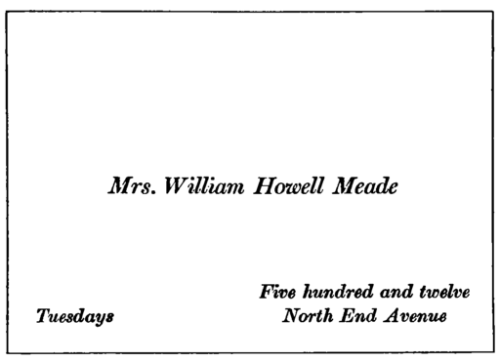
Lady’s visiting card, Wikipedia, Public Domain
During the Georgian, Regency, and Victorian eras, calling cards were a necessary accessory for a gentleman or lady who called upon friends or acquaintances, or who wished to announce their presence in town. In fact, one wasn’t received unless one conveyed one’s card first. Gentlemen could place their addresses on their cards, but ladies could not, and a matron would naturally place her married name on her card, such as Mrs. John Smith. (Click on this link to see examples of Visiting Cards in the Regency.)
The best calling cards were made from plain, excellent quality paper and were engraved. They were kept in beautiful cases, such as the one above. A gentleman’s card case was slightly smaller than a lady’s, since he had to carry it in his pocket. Ornamentation on a card was considered to be poor taste, although as the 19th century progressed, the more colorful calling card seemed to become quite common.
For the recipient, calling cards were a handy way of recalling who had come to visit, and which calls needed to be returned. They were also effective in letting one know exactly where one stood in the social order. For example, if an individual received a calling card in lieu of a personal visit, well, then, the point was likely made.
For more information, click on this link: Calling Cards and the Etiquette of Paying Calls goes into some detail about using this important accessory.







 Jane Austen's World