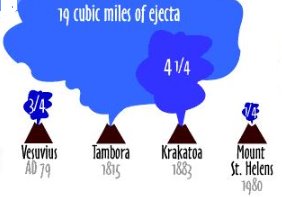
 Three years ago I wrote about the summer of 1816 in England, which was widely regarded as the year without a summer. Six months before, a volcanic eruption in Indonesia ejected over 19 million cubic miles of volcanic ash in the atmosphere. This ash traveled in the upper atmosphere, blocking the sun.
This week, an ash plume from a volcanic eruption of Eyjafjallajokull (ay-yah-FYAH’-plah-yer-kuh-duhl) volcano in Iceland has grounded air travel in Europe. As the debris travels around the world in upper atmospheric currents, one wonders if a colder winter than normal will affect the world next year. Will we also experience a year without summer? Or is this an eenie minie volanic eruption as far as eruptions go?

Icelandic volcano April 2010







 Jane Austen's World
Awesome photo of the Icelandic volcano of Eyjafjallajokull – try saying that in a tongue-twister!
I do wonder what the effects will be?!
How very interesting! History (and science) repeats itself! At least Jane didn’t have to deal with flight cancellations.
Coming from a very warm part of the states, I would welcome a cooler summer, but I’m afraid my northern friends would suffer. Not to mention the crop failures and the rise in food prices because of it. On second thought, lets all pray this volcano eruption soon ends! For the sake of Iceland and the rest of the world.
[in passing]
At least one expert says so far not. According to Prof. Alan Robock not enough sulfur dioxide has been emitted into the atmosphere.
I have thought with this news immediately to the year without sommer.
Now the results on the air traffic are already quite disastrous. Hopefully that becomes not so bad as in 1816.
Wow, beautiful picture! Our weather patterns certainly are changing.
I had an impression that 1815 was not the first ‘volcanic’ summer that Jane Austen experienced and I have just checked in Glibert White’s journals and found that the same thing happened when Jane was only eight years old, in 1783.
Gilbert White was a naturalist who lived in Selbourne, quite near to Chawdon (not near to Steventon as was portrayed in ‘Becoming Jane’) and he wrote down observations of birds etc. This is what he says:
“The summer of the year 1783 was an amazing and portentous one, and full of horrible phaenomena; for besides the alarming meteors and tremendous thunder-storms that affrighted and distressed the different counties of this kingdom, the peculiar haze, or smokey fog, that prevailed for many weeks in this island, and in every part of Europe, and even beyond its limits, was a most extraordinary appearance, unlike anything known within the memory of man. By my journal I find that I had noticed this strange occurrence from June 23 to July 20 inclusive…”
Thank you, Cora. How fascinating!!
Thank you for such an interesting post! A perfect mix of history and modern science.
Great facts. I have been watching this one close as I believe a new ice age is more likely than the earth continuously warming. Most don’t know that NY harbor froze completely over, the winter of 1779-1780, for 5 weeks.
In 1853, the Mississippi. Records of many other freezes around the world exist over the last centuries. Although “leading experts” have little concern for a cooling effect due to many variables, Katla has not uttered her peep….will she?
As it is all based on science (studies) and humans (that’s us) have been wrong many times (spinach? etc….), the uncertainty is still ours.
Freeze-overs in history:
http://www.associatedcontent.com/article/2508261/when_is_the_last_time_new_york_harbor.html
Don’t ever take one expert’s word for it though – let alone a blogged opinion. Look into it yourself.
You might already know this story, but maybe some of your readers haven’t heard it. The Year without a Summer gave rise to two of the best literature monsters ever: the vampire and Frankenstein’s monster.
Mary Shelley had just eloped with Percy Shelley, and they joined his friend Lord Byron and Byron’s doctor John Polidori in Geneva. The weather was so terrible because of the effects of the volcano eruption that the crew couldn’t enjoy any of the normal outdoor pursuits that one enjoyed in Geneva. Instead, they were stuck inside and fell to telling spooky stories. Byron suggested a challenge: they would each write a scary story. Out of that challenge, Mary Shelley created the novel Frankenstein, and John Polidori wrote The Vampyre (and likely based the vampire in his novel on Byron). The Vampyre would go on to influence Bram Stoker when he created his much more well known Dracula.
As far as I know, two movies have been made about this story: Haunted Summer and Gothic. There could be others.
Your theory is proving true. Winter of 2010 – 2011. Is the only the beginning, Indonesia and Iceland have both been busy with volcanic activity and storms have increased. Also temperatures have dropped, to the east of both these locations. California and UK.
I live in the part of the Northeastern part of the U.S., , where they have one snowstorm after another. I have the feeling that the Winter of 2010-11 will be the longest of them all. We are now in March and is still snowing..
If the year without summer were to occur in 2011 or 2012,
the places that people enjoy going to during summer, e,g., the beach; a state park for camping, picnic, or fishing; a stadium to watch a baseball or football game; fairs or amusement parks; or ice cream shops would shut down and lose money, and even go out of business.
If the year without summer were to occur, there will be famine (extreme scarcity of food) – grocery stores and convenience stores would be looted, and so would be gas stations where people get gas. There would be tutors (schools and colleges would be shut down), and alot of federal aid. (help or relief)