• Home
  • Audio/Podcasts
  • Austensites
  • AV/E-Texts
  • History
  • JA Novels & Bio
  • Links
  • Original Sources/19th C. Texts
  • Social Customs During the Regency
  • Teacher/Student
  • Writer/Literature Resources

Jane Austen's World

This Jane Austen blog brings Jane Austen, her novels, and the Regency Period alive through food, dress, social customs, and other 19th C. historical details related to this topic.

Feeds:
Posts
Comments
« Happy Birthday, Georgette Heyer
Louis Bazalgette: The Prince Regent’s Tailor »

The Servant’s Entrance to Regency Townhouses

August 17, 2010 by Vic

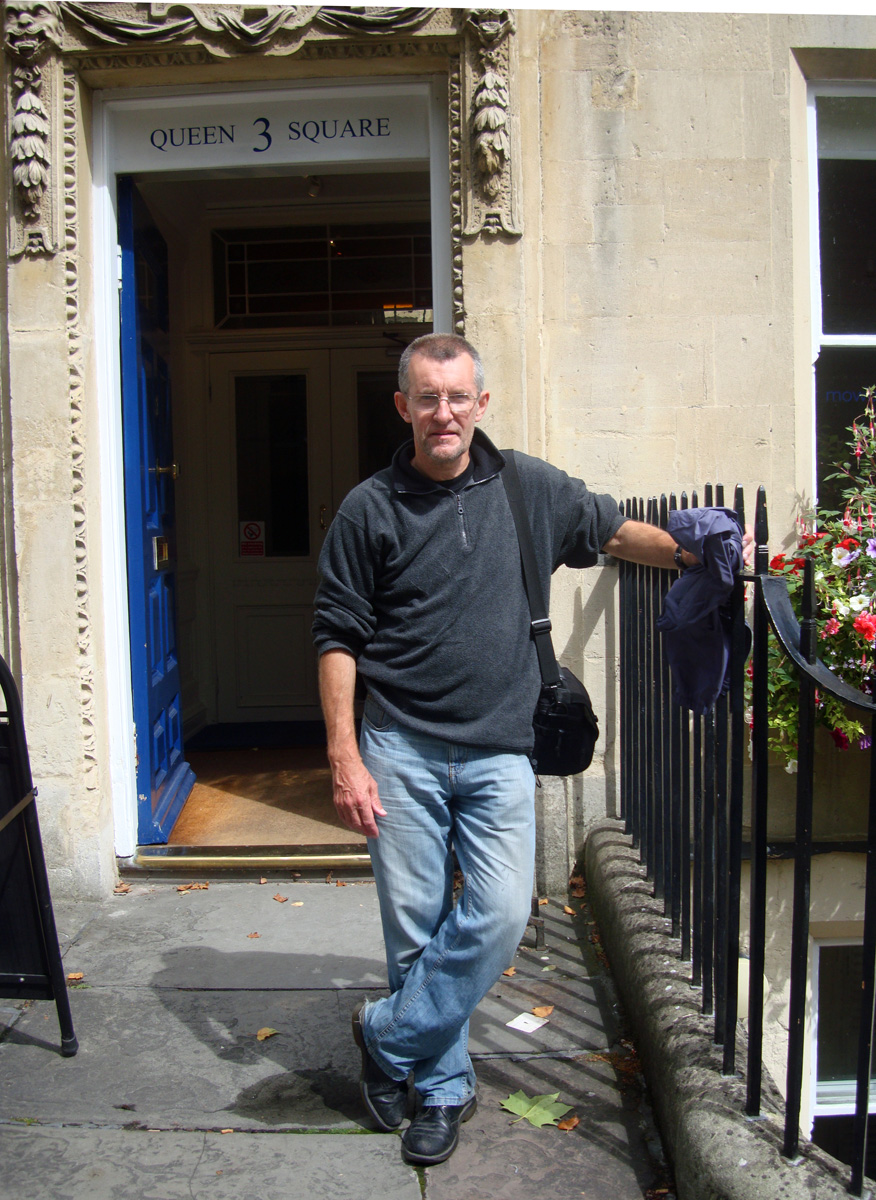
Tony Grant at 3 Queen Square, down the road from the Jane Austen Centre

Tony Grant, who writes posts for Jane Austen Today and London Calling, stands above the “area”, the servants entrance that sits below ground and in front of town houses built during the Georgian and Regency eras. A wrough-iron fence separated the upper level from the lower basement level, which was sunk partly below the street. Windows in the work areas gave the servants a view of the people walking along the sidewalks.

Wherever these town houses were built, servants and delivery people used the lower entrance. The “area” also contained a coal vault used for storage.
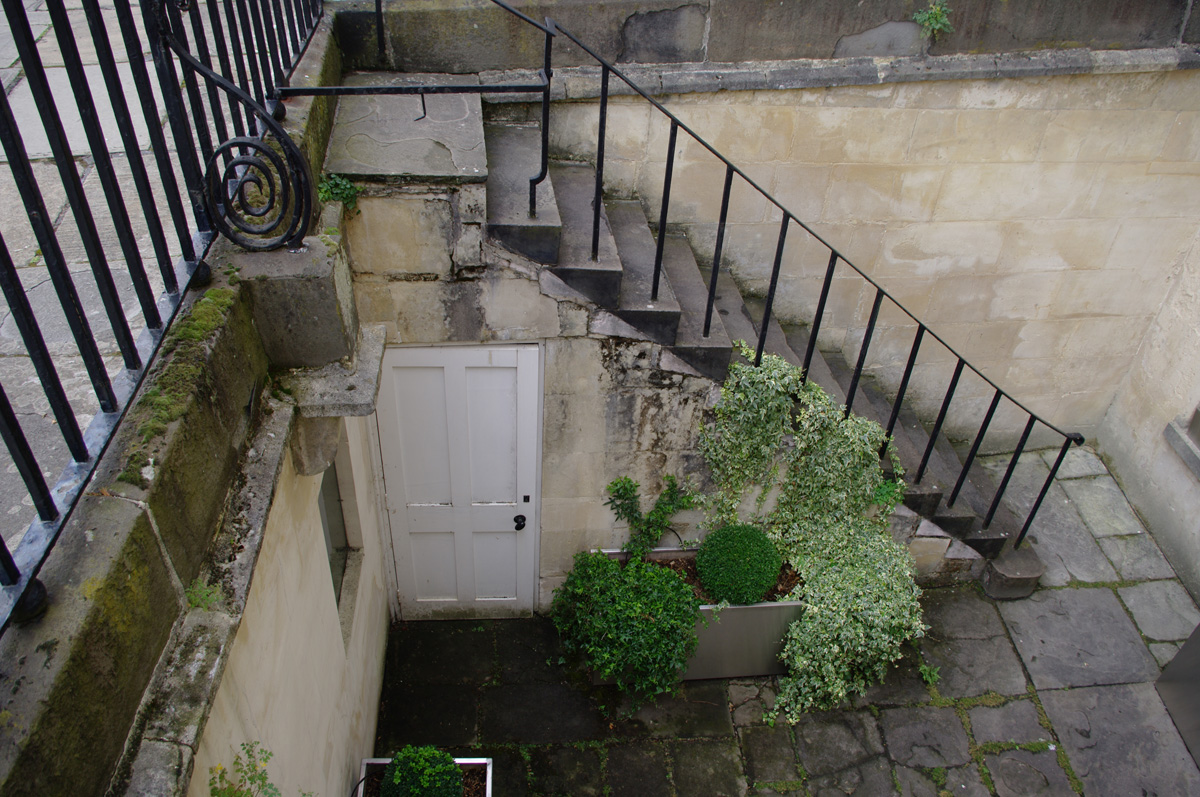
The "area", or the way down to the servant's quarters

A collier unloaded coal from a cart directly into the coal vault. This practice prevented dirty coal sacks from being dragged through the house. Coal was dumped down a chute via a coal hole. The coal would then be used for fires or the kitchen stove. (Gaelen Foley)  The design of the coal hatch, which was locked from the inside, would vary from house to house. Coal holes were in use from the early 1800s to the middle 1900s, when the Clean Air Act made the burning of coal illegal. (Knowledge of London)

Coal hole, Bath, England

So much coal was burned in 19th century London (in 1800 over one million London residents were burning soft coal) that “winter fogs” became common.

An 1873 coal-smoke saturated fog, thicker and more persistent than natural fog, hovered over the city of days. As we now know from subsequent epidemiological findings, the fog caused 268 deaths from bronchitis. Another fog in 1879 lasted from November to March, four long months of sunshineless gloom. (London’s Historic “Pea Soupers”)


Share with others:

  • Click to email a link to a friend (Opens in new window) Email
  • Click to print (Opens in new window) Print
  • Click to share on Facebook (Opens in new window) Facebook
  • Click to share on Reddit (Opens in new window) Reddit
  • Click to share on X (Opens in new window) X
  • Click to share on Pinterest (Opens in new window) Pinterest
  • Click to share on Tumblr (Opens in new window) Tumblr
  • Click to share on LinkedIn (Opens in new window) LinkedIn
Like Loading...

Related

Posted in Architecture, Bath, jane austen, Jane Austen's World, Regency Life, Regency London, Regency Period, Regency society, Regency style, Regency World | Tagged Coal Hole, Coal Vault, London Calling, Regency town house, Servant's entrance, Tony Grant | 15 Comments

15 Responses

  1. on August 17, 2010 at 01:02 Liana's avatar Liana

    Interesting post.=) Thank you Vic. Now I know who was really responsible for global warming. It isn’t us 21st century folk but the upper-classes of the 18th century!

    If I recall correctly, it was mentioned, in What Jane Austen Ate and Charles Dickens Knew by Daniel Pool, that a family used to burn a tonne of coal everyday in their townhouse residence in winter. Imagine that!

    That was a lovely book anyway, gives all the facts and fun of regency england, refering to all the classics of the period on the way. I had no idea what Mrs Bennet meant by a special license till then.=D


  2. on August 17, 2010 at 01:26 Karen's avatar Karen

    Thanks for the post, Vic. I actually wonder about such things. I always thought such entrances were in the back of houses, which could be deuced inconvenient.

    My grandparents’ house in West Virginia had a coal room that was used until the 1980’s. A coal truck would come every winter and had a long chute that would dump coal into their coal room which they burned in their furnace.

    A Christmas Story, a movie my family watches every Christmas Eve, shows the family dealing with the “clinkers” that use of coal involves. I’m wondering what Regency/Victorian families did when the coal “clinkers” occurred.

    I loved reading What Jane Austen Ate and Charles Dickens Knew but was frustrated with the title’s implication that Charles Dickens’ thoughts were more important than what Jane Austen ate. The book was a good book and provided info pertinent to Jane Austen readers. Also a good reference is Georgette Heyer’s Regency World. It gives lots of info that Jane readers would benfit from.


  3. on August 17, 2010 at 07:58 Vic's avatar Vic

    My only quibble with that book by Daniel Pool was that he rarely made the distinction between Regency and Victorian customs, jumbling the two. Thank you for your comments!!

    Vic


  4. on August 17, 2010 at 08:07 Enid Wilson's avatar Enid Wilson

    Interesting. How many servants would Mr. Darcy have? I wonder how busy the servant’s entrance would be at Pemberley.

    Really Angelic


  5. on August 17, 2010 at 13:41 Bebe's avatar Bebe

    I have just stumbled upon your blog- and I’m so happy I did! I love learning about different eras, and this blog is a veritable treasure trove! Thank you for taking the time to build up such a source of knowledge!


  6. on August 17, 2010 at 13:59 Charles Bazalgette's avatar Charles Bazalgette

    I was often in London when I was a boy even though I lived in the country. One of the chief differences from now is that all the buildings were black. Over the years since coal fires were banned, they have mostly been cleaned. I remember the smog too. It killed thousands of people who already had respiratory complaints. The railings outside these houses were mostly removed during WWII because of the need for scrap metal for the war effort. Just as housewives were encouraged to donate their aliminium (using the British spelling!) saucepans for use in building aircraft.
    The coal hole covers (known by enthusiasts as ‘opercula’) were mostly round and of a bewildering number of designs. I used to take rubbings of them. The coal-cellars extended under the pavement (sidewalk) and their roofs were arched for strength. Thus, the coal could be dropped straight into the cellar. The coal was carried in heavy burlap sacks and dumped into the coal-hole one at a time by the coal-men, who were always quite black from the dust. They also sometimes used a contrivance like a chute so they could dump the coal straight off the lorry (truck!). I also remember coal-carts drawn by horses.


  7. on August 17, 2010 at 19:11 Tweets that mention The Servant’s Entrance to Regency Townhouses « Jane Austen's World -- Topsy.com

    […] This post was mentioned on Twitter by Vic and Emmeline Cartwright, Maria Grazia. Maria Grazia said: RT @janeaustenworld: The servant's entrance to Regency town houses. http://bit.ly/9ZIYvC […]


  8. on August 17, 2010 at 19:22 Ann Lethbridge's avatar Ann Lethbridge

    Great post. I always like to look into the areas when I am in Britiain. I stayed at a B & B similar to this in London this past summer in Gower Street, part of the Bedford estate. We ate breakfast on that lower level. So interesting.

    One thing to note, wrought iron railings in the Regency were painted green, to look like copper, or a teal blue. Not black. I believe you can see one of these colours at Apsley House.


  9. on August 17, 2010 at 21:31 Jean at The Delightful Repast's avatar Jean at The Delightful Repast

    Great information, Vic! I’ve always enjoyed scenes in period mysteries where the police who had the cheek to appear at the main entrance are directed by a haughty servant to the servant’s entrance.


  10. on August 17, 2010 at 22:50 Twitted by OregonKimm

    […] This post was Twitted by OregonKimm […]


  11. on August 18, 2010 at 03:07 SuSu's avatar SuSu

    Many of the homes in the Fan (in Richmond VA where Vic lives – I live in Ashland) have beautiful coal doors which are a little bit bigger.

    I grew up outside of Boston MA and I took my grandmother to Quincy Market in downtown Boston for lunch one day. She loved the restaurant but remembered it as the place where her mother used to order her coal and shopped for her meat and vegtables every week. She also remembered how dirty everything was from the coal. How the times change!


  12. on September 1, 2010 at 09:03 A Tour Through Bath With Jane « Jane Austen's World

    […] also has published several posts about his trip on this blog: Going to Bath With Jane Austen and The Servant’s Entrance to Regency Townhouses, for which he supplied the photographs. He has already contributed a post about Milsom Street for […]


  13. on September 1, 2010 at 09:04 A Tour Through Bath With Jane Austen « Jane Austen's World

    […] also has published several posts about his trip on this blog: Going to Bath With Jane Austen and The Servant’s Entrance to Regency Townhouses, for which he supplied the photographs. He has already contributed a post about Milsom Street for […]


  14. on December 3, 2010 at 13:13 Ruth's avatar Ruth

    Elizabeth Gaskell, who was a writer of the Victorian age, wrote the novel “North and South” in which the characters
    suffered from the bad air in a textile mill town……


  15. on February 1, 2013 at 19:39 Dorothy McCougney's avatar Dorothy McCougney

    Very interesting article. Thanks por sharing it!


Comments are closed.

  • Enter your email address to subscribe to this blog and receive notifications of new posts by email.

    Join 7,249 other subscribers
  • 2025 AGM in Baltimore

  • Items of Interest

  • Blog Stats

    • 18,394,385 hits
  • Follow Jane Austen's World on WordPress.com
  • RECOMMENDED BOOKS AND RESOURCES

  • Fashionable Goodness: Christianity in Jane Austen's England is now available! By JAW contributor Brenda S. Cox. See Review. Available from Amazon and Jane Austen Books.
  • We also recommend JAW contributor Rachel Dodge's devotionals based on Jane Austen's prayers and classic literature. Reviews:
    Praying With Jane: 31 Days Through the Prayers of Jane Austen
    The Anne of Green Gables DevotionalThe Little Women Devotional
    The Secret Garden Devotional
  • The Tour of Doctor Syntax. Edited by Ben Wiebracht. Read the review of the book at this link. Click to order the book on Amazon US or Amazon UK or Jane Austen Books
  • FREE Student Membership to JASNA

    Available through December 31st, 2025. Click on image for details, and share this poster with other teachers and students!

  • The Obituary of Charlotte Collins by Andrew Capes

    Click on image to read the story.

  • Comments

    “My idea of good company…is the company of clever, well-informed people, who have a great deal of conversation.” – Jane Austen, Persuasion


    Gentle readers: Please feel free to post your comments and continue the conversation! Due to SPAM, we will no longer accept comments on posts after 30 days of publication. In some instances, links will be removed from comments as well.

  • Administrators and Contributors

    Vic Sanborn, founder of this blog, is supported by a team of talented and knowledgeable writers about Jane Austen and the Regency era. They are:

    • Brenda Cox
    • Rachel Dodge and
    • Tony Grant, who now contributes his photos from London and England

    Click on their names to enter their own blogs.

    In addition, we thank the many experts and authors who frequently contribute their posts and opinions, and who continue to do so freely or at our request.

  • Pin It!

    Follow Me on Pinterest
  • Top Posts

    • Highclere Castle Floor Plan: The Real Downton Abbey
      Highclere Castle Floor Plan: The Real Downton Abbey
    • Regency Fashion: Men's Breeches, Pantaloons, and Trousers
      Regency Fashion: Men's Breeches, Pantaloons, and Trousers
    • Cassandra Writes About Jane Austen's Death, July 18, 1817
      Cassandra Writes About Jane Austen's Death, July 18, 1817
    • Men's hair styles at the turn of the 19th century
      Men's hair styles at the turn of the 19th century
    • Social Customs During the Regency
      Social Customs During the Regency
    • Regency Hygiene: The Bourdaloue
      Regency Hygiene: The Bourdaloue
    • Dancing at the Netherfield Ball: Pride and Prejudice
      Dancing at the Netherfield Ball: Pride and Prejudice
    •  A Triple Tragedy: How Princess Charlotte's Death in 1817 Changed Obstetrics
      A Triple Tragedy: How Princess Charlotte's Death in 1817 Changed Obstetrics
    • Pride and Prejudice 1995: 20 years Later
      Pride and Prejudice 1995: 20 years Later
    • The Servant's Quarters in 19th Century Country Houses Like Downton Abbey
      The Servant's Quarters in 19th Century Country Houses Like Downton Abbey
  • Recent Posts

    • Jane Austen and Music
    • More Birthday Events for Jane Austen!
    • Happy 250th Birthday, Jane Austen!
    • Coming Soon: Birthday Tales for Jane Austen’s 250th
    • Book Review: The Austens, by Sarah Emsley
  • Links to Jane Austen Blogs

    Click here to enter the page. Topics include Regency fashion, historic foods, Jane Austen societies, British sites, related topics. Click on image.

  • May we suggest?

  • Unknown's avatarHello, my name is Vic and I live in Maryland, USA. I have adored Jane Austen almost all of my life. I am a proud lifetime member of the Jane Austen Society of North America. This blog is a personal blog written and edited by me and my team. We do not accept any form of cash advertising, sponsorship, or paid topic insertions. However, we do accept and keep books and CDs to review.

    If you would like to share a new site, or point out an error, please email us. (Yes, we are fallible. We'll own up to our mistakes and will make the corrections with a polite smile on our faces.) Write us at

    gmailbw

    Thank you for visiting this blog. Your comments and suggestions are most welcome.

  • Project Gutenberg: eBook of Stage-coach and Mail in Days of Yore, Volume 2 (of 2), by Charles G. Harper

    STAGE-COACH AND MAIL IN DAYS OF YORE: A PICTURESQUE HISTORY
    OF THE COACHING AGE, VOL. II, By CHARLES G. HARPER. 1903. Click on this link.


  • Top Posts & Pages

    • Highclere Castle Floor Plan: The Real Downton Abbey
    • Regency Fashion: Men's Breeches, Pantaloons, and Trousers
    • Cassandra Writes About Jane Austen's Death, July 18, 1817
    • Men's hair styles at the turn of the 19th century
    • Social Customs During the Regency
    • Regency Hygiene: The Bourdaloue
    • Dancing at the Netherfield Ball: Pride and Prejudice
    • A Triple Tragedy: How Princess Charlotte's Death in 1817 Changed Obstetrics
    • Pride and Prejudice 1995: 20 years Later
    • The Servant's Quarters in 19th Century Country Houses Like Downton Abbey
  • Tour Chawton Cottage on YouTube

  • Disclaimer: Our team makes no profit from this blog. We may receive books (physical or digitized) for review purposes.

  • Copyright Statement: © Jane Austen's World blog, 2009-2024. Unauthorized use and/or duplication of this material without express and written permission from this blog’s author and/or owners is strictly prohibited. Excerpts and links may be used, provided that full and clear credit is given to Jane Austen's World with appropriate and specific direction to the original content.

Blog at WordPress.com.

WPThemes.


  • Reblog
  • Subscribe Subscribed
    • Jane Austen's World
    • Join 7,249 other subscribers
    • Already have a WordPress.com account? Log in now.
    • Jane Austen's World
    • Subscribe Subscribed
    • Sign up
    • Log in
    • Copy shortlink
    • Report this content
    • View post in Reader
    • Manage subscriptions
    • Collapse this bar
 

Loading Comments...
 

    %d
