One can imagine that during her final illness, Jane Austen was no stranger to leeches. This method of bloodletting was so common in Great Britain (Wales especially) and France that by the 1830’s Hirudo medicinal leeches (common in Europe) were hard to find and had to be imported or home grown .

Leech finders, 1814. George Havell, Costumes of Yorkshire.
Gathering leeches was a traditional female occupation, although there are always exceptions to the rule. Take this passage about leech-fishers in France from the Gazette des Hopitaux:
Man leech fishing in a marsh in Bretagne. 1857. Image @Shutter Stock
If ever you pass through La Brenne, you will see a man, pale and straight-haired with a woollen cap on his head, and his legs and arms naked; he walks along the borders of a marsh, among the spots left dry by the surrounding waters. This man is a leech- fisher. To see him from a distance,—his wo-begone aspect, his hollow eyes, his livid lips, his singular gestures,—you would take him for a maniac. If you observe him every now and then raising his legs and examining them one after another, you might suppose him a fool ; but he is an intelligent leech-fisher. The leeches attach themselves to his legs and feet as he moves among their haunts; he feels their bite, and gathers them as they cluster about the roots of the bulrushes and aquatic weeds, or beneath the stones covered with a green and slimy moss. He may thus collect, ten or twelve dozen in three or four hours. In summer, when the leeches retire into deep water, the fishers move about upon rafts made of twigs and rushes.” – Excerpt taken from Curiosities of Medical Experience (1838) by John Gideon Millingen, via The Condenser: Hunting Down Good Bits

Despite the many strides that were made in medicine regarding human anatomy and diseases, the knowledge about treatments lagged behind. Lack of anesthetics made surgery an excruciating experience, and there were no antibiotics. Useful plants, such as digitalis, were discovered more by luck than by science. Bloodletting or ‘breathing a vein’ was one way in which a patient could be treated by a physician who had few options. Applying leeches often resulted in a severe loss of blood, which was more detrimental to the patient’s condition than not. A human with a poor immune response could suffer from wound infections, diarrhea and septicemia, all influenced by the bacterium, Aeromonas veronii, carried in the leeche’s gut.

19th century leech advertisement
Regardless of adverse consequences, bloodletting has been practiced for at least 2,500 years. The earliest instruments, or lancets, were sharpened pieces of wood or stone, but it is leeches that I want to write about. (I am more repulsed by their sight than a snake’s, and had a hard time searching for an image that did not make me gag.) The ancient Greeks believed in the humoral theory, which proposed that when the four humors, blood, phlegm, black and yellow bile in the human body were in balance, good health was guaranteed. An unbalance in these four humors led to ill health. Fast forward to the middle ages, when superstition and religion gave weight to the art of bleeding. If you recall, the earliest surgeons were barbers as well. Their leeches cured anything from headaches to gout!
Bloodletting with leeches is an ancient tradition
Leeches are commonly affixed by inverting a wine-glass containing as many as may be required, upon the part affected. The great disadvantage of this practice is, that some of them frequently retire to the upper part of the glass and remain at rest, defying all attempts to dislodge them, without incurring the risk of removing those that may have fastened.” – James Rawlins Johnson, A Treatise on the Medicinal Leech
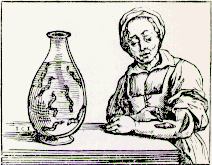
Francois Broussais proposed in his Histoire des phlegmasies ou inflammations chroniques (1808) that all disease resulted from excess build up of blood. The alleviation of this condition required heavy leeching and starvation. Leeches subsequently became the most prevalent way of treating a patient, especially in France, where tens of million of leeches were used per year, resulting in a drastic leech shortage. The British were equally enamored with this form of therapy. It is conjectured that Princess Charlotte’s death in childbirth in 1817 was exacerbated by her physician, who prescribed a rigorous course of blood letting and starvation diet during her pregnancy, weakening her before her agonizing 50+ hours of labor. (Read my article on this topic.)
In 1833, bloodletting became so popular in Europe, that the commercial trade in leeches became a major industry. France, suffering a deficiency, had to import 41.5 million leeches. The medicinal leech almost became extinct in Europe due to the extremely high demand for them. Leeches were collected in a particularly creepy way. Leech collectors would wade in leech infested waters allowing the leeches to attach themselves to the collector’s legs. In this way as many as 2,500 leeches could be gathered per day. When the numbers became insufficient, the French and Germans started the practice of leech farming. Elderly horses were used as leech feed where they would be sent into the water and would later die of blood loss. – Maggots and Leeches Make a Comeback
Oh, how I pity those elderly horses!
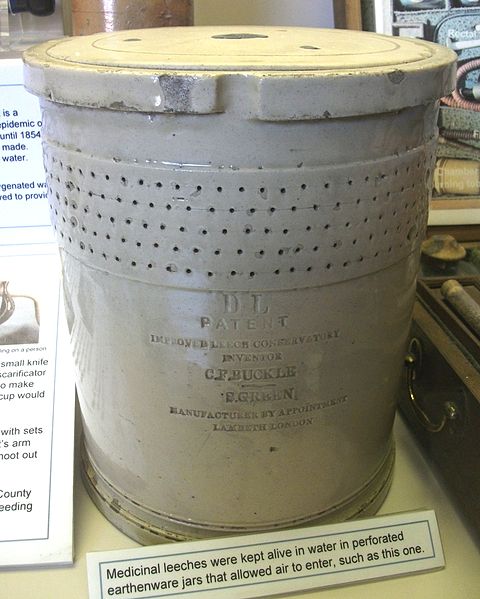
Large leech collector jar.

Intestinal tract of the hirudo leech
Leeches are quite extraordinary in that they have 31 brains and can gorge themselves up to five times their body weight before falling off their host. Afterward they require no feeding for another 6 months. There are over 650 known species of leeches, not all of which are bloodsuckers (some eat earthworms, for example). Placing leeches onto a patient (making sure the frontal sucker with teeth was directed to the skin) is relatively pain free, for their bite releases an anaesthetic. During feeding they secrete compounds, such as a vasodilator that dilates blood vessels and anticoagulant that prevents the blood from clotting. The worms are hermaphrodites, functioning as both the male and female sex. Even after being frozen, leeches can be coaxed back to life! Needless to say, these creatures must provide an endless source of interest to scientists.

Early 19th century rare cobalt blue transportable leech jar. These were mostly made of clear glass. Cloth covered the everted lip to prevent escapees.
People (meaning mostly women) stood in fresh water marshes, lakes, pools, and the edges of river banks, and allowed the leeches to attach to their legs. (I shudder as I type this.) Once the leeches were gathered, they were placed in a basket, ceramic pot with breathing holes, or a reservoir.
One of these traders was known to collect, with the aid of his children, seventeen thousand five hundred leeches in the course of a few months; these he had deposited in a reservoir, where, in one night, they were all frozen en masse.” But congelation does not kill them, and they can easily be thawed into life, by melting the ice that surrounds them. Leeches, it appears, can bear much rougher usage than one might imagine: they are packed up closely in wet bags, carried on pack-saddles, and it is well known that they will attach themselves with more avidity when rubbed in a dry napkin previous to their application. Leech-gatherers are in general short-lived, and become early victims to agues, and other diseases brought on by the damp and noxious air that constantly surrounds them ; the effects of which they seek to counteract by the use of strong liquors.” Excerpt taken from Curiosities of Medical Experience (1838) by John Gideon Millingen, via The Condenser: Hunting Down Good Bits
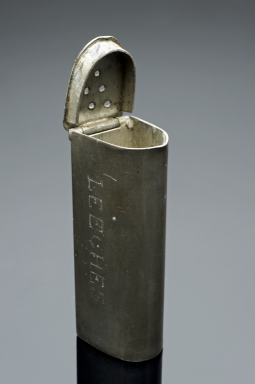
Pewter box for transporting leeches. Image @Science Museum of london
Leeches were carried in a variety of containers made of glass, silver, or pewter. Small bowls were portable, and the larger ones were probably kept in an apothecary’s shop or pharmacy. The everted lips were used to attach a cloth, which prevented the hapless creatures from escaping.
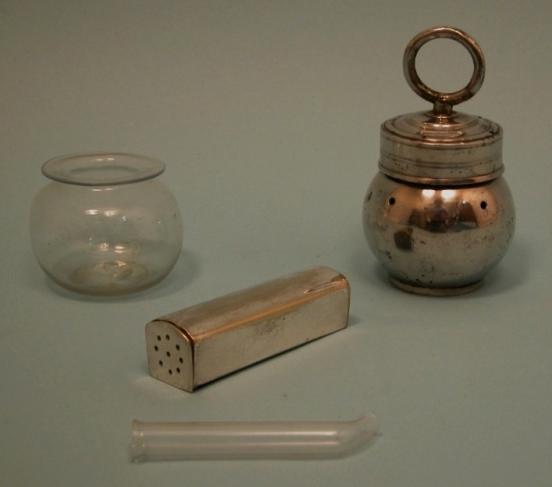
Portable leech carriers made of glass, silver and pewter. Small leech tubes directed the worm to difficult to reach places in the mouth, larynx, ear, conjunctiva, rectum and vagina, begging this question: How did one retrieve the engorged leech?
After the 1830s, the practice of leeching began to decline as medical diagnostic skills improved. Physicians realized that patients who were leeched did not often recover more fully than those who were not, and other, more beneficial treatments, including pharmaceutical and homeopathic remedies, began to replace leeching
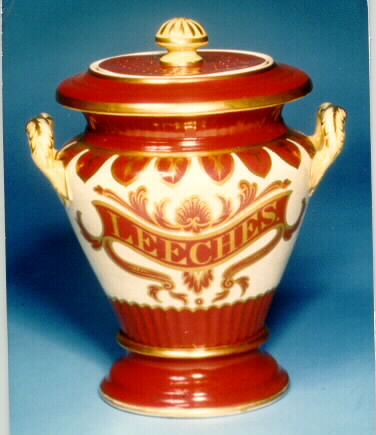
Red and cream Staffordshire leech jar
More on the Topic
- Leeches Used in Bloodletting
- Medicinal Use of Medicinal Leeches
- Biopharm’s Leech Facts
- Collect Medical Antiques
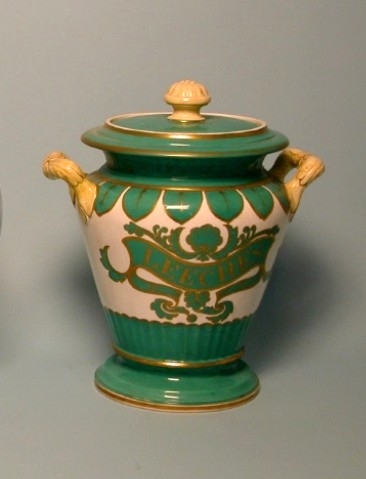
Leech bowl







 Jane Austen's World
How do the kids put it these days? Right. Now I remember. “Well that sucks.”
Those poor horses! Very interesting post, thanks!
Re Humoral Theory:
This is not restricted to the “ancient” Greeks. It was alive and well as recently as the 1950s in at least one mountainside village in the north of Greece. Whether it continues, I cannot say. I left in the early winter of 1957 and I haven’t been back.
I shudder at the thought of what those poor people had to endure to collect leeches! And those poor elderly horses too!
Thanks for this very informative post.
I can assure you from personal experience that it’s not exactly a day at the beach when fisher and bait happen to be one and the same. That said, we do what we must to get by.
Leeches,( Hirudo medicinalis,) are still contributing to the medicals arts.
The are used to maintain circulation in surgically reattached parts. Horses, elderly or otherwise, are no longer part of the equation, as the leeches are bred in sterile condition.
EJ Wagner
It’s not that I don’t believe you, but I refuse to wade into that creek again unless you go first.
I believe you that the elderly horses are out of the equation! 150 years ago this was not the case.
I find it fascinating that leeches are contributing so much information about blood clotting and anesthesia in this day and age, and that they (plus the use of maggots) are attracting medical interest.
Still, I cannot abide to look at them.
You get used to it after a while. Looking at them is no big deal. The yucky part is plucking them off your feet and your legs and your — well, let’s leave it at feet and legs, shall we?
I share your disgust, Vic, and am glad you chose the pictures you did! I’ve only had the misfortune once, in a lake, to have the teeniest one attached to my toe, and I screamed and kicked so hard, it went flying! Needless to say, I caused quite a commotion!
So sad to think of all the people that had to act as guinea pigs so that we could be leech-free.
Flying where I wonder?
(Kicking is the worst thing to do.)
Fascinating blog post. As much as I tend to be squeamish about this sort of thing, it is also a really interesting topic. As a prior commenter said, leeches are still in medicinal use today although care is taken to ensure that they don’t transmit disease. I do feel sorry for all of the poor people and horses who had to endure leeching in less than sanitary conditions though.
Beth, there’s really nothing to feel squeamish about — and you can get your blood back simply by taking the leech between your thumb and index finger and pinching hard.
Dear Leech you’re now misunderstood
But in your day you did much good
To me you’re lovely in that brook
How sad to think that Vic won’t look.
Hah, Thank you so much Upstart Crowe-Martie, for my laugh for the day. I shall endeavor to thank the leech for its many contributions to medicine today!
Bless you sir — you are a kind and gentle man — never mind what Tony Grant says. Talk about bloodsuckers.
SPOILER ALERT
In the Season 3 finale of Downton Abbey, Maggie Smith takes to her bed with a mysterious illness. Enter: Shirley MacLaine, holding what appears to be an earthen jar and a long-stem wine glass, inverted. “Still under the weather, my dear?” she says. ” I have just the thing.”
Ohhh…awesome!!!!
Maggie and Shirley share Vic`s prejudice alas — using real leeches was out of the question. Authenticity gave way to … Gummy worms!!
Please do not post spoilers to DA on this blog. We are a community that loves finding out for ourselves during the episodes and reading the musings of the host and blog followers.
Not to worry Karen. I just got off the phone with Brian. He has agreed to cut that scene. Mr. Percival assures me there will be NO leeching in the Season 3 finale. None.
Perhaps you ought to blame Lord Julian for the leech scene. He’s the one who yearns for those old traditions….
Love this post. As a nurse I am fascinated by science and as a History fan this post, detailed and well-researched was quite fun – not to mention the illustrations – awesome! Here is the heads up on modern use of Leech Therapy. They have even come up with a mechanical leech but doctors swear by the real thing…
“The leech is invaluable in microsurgery when faced with the difficulties of reattaching minute veins. Ears have such tiny veins that, in the past, no one was able to successfully reattach them. Then, in 1985, a Harvard physician was having great difficulty in reattaching the ear of a five-year-old child; the tiny veins kept clotting. He decided to use leeches and the ear was saved. This success established leeches in the modern medical world. Since then, leeches have saved lives and limbs, reducing severe and dangerous venous engorgement post-surgery in fingers, toes, ear, and scalp reattachments; limb transplants; skin flap surgery; and breast reconstruction.”
http://www.pbs.org/wnet/nature/bloodysuckers/leech.html
Another interesting link.
http://news.bbc.co.uk/2/hi/health/3858087.stm
Thank you so much about this modern information! I am rapidly overcoming my “distaste” about leeches with these interesting bits of medical lore!
My pleasure! My admiration for them and their wonderful medicinal achievements did not stop me from screaming like a 10-year old girl when one latched onto my foot. Everybody around me (all in laws and all men except for the mother laughed at me while I suffered and kept on screaming) and my husband did nothing to remove it because he thought it was just too funny. Finally, one of my brothers (in-law) took pity on me and removed it. I hated seeing that black thing stuck on my toe and could not explain my hysteria…LOL…still I do admire them.
You had to go and use the word “taste” didn’t you Vic?
Available by prescription only, I assume.
I hope! I think I might prefer leeches over surgery.
Cheaper for one thing — imagine the money you`d save!!
Let me see now … We have Martha’s and we have crazyaboutjane’s. Any other personal testimonials? Don’t be shy friends. Share your stories!
p.s. So far the common denominator is “screaming.”
For the film buffs among you I highly recommend: The Leech Woman.
“She Drained Men of Their Loves and Lives!“
Enjoyed it thoroughly. Every time.
p.s. This is also where I learned to spell “endochrinologist.“
Four or five years ago a three-piece band named Fog did a song called The Leech Within.
My favorite Jane Austen quotations. Ten of them anyhow. Can you name the novels in which they appear? Good luck and begin — now!!
“The person, be it gentleman or lady, who has not pleasure in a good leech, must be intolerably stupid.”
“A leech’s imagination is very rapid; it jumps from admiration to love, from love to matrimony in a moment.”
“How much sooner one tires of any thing than of a leech!”
“The more I know of the world, the more I am convinced that I shall never see a leech whom I can really love. I require so much!”
“It is a truth universally acknowledged that a single man in possession of a good fortune must be in want of a leech.”
“Perhaps it is our leeches that make us so perfect for one another!”
“The very first moment I beheld leeches my heart was irrevocably gone.”
“I always deserve the best leeches because I never put up with any other.”
“I may have lost my heart, but not my leech.”
“Laugh as much as you choose, but you will not laugh me out of my leech.”
(Do we have prizes Vic?)
Really interesting piece again. It’s amazing how many of the common treatments still used by the Victorians actually weakened and sometimes killed the patients. Two other popular treatments of the time were,
“Blistering” – placing caustic or hot substances on the flesh to draw out infections,
and
“Purgation” – the administration of an emetic to induce vomiting or a laxative to purge the bowels.
And although there were no anaesthetics until the middle of the 19th century (I think Queen Victoria may have been one of the first women to have anaesthetic in giving birth?) it’s amazing how common the use of opium was.
Have done a piece on opium in Victorian times.It was commonly used in England to “strengthen” cheap beer, prescribed by doctors for a whole range of ailments, and was a major ingredient in “tonics” available from chemists and “snake-oil” salesmen.
I don’t know whether you have, “dead skin removing shops,” in the States? I have no idea what they are actually called. From the street you can look into these establishments and there you will see a row of people sitting with their tights, socks, shoes, removed with their bare feet immersed in a tank full of little fish nibbling away at the dead skin on their feet. Apparently the sensation is very pleasant.I have seen these shops in the most unlikely high streets, Canterbury, near the Cathedral, York, near York Minster, Salisbury, next to the market cross which is a mere stones throw from the cathedral. Actually there does seem to be a pattern emerging here. These cities are all ancient medieval cities with cathedrals!!!!!!!!!!!!!!!!!
And talking about little animals that make our lives better here is the best one of all.
John Donne the 16th century poet, priest, satirist and lawyer wrote:
THE FLEA.
by John Donne
MARK but this flea, and mark in this,
How little that which thou deniest me is ;
It suck’d me first, and now sucks thee,
And in this flea our two bloods mingled be.
Thou know’st that this cannot be said
A sin, nor shame, nor loss of maidenhead ;
Yet this enjoys before it woo,
And pamper’d swells with one blood made of two ;
And this, alas ! is more than we would do.
O stay, three lives in one flea spare,
Where we almost, yea, more than married are.
This flea is you and I, and this
Our marriage bed, and marriage temple is.
Though parents grudge, and you, we’re met,
And cloister’d in these living walls of jet.
Though use make you apt to kill me,
Let not to that self-murder added be,
And sacrilege, three sins in killing three.
Cruel and sudden, hast thou since
Purpled thy nail in blood of innocence?
Wherein could this flea guilty be,
Except in that drop which it suck’d from thee?
Yet thou triumph’st, and say’st that thou
Find’st not thyself nor me the weaker now.
‘Tis true ; then learn how false fears be ;
Just so much honour, when thou yield’st to me,
Will waste, as this flea’s death took life from thee.
Love this poem, Tony. As for little fish nibbling dead skin off my feet, well…
Vic it has been a pleasure. Informative and amusing as well. But I’m going to take my leave now. This website is getting too kinky for me. Way too kinky. My best to all.
Opium in the beer again, Mr. Grant?
Ah Nick. Your undoubted talent at humour will be missed. What a shame.
Go on, try writing a blog yourself. I really think you should.
I haven’t noticed whether you have visited London Calling yet.
Pay no attention to him Mr. Grant. He’s over-reacting as usual. It’s first thing in the morning here, you see, and, quite frankly, all this talk of fleas sucking and fish nibbling is making it very hard for him to concentrate on his work.
p.s. He has indeed given serious thought to paying a visit to London Calling. But now I’m not sure it’s going to happen. Can’t say that I blame him, really. If it’s this kinky in America, I can imagine what it’s like … over there.
Well Nick Upstart you disappoint me.
Your mild sarcasm ,is becoming boring. Are you capable of anything else?Anger or hatred would be a lot better. It would show some real human engagement. But what you are doing is keeping any real dialogue at a distance like some spotty bad breathed teenager unable to communicate properly hiding behind your own jokes.
Hey, plenty of scope for you to reply with more of your sarcasm!!!!!!!!!!
That would be so boring though.
Gosh. It sounds like I’ve overstayed my welcome. Time to move on. Thank you Tony for being such a good sport and you too Master Vic. My best to both. Cheers.
No Nick, it is not, Master Vic. Vic is a very nice lady who lives in the States.
One of the things that concerns me about blogging is that there is always the possibility of abuse. I presume you are a group and not one or two, who feel it is OK to take the piss. If you and your friends were to express real views and communicate properly we could have a dialogue. You probably don”t want that though.Well you have had your fun. Blogging is a great way to communicate with people and to practice writing about things you enjoy.
Thanks for setting the record straight Tony. I owe you one.
Several years ago I had an accident and was struck above my left eye which caused extreme swelling in the eyelid. I was seen by a plastic surgeon who placed leeches on the eyelid which rapidly reduced the swelling. It didn’t bother me as much as it did the lady in the other bed in the room.
I had plenty of experience with them as a child, while gathering watercress, in which leeches like to hang out but those were much smaller than the ones used on my eyelid.
We carried a can of salt with us when collecting watercress as an application to the leeches would cause them to fall off.
I love this personal anecdote. There must be a reason that leeches have been used for so many centuries, and you just gave a good one!
My wife is a nurse and she has used leeches from time to time on infected wounds/sores. They are extremely effective, but obviously unpleasant to handle – and require very careful counting when being applied and removed.
I had not thought of the counting! I understand that maggots are very effective in cleaning wounds and are being used again as well.
Yuck, I just had my blood test today and if I were to be blood let every day, I’ll ….
Thanks for the detail and interesting read.
The Spinster’s Vow
your page, I want my permission to publish on my site, I have very good information
Thank you Ari CAFER