Early Life of Robert Geffrye
Robert Geffrye was born at Tredinnick Farm near Landrake in Cornwall in 1613. His father was a yeoman farmer. That meant, unlike a tenant farmer, he owned his own land. He was baptised at St Michael’s Church in Landrake on the 24th May 1613. The local vicar, Roger Jope, chose children from the area to teach the basics of reading and writing. He discovered in Robert a quick and intelligent child. At that time, learning to read and write opened opportunities to any able boy.
A number of national and international incidents happened in the early years of Robert Geffrye’s life. In 1623 and again in 1630, storms affected the crops and many families were left hungry. In 1618, the 30 Years War began in Europe. A period of continuous war over three decades between Catholic and Protestant states in Europe and particularly amongst the Germanic states ensued. Even though Britain was not officially a participant in these wars, James Ist still provided an army of 30,000 English troops to support his Protestant allies. In 1625, three hundred young Cornishmen were conscripted to fight. In 1627 a failed raid on La Rochelle saw the returning English army of 5000 men billeted on Cornish households. Landrake was no exception. Because of the unruly nature of some bands of troops stationed in Cornwall, martial law was imposed on the area. Poor prospects and many dangers beset the young teenage Robert Geffrye.
A young man wanting to get on in life obtained an apprenticeship, especially with one of the great livery companies in the City of London. This was a route to prosperity and advancement. Many Cornish men had made their fortunes by joining such livery companies and many prominent Cornishmen had links to the livery companies. For instance, Richard Randall the Deputy Vice Admiral in Devon had a longstanding connection with The Ironmongers Company. Richard Peate, another Cornishman, made a lucrative career with The Ironmongers and became their senior warden. Robert Geffrye went to London at the age of 17 and applied successfully to join the Ironmongers as an apprentice with Richard Peate.
Robert Geffrye’s father paid Robert Peate the £200 apprenticeship fee. Apprentices became part of their masters family and boarded with them for the seven years the apprenticeship lasted. Robert Geffrye lived with the Peates at Whitecross Street, Finsbury, and initially would have been set to work sweeping the warehouse floor, and packing and weighing goods. Towards the latter years of his apprenticeship he would have worked in the counting house dealing with bills, and learning the elements of book keeping and correspondence, and so became acquainted with Peate’s customers. Daniel Defoe had been an apprentice with the Butchers company. He wrote that on the completion of an apprenticeship, a young man could,
“turn his hand to anything, or deal in anything or everything.”
Robert Geffrye completed his apprenticeship with credit in August 1637. He was given the freedom of the city, which gave him privileges within the city. He later became a liveryman of the company, putting him in a position of authority, checking standards, and attending church services, dinners, and ceremonies in the name of the company. His dealings were with men who had trained and achieved the same status he had. This put him on a trajectory within the political and trading establishment of the city.
In 1667 and again in 1687, Geoffrey became the Master of the Ironmongers Company. In 1674 he became the Sherriff of London, an important role in the 17th century. Officeholders had important judicial responsibilities and attended the justices at the Central Criminal Court, The Old Bailey. In 1676, Robert Geffrey became an Alderman and eventually the Lord Mayor of London in 1685.
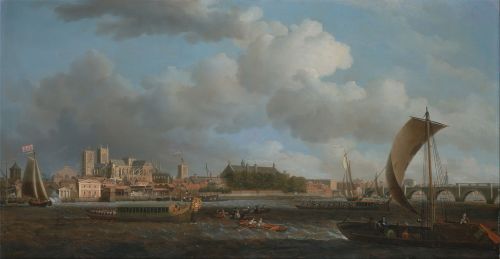
Samuel Scott, ca, 1745, Westminster from Lambeth, with the Ceremonial Barge of the Ironmongers Company – Google Art Project.
Robert Geffrey’s life and his rise in importance and influence came during a tumultuous time, starting in his youth with The Thirty Years War, the reign of Charles 1st during the English Civil war, when war was waged between the Parliamentarians known as The Roundheads, who were who were mostly Puritan, and the Cavaliers who were monarchists and Church of England followers. The monarchy was defeated, leading to the execution of Charles 1s in 1649. Scotland proclaimed his son, also Charles, as King Charles II, whose army was defeated at the Battle of Worcester in 1651, when he escaped to The Netherlands.
The following nine years were known as The English Commonwealth under Oliver Cromwell. After Cromwell died, Charles II was invited back to England in 1660 and was welcomed in London in May of that year. Charles II died in 1685 and his brother James became King James II.
Robert Geffrye lived through The Plague year of 1665, followed by The Great Fire of London in 1666. More conflict followed, including a successful attack by Charles II, a Roman Catholic, on The Medway ports with a Dutch fleet. The victory caused problems among many of the Protestant aristocracy and government ministers. They wanted to get rid of Charles II and, backed by the Protestant Duke of Monmouth, to usurp him. Monmouth’s army was defeated at The Battle of Sedgemoor in Somerset. He was captured and executed and many of his followers were pursued by Judge Jeffryes and condemned to death at the famous Bloody Assizes.
James II was able to consolidate his power and reigned until 1688, when he was deposed by William of Orange. During this tumultuous time, Robert Geffrye must have been a very astute politician and able administrator to navigate those times. You have to admire him for his tenacity.
Later life and the Almshouses
During his life Robert married a mercer’s daughter, Priscilla Cropely. They lived in Lime Street, very close to Leadenhall Market in the City and by the Ironmongers Hall. They had no children.
In 1653 he joined The Levant trading company. It is recorded that he traded cloth to Leghorn in Italy. Robert Geffrye became an administrator in The Levant Company trading with Northern Europe, the Mediterranean and Turkey. In 1670 he profited from the slave trade by his investments and involvement in the Royal African Company, and in 1680 Robert Geffrye became a joint owner of the trading ship, The China Merchant. He and his fellow owners wanted to hire their ship at first to The East India Company.
He became an administrator in The Royal African Company whose whole purpose was the ”Triangular Trade” with the Guinea Coast of West Africa, The West Indies, and Britain. All these great trading companies had strong links to The Ironmongers Company, trading in cloth, tin, lead, pewter, calico, spices, pepper and slaves. It is rather chilling seeing a list of their trading interests with slavery as just one more item on the list.
During the last fifteen years of his life, Robert Geffrye devoted his time to charitable work. He became the president of Bethlem and Bridewell Hospitals. Sir Robert Geffrye and his wife Priscilla were childless. She predeceased him by many years. When he died in 1704 at the age of 91 years, he left a small fortune of £13000. In his will, some of the money went to financing a school in his home village of Landrake in Cornwall, but a substantial amount of the £13000 was left to build almshouses for poor deserving people who had worked mainly for the ironmongers and fell on hard times when they retired.

The Geffrye Almshouses, image by Tony Grant
An almshouse is a charitable home for poor people of good character. The Ironmongers Company set up a group of officers called the Geffrye Charity Committee. They took nearly nine years to find a suitable site to build the almshouses–a site near the city so it had convenient access to the committee based at Ironmongers Hall.
They wanted the site to be conspicuous to passers-by so that Robert Geffrye’s legacy could be seen and admired. They first looked at a site in Old Street that the Ironmongers owned and a site in Bow was also considered. By 1711, the committee was still looking for a site and in November of that year they published an advertisement. A Mr Hunt, who owned a large plot of land fronting the Kingsland Road, responded, and sold the site to the Ironmongers for £200.
There were other charitable foundations in The Kingsland Road too. Just to the north of this new site, The Drapers had built an almshouse. To the south, The Framework Knitters also had their almshouses. The area, although close to The City, consisted mostly of market gardens and arable farming. Clay pits in the area provided clay for brickmaking. In 1712, the Geffrye Charity Committee drew up their architectural plans for the almshouses. Someone who was not an architect must have been a competent draughtsman, for the plans were very good. The almshouses were well designed in a typical 18th century style copying Christopher Wren and aspects of Inigo Jones.
Tenders were submitted in 1712 for building the houses. Robert Burford, a carpenter, was employed to build the central great room and six almshouses located on the north side. Mr Halsaul, also called a carpenter in the documents, was contracted to build six more almshouses on the south side. In the documents they are merely called carpenters, but they were more likely to have been members of the Carpenters Guild, who had their own building apprentices. The central Great Room was used as a meeting place and to socialise for the first two years of its existence. It was soon turned into a chapel for Sunday services, which the pensioners were required to attend.
The chosen site sloped to the west. To make it flat, the Committee encouraged people to dump their waste on the land to fill in the dip. Six hundred carts of soil were transported to cover the ground. The actual buildings were constructed at the back on solid ground that had not needed levelling. This provided ground for a solid foundation and left the front area to be grassed over as a lawn for recreation, and room for Lime trees to be planted. Twelve houses were completed by 1712 with the great room in the middle. Two more houses were added, one to each wing in the following two years, making fourteen altogether.
The Geffrye Charity Committee insisted on high quality materials for the buildings. Today you can see how well constructed they are. The interiors are well designed. The floors are made of strong sturdy oak boards and the interior walls and ceilings are plastered. An American lady I showed round once finished the tour by saying, “ I’m ready to move in now.”
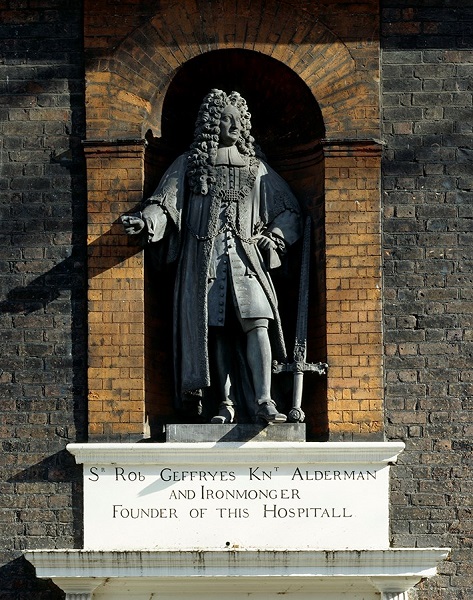
Statue of Robert Geffryes, Founder of the Hospital
In December 1714, the first pensioners moved in. The criteria for becoming a pensioner was that you had to be 56 years old at least, poor, and of good character. The rules in the Geffrye Charity Committees documents state,
“any member or their widow that shall have been Liveryman or Freeman of The Company of Ironmongers shall be preferred.”
This did not mean that people who were not from the Ironmongers Company could not get in, but Ironmongers were given preference. Until 1740, on average between forty to fifty pensioners lived in the almshouses.
Robert Geffryes’ endowment provided a Geffrye pensioner with a single room that had a small walk-in cupboard in one corner. They were given a pension of £6 a year. Each pensioner was provided with six sacks of coal a year. A new gown was given to each every Lady Day ( March 23rd). They were required to make ,”petticoats,” from their old gowns. Some of these official pensioners – male – often had wives, and it is thought some even had children living with them. £6 per year was not enough to live on for some. They could petition for extra funds from the almshouse poor box or the Ironmongers Companies estate. Many received extra money in this way. Some were also employed in work in the almshouses. The matron, groundskeeper and chapel clerk were employed from among the pensioners. A chaplain was also employed but he was not a pensioner. The Chaplain held a position of authority over the pensioners.
The committee made up rules for the pensioners to live by and were based on the rules enforced by other almshouses, so they were not unique.
- Pensioners could be fined for blasphemy. In this case they would be expelled from the almshouses to return to their parishes. This was not a good thing to happen. Living off their parish made them extremely poor.
- If they were found guilty of adultery or lewdness they could be expelled.
- Staying out overnight could bring a fine. The gates were closed from 7pm in the winter and from 9pm in the summer.
- Rule number 8 stated that a pensioner had to be. “of good life and conversation.” They were expected to get on well with the other pensioners and support each other when ill. Rule number 10 related to drunkenness. A fine would be given. Cases were heard at the Geffrye Charity Committee meetings held in the great room, to begin with. Generally, they were lenient and expulsion was very rare.
The almshouses today are called “The Museum of The Home.” Over the last three years a government grant from the lottery fund of £18 million pounds has been given to the museum to extend and develop its work. The basement has been lowered and refurbished to contain exhibitions and displays on the theme of The Home, which covers many aspects. Documentary films have been made about the home lives of local Shoreditch residents and their background. Various themes, such as migrant camps, sleeping rough on the streets ,”games in the home,” and other aspects of home life are covered. The key element about these new exhibitions and displays is to instigate discussion and to ask questions.
The ground floor has remained as the middle class English period rooms from Tudor times to the 21st century. A new addition called “The West Indian Front Room” has been installed as the 1970s room. Eventually, over time, the museum will move away from being predominantly a museum of middle class rooms to rooms that cover all of society. The roof has been opened up to contain a research library.
An important element of the museum’s work is its ground-breaking educational work with schools, colleges, and universities. A new education block has been built at the back, a major element of the museum. The museum is now famous for its important outreach into the local community. Molly Harrison, the curator of the museum from 1949 into the 50s and 60s, developed child-centred exploratory education techniques, which many museums in Britain and the world over still use today.
The second part of this series, which is a guided tour of the 18th century room in the Almshouses, will be posted on Thursday of this week. “Welcome to a Guided Tour of the 18th Century Room in the Museum of the Home at the Geffrye Almshouses, Part II.”
Links:
- Stories of home: About the Museum: https://www.museumofthehome.org.uk/
- Link to images of Museum of the Home
- Wikipedia article about Almshouses in Britain.
References:
- Kathy Haslam : A History of the Geffrye Almshouses, Published by The Geffrye Museum
- Penelope Hunting : Riot and Revolution ( Sir Robert Geffrye 1613-1704) Published by The Geffrye Museum 2013







 Jane Austen's World
Thank you so much, Tony, for this informative piece. So much to learn, so little time.
Michelle, if you come to London one of these days, there are of course the famous museums and sites but it really is worth visiting The Geffrye Almshouses where The Museum of The Home is located. Home, is a very important place for every human being and the museum explores the whole concept of home. It gets you asking questions. I have volunteered as a guide there since I retired from teaching three years ago. I love it.
Interesting history.
denise
Thanks Denise. You will have to visit The Museum of The Home.
That was really interesting, amazing life story and legacy. Thank you.
Thanks Carolyn.All the best, Tony
Tony, I knew very little about Robert Jeffryes until your highly interesting article about his almshouses. Were these the only means in which the poor were helped in British society, aside from the coins tossed their way?
There were not a lot of choices for the poor in the 18th and indeed the 19th centuries. After the Reformation local parishes had responsibility for the poor within their parishes. The start of the workhouses began then. These were virtually prisons. The men, women and children were separated from each other. They had hard menial tasks to perform. Once in a workhouse they died there. It was an awful existence. The almshouses set up by companies like The Ironmongers, in the name of Robert Geffrye in this case, were luxury compared to living on the parish. The almshouses inmates(yes they were called inmates) had a relatively comfortable life.