As we continue our investigation into Jane Austen’s irresistible romantic themes and plots, we now come to one of my favorite Austen novels, Persuasion.
In this series, we’ve looked at “Enemies to Lovers” in Pride and Prejudice, the “Slow Burn” Romance in Emma, and “Best Friends to Lovers” in Mansfield Park.
Now we turn our attention to the love story that many Austen fans love as much as (or more than) Pride and Prejudice. It’s the story of Anne Elliot and Captain Wentworth and the one that got away.
Second-Chance Love
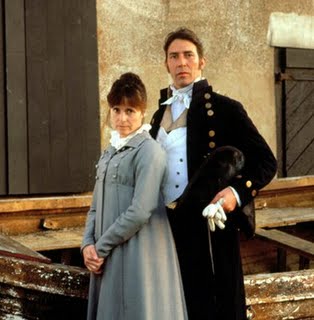
Persuasion is a second-chance story because Anne Elliot receives another chance at love with Captain Wentworth and another chance at living her own life and choosing her own happiness.
When the story opens, she’s somewhat of a faded, wilted flower:
A few years before, Anne Elliot had been a very pretty girl, but her bloom had vanished early; and as even in its height, her father had found little to admire in her, (so totally different were her delicate features and mild dark eyes from his own), there could be nothing in them, now that she was faded and thin, to excite his esteem.
Persuasion

However, her true beauty and worth go far beyond her exterior, and Captain Wentworth quickly notices that she’s still the same Anne:
She was looking remarkably well; her very regular, very pretty features, having the bloom and freshness of youth restored by the fine wind which had been blowing on her complexion, and by the animation of eye which it had also produced. It was evident that the gentleman . . . admired her exceedingly. Captain Wentworth looked round at her instantly in a way which shewed his noticing of it. He gave her a momentary glance, a glance of brightness, which seemed to say, ‘That man is struck with you, and even I, at this moment, see something like Anne Elliot again.’
Persuasion
The One That Got Away
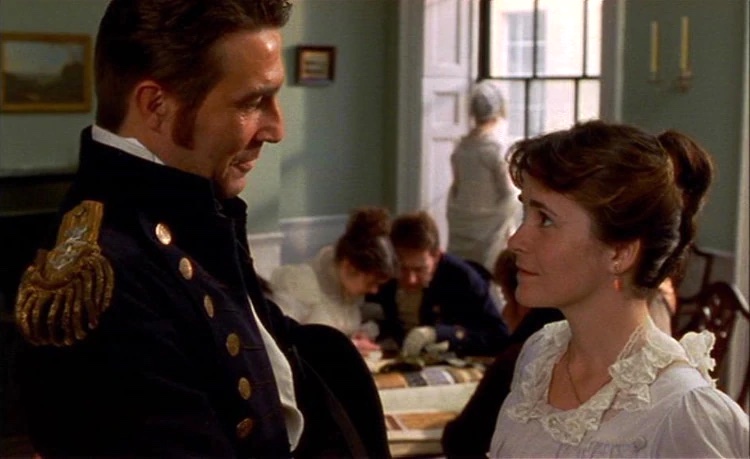
Beyond a second chance at love, Persuasion is a picture-perfect model of “The One That Got Away” (or “Long-Lost Love”) romantic theme that has become so popular in romantic movies and books. Austen knew what she was doing when she created a storyline about passionate, young love; years of separation, heartache, and regret; and a long, drawn-out rekindling of a long-lost love that has only grown deeper and more mature with time.
But one of the reasons Persuasion is so intriguing is that Austen doesn’t instantly rekindle the relationship when Anne and Wentworth meet again. Instead, Austen builds a storyline that creates questions, heartache, and angst for Anne (and Austen’s readers).
While Anne never stopped pining for Wentworth, it seems as though he has moved on completely and has not forgiven Anne. There is no quick thrill, instant reignite, or swift rekindle. He acts almost as though they’ve never met.
Anne’s only recourse is to patiently, achingly watch the love of her life search for a wife, flirt with other women, and essentially ignore her (or so she thinks). She remains humble, quiet, and ever-patient, though each day brings fresh torture.
Forced Proximity
One romantic device Austen uses expertly in Persuasion (and in most of her novels) is what we now term “forced proximity.” This is when an author places two characters in a situation where they are forced to spend extra time together in close quarters. It might be a stalled elevator, a shared school or work project, a single bed in a hotel room, or a small car on a long road trip.
In Persuasion, Austen brings Wentworth right into Anne’s neighborhood, places him among the families she and her family socialize with, and even has them travel in the same group to Lyme. Austen also creates situations where Anne and Wentworth are even in close physical proximity:
They were actually on the same sofa, for Mrs Musgrove had most readily made room for him; they were divided only by Mrs Musgrove.
Persuasion
In another moment, however, she found herself in the state of being released from him; some one was taking him from her, though he had bent down her head so much, that his little sturdy hands were unfastened from around her neck, and he was resolutely borne away, before she knew that Captain Wentworth had done it. Her sensations on the discovery made her perfectly speechless.
Persuasion
In Bath, there are more opportunities for the two of them to cross paths, including the day when Wentworth overhears Anne’s conversation with Captain Harville and writes her his letter.
Love Stories Like Persuasion
Many popular romantic movies make use of these similar themes, such as The Notebook, Serendipity, The Princess Bride, Sweet Home Alabama, Before Sunset, 13 Going on 30, The Best of Me, The Parent Trap, Grosse Pointe Blank, Ticket to Paradise, Pearl Harbor, Love Actually, The Story of Us, Crazy, Stupid Love, When Harry Met Sally, and An Affair to Remember.
Television shows such as Friends (Ross Geller and Rachel Green) and As Time Goes By (Jean Pargetter and Lionel Hardcastle) also utilize the rekindled love or long-lost love theme.

Stories We Love
I’m sure you can add other books, shows, or movies to this list with similar themes. I personally think that many of us can relate to Anne Elliot and a desired second chance, whether it’s in love or some other passion or pursuit. Though none of these popular rom coms hold a candle to Jane Austen’s masterpiece, it’s clear that the themes she employed have stood the test of time.
RACHEL DODGE teaches college English classes, gives talks at libraries, teas, and book clubs, and writes for Jane Austen’s World blog. She is the bestselling author of The Little Women Devotional, The Anne of Green Gables Devotional and Praying with Jane: 31 Days Through the Prayers of Jane Austen. Now Available: The Secret Garden Devotional! You can visit Rachel online at www.RachelDodge.com.







 Jane Austen's World
Thanks, Rachel, for the reminder of true romance. It’s not just for novels. My cousin, who was a widow with adult children, went to a college reunion and re-met her old flame, then a widower with grown children. They started corresponding and then meeting up, going from Michigan to California where they lived. A year later they got married. I’ve been trying to convince my cousin to write a novel about her remarrying and all and so far she hasn’t done it even though she’s a professional writer.
That’s so beautiful! She should definitely write about it!! I have a friend with an incredible second-chance love story and I always encourage her to write about it as well. I think it gives people hope. After great loss, there is sometimes a “second act” that brings unexpected joy.
It’s the might-have-been that catches our imaginations. Similarly, The search for an unknown parent or sibling engages our sympathy.
In Persuasion, it’s Anne’s ruminations and self talk that I especially enjoy and her movement from depression and hopelessness to self-empowerment. As well, though unhappy, Anne elicits respect because although deeply unhappy, she is an active and positive sister and friend.
Oh, this is so well said!! It’s difficult to capture the beauty of Persuasion in words. It’s absolutely masterful. Anne’s thought life is intriguing and empowering. And you’re right – it’s the “might-have-been” that draws us in. We feel the pathos of her situation.
I do not accept that Jane Austen concerned with Romantic Themes. That there are heroines and marriages is not evidence of romance, but the response of a serious mind working out how best young women can secure a rational existence commensurate with their situation
I agree. Though she certainly wrote romance beautifully, it was not her main concern. I do think that many romantic movies today carry similar themes because they are universally enjoyed. Many just don’t do them justice because the plots (sadly) aren’t nearly as sophisticated as Austen’s.
“Forced proximity” is annoying; my life is as such and yet, not everything is about me; otherwise, this was a lovely post.
I love Persuasion for this very reason.
The Gay Divorcee, The Philadelphia Story, The Awful Truth, Love Crazy, The Lady Eve, The Palm Beach Story, PHFFFT, All that Heaven Allows, etc… are great OG romcoms with a second chance trope. All but one are B&W.
denise
My first encounter with Jane Austen as literature was at a lycée in France i the medium of French and the chosen work was ‘Persuasion’ The teacher was interested in JA in connection with the History of Ideas and their transmission and her approach was one of ‘Ethics and Jane Austen’ and in this approach she argued that Jane Austen in Persuasion was advancing the view that ‘Mlle Austen seems to have been greatly influenced not my the evangelical but by Coleridge as a transmitter of the ideas of Kant on Religion and Ethics.’ She ‘[Mme lafoy] believed that Jane Austen was presenting a highly intelligent and reasoned case against ‘Morality’ and insinuating in her novels a very subtle ‘Feminist case’ for Reason and Education. She also believed in the necessity for education and continence so that a woman was better unmarried than yoked into a loveless marriage or one that was on sentimental. [Captain Benwick] I had those ideas indelibly fixed in my mind and have always since believed that Jane’s intellect and intentions have not been understood because we impose on her an English rational and almost utilitarian notion.