• Home
  • Audio/Podcasts
  • Austensites
  • AV/E-Texts
  • History
  • JA Novels & Bio
  • Links
  • Original Sources/19th C. Texts
  • Social Customs During the Regency
  • Teacher/Student
  • Writer/Literature Resources

Jane Austen's World

This Jane Austen blog brings Jane Austen, her novels, and the Regency Period alive through food, dress, social customs, and other 19th C. historical details related to this topic.

Feeds:
Posts
Comments
« Jane Austen and Rom Coms: Sense and Sensibility (“Love Triangles”)
Jane Austen’s Family Churches: St. Michael and All Angels at Hamstall Ridware, and Austen’s First Cousin, Edward Cooper »

Letterlocking a Jane Austen Letter

October 17, 2023 by Vic

Letterlocking was a method used by European societies between the 15th – 18th centuries to keep messages private.  Ancient human societies found other techniques to protect their messages through the use of seals, or, as in the case of Ancient Mesopotamia, cylinder seals that were unique to each owner. These were eventually replaced with stamp seals, some of which are still used today in the form of signet rings.

Cylinder seal, Walters Art Museum, public domain image
Stamp seal, Met Museum, public domain image.

Today I seek other ways to keep my public affairs private. Passwords for my online correspondence and purchases are changed frequently, and I make sure to have a secure two-step process for accessing the information along with a back up plan.

During Jane Austen’s lifetime, envelopes were not yet used. The extra weight made the expense of sending or receiving letters more expensive. Therefore, the paper was carefully folded. Often the lines were crossed, as shown in an article from this blog.  Images of Austen’s surviving letters demonstrate the method by which she folded them, as described by Jane Austen’s House .

The letter was written across the first three pages and the top and bottom thirds of the fourth page, leaving its middle third blank. With the first page uppermost, the bottom third of the letter was then folded upwards and the top third folded down so that the edges met in the middle. Then, holding the letter lengthways, the left-hand and right-hand sides were tucked inside each other. The packet was sealed with wax and the address written on the blank reverse. –  Room 5: How to Write and Fold a Letter, Jane Austen’s House

One method of letterlocking is shown in the YouTube video below.

Letterlocking is the art of using specific folds and cuts in flexible paper to seal it shut for document security. Because paper was not always as common as it is today, it was much more expensive, which led to minimizing the use of paper as much as possible. At this point in history, envelopes would have been seen as excess cost, an issue that was quickly solved with letterlocking.” — Securing Ancient Secrets: The Fascinating History of Letterlocking, Ancient Origins

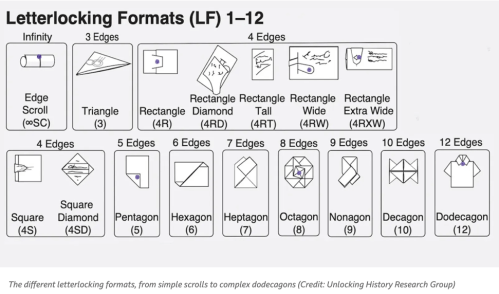
In a BBC article (see link below), Richard Fisher described the historic research that uncovered the secrets to letterlocking in the early 2000’s. Conservator Jana Dambrogio was the first woman allowed to work in the Vatican Secret Archives when she found a cache of documents and noticed cuts, creases and folds in the paper. Thinking they were evidence of letterlocking, she scientifically described what she observed.
Screen Shot 2023-10-17 at 1.06.18 PM

She and a colleague, Starza Smith, searched for more letterlocking samples, which they often found in old archives and museum collections. Recently they discovered a trunk containing 2,600 letters from 17th-Century Europe, of which 577 were unopened. This trove provided details of European life during the 1600s.

As a final act before her execution, Mary Queen of Scots sealed a letter she wrote to her brother-in-law with a spiral lock. He would have known her message had been intercepted if that seal arrived broken. The irony would not have been lost on a juvenile Austen, whose “History of England” included a memorable passage about the doomed queen.

  • The Clever Folds That Kept Letters Secret, Richard Fisher, 2021, BBC
  • The Postal Service in 18th Century Britain, Jane Austen’s World

Share with others:

  • Click to email a link to a friend (Opens in new window) Email
  • Click to print (Opens in new window) Print
  • Click to share on Facebook (Opens in new window) Facebook
  • Click to share on Reddit (Opens in new window) Reddit
  • Click to share on X (Opens in new window) X
  • Click to share on Pinterest (Opens in new window) Pinterest
  • Click to share on Tumblr (Opens in new window) Tumblr
  • Click to share on LinkedIn (Opens in new window) LinkedIn
Like Loading...

Related

Posted in Jane Austen's letters, Jane Austen's World | Tagged Letterlocking | 22 Comments

22 Responses

  1. on October 17, 2023 at 23:27 dholcomb1's avatar dholcomb1

    Fascinating to watch the folding. Never realized they would have sealed it from inside.

    denise


    • on October 18, 2023 at 07:40 Vic's avatar Vic

      That surprised me as well. I always assumed the seals were placed outside.


      • on October 18, 2023 at 17:20 dholcomb1's avatar dholcomb1

        I have sealing wax and seals I bought and used as a teenager.


        • on October 19, 2023 at 18:59 Vic's avatar Vic

          I tinkered with mine, but lost them during my many moves!!


  2. on October 18, 2023 at 04:10 clareeshepherd's avatar clareeshepherd

    Thank you for this post. I knew about the sealing wax, but not the method of folding. Some letters were still sealed in 1950s England. They were usually important documents from solicitors etc. I worked for a short while for an insurance company in the 60s, and we would very occasionally receive sealed letters. I think old wills were sealed with wax.


    • on October 18, 2023 at 07:42 Vic's avatar Vic

      In my childhood I received sealing wax and sealing stamps from old Dutch aunts whose wardrobes came straight out of the Victorian playbook. My, how times have changed!


      • on October 18, 2023 at 08:18 clareeshepherd's avatar clareeshepherd

        Not all changes have been for the better. The Victorian post office had several deliveries per day. So a card sent from London in the early post could get to Devon in the late post on the same day, or next morning early. Trollope worked fir the Post Offuce


  3. on October 18, 2023 at 05:44 Mrs Margaret Mills's avatar Mrs Margaret Mills

    Clare’s post struck a chord with me – I remember doing some ‘temping’ work for a firm of solicitors in the 1970’s. One of their storerooms had some old documents sealed with sealing wax and it was the first time I’d ever seen anything like this, apart from pictures in books or in films.

    Sending a letter was certainly much harder work in bygone days, no simply popping it into a self-adhesive envelope and writing the address!


    • on October 18, 2023 at 07:51 Vic's avatar Vic

      Indeed it was. Sending letters in the good old days took a great deal of my mother’s day. To save on postage, the paper was ultra light and had to be folded a certain way. Our relatives were spread across the world, and so she diligently spent an hour or two responding to their letters and sending news of our family. She had a special monthly birthday calendar and faithfully sent birthday wishes, condolences, and get well messages to young an old. It was the only way to keep in touch with relatives in The Netherlands, Australia, South Africa, and the Netherlands Antilles. A phone call abroad in the 50’s, 60’s, and 70’s was prohibitive in cost and reserved for emergencies.


  4. on October 18, 2023 at 06:41 Harvey T. Dearden's avatar Harvey T. Dearden

    Something wrong with that demonstration: you can clearly see (2:27) that some of the text has been lost with the seal.


    • on October 18, 2023 at 07:39 Vic's avatar Vic

      I noticed that, Harvey. There must have been a trick to it, like knowing where to stop writing to make room for the seal. It’s sad that so much knowledge has been lost over the centuries.


      • on October 18, 2023 at 07:56 Harvey Dearden's avatar Harvey Dearden

        This was using a gummed disc. Clearly the ‘inside’ placement would not have been possible if using an impressed wax seal.


        • on October 18, 2023 at 12:54 Vic's avatar Vic

          Good point. One would imagine that the original letter writer would have known to keep the area of the discs writing-free.


  5. on October 18, 2023 at 09:13 lifegetsinthewayofliving's avatar lifegetsinthewayofliving

    I actually have a wax seal set and have for many years. Don’t use it anymore though because of email and texting though.

    Both wax and gummed discs have their pros and cons. Wax seal sticks require heat and flame to use, gumed discs can get stuck together in humid weather. Either can melt in hot weather.

    Gummed discs are easier to use but I prefer wax seals to gummed discs as when they break off you don’t cut off the writing.


    • on October 18, 2023 at 10:13 Vic's avatar Vic

      I stopped using wax seals for this reason. They looked pretty and decorative, though!


  6. on October 18, 2023 at 12:31 HKS's avatar HKS

    When I lived in the UK during the 1960’s I would purchase postage paid air mail letter blanks from the post office to write to family in the US. The writing area was similar to the one shown and it folded in a similar way. the only difference was that there was a flap that had glue like on a modern envelope. When my former mother-in-law passed away many years later I was surprised to have my daughter give me probably all the letters I had written to the ever loved lady (she wasn’t responsible for her son’s actions) 40 years prior.


    • on October 18, 2023 at 12:56 Vic's avatar Vic

      I saved all of Mom’s letters and cards. When I get mom-sick, I read one or two and feel her hugs from heaven.


  7. on October 18, 2023 at 16:07 Margaret Mills's avatar Margaret Mills

    It makes me sound ancient(!) but I do miss the days when letters were more common. I still write letters to relatives abroad and to a couple of pen friends and would hate to replace these with texts and emails, they’re just not the same. Vic, I loved your comment about your Mom’s letters and cards – I too have letters from my late Mum that I treasure, and some of her knitting work. When I read the letters I can hear her talking to me.


  8. on October 18, 2023 at 17:26 Julie Cooper's avatar Julie Cooper

    So many good things have vanished now–thanks for this super interesting glimpse into the past.


  9. on October 19, 2023 at 07:56 generalgtony's avatar generalgtony

    Sounds like origami, Vic. Reading the comments above, people did keep letters written to them.Think of Jane Austens letters , until Cassandra destroyed many of them of course. I have handwritten letters from aunts and uncles and also from my dad when he used to work in Nigeria in the 1960s.
    Handwriting is unique to the individual and often expresses their personality. Also rereading letters makes an immediate contact with that person again I think. I always feel they are there again talking to me.I have a letter handwritten by my great uncle Will from 1918. He was in the Civil Service Rifle Regiment during the last Battle of the Somme. The letter is in two parts. It is written to his elder brother another great uncle of mine. The first part ,written in the morning, is when his regiment is at rest and obviously having rations to eat. The aftrenoon part of the letter changes tone. Its edgy and he is a little short tempered. He says they are about to go into action in Aveluis Woods (near Arras in northern France)against Germans on manoevers near the woods. My ucle Will didn’t survive the war. He was killed in action three weeks from writing the letter.He was 18 years old.


    • on October 19, 2023 at 19:04 Vic's avatar Vic

      No wonder your Uncle Will was edgy, Tony. His letter is a precious memory but also a part of history. I not only saved my mother’s letters, but my mother-in-law’s also. It’s tough to save everything, but some possessions are priceless. I wonder if texts, emails, and IMs will have as much of an historic impact.


  10. on October 30, 2023 at 14:28 Petronilla's avatar petronilla2020

    Fascinating. I have often wondered how wafers were used.


Comments are closed.

  • Enter your email address to subscribe to this blog and receive notifications of new posts by email.

    Join 7,249 other subscribers
  • 2025 AGM in Baltimore

  • Items of Interest

  • Blog Stats

    • 18,365,096 hits
  • Follow Jane Austen's World on WordPress.com
  • RECOMMENDED BOOKS AND RESOURCES

  • Fashionable Goodness: Christianity in Jane Austen's England is now available! By JAW contributor Brenda S. Cox. See Review. Available from Amazon and Jane Austen Books.
  • We also recommend JAW contributor Rachel Dodge's devotionals based on Jane Austen's prayers and classic literature. Reviews:
    Praying With Jane: 31 Days Through the Prayers of Jane Austen
    The Anne of Green Gables DevotionalThe Little Women Devotional
    The Secret Garden Devotional
  • The Tour of Doctor Syntax. Edited by Ben Wiebracht. Read the review of the book at this link. Click to order the book on Amazon US or Amazon UK or Jane Austen Books
  • FREE Student Membership to JASNA

    Available through December 31st, 2025. Click on image for details, and share this poster with other teachers and students!

  • The Obituary of Charlotte Collins by Andrew Capes

    Click on image to read the story.

  • Comments

    “My idea of good company…is the company of clever, well-informed people, who have a great deal of conversation.” – Jane Austen, Persuasion


    Gentle readers: Please feel free to post your comments and continue the conversation! Due to SPAM, we will no longer accept comments on posts after 30 days of publication. In some instances, links will be removed from comments as well.

  • Administrators and Contributors

    Vic Sanborn, founder of this blog, is supported by a team of talented and knowledgeable writers about Jane Austen and the Regency era. They are:

    • Brenda Cox
    • Rachel Dodge and
    • Tony Grant, who now contributes his photos from London and England

    Click on their names to enter their own blogs.

    In addition, we thank the many experts and authors who frequently contribute their posts and opinions, and who continue to do so freely or at our request.

  • Pin It!

    Follow Me on Pinterest
  • Top Posts

    • Regency Fashion: Men's Breeches, Pantaloons, and Trousers
      Regency Fashion: Men's Breeches, Pantaloons, and Trousers
    • Highclere Castle Floor Plan: The Real Downton Abbey
      Highclere Castle Floor Plan: The Real Downton Abbey
    • Men's hair styles at the turn of the 19th century
      Men's hair styles at the turn of the 19th century
    • Emma 2010 on PBS Masterpiece Classic: A Review
      Emma 2010 on PBS Masterpiece Classic: A Review
    • Cassandra Writes About Jane Austen's Death, July 18, 1817
      Cassandra Writes About Jane Austen's Death, July 18, 1817
    • Regency Hygiene: The Bourdaloue
      Regency Hygiene: The Bourdaloue
    •  A Triple Tragedy: How Princess Charlotte's Death in 1817 Changed Obstetrics
      A Triple Tragedy: How Princess Charlotte's Death in 1817 Changed Obstetrics
    • The Green Baize Door: Dividing Line Between Servant and Master
      The Green Baize Door: Dividing Line Between Servant and Master
    • Dressing for the Netherfield Ball in Pride and Prejudice: Regency Fashion
      Dressing for the Netherfield Ball in Pride and Prejudice: Regency Fashion
    • In Jane Austen’s Own Words: Economic Sense and Sensibility
      In Jane Austen’s Own Words: Economic Sense and Sensibility
  • Recent Posts

    • Coming Soon: Birthday Tales for Jane Austen’s 250th
    • Book Review: The Austens, by Sarah Emsley
    • Praying with Jane Audiobook with Amanda Root
    • Book Review: The Worlds of Jane Austen: The Influences and Inspiration Behind the Novels
    • Books Purchased at the 2025 AGM in Baltimore
  • Links to Jane Austen Blogs

    Click here to enter the page. Topics include Regency fashion, historic foods, Jane Austen societies, British sites, related topics. Click on image.

  • May we suggest?

  • Unknown's avatarHello, my name is Vic and I live in Maryland, USA. I have adored Jane Austen almost all of my life. I am a proud lifetime member of the Jane Austen Society of North America. This blog is a personal blog written and edited by me and my team. We do not accept any form of cash advertising, sponsorship, or paid topic insertions. However, we do accept and keep books and CDs to review.

    If you would like to share a new site, or point out an error, please email us. (Yes, we are fallible. We'll own up to our mistakes and will make the corrections with a polite smile on our faces.) Write us at

    gmailbw

    Thank you for visiting this blog. Your comments and suggestions are most welcome.

  • Project Gutenberg: eBook of Stage-coach and Mail in Days of Yore, Volume 2 (of 2), by Charles G. Harper

    STAGE-COACH AND MAIL IN DAYS OF YORE: A PICTURESQUE HISTORY
    OF THE COACHING AGE, VOL. II, By CHARLES G. HARPER. 1903. Click on this link.


  • Top Posts & Pages

    • Regency Fashion: Men's Breeches, Pantaloons, and Trousers
    • Highclere Castle Floor Plan: The Real Downton Abbey
    • Men's hair styles at the turn of the 19th century
    • Emma 2010 on PBS Masterpiece Classic: A Review
    • Cassandra Writes About Jane Austen's Death, July 18, 1817
    • Regency Hygiene: The Bourdaloue
    • A Triple Tragedy: How Princess Charlotte's Death in 1817 Changed Obstetrics
    • The Green Baize Door: Dividing Line Between Servant and Master
    • Dressing for the Netherfield Ball in Pride and Prejudice: Regency Fashion
    • In Jane Austen’s Own Words: Economic Sense and Sensibility
  • Tour Chawton Cottage on YouTube

  • Disclaimer: Our team makes no profit from this blog. We may receive books (physical or digitized) for review purposes.

  • Copyright Statement: © Jane Austen's World blog, 2009-2024. Unauthorized use and/or duplication of this material without express and written permission from this blog’s author and/or owners is strictly prohibited. Excerpts and links may be used, provided that full and clear credit is given to Jane Austen's World with appropriate and specific direction to the original content.

Blog at WordPress.com.

WPThemes.


  • Reblog
  • Subscribe Subscribed
    • Jane Austen's World
    • Join 7,249 other subscribers
    • Already have a WordPress.com account? Log in now.
    • Jane Austen's World
    • Subscribe Subscribed
    • Sign up
    • Log in
    • Copy shortlink
    • Report this content
    • View post in Reader
    • Manage subscriptions
    • Collapse this bar
 

Loading Comments...
 

    %d

