• Home
  • Audio/Podcasts
  • Austensites
  • AV/E-Texts
  • History
  • JA Novels & Bio
  • Links
  • Original Sources/19th C. Texts
  • Social Customs During the Regency
  • Teacher/Student
  • Writer/Literature Resources

Jane Austen's World

This Jane Austen blog brings Jane Austen, her novels, and the Regency Period alive through food, dress, social customs, and other 19th C. historical details related to this topic.

Feeds:
Posts
Comments
« Book Review: Jane Austen’s Wardrobe by Hilary Davidson
Jane Austen’s Rich(er) Leigh Family Connections at Adlestrop and Stoneleigh Abbey (Jane Austen’s Family Churches) »

Thanksgiving’s relation to British Christmas food

November 22, 2023 by Vic

This week the United States celebrates Thanksgiving, a holiday in honor of families and friendship. For the most part, we lay aside our differences and grievances, and give thanks for what we have. The poor, aged, and lonely are not forgotten. Community soup kitchens are filled with volunteers, and many are turned away because of the sheer volume who want to serve their less fortunate brethren. 

This annual North American feast is reminiscent of the British Christmas dinners celebrated in Jane Austen’s day. In Emma, Mr Elton states:

This is quite the season indeed for friendly meetings. At Christmas, everybody invites their friends about them, and people think little of even the worst weather.” 

If we substitute Christmas for Thanksgiving, Austen’s phrase applies just as well. Foods offered on the Georgian Christmas table and Colonial thanksgiving tables in the U.S. and Canada have been remarkably similar from the 17th century on: Soup, cheese, nuts, turkey, goose, duck, mashed potato, yams, fresh cranberries, dried fruits, pumpkin and mince pies.
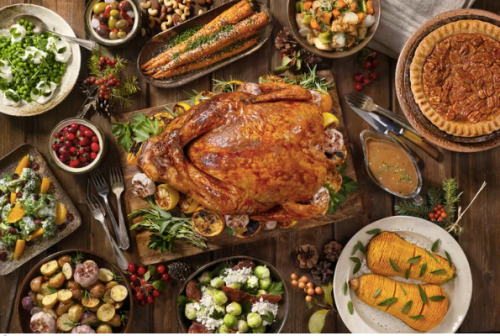
Screen Shot 2023-11-20 at 2.43.27 PM

Image of traditional Thanksgiving foods. iStock image, LauriPatterson.

We North Americans have our British ancestors to thank for this tradition, so closely tied to these countries’ respective fall harvests. Earlier ripening explains why Canada’s Thanksgiving falls on the second Monday of October, almost two months before its southern neighbor, the US, celebrates this event. 

Canadian Thanksgiving:

One can only envision the reaction of explorer Martin Frobisher and his men when, in three voyages to Canada to find a northwest passage to Asia, they encountered the immensity, richness, and diversity of flora and fauna, and countless miles of almost untouched forests, lakes, and fields populated by an abundance of wildlife. These natural riches must have overwhelmed their senses, prompting them to give thanks in a tradition still celebrated today. The reality was less than elaborate:

In 1578, … privateer and mariner Sir Martin Frobisher was the first European to celebrate “Thanksgiving” with his crew. The meal was decidedly less glamorous than today’s feasts: mostly salt beef, biscuits and mushy peas. The locale, too, was less inviting. Frobisher and his men celebrated in current-day Nunavut, likely aboard one of the 15 ships that had set sail to discover a northwest passage to Asia’s trading areas. – A Short History of Thanksgiving in Canada, Ottawa Citizen 
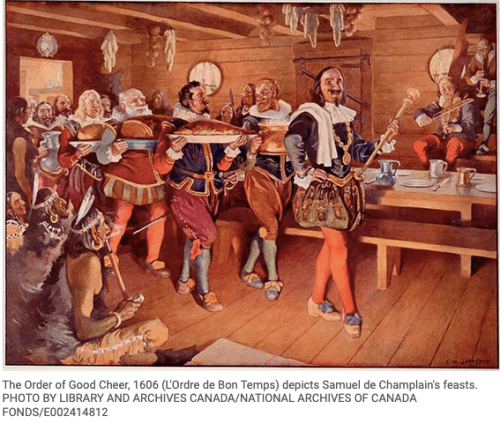
Screen Shot 2023-11-20 at 7.31.45 PM

Explorer Samuel de Champlain organized a thanksgiving celebration in the early 17th century which is more reminiscent of today’s ceremonies than Frobisher’s. To prevent scurvy, Champlain introduced a variety of foods that included fresh vegetables and fruits high in vitamin C, such as cranberries. Since the 18th century, Nova Scotia’s Thanksgiving meals have resembled today’s variety of foods. But this is not the full story. Without indigenous Indians, neither the Canadian explorers nor the pilgrims would have survived long enough to present a meal of any great variety. 

U.S. Thanksgiving:
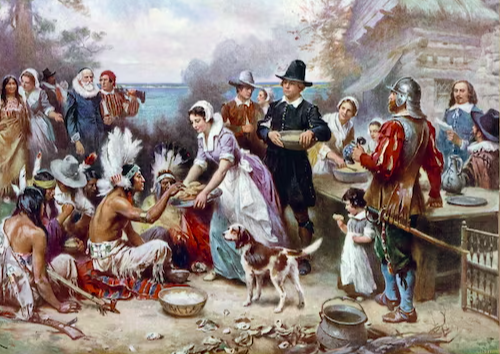
Screen Shot 2023-11-20 at 2.40.04 PM

Romantic version of the first Thanksgiving in the U.S. Plymouth Rock Foundation.

In contrast to the happy scene depicted in the storybook image above, settlers and indigenous warriors experienced devastating losses from natural causes – the settlers from starvation and the tribes from the loss of as much as 50 to 90 percent of their population to the epidemics the Europeans brought with them. The pilgrims and Wampanoags joined forces to strengthen their numbers and to fight off possible attacks from other Indian tribes. And so the Wampanoags taught settlers to plant corn and other vegetables and to use herring for fertilizer. Under their tutelage, the pilgrims learned to fish for cod and bass, build housing with the materials at hand, and trade and barter for products they could not produce. 
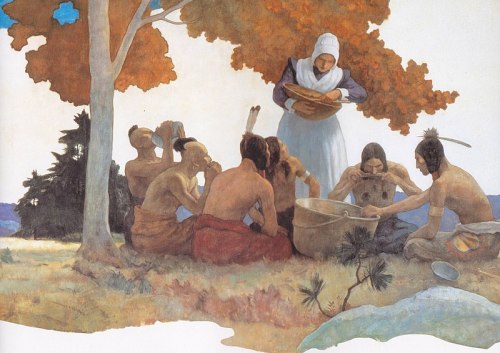
N.C._Wyeth_-_Thanksgiving_with_Indians_(detail)

Detail of an NC Wyeth painting, Wikimedia Commons

After the bountiful result of their hard labor, the pilgrims commemorated their success with a series of feasts that featured the riches of their fall harvest. The chief of the Wampanoags, Massasoit, attended the event for three days with 90 men. They brought five deer, which were roasted, and played games in celebration.  According to an article in the National Endowment for the Humanities entitled Who Were the Pilgrims Who Celebrated the First Thanksgiving? | The National Endowment for the Humanities this was the true first American Thanksgiving.

Interestingly, in 1862 President Lincoln declared the turkey to be the official meat for the Thanksgiving dinner table. Before this time, there was no consensus. U.S. dinner tables had featured venison, ham, pheasant, duck, oysters, and other choices preferred regionally, such as bison. Personally, I like turkey once a year. At Christmas, I prefer ham.
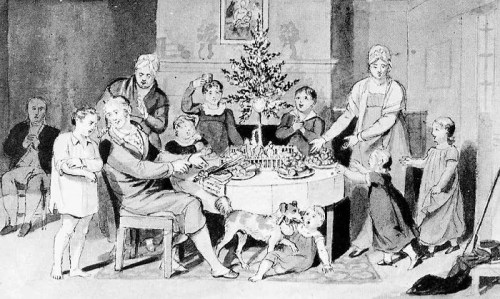
Sketch-of-a-Christmas-Celebration-Republic-of-Pemberley

Festive 19th century Christmas goodies for a family. Image: British Food and Travel 

British Christmas Dinner:

When one examines the traditional Traditional Christmas dinner menu featured in this BBC Good Food website, one recognizes how close the three nations still are in their traditional celebratory food offerings. Oh, variations have crept in. Local foods are offered in abundance (in Maryland crab cakes and seafood recipes are heavily featured, and Tex Mex recipes are also making an appearance, especially at the appetizer and dessert tables.) But overall, we U.S. Americans are staying with the traditional holiday feast on the 4th Thursday in November.

Author Syrie James’s Jane Austen quote is apropos for both holiday feasts:

After Jane Austen’s Christmas guests had departed in January 1807, Jane wrote to her sister, Cassandra, “I shall be left to the comfortable disposal of my time, to ease of mind from the torments of rice puddings and apple dumplings, and probably to regret that I did not take more pains to please them all.”  

Share with others:

  • Click to email a link to a friend (Opens in new window) Email
  • Click to print (Opens in new window) Print
  • Click to share on Facebook (Opens in new window) Facebook
  • Click to share on Reddit (Opens in new window) Reddit
  • Click to share on X (Opens in new window) X
  • Click to share on Pinterest (Opens in new window) Pinterest
  • Click to share on Tumblr (Opens in new window) Tumblr
  • Click to share on LinkedIn (Opens in new window) LinkedIn
Like Loading...

Related

Posted in 19th century food, Georgian Christmas food, Jane Austen's World | Tagged 17th C. Thankgsiving, Origins of North American Thanksgiving | 4 Comments

4 Responses

  1. on November 22, 2023 at 14:33 Patty S's avatar Patty S

    Thanks, Vic, for the comparison of holiday feasts. I was recently given A Great and Noble Scheme by John Macy Farager about the Acadians in Nova Scotia. It’s actually not dull and dry but very amusing as the historian used letters and eyewitness testimonies, and the English, French and Indians at the time were such colorful characters. Women were powerful too, some in business. There’s a lot about food and agriculture.


  2. on November 23, 2023 at 04:40 dholcomb1's avatar dholcomb1

    I enjoyed your article. It’s amazing how much is similar and much is unchanged over the years.

    Happy Thanksgiving!
    Denise


  3. on November 23, 2023 at 17:37 generalgtony's avatar generalgtony

    .. and thank you Vic. It is interesting to see how similar traditions have developed over the centuries in different countries. You just have to look at baseball and cricket or American Football and Rugby Union. Take care and enjoy your turkey, Vic.


  4. on November 29, 2023 at 13:08 Miss Posabule's avatar Miss Posabule

    I really enjoyed reading your article. It is very well researched! It’s so interesting how the holiday we call Thanksgiving has evolved throughout American history!


Comments are closed.

  • Enter your email address to subscribe to this blog and receive notifications of new posts by email.

    Join 7,246 other subscribers
  • 2025 AGM in Baltimore

  • Items of Interest

  • Blog Stats

    • 18,382,940 hits
  • Follow Jane Austen's World on WordPress.com
  • RECOMMENDED BOOKS AND RESOURCES

  • Fashionable Goodness: Christianity in Jane Austen's England is now available! By JAW contributor Brenda S. Cox. See Review. Available from Amazon and Jane Austen Books.
  • We also recommend JAW contributor Rachel Dodge's devotionals based on Jane Austen's prayers and classic literature. Reviews:
    Praying With Jane: 31 Days Through the Prayers of Jane Austen
    The Anne of Green Gables DevotionalThe Little Women Devotional
    The Secret Garden Devotional
  • The Tour of Doctor Syntax. Edited by Ben Wiebracht. Read the review of the book at this link. Click to order the book on Amazon US or Amazon UK or Jane Austen Books
  • FREE Student Membership to JASNA

    Available through December 31st, 2025. Click on image for details, and share this poster with other teachers and students!

  • The Obituary of Charlotte Collins by Andrew Capes

    Click on image to read the story.

  • Comments

    “My idea of good company…is the company of clever, well-informed people, who have a great deal of conversation.” – Jane Austen, Persuasion


    Gentle readers: Please feel free to post your comments and continue the conversation! Due to SPAM, we will no longer accept comments on posts after 30 days of publication. In some instances, links will be removed from comments as well.

  • Administrators and Contributors

    Vic Sanborn, founder of this blog, is supported by a team of talented and knowledgeable writers about Jane Austen and the Regency era. They are:

    • Brenda Cox
    • Rachel Dodge and
    • Tony Grant, who now contributes his photos from London and England

    Click on their names to enter their own blogs.

    In addition, we thank the many experts and authors who frequently contribute their posts and opinions, and who continue to do so freely or at our request.

  • Pin It!

    Follow Me on Pinterest
  • Top Posts

    • Exploring Jane Austen's Prayers
      Exploring Jane Austen's Prayers
    • Cassandra Writes About Jane Austen's Death, July 18, 1817
      Cassandra Writes About Jane Austen's Death, July 18, 1817
    • Highclere Castle Floor Plan: The Real Downton Abbey
      Highclere Castle Floor Plan: The Real Downton Abbey
    • Regency Fashion: Men's Breeches, Pantaloons, and Trousers
      Regency Fashion: Men's Breeches, Pantaloons, and Trousers
    • Men's hair styles at the turn of the 19th century
      Men's hair styles at the turn of the 19th century
    • Happy 250th Birthday, Jane Austen!
      Happy 250th Birthday, Jane Austen!
    • More Birthday Events for Jane Austen!
      More Birthday Events for Jane Austen!
    • Sense and Sensibility, 1995 & 2008: Marianne’s Illness
      Sense and Sensibility, 1995 & 2008: Marianne’s Illness
    • In Jane Austen’s Own Words: Economic Sense and Sensibility
      In Jane Austen’s Own Words: Economic Sense and Sensibility
    • Social Customs During the Regency
      Social Customs During the Regency
  • Recent Posts

    • More Birthday Events for Jane Austen!
    • Happy 250th Birthday, Jane Austen!
    • Coming Soon: Birthday Tales for Jane Austen’s 250th
    • Book Review: The Austens, by Sarah Emsley
    • Praying with Jane Audiobook with Amanda Root
  • Links to Jane Austen Blogs

    Click here to enter the page. Topics include Regency fashion, historic foods, Jane Austen societies, British sites, related topics. Click on image.

  • May we suggest?

  • Unknown's avatarHello, my name is Vic and I live in Maryland, USA. I have adored Jane Austen almost all of my life. I am a proud lifetime member of the Jane Austen Society of North America. This blog is a personal blog written and edited by me and my team. We do not accept any form of cash advertising, sponsorship, or paid topic insertions. However, we do accept and keep books and CDs to review.

    If you would like to share a new site, or point out an error, please email us. (Yes, we are fallible. We'll own up to our mistakes and will make the corrections with a polite smile on our faces.) Write us at

    gmailbw

    Thank you for visiting this blog. Your comments and suggestions are most welcome.

  • Project Gutenberg: eBook of Stage-coach and Mail in Days of Yore, Volume 2 (of 2), by Charles G. Harper

    STAGE-COACH AND MAIL IN DAYS OF YORE: A PICTURESQUE HISTORY
    OF THE COACHING AGE, VOL. II, By CHARLES G. HARPER. 1903. Click on this link.


  • Top Posts & Pages

    • Exploring Jane Austen's Prayers
    • Cassandra Writes About Jane Austen's Death, July 18, 1817
    • Highclere Castle Floor Plan: The Real Downton Abbey
    • Regency Fashion: Men's Breeches, Pantaloons, and Trousers
    • Men's hair styles at the turn of the 19th century
    • Happy 250th Birthday, Jane Austen!
    • More Birthday Events for Jane Austen!
    • Sense and Sensibility, 1995 & 2008: Marianne’s Illness
    • In Jane Austen’s Own Words: Economic Sense and Sensibility
    • Social Customs During the Regency
  • Tour Chawton Cottage on YouTube

  • Disclaimer: Our team makes no profit from this blog. We may receive books (physical or digitized) for review purposes.

  • Copyright Statement: © Jane Austen's World blog, 2009-2024. Unauthorized use and/or duplication of this material without express and written permission from this blog’s author and/or owners is strictly prohibited. Excerpts and links may be used, provided that full and clear credit is given to Jane Austen's World with appropriate and specific direction to the original content.

Blog at WordPress.com.

WPThemes.


  • Reblog
  • Subscribe Subscribed
    • Jane Austen's World
    • Join 7,246 other subscribers
    • Already have a WordPress.com account? Log in now.
    • Jane Austen's World
    • Subscribe Subscribed
    • Sign up
    • Log in
    • Copy shortlink
    • Report this content
    • View post in Reader
    • Manage subscriptions
    • Collapse this bar
 

Loading Comments...
 

    %d

