Inquiring readers,
I recently purchased a book entitled The Grand Tour of Europe (*1). The tour was a rite of passage from the 17th through 19th centuries for the sons (and in a few cases, the daughters) of aristocrats, the wealthy gentry, and rising merchant classes. Some of the travelers were accompanied by their tutors for serious study, others led merry, somewhat debauched lives with friends. Most returned to their homeland 3 – 5 years later with a sense of continental sophistication. Perfecting their French was an accomplishment absolutely expected of the sophisticated, well-traveled Englishman or woman.
In her review of Masculinity and Danger on the Eighteenth-Century Grand Tour (2*), Michele Cohen mentions Stephen Conway’s reasoning – that the tour:
“Encouraged a ‘specifically European outlook’, which included polish and refinement, appreciation of classical art and architecture, theatre, and music as well as continental cuisine, wine and fashion.”
Austen’s connection to the grand tour was her brother Edward Austen Knight, who took several extended journeys. He wrote his memories in private journals. (The Grand Tour in the 18th & 19th Century | Jane Austen’s World.)
Copies and molds of ancient gems that visitors collected and brought back:
Throughout history, the marvelous gems and cameos cut in Ancient Greece and Rome were admired by collectors for their beauty and perfection. Many visitors who returned from their Grand Tour brought back fabulous paintings, sculptures, and a collection of impressions and casts made from those gems. Others, who were not as flush in the pocket, returned with more modest, portable souvenirs, such as trinkets, fans, and a few impressions and casts.
Tourists in Italy commissioned intaglios and cameos from numerous workshops as souvenirs of their travels:
“…the demand was chiefly for technically accomplished, accurate copies, often difficult to distinguish from the originals, a feat made possible because the engravers had at hand collections of casts from well-known gems which made copying easy. Such casts, produced in quantity by moulding in materials such as wax and plaster of various kinds, had been circulating among connoisseurs and collectors for centuries in mid-i8th century Rome. Their manufacture in hard-wearing, red-dyed sulphur or white gesso became a major industry…” – The Grand Tourist’s favourite souvenirs: cameos and intaglios, Gertrud Seidmann (*3).
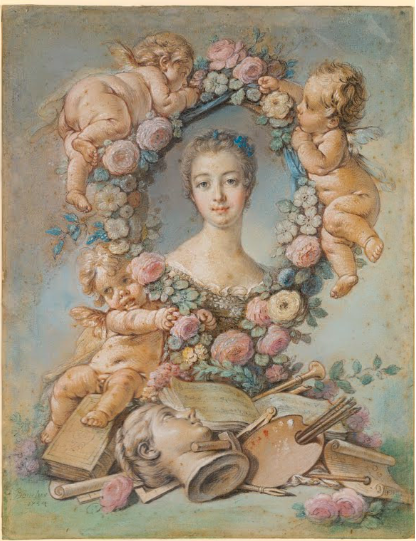
Madame de Pomadour, 1754, François Boucher
Madame de Pompadour, the mistress of King Louis XV of France, was an influential patron of the arts and helped revive the ancient art of gem carving. She hired the best gem carver to live at Versailles and provided him with the finest tools. Then she asked him to teach her how to carve gems. (National Galleries Scotland.) In this portrait she “is depicted surrounded by a garland of flowers supported by three putti. Scattered at the base of the design are the symbolic attributes of the arts she so enthusiastically supported – painting, drawing, sculpture, architecture, writing and music.” – Google Arts and Culture
The following pair of casts are made in sulfur and sealing wax and are from a private 19th C collection. They are part of a much larger collection. (*1)
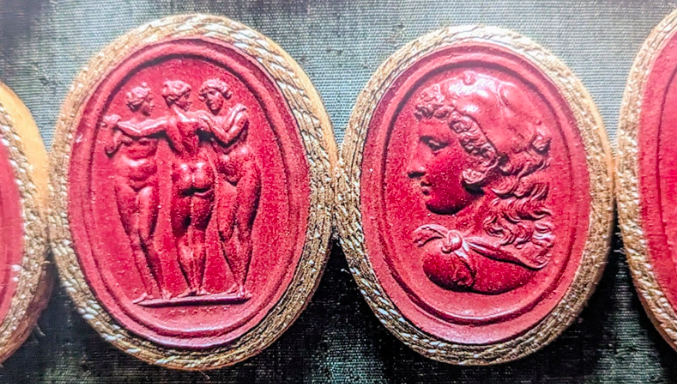
“During the sixteenth century, ancient gems and cameos circulated widely among collectors, directly or by means of impressions and metal casts.” (*1, p120.)
Shared Knowledge
Ancient Carved Art Gems in 18th-Century Europe:
“During the 18th century, the arts of Rome and Greece were discovered anew. With their simple linear grace, ancient carved gems in particular inspired artists, scholars, and collectors. Long part of royal or aristocratic collections, these tiny but enduring fragments of the distant past now sparked a popular craze…” – From an explanation near an art display of an Oak Cabinet, at the Walters Art Museum in Baltimore, Maryland.
“The 18th century saw the standardization and sharing of all kinds of knowledge…This oak cabinet is part of the same movement. Its carefully lettered drawers contain thousands of numbered red sulphur wax impressions or casts of ancient and modern carved gems created in the London shop of Scotsman James Tassie (1735-99)…[and] copied from collections around Europe, was the most comprehensive of its kind, numbering about 20,000 casts at the time of his death.” – From a wall plaque near an oak cabinet displaying James Tassie impressions and casts at the Walters Art Museum.
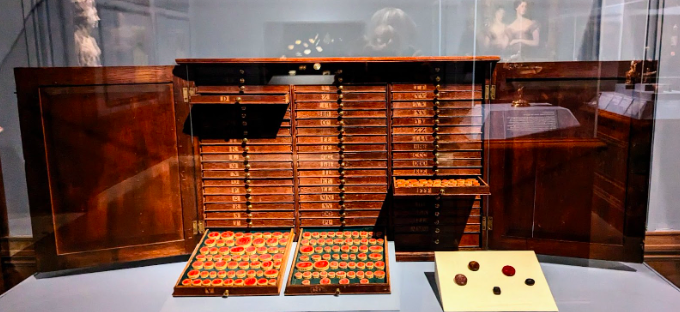
Oak Cabinet, – Photo @ Vic Sanborn, February 2024
Click on this link to see a Drawer of Gem Impressions and read a description about it. Their arrangement is typical of the thousands of gems that rest inside the drawers.


[The] carved gems fall into two categories: intaglios and cameos. With intaglios, the design is carved down into the selected material, whereas with cameos, material is carved away so that the design projects upward from the surface. Glass paste copies of carved gems made by Tassie could be used as costume jewelry, seals, or mounted into frames to create innovative window displays.
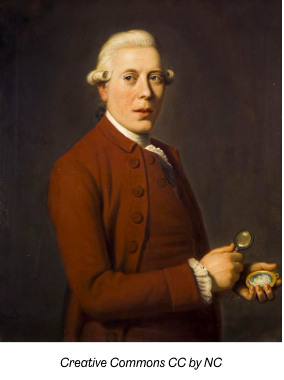
James Tassie holds one of his cameos. Portrait by David Allen.
James Tassie, 1735 – 1799. Sculptor and gem engraver | National Galleries of Scotland. Interestingly, Tassie and Allen went to art school together and later shared a house in London. Tassie then invented vitreous glass paste and used it to create small portrait medallions and reproductions of antique gems and cameos. His fame spread, and Catherine the Great became his most important patron. Listen to the Talk | by Liz Louis – The life and work of James Tassie on the National Galleries of Scotland site.
Smaller collections in smaller cabinets
Not all of the copies were made for large and elaborate collections, as shown in this Portrait of a Lady, painted in oil. (Walters Art Museum, 37.394, Acquired by Henry Walters.)


“On the table in this portrait is a smaller cabinet of impressions of ancient carved gems than the larger cabinet. The unknown woman seems lost in thought…and is presented as scholarly (literate and interested in the Classical past), but also ladylike (fashionably dressed and bonded to a male relative or lover-shown by the miniature portrait pinned to her dress). The portrait can be dated to after 1793, as this is the year that saw the publication of the sheet music, seen rolled on the table, for Peter von Winter’s duet “Con quell occhietto languido non mi” (“With that little languid eye, not to me”).
The objects included in this portrait tell a story about the interests of the woman portrayed…”
– Plaque near the portrait in the North Flanking Gallery, Walters Museum of Art.
About the exhibit at the Walters Art Museum described in this post:
This exhibit in the north flanking galleries was taken down on July 3rd, 2024, and is no longer in view. In its place, a new installation, entitled Art of the Americas, will open in 2025. Some galleries featuring 19th C. art objects, mostly the Walter’s sevres porecelain collection, will still be available .
Fortuitously, I had made photos of the art objects and the wall signs, which are now taken down but are quoted in full. I’ve also linked directly to the museum’s website for a different description to provide you with a more rounded story.
In conclusion:
“Returning with a gem on one’s finger or with a precious collection, shipping back cabinets of casts – the later collections often miscellanies of Roman monuments, sculptures and paintings intermingled with gems, almost equivalent to modern photograph albums – was an inevitable part of the scene for the grandest as well as humbler visitors to Italy.” – (*3.)
Sources:
*1 – The Grand Tour of Europe, (2023) Editor Franco Maria Ricci, 167 p. Van Cleef & Arpels
*2 – Professor Michèle Cohen, review of “Masculinity and Danger on the Eighteenth-Century Grand Tour,” (review no. 2451) 10.14296/RiH/2014/2451 Date accessed: 04 July 2024
*3 – “The Grand Tourist’s favourite souvenirs: cameos and intaglios”, Gertrud Seidmann, Research Associate, University of Oxford Institute of Archaeology, Delivered to the Society’s History Study Group on 18 November, 1996. JSTOR
*4 – “Madame de Pompadour’s Legacy as a Patron of Arts Is Often Overlooked: A new exhibit explores the creative works of one of history’s most famous mistresses”, Maris Fessenden, Former correspondent, May 12, 2016, The Smithsonian Magazine.
Additional Sources:
James Tassie, Cast Collection, Victoria & Albert (V&A) Museum, London
The Grand Tour: Souvenir Project: An exploration of culture and memory.
‘Making an Impression’ exhibit highlights ancient engraved gemstones
Also see Artworks by James Tassie at the Walters Art Museum website.







 Jane Austen's World
Fascinating look at the reproduction industry for the Grand Tour. Thank you. Cameo souvenirs are still being sold in Italy. When we went to Pompeii on a bus tour the stop for lunch (not good) was also a cameo shop with first rate pieces.
I recall all the souvenir stands near the major monuments in Italy, which I think now are being removed further from the entrance to the most popular ones. The proud tradition of making cameos and intaglios continues. My father brought back a beautiful cameo from his time in Italy in the 1950’s, which he gave to my mother and that I still have. I can wear it as either a brooch or a necklace.
Thank you for the fascinating article! Doesn’t it remind you of that bit in “Emma”:
Mr. Knightley had done all in his power for Mr. Woodhouse’s entertainment. Books of engravings, drawers of medals, cameos, corals, shells, and every other family collection within his cabinets, had been prepared for his old friend, to while away the morning; and the kindness had perfectly answered. Mr. Woodhouse had been exceedingly well amused.
Yes, that is one reason why I thought this topic was appropriate for JAW. I’ve been examining that oak cabinet at the Walters for two years now, and noticed that the dates of those gems, casts, cameos and intaglios were featured largely during the 17th-18th-early 19th centuries, precisely during the popularity of the English traveling to the continent on their grand tours. And then I purchased a book about the journals of Edward Austen Leigh, which I haven’t finished yet, but which connects the Grand Tour to the world the Austens knew and read about. I’ve enjoyed reading more about the topic. Thank you, Jean, for stopping by and including this Emma quote!
Gosh, Jean – well spotted. I had completely forgotten that bit in Emma. Vic’s article ties in perfectly as Mr. Woodhouse was definitely a challenge sometimes.
What a wonderful post.
In going through late MIL’s jewelry, I found a cameo from the Victorian Era–confirmed with a jeweler–not the right time period for your post, but it was a great find. She had received it from a grand-aunt, and it was from an unnamed relative.
denise
Thanks for stopping by, Denise. I recall two of my great Aunts, who never married. When I was a child in The Netherlands, they still wore Victorian-like clothing, dark, with hand-made lace collars, skirts that reached just above their ankles, sturdy shoes, and, yes, cameo pins at their throats.