• Home
  • Audio/Podcasts
  • Austensites
  • AV/E-Texts
  • History
  • JA Novels & Bio
  • Links
  • Original Sources/19th C. Texts
  • Social Customs During the Regency
  • Teacher/Student
  • Writer/Literature Resources

Jane Austen's World

This Jane Austen blog brings Jane Austen, her novels, and the Regency Period alive through food, dress, social customs, and other 19th C. historical details related to this topic.

Feeds:
Posts
Comments
« Jane Austen and the Creation of Modern Fiction: Book Review
A Summer Party for Sense and Sensibility, Hosted by Author Sarah Emsley »

Jane Austen and the Creation of Modern Fiction: Author Interview

July 29, 2024 by Brenda S Cox

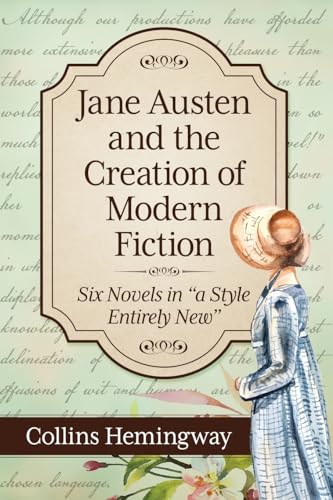
Jane Austen and the Creation of Modern Fiction: Six Novels in “a Style Entirely New,” explores Jane Austen’s development as a fiction writer.

by Brenda S. Cox

A few days ago I reviewed Collins Hemingway’s fascinating new book on the development of Austen’s writing techniques, Jane Austen and the Creation of Modern Fiction: Six Novels in “a Style Entirely New.”  Today we meet with the author to get his perspectives on the book.

Collins Hemingway began his analysis of Jane Austen’s writing techniques as he wrote a fiction trilogy speculating on the “lost years” of Austen’s life, The Marriage of Miss Jane Austen.

I asked Collins Hemingway to tell us more about Jane Austen and the Creation of Modern Fiction.

JAW: What led you to write this book, Collins?

Collins: I’ve read Austen all my life, but I did not read much commentary during my 25-year high-tech career. When I came back to Austen fulltime, I read a ton of Austen scholarship from the last 20 years. I noticed that there wasn’t much about her writing, as writing. Scholars would mention a technique and use it as a launch point for broader criticism. With rare exceptions, they would not analyze the technique itself or how it affected the reader. I saw this as an area in which I could add something new.

JAW: You have, of course, written a fiction series, The Marriage of Miss Jane Austen. How did your experiences writing fiction about Austen feed into your development of Jane Austen and the Creation of Modern Fiction?

Collins: Writing the novels led directly to this book, though it took several years of hard reading, notetaking, and writing to flesh out the meat over the bones. I have shared that story on my blog.

JAW: The book is full of great insights. For you, what was one of the most helpful, something that helped you see Austen’s novels in a new way?

Collins: After completing the fiction trilogy, I went a step further, going through each of Austen’s six novels line by line, noting everything of interest to a writer. I ended up with 20 to 30 pages of handwritten notes on each one. Then I began to consolidate various topics. For instance, I ended up with five pages of notes just on description, collated from all her books, including the juvenilia. Then I examined the patterns in different aspects of writing and tried to understand how the patterns fit within and between each book.

As the patterns began to organize themselves, I realized that there was a distinct trend from early to late. In each book, Austen learned something, then applied it in the succeeding books. Like Virginia Woolf examining the early works and the unfinished works, I began to see the internal structures of each book. (As my wife would caution—in my opinion.) I could see how Austen was feeling her way along in the early works, then painting like a master in the later ones.

JAW: You’ve pointed out the strengths and weaknesses of each of Austen’s novels. It appears that you see Emma as the most “perfect” novel, as other commentators do. But for you personally, which novel do you tend to enjoy re-reading the most, and why?

Collins: Depends on my mood. P&P for its sheer energy, and for Liz bowing to no one, ever. Emma for its magnificence, page by page. Persuasion for the depth of Anne’s feeling. MP, though it is in no way my favorite, when I just want to admire the structural purity and the work she put into it.

JAW: You talk about many techniques of modern fiction that Jane Austen helped to develop and show how they developed in her novels over time. Could you briefly list for us some of those techniques, so readers can see some of the treats they have in store?

Collins: She was a master of dialogue probably from the day she first picked up a quill pen. Description. Behavior. Character motivation and interaction. Complex plots (without castles, brigands, or shipwrecks.) Ever deeper and subtler ways to get into her characters’ minds.

JAW: What is one takeaway that you want readers to have when they finish reading your book?

Collins: What Austen accomplished would make any author proud. But the fact that she learned all that she did on her own, away from other writers, pulling the best from a small number of others (such as Richardson, in a very specific way), building on a few good things from tradition, figuring out the rest on her own—it’s astonishing. And she did it in her too short 41.5 years of life!

JAW: What was the most fun part of the book to write?

Collins: My breakthrough in really understanding the internals came through descriptions. They unlocked the issues in NA and S&S, showed how radically different P&P was from the earlier two, and became miraculously mature in MP. This was the most fun. Especially when I realized the difference in the way Austen treated Lady Russell and Anne as they entered Bath in Persuasion. It took my breath away to see what Austen had done.


You may want to read my review if you missed it earlier. This is a fascinating book if you want to better understand Jane Austen’s modern writing techniques and how she developed them herself. Jane Austen and the Creation of Modern Fiction is available from Amazon and from Jane Austen Books. Jane Austen Books is currently offering it at a substantial discount.


Brenda S. Cox is the author of Fashionable Goodness: Christianity in Jane Austen’s England. She also blogs at Faith, Science, Joy, and Jane Austen.

Share with others:

  • Click to email a link to a friend (Opens in new window) Email
  • Click to print (Opens in new window) Print
  • Click to share on Facebook (Opens in new window) Facebook
  • Click to share on Reddit (Opens in new window) Reddit
  • Click to share on X (Opens in new window) X
  • Click to share on Pinterest (Opens in new window) Pinterest
  • Click to share on Tumblr (Opens in new window) Tumblr
  • Click to share on LinkedIn (Opens in new window) LinkedIn
Like Loading...

Related

Posted in Author interview, Jane Austen Novels, Jane Austen's World, Jane Austen's Writing Techniques | Tagged Collins Hemingway, Jane Austen and fiction writing | 9 Comments

9 Responses

  1. on July 29, 2024 at 08:47 lifegetsinthewayofliving's avatar lifegetsinthewayofliving

    As was said in this article, “But the fact that she learned all that she did on her own, away from other writers…”

    She was a brilliant writer (and is my favorite author) but I’ve often wondered how much “help” Jane received from her “test readers” in evolving the plots of her books. Alas, we’ll probably never know.


    • on July 29, 2024 at 18:51 Brenda S Cox's avatar Brenda S Cox

      Good point. She apparently read her books aloud repeatedly to family members as they were in process, and I’m sure they must have given her great feedback!


  2. on July 29, 2024 at 10:50 Rebecca's avatar Rebecca

    I’m now feeling a deep need to go back and reread all (except MP, I’ve never actually finished that one) and look closer at the writing itself versus losing myself in the story :)


    • on July 29, 2024 at 18:52 Brenda S Cox's avatar Brenda S Cox

      Yes, Rebecca, great idea! Though I am currently re-reading Mansfield Park, which I’ve read many times, and I still get lost in the story! That’s one of Austen’s gifts.


  3. on July 29, 2024 at 11:06 Jennifer Finger's avatar Jennifer Finger

    Emma is good, but I have to admit that I find hearing about how “perfect” and “magnificent” it is to be off-putting. I wish critics would stop throwing around superlatives and actually be more critical when it comes to Emma. It could do with some improvements.


    • on July 29, 2024 at 18:53 Brenda S Cox's avatar Brenda S Cox

      Well, Jennifer, Emma is not my favorite either, actually. But I’m not sure the structure is flawed, I think it’s just that I’m not crazy about Emma herself. And yet the story still grows on me when I re-read it. Probably eventually I’ll love it!


  4. on July 29, 2024 at 19:09 Jennifer Finger's avatar Jennifer Finger

    I think it’s one thing to say that “the story still grows on me when I re-read it” but something else entirely to characterize it as “perfect” or “magnificent.”

    Mr. Woodhouse gets too much deference within Emma, and I think it’s unrealistic that the marriage of Emma to Mr. Knightley as providing “perfect happiness” when it takes place only because Mr. Knightley chooses to move into Hartfield because Mr. Woodhouse is scared of a chicken thief who robbed Mrs. Weston. And there’s too much discussion of colds, drafts, and putrid sore throats.

    Yes, Emma can certainly use some correction, but she really only gets it when Mr. Knightley tells her off after she is rude to Miss Bates at Box Hill.


    • on August 8, 2024 at 17:23 Brenda S Cox's avatar Brenda S Cox

      Of course, Jennifer, we all know that nothing in this world is perfect. With books, our judgments are always subjective, what I like, what you like, what he or she likes. I’m sure Jane Austen herself would have seen things to improve in each of her novels, including Emma. Certainly I can look back at anything I’ve written and see ways that I could have made it better. But if any author waited until their work was perfect, nothing would ever be published!

      Sorry, that’s a rabbit trail. I’m sure we could have quite a discussion of ways we think each of Austen’s books could be better, and we would all have different ideas. It was interesting to see how Hemingway thought that Persuasion could have been revised to make it better. But I’m content to enjoy Austen’s novels as they are! Imho, they are all far better than I, or most anyone whose books I’ve read, could write. :-)


  5. on July 30, 2024 at 00:44 dholcomb1's avatar dholcomb1

    What a wonderful Q&A. Loved his process.

    denise


Comments are closed.

  • Enter your email address to subscribe to this blog and receive notifications of new posts by email.

    Join 7,246 other subscribers
  • 2025 AGM in Baltimore

  • Items of Interest

  • Blog Stats

    • 18,382,579 hits
  • Follow Jane Austen's World on WordPress.com
  • RECOMMENDED BOOKS AND RESOURCES

  • Fashionable Goodness: Christianity in Jane Austen's England is now available! By JAW contributor Brenda S. Cox. See Review. Available from Amazon and Jane Austen Books.
  • We also recommend JAW contributor Rachel Dodge's devotionals based on Jane Austen's prayers and classic literature. Reviews:
    Praying With Jane: 31 Days Through the Prayers of Jane Austen
    The Anne of Green Gables DevotionalThe Little Women Devotional
    The Secret Garden Devotional
  • The Tour of Doctor Syntax. Edited by Ben Wiebracht. Read the review of the book at this link. Click to order the book on Amazon US or Amazon UK or Jane Austen Books
  • FREE Student Membership to JASNA

    Available through December 31st, 2025. Click on image for details, and share this poster with other teachers and students!

  • The Obituary of Charlotte Collins by Andrew Capes

    Click on image to read the story.

  • Comments

    “My idea of good company…is the company of clever, well-informed people, who have a great deal of conversation.” – Jane Austen, Persuasion


    Gentle readers: Please feel free to post your comments and continue the conversation! Due to SPAM, we will no longer accept comments on posts after 30 days of publication. In some instances, links will be removed from comments as well.

  • Administrators and Contributors

    Vic Sanborn, founder of this blog, is supported by a team of talented and knowledgeable writers about Jane Austen and the Regency era. They are:

    • Brenda Cox
    • Rachel Dodge and
    • Tony Grant, who now contributes his photos from London and England

    Click on their names to enter their own blogs.

    In addition, we thank the many experts and authors who frequently contribute their posts and opinions, and who continue to do so freely or at our request.

  • Pin It!

    Follow Me on Pinterest
  • Top Posts

    • Happy 250th Birthday, Jane Austen!
      Happy 250th Birthday, Jane Austen!
    • Exploring Jane Austen's Prayers
      Exploring Jane Austen's Prayers
    • Cassandra Writes About Jane Austen's Death, July 18, 1817
      Cassandra Writes About Jane Austen's Death, July 18, 1817
    • Highclere Castle Floor Plan: The Real Downton Abbey
      Highclere Castle Floor Plan: The Real Downton Abbey
    • Regency Fashion: Men's Breeches, Pantaloons, and Trousers
      Regency Fashion: Men's Breeches, Pantaloons, and Trousers
    • Men's hair styles at the turn of the 19th century
      Men's hair styles at the turn of the 19th century
    • Jane Austen’s Christmases
      Jane Austen’s Christmases
    • Sense and Sensibility, 1995 & 2008: Marianne’s Illness
      Sense and Sensibility, 1995 & 2008: Marianne’s Illness
    • Jane Austen and Music
      Jane Austen and Music
    • Regency Hygiene: The Bourdaloue
      Regency Hygiene: The Bourdaloue
  • Recent Posts

    • More Birthday Events for Jane Austen!
    • Happy 250th Birthday, Jane Austen!
    • Coming Soon: Birthday Tales for Jane Austen’s 250th
    • Book Review: The Austens, by Sarah Emsley
    • Praying with Jane Audiobook with Amanda Root
  • Links to Jane Austen Blogs

    Click here to enter the page. Topics include Regency fashion, historic foods, Jane Austen societies, British sites, related topics. Click on image.

  • May we suggest?

  • Unknown's avatarHello, my name is Vic and I live in Maryland, USA. I have adored Jane Austen almost all of my life. I am a proud lifetime member of the Jane Austen Society of North America. This blog is a personal blog written and edited by me and my team. We do not accept any form of cash advertising, sponsorship, or paid topic insertions. However, we do accept and keep books and CDs to review.

    If you would like to share a new site, or point out an error, please email us. (Yes, we are fallible. We'll own up to our mistakes and will make the corrections with a polite smile on our faces.) Write us at

    gmailbw

    Thank you for visiting this blog. Your comments and suggestions are most welcome.

  • Project Gutenberg: eBook of Stage-coach and Mail in Days of Yore, Volume 2 (of 2), by Charles G. Harper

    STAGE-COACH AND MAIL IN DAYS OF YORE: A PICTURESQUE HISTORY
    OF THE COACHING AGE, VOL. II, By CHARLES G. HARPER. 1903. Click on this link.


  • Top Posts & Pages

    • Happy 250th Birthday, Jane Austen!
    • Exploring Jane Austen's Prayers
    • Cassandra Writes About Jane Austen's Death, July 18, 1817
    • Highclere Castle Floor Plan: The Real Downton Abbey
    • Regency Fashion: Men's Breeches, Pantaloons, and Trousers
    • Men's hair styles at the turn of the 19th century
    • Jane Austen’s Christmases
    • Sense and Sensibility, 1995 & 2008: Marianne’s Illness
    • Jane Austen and Music
    • Regency Hygiene: The Bourdaloue
  • Tour Chawton Cottage on YouTube

  • Disclaimer: Our team makes no profit from this blog. We may receive books (physical or digitized) for review purposes.

  • Copyright Statement: © Jane Austen's World blog, 2009-2024. Unauthorized use and/or duplication of this material without express and written permission from this blog’s author and/or owners is strictly prohibited. Excerpts and links may be used, provided that full and clear credit is given to Jane Austen's World with appropriate and specific direction to the original content.

Blog at WordPress.com.

WPThemes.


  • Reblog
  • Subscribe Subscribed
    • Jane Austen's World
    • Join 7,246 other subscribers
    • Already have a WordPress.com account? Log in now.
    • Jane Austen's World
    • Subscribe Subscribed
    • Sign up
    • Log in
    • Copy shortlink
    • Report this content
    • View post in Reader
    • Manage subscriptions
    • Collapse this bar
 

Loading Comments...
 

    %d

