Feeds:
Posts
Comments

Archive for the ‘Jane Austen Novels’ Category

Good news for Janeites who live within striking distance of Johns Hopkins University in Baltimore, MD! At 7:00 PM EST on April 29th, the Bird in Hand, a cafe/bookstore, will be offering the first in a series of workshops on the last Monday of each month in the public humanities. Sponsored by the Alexander Grass Humanities Institute at Johns Hopkins, Baltimore-based professors and students will share new work in the public humanities and oriented toward broader public audiences. The intimate setting is meant to encourage public feedback and critical dialogue. One guest lecturer will be Juliette Wells, author of ‘Reading Austen in America’ (see Project MUSE’s review of the book at this link and purchase the book at this link to Amazon prime.

Date: Monday, April 29, 2019 –
Time: 7:00pm,
Place: Bird in Hand, 11 E. 33rd Street, Baltimore, MD 21218

Excerpt from the advert from the Ivy Bookshop:

Just over a century after Jane Austen’s death in 1817, devoted readers sought out her letters and personal possessions, as well as first and rare editions of her novels. Alberta Hirshheimer Burke, Goucher College class of 1928, built the most extensive collection in the U.S. of Austen manuscripts, editions, translations, and ephemera–plus one famous relic, a lock of Jane Austen’s hair, which made international news when Mrs. Burke donated it to the Jane Austen House in Chawton, England. Second only to Mrs. Burke’s was the collection formed by Charles Beecher Hogan, Yale class of 1928, which included the topaz cross necklace owned by Austen. Drawing on new research in the two collectors’ personal archives, this presentation establishes the importance to Austen reception history of their pursuit of items that held great personal importance to them.

Event Topic (click on links):


Other posts on the topic of Jane Austen’s letters and personal possessions and Jane Austen scholars:

Read Full Post »

Inquiring readers,

Today is Valentine’s day, a perfect time to revisit some of Jane Austen’s most romantic and memorable quotes.

I can listen no longer in silence. I must speak to you by such means as are within my reach. You pierce my soul. I am half agony, half hope. Tell me not that I am too late, that such precious feelings are gone forever. I offer myself to you again with a heart even more your own…I have loved none but you.” – Captain Wentworth, Persuasion

The driving force behind this quote was a talented and witty, yet ordinary-looking spinster. The sentiments expressed in her novels were remarkable given that Austen lived in an era when money and status were considered primary reasons for courtship and marriage.

This caricature, created in 1805, poked fun at the era’s courtship conventions, much like Jane Austen did through characters like Mr. Elliot, Mr. Collins, and Henry Crawford, all of whom followed current courtship conventions but misread their heroines exceedingly.
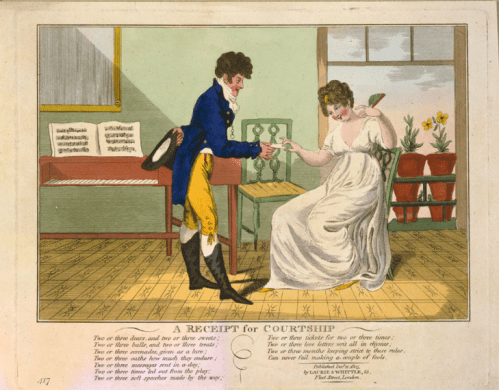
receipt image

Image in the public domain, U.S. Library of Congress

Receipt for Courtship – Text

Two or three dears, and two or three sweets;
Two or three balls, and two or three treats;
Two or three serenades, given as a lure;
Two or three oaths how much they endure;
Two or three messages sent in a day;
Two or three times led out from the play;
Two or three soft speeches made by the way;
Two or three tickets for two or three times;
Two or three love letters writ all in rhymes;
Two or three months keeping strict to those rules,
Can never fail making a couple of fools.

A lady’s imagination is very rapid; it jumps from admiration to love, from love to matrimony in a moment.” – Mr. Darcy’s sarcastic comment to Miss Bingley, Pride and Prejudice
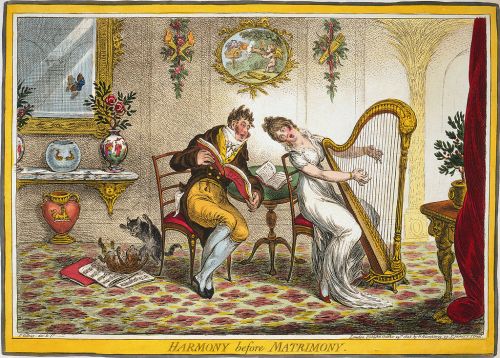
1024px-1805-Gillray-Harmony-before-Matrimony

Image in the public domain, Wikimedia Commons

This 1805 caricature entitled “Harmony before Matrimony” of a courting couple would have the young lady assume that a proposal would soon be in the offing. The artist made sure that the viewer understood this through iconography: the cupid in the oval painting, which also shows two courting doves, the two roses in a vase featuring a Chinese couple, the two fish, the two playful cats, a wall sconce made of cupid’s arrows, the two flaming torches, and the butterfly reflected in the mirror making two. The couple sit on a carpet of roses, the music book, “Duets de L’Amour,” is held by the courting swain, while on the table lies an open copy of Ovid’s “Art of Love.” In this scene, all is harmonious, all is good, but those familiar with the caricatures of the engraver James Gillray know that not “all” is what it seems.
The second companion cartoon “Matrimonial Harmonics” depicts life after marriage: Cupid is dead in the funereal image, two parrots sit in their cage with their backs to each other, a dog barks at a hissing cat, the husband covers his ear as his baby screeches in the maid’s arms, and his wife sings alone at the piano forte. It is a scene of inharmonious conflict, one often described by Jane Austen (Mr. and Mrs. Bennet, John and Frances Dashwood, Charlotte and Mr. Collins, Mr. Wickham and wife Lydia).

If I loved you less, I might be able to talk about it more.” ― George Knightley, Emma

Jane’s Heroes were men of few words as this quote by Mr. Knightley attests. A number of Jane Austen’s heroes were men of few words, but Elinor Dashwood and Fanny Pricem two long-suffering heroines, also had difficulty expressing their emotions.
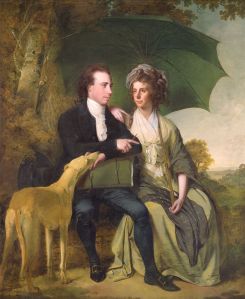
Thomas_Gisborne_Joseph_Wright_Derby

Image in the public domain, wikimedia commons.

This 1786 painting of The Rev. and Mrs. Thomas Gisborne, of Yoxhall Lodge, Leicestershire by Joseph Wright of Derby depicts a sober couple much in the vein of Elinor Dashwood and Edward Ferrars or Fanny Price and Edmund Bertrum. The year the portait was painted precedes Jane’s era, but the calmness of the scene and the sober mien of a couple who clearly come from the gentry class remind me very much of how I envisioned both couples. Neither seem to be the type to behave in in unseemly manner at an assembly ball.

In Jane’s novels, lovers who behaved badly often expressed good insights tinged with regret.

“Where the heart is really attached, I know very well how little one can be pleased with the attention of any body else. — Isabella, Northanger Abbey

and

Yes, I found myself, by insensible degrees, sincerely fond of her; and the happiest hours of my life were what I spent with her.— Mr. Willoughby, Sense and Sensibility
Johan Christian and his wife-Engelke Jens Juel 1797 Statens Museum for Kunst

Thumbnail of Johan and Engelke Christian, 1797, by Jens Juel


Older sensible couples who weathered married life and its vicissitudes and remained happy together play prominent roles in Austen’s plots. One senses that Admiral and Mrs Croft who befriend Anne Ellito in Persuasion must have observed the kind attention that Caption Wentworth paid her when he thought no one was looking.

The sensible older couple in Pride and Prejudice are Mr & Mrs Gardiner. He is silly Mrs. Bennet’s brother and a relation over whom Elizabeth did not need to blush. Their calmness and common sense helped to unite Mr. Darcy and Elizabeth after many missed opportunities.

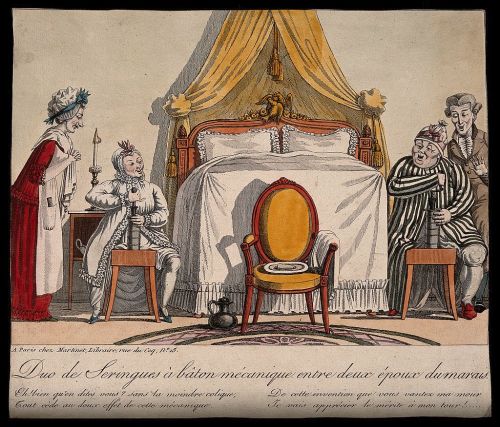
An_old,_rich_couple_enjoy_the_latest_fad_in_baton-powered_en_Wellcome_V0011705

Wellcome Collection image in the public domain by G. di Cari?

Romantic gestures change for many older couples. Over the years they are comfortable with each other. With age, often physical comfort and health have priority over more youthful pursuits. In her novels Jane Austen ignored the prurient, yet she lived in the Georgian age where social and political cartoons or satire were often graphic. Families took care of each other in sickness and health. They bathed their sick and tended to their every need. One wonders what was in Jane’s private letters to Cassandra regarding the more ordinary tasks of life.

The above image shows the sweetness of an older couple enjoying in tandem the latest fad in Baton-powered enemas. They seem happy and content and at ease with each other!

Jane, however, never found such a mate for life.

To you I shall say, as I have often said before, Do not be in a hurry, the right man will come at last.” – Jane Austen’s Letter to Fanny Knight

Following Jane’s advice, Fanny married for keeps. She bore 9 children to Sire Edward Knatchbull a baronet, to whom she was married for 26 years until his death.

Jane’s heroines were astute about pledging their love. Elizabeth Bennet failed to see through Wickham’s falsehoods at first, but common sense prevailed. Anne Elliot was never quite enamored of slimy William Elliot, for her heart belonged to the infinitely superior Caption Wentworth. One of Anne’s more memorable quotes is:

“My idea of good company, Mr. Elliot, is the company of clever, well-informed people, who have a great deal of conversation; that is what I call good company.” – Persuasion

One can only surmise that rather than settle for marriage to just any man, Jane Austen chose good company over a less than perfect union.

Jane’s heroes were equally steadfast and saw through foibles, insecurities, and prejudices of the women they loved, especially when their first impression was. They, like Mr. Darcy, waited patiently for the right moment to reveal their true feelings:

“My real purpose was to see you, and to judge, if I could, whether I might ever hope to make you love me.”— Darcy, Pride and Prejudice

In my opinion, none of Jane’s true heroes and heroines were ridiculous or maudlin. They chose well and understood the meaning of true love.

More on the topic: 


Read Full Post »
Dear Readers,

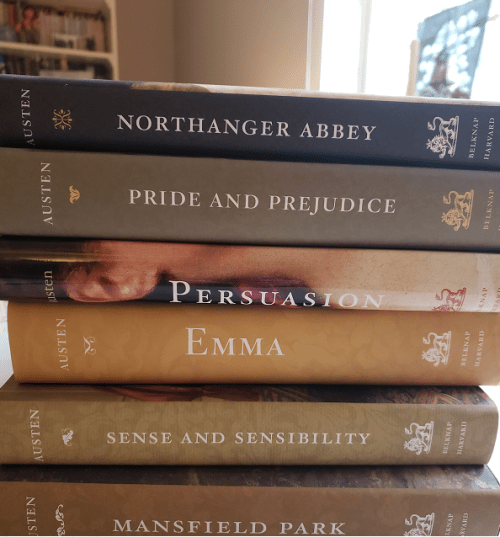
Happy New Year! I hope your holiday season was as fabulous and unforgettable as mine. One of my favorite holiday gifts was a gift certificate from Barnes & Noble, which helped me to complete all six annotations by Harvard University Press of Jane Austen’s best known novels. I quickly purchased Northanger Abbey, which I’ve been perusing since receiving it a few days ago.

Image of the covers of Northanger Abbey (front) and Emma (back) by Jane Austen and published by Harvard University Press.
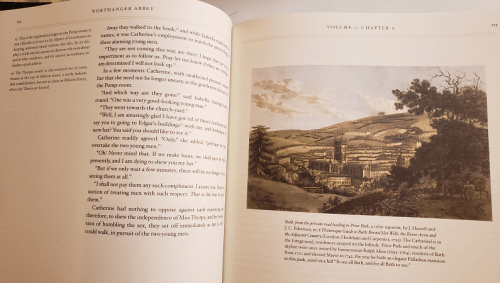
Susan J. Wolfson, professor in the Department of English at Princeton University, edited this edition, which has an extensive 60-page introduction. The book’s format follows the five other annotations – Pride and Prejudice, Sense and Sensibility, Mansfield Park, Emma, and Persuasion – with Jane Austen’s text in the center and the annotated commentary placed on the far right on uneven pages or far left on even pages.  Descriptive images of Bath, a poste chaise, or fashions of the day provide a visual punch to this annotation, as do the well-chosen images in the other books.

Image of Pages 112 and 113 with Jane Austen's text, annotations, and an image of Bath from a private road leading to Prior Park.

Two-page spread of pages 112 & 113 of Northanger Abbey, annotated edition.

For readers who were lucky enough to receive gift cards for books, I cannot recommend these gorgeous hard-cover books enough.

Image of a stack of Jane Austen's six novels, annotated editions by Harvard University Press.

More on the topic:

  • The Jane Austen Annotated Editions: Harvard University Press (includes information about all six editions)
  • This blog’s reviews of the Harvard University Press’s annotated editions of Jane Austen’s Novels: Click here


Read Full Post »

Inquiring readers, Rachel Dodge has once again submitted a superb article. This time she describes the fathers in Jane Austen’s novels. This Sunday marks Father’s Day in the U.S. I lost my own father four years ago. This article once again proves that my father, in every way, was superior to those described by Jane, making me realize how lucky I am and how smart my mother was to choose him.


In life, Jane Austen enjoyed a close relationship with her father. After his death, Austen wrote these words to her brother Francis: “His tenderness as a father, who can do justice to?” (Austen-Leigh 18). In the same letter, she refers to him as “an excellent Father” and writes of “the sweet, benevolent smile which always distinguished him” (144).

But what of the fathers in Austen’s novels? While some of them show exemplary characteristics, others leave much to be desired.

In Persuasion, Sir Walter Elliot is described as “a conceited, silly father” (5) and a “foolish, spendthrift baronet, who had not had principle or sense enough to maintain himself in the situation in which Providence had placed him” (248). He is more interested in his reflection in the mirror than in fathering his three daughters.

In Northanger Abbey, General Tilney runs a tight ship and dislikes delays. Walks cannot be put off, because he is “hurried for time” and mealtimes must be punctual: In one scene, he is “impatient when his eldest son is late” and expresses “displeasure . . . at his laziness” when he finally comes down to breakfast (154). In another scene, General Tilney is described as “pacing the drawing-room, his watch in his hand, and having, on the very instant of their entering, pulled the bell with violence, ordered ‘Dinner to be on table directly!’” (165).

Royalty free image of Mr. Bennet by illustrator Hugh Thomson

1985 edition of Pride and Prejudice, illustrated by Hugh Thomson and published by Macmillan & Co.

In the Bennet household, Mr. Bennet prefers the quiet of his library to the daily activities of family life: “In his library he had been always sure of leisure and tranquillity; and though prepared, as he told Elizabeth, to meet with folly and conceit in every other room of the house, he was used to be free from them there” (71).

In Emma, though Mr. Woodhouse is good-natured and “everywhere beloved” (7), he is most comfortable at home. He’s described on one hand “as a most affectionate, indulgent father” (5), but we also learn that while Emma “dearly loved her father . . . he was no companion for her. He could not meet her in conversation, rational or playful” (7). Austen further explains the intricacies of Mr. Woodhouse here: “He had not much intercourse with any families beyond that circle; his horror of late hours, and large dinner-parties, made him unfit for any acquaintance but such as would visit him on his own terms” (20).

In Mansfield Park, Sir Thomas Bertram is a “truly anxious father,” but he is not “outwardly affectionate” to his children (19). Austen tells us that the “reserve of his manner represse[s] all the flow of [his children’s] spirits before him” (19). Later in the novel, Sir Thomas sees “how ill he had judged” in raising his daughters and that he had “increased the evil by teaching them to repress their spirits in his presence” (463). He feels his “grievous mismanagement” and realizes that his daughters “had been instructed theoretically in their religion, but never required to bring it into daily practice” (463). In his case, Sir Thomas reflects upon, softens, and corrects his own manner.

QUIZ: Which Father is Which?

Finally, the fathers and father figures in Jane Austen’s novels have plenty of interesting advice for their children and fascinating perspectives on the world around them. Test yourself to see if you can guess which father is represented in the following quotes (answer key below):

  1. On One’s Complexion: “I should recommend Gowland, the constant use of Gowland, during the spring months. [She] has been using it at my recommendation, and you see what it has done for her. You see how it has carried away her freckles.”
  2. On Matters of Love: “Next to being married, a girl likes to be crossed a little in love now and then. It is something to think of, and it gives her a sort of distinction among her companions.”
  3. On Being Out of Doors: “It is never safe to sit out of doors, my dear.”
  4. On Early Marriages: “I am an advocate for early marriages, where there are means in proportion, and would have every young man, with a sufficient income, settle as soon after four-and-twenty as he can.”
  5. On the Dangers of Reading: As he had been “found on the occasion . . . with some large books before him, [they] were sure all could not be right, and talked, with grave faces, of his studying himself to death.”
  6. On the Subject of Daughters: “They have none of them much to recommend them,” replied he; “they are all silly and ignorant like other girls; but [she] has something more of quickness than her sisters.”
  7. On a Father’s Role in Parenting: “[He] was a sportsman, [she] a mother. He hunted and shot, and she humoured her children; and these were their only resources. [She] had the advantage of being able to spoil her children all the year round, while [his] independent employments were in existence only half the time.”
  8. On the Care of Ladies in Crowds and Street Crossings: “Come, girls; come . . . come . . . take care of yourselves; keep a sharp lookout!”
  9. On Being Agreeable: “[He], though so charming a man, seemed always a check upon his children’s spirits, and scarcely anything was said but by himself; the observation of which, with his discontent at whatever the inn afforded, and his angry impatience at the waiters, made [her] grow every moment more in awe of him, and appeared to lengthen the two hours into four.”
  10. On Girls Receiving Letters from Lovers: “Whether the torments of absence were softened by a clandestine correspondence, let us not inquire. [Her parents] never did—they had been too kind to exact any promise; and whenever [their daughter] received a letter, as, at that time, happened pretty often, they always looked another way.”

As you reflect on Austen’s literary fathers, may these examples increase your appreciation of the fathers, grandfathers, uncles, and mentors for whom you are most thankful today.

Answer Key: 1) Sir Walter Elliot, Persuasion, 146. 2) Mr. Bennet, Pride and Prejudice, 137-8. 3) Mr. Woodhouse, Emma, 48. 4) Sir Thomas Bertram, Mansfield Park, 317. 5) Mr. Musgrove, Persuasion, 82. 6) Mr. Bennet, Pride and Prejudice, 5. 7) Sir John Middleton, Sense and Sensibility, 32. 8) Mr. Price, Mansfield Park, 403. 9) General Tilney, Northanger Abbey, 156. 10) Mr. and Mrs. Morland, Northanger Abbey, 250.

About the Author

Rachel Dodge is a Christian author, college English instructor, and Jane Austen speaker. A true Janeite at heart, she loves books, bonnets, and ball gowns. For more of Rachel’s literary ramblings, you can follow her at http://www.racheldodge.com or on Facebook or Instagram (https://www.instagram.com/kindredspiritbooks/).

Works Cited:

Austen, Jane, and R. W. Chapman. The Oxford Illustrated Jane Austen. Oxford UP, 1988.

Austen-Leigh, William and Richard Arthur Austen-Leigh. Jane Austen: Her Life and Letters, A Family Record. New York: Barnes & Noble, 2006.


Read Full Post »

Inquiring readers, Rachel Dodge and frequent contributor to this blog has written a wonderful post for you this Mother’s Day. Enjoy!


The business of her life was to get her daughters married; its solace was visiting and news.” –Pride and Prejudice

Jane Austen never had children of her own, and she never wrote a conduct manual for mothers, but her novels certainly speak volumes about her opinion on the state of motherhood in 18th-century England—and specifically that of the landed gentry.

In her novels, the majority of Austen’s mothers can be broken down into three general categories: The Spectator, the Matchmaker, and the Manager.


The Indulgent Spectator

[She] never thought of being useful to anybody.” –Mansfield Park

In this category, Austen presents us with lenient and uninvolved mothers like Lady Middleton, Lady Bertram, and Mrs. Price.

In Sense and Sensiblity, Lady Middleton is a mother described as having the “advantage of being able to spoil her children all the year round” (32). She insists on bringing her “troublesome boys” (55) with her to most of her social engagements, and their actions speak volumes: “Lady Middleton seemed to be roused to enjoyment only by the entrance of her four noisy children after dinner, who pulled her about, tore her clothes, and put an end to every kind of discourse except what related to themselves” (34).

In Mansfield Park, Austen says Lady Bertram is a mother who “might always be considered as only half-awake” (343). She is most often described as “indolent” (four times) and most often found sitting on the sofa (eight times). Lady Bertram spends “her days in sitting, nicely dressed, on a sofa, doing some long piece of needlework, of little use and no beauty, thinking more of her pug than her children, but very indulgent to the latter when it did not put herself to inconvenience” (19-20). As to the “education of her daughters,” she pays “not the smallest attention.” She is of little “service to her girls” in this regard, considering it “unnecessary” because they are “under the care of a governess, with proper masters, and could want nothing more” (20).

1985 edition of Mansfield Park, illustrated by Hugh Thomson and published by Macmillan & Co

1985 edition of Mansfield Park, illustrated by Hugh Thomson and published by Macmillan & Co

Lady Betram’s sister, Mrs. Price, is described similarly: “Her disposition was naturally easy and indolent, like Lady Bertram’s” (390). Upon visiting home, Fanny’s “disappointment in her mother was [great]; there she had hoped much, and found almost nothing” (389). In describing her home management, Austen says Mrs. Price’s days are “spent in a kind of slow bustle; all was busy without getting on, always behindhand and lamenting it, without altering her ways; wishing to be an economist, without contrivance or regularity; dissatisfied with her servants, without skill to make them better” (389). Mrs. Price, the mother of nine children, is termed “a partial, ill-judging parent, a dawdle, a slattern, who neither taught nor restrained her children, whose house was the scene of mismanagement and discomfort from beginning to end . . .” (390). With such an aunt and such a mother, it’s a wonder Fanny turns out so well.


The Meddling Matchmaker

 the pains which they, their mothers (very clever women), as well as my dear aunt and myself, have taken to reason, coax, or trick [Henry] into marrying, is inconceivable!” –Mansfield Park

In this category, we find mothers like Mrs. Bennet and Mrs. Jennings who live to make matches. Both women make the business of matchmaking the main focus of their lives.

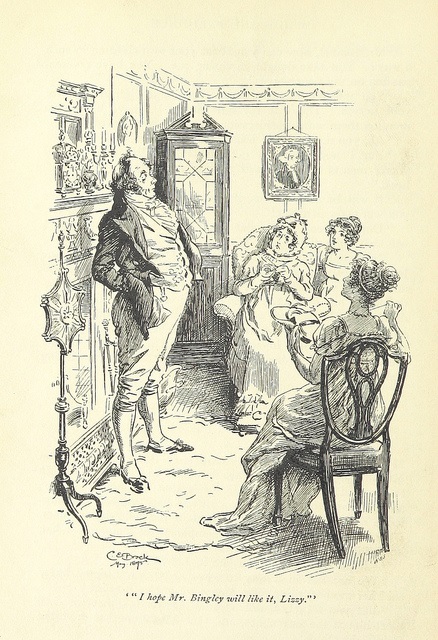
Mrs. Bennet, from the 1985 edition of Pride and Prejudice, illustrated by Hugh Thomson and published by Macmillan & Co

Mrs. Bennet, from the 1985 edition of Pride and Prejudice, illustrated by Hugh Thomson and published by Macmillan & Co

For Mrs. Bennet, marrying off her daughters is the “business of her life” (5). With five daughters and an entailed estate, Mrs. Bennet is always on the look-out: “A single man of large fortune; four or five thousand a year. What a fine thing for our girls!” (3-4). Mrs. Bennet even comes up with elaborate schemes to achieve her goal, such as the day when Jane is invited to Netherfield and Mrs. Bennet sends her off on horseback, in the hopes that it might rain and she might be asked to stay the night. It all goes according to plan: “This was a lucky idea of mine, indeed!” (31). Only when Jane and Elizabeth marry well does Mrs. Bennet finally experience the joyful relief of sweet success: “Happy for all her maternal feelings was the day on which Mrs. Bennet got rid of her two most deserving daughters” (385).

In Sense and Sensibility, Austen gives us this description of Mrs. Jennings: “She had only two daughters, both of whom she had lived to see respectably married, and she had now therefore nothing to do but to marry all the rest of the world” (36). In the role of matchmaking busybody, Mrs. Jennings is “zealously active.” Upon offering to take Elinor and Marianne to London, she says, “I have had such good luck in getting my own children off my hands that [your mother] will think me a very fit person to have the charge of you” (153). She takes her role as surrogate mother seriously while in London: “if I don’t get one of you at least well married before I have done with you, it shall not be my fault. I shall speak a good word for you to all the young men, you may depend upon it” (153-4).


The Business Manager

She took the first opportunity of affronting her mother–in–law on the occasion, talking to her so expressively of her brother’s great expectations, of Mrs. Ferrars’s resolution that both her sons should marry well, and of the danger attending any young woman who attempted to draw him in.” –Sense and Sensibility

The mothers in this category, such as Lady Catherine de Bourgh and Mrs. Ferrars, possess money and power, and they use both to rule over their offspring. Lacking in motherly affection or compassion, their matchmaking is purely strategic.

Lady Catherine is described as “a tall, large woman, with strongly-marked features” (162), the only living parent of Miss de Bourgh, the heir to the de Bourgh estate. As Mr. Darcy’s aunt, and “almost the nearest relation he has in the world,” she believes she is “entitled to know all his dearest concerns” (354). With both Pemberley and Rosings at stake, she takes her role quite seriously. She believes it’s her duty to “unite the two estates” by ensuring the marriage of her daughter to Mr. Darcy (83). For this reason, upon hearing news of Mr. Darcy’s probable engagement to Elizabeth Bennet, Lady Catherine “instantly resolve[s] on setting off” to confront Elizabeth at Longbourn, that she “might make [her] sentiments known” and pressure Elizabeth into giving up Mr. Darcy (353).

Similarly, Mrs. Ferrars in Sense and Sensibility is a “very headstrong proud woman” (148) who uses money to try to control her sons. In order to pressure Edward to marry well, she “told him she would settle on him the Norfolk estate, which, clear of land-tax, brings in a good thousand a-year; offered even, when matters grew desperate, to make it twelve hundred” (266). When he won’t comply, she threatens his ruin: “his own two thousand pounds she protested should be his all; she would never see him again; and so far would she be from affording him the smallest assistance, that if he were to enter into any profession with a view of better support, she would do all in her power to prevent him advancing in it” (267). When Edward persists in honoring his engagement to Lucy, Edward is “dismissed for ever from his mother’s notice.” Mrs. Ferrars settles the estate “which might have been Edward’s” upon his brother Robert (268).


The Fond, Caring Mother

 With only these examples of motherhood, one might think Austen had nothing good to say on the topic of mothers. Thankfully, Austen’s novels do provide us with redemptive motherly moments as well.

In Emma, Austen tells us that Miss Taylor “had fallen little short of a mother in affection” in her care of young Emma (5). In Sense and Sensibility, Mrs. Dashwood is described as possessing “tender love for all her three children” (6). In Northanger Abbey, when Mrs. Morland worries that Catherine’s low spirits and inactivity stem from Catherine’s worldly experiences, she cautions her on that subject, saying, “there is a time for everything—a time for balls and plays, and a time for work. You have had a long run of amusement, and now you must try to be useful” (240). And Mrs. Gardiner is described in Pride and Prejudice as “an amiable, intelligent, elegant woman, and a great favourite with all her Longbourn nieces” (139). She gives mother-like advice to Elizabeth, “a wonderful instance of advice being given on such a point, without being resented” (145).

In Persuasion, Austen presents a handsome picture of motherhood in Mrs. Musgrove. She loves her own children, worries that her grandchildren are being spoiled, and cares for the Harville children while Mrs. Harville nurses Louisa. At Christmas, the Musgroves bring the Harville children home with them and “receive their happy boys and girls from school” (129). Austen describes Mrs. Musgrove’s home at Christmas as “a fine family-piece.” There, Mrs. Musgrove is surrounded by “the little Harvilles,” a group of “chattering girls” at a table “cutting up silk and gold paper,” and “riotous boys” holding “high revel” near “tressels and trays, bending under the weight of brawn and cold pies” (134).

Finally, Austen gives us a glimpse into the future when she describes Jane Bennet’s natural motherly instincts: “The children, two girls of six and eight years old, and two younger boys, were to be left under the particular care of their cousin Jane, who was the general favourite, and whose steady sense and sweetness of temper exactly adapted her for attending to them in every way—teaching them, playing with them, and loving them” (239).

On a day when we celebrate mothers everywhere, let us thank all of the mothers, grandmothers, aunts, sisters, and mentors who have guided and loved us through the various seasons of our lives. If you’d like to read further about Jane Austen’s own mother, Cassandra Austen, please visit these links: (link to a selection of Vic’s other articles on Cassandra Austen, etc.)

You can follow Rachel and her literary ramblings at www.racheldodge.com or on Instagram (https://www.instagram.com/kindredspiritbooks/) or Facebook.

Works Cited

Austen, Jane, and R. W. Chapman. The Oxford Illustrated Jane Austen. Oxford UP, 1988.


Read Full Post »

« Newer Posts - Older Posts »