Feeds:
Posts
Comments

Archive for the ‘Jane Austen’s letters’ Category

Inquiring readers:  CLD Stationery has been creating personalised stationery for over thirty years. Its staff has learned a great deal about the traditions and etiquette of stationery and letter writing through the ages, especially the history of personal correspondence, from beautiful writing instruments and the development of the quality of paper to the evolution of quality inks.  At my request, this post was written especially for Jane Austen’s World. Enjoy!

How many of us take pens and paper for granted? Correspondence is such an integral part of our daily lives and it has played such an important role in the history of our civilisation.

Jane Austen as we know well, was a prolific writer and not just of novels, she enjoyed writing many personal letters that are thankfully, still in existence today for us to enjoy.  In particular, there are many splendid examples of letters that Jane sent to her sister Cassandra that have been collected into this fascinating book.

“You deserve a longer letter than this; but it is my unhappy fate seldom to treat people so well as they deserve” From a letter to her sister Cassandra, 1798

Her letters are delightfully witty and they are also beautifully written – despite her misgivings. When you think of how easy it is for us to write and edit our work today on a computer, it adds an extra dimension to her wonderful writing skills.  The image below shows a real excerpt in her own handwriting from the novel Persuasion.
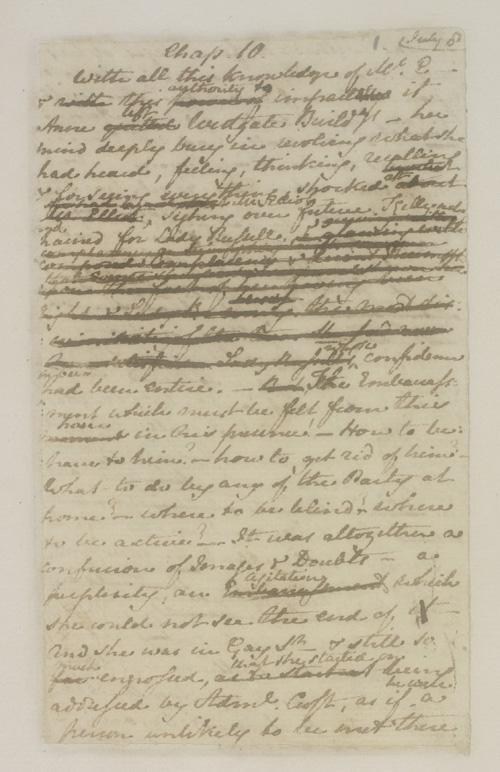
http://www.janeausten.ac.uk/manuscripts/blpers/1.html

During Jane Austen’s life, metal pen nibs had already been invented but were still rare and much more expensive than using a quill pen.  The majority of people were still using feather quills for all their personal correspondence. Jane Austen at this time would be using a quill made from a large goose feather or perhaps even a crow’s feather for smaller text.  The most desirable and hiqh quality quills were made from swans or peacocks feathers.

The feather quill has the ability to hold a little ink, allowing for less dipping time than using a reed or fine brush, this accounts for its huge popularity.  Interestingly, the feather quill is still used today as the preferred choice for calligraphy experts, due to it’s flexibility. The quill is cut with a knife to vary the thickness of writing, creating the perfect bespoke nib for the writer.

“I must get a softer pen. This is harder. I am in agonies. … I am going to write nothing but short sentences. There shall be two full stops in every line.” From a letter to her sister Cassandra, 1813

The quill cannot just be taken from the goose and cut, it needs to be hardened and there is some skill needed in creating the perfect writing tool – as you can read from Jane’s frustrations with her own quill!

If, like Jane Austen, you are a prolific letter writer and you favour the personal touch of a handwritten letter, then do visit our CLD Stationery website where we have a great selection of personalised stationery, from invitations to correspondence cards.
Read Full Post »

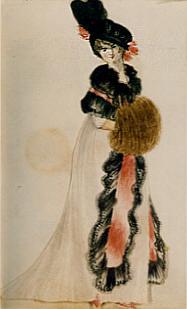
Watercolor, James Stanier Clarke. Portrait of Jane Austen?, 1816

For those who mistakenly think that Jane Austen wrote frothy romances, let her words speak for her. Jane had been invited to view the Prince’s library in Carlton House just before the publication of Emma and had been “encouraged” to dedicate her book to the Prince, which she did reluctantly, for she was no great admirer of his. She had written about the Prince’s long-suffering wife, Caroline: “Poor woman, I shall support her as long as I can, because she is a Woman and because I hate her Husband.”

While visiting Carlton House, she was escorted by Rev. James Stanier Clarke, the Prince’s librarian, who was so struck by her that he painted her watercolor image from memory and kept up a correspondence afterwards. Eventually, Rev. Clarke had the audacity to suggest how Jane might proceed in her next novel. In March 1816, he wrote: “Perhaps when you again appear in print … chuse to dedicate your Volumes to Prince Leopold: any Historical Romance illustrative of the History of the august house of Cobourg, would just now be very interesting.”

Jane penned this terse reply 195 years ago on April 1st:

MY DEAR SIR, — I am honoured by the Prince’s thanks and very much obliged to yourself for the kind manner in which you mention the work. I have also to acknowledge a former letter forwarded to me from Hans Place. I assure you I felt very grateful for the friendly tenor of it, and hope my silence will have been considered, as it was truly meant, to proceed only from an unwillingness to tax your time with idle thanks. Under every interesting circumstance which your own talents and literary labours have placed you in, or the favour of the Regent bestowed, you have my best wishes. Your recent appointments I hope are a step to something still better. In my opinion, the service of a court can hardly be too well paid, for immense must be the sacrifice of time and feeling required by it.

You are very kind in your hints as to the sort of composition which might recommend me at present, and I am fully sensible that an historical romance, founded on the House of Saxe-Cobourg, might be much more to the purpose of profit or popularity than such pictures of domestic life in country villages as I deal in. But I could no more write a romance than an epic poem. I could not sit seriously down to write a serious romance under any other motive than to save my life; and if it were indispensable for me to keep it up and never relax into laughing at myself or at other people, I am sure I should be hung before I had finished the first chapter. No, I must keep to my own style and go on in my own way; and though I may never succeed again in that, I am convinced that I should totally fail in any other.

I remain, my dear Sir,
Your very much obliged, and sincere friend,
J. AUSTEN.

Chawton, near Alton, April 1, 1816.

It is so very telling (is it not?), that Jane did not characterize her own novels as serious romance. To whit, I must agree with her self-assessment.

Gentle reader: My April Fool’s joke is subtle. Those who came over after reading my tweet and compared it to the date of the letter will see that I made the announcement five years off.

More on the Topic:

Read Full Post »

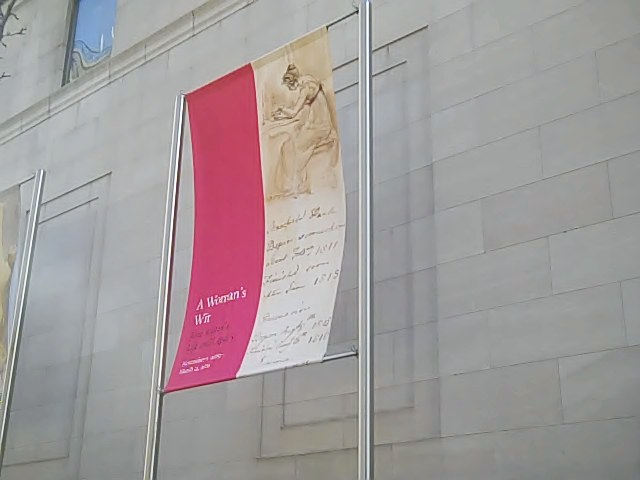
The exhibit, A Woman’s Wit: Jane Austen’s Life and Legacy, will be shown through March 14, 2010 at the Morgan Library in New York City. This week I had the distinct pleasure of seeing this unique presentation of Jane’s letters, the drafts of two of her novels (The Watsons and Lady Susan), several books, and images and cartoons of the Regency era.

I had taken a number of shots with my flip camera before a museum guard advised me that I could not take pictures. (Since it was possible to take pictures to my heart’s delight in The Louvre, it did not cross my mind that I could not do so at the Morgan Library). Interestingly, I had already taken numerous shots in full view of everyone before the guard stopped me.

The room is small; the riches contained within it are immeasurable

The actual exhibition area is contained within a small room, but there are so many letters and items of interest that I could have spent the entire day inside that space. Jane’s Life and Legacy were divided into three sections – her life and personal letters, her works, and her legacy. Over the next few weeks I shall write about my impressions from that exhibit, tying in other links and posts.

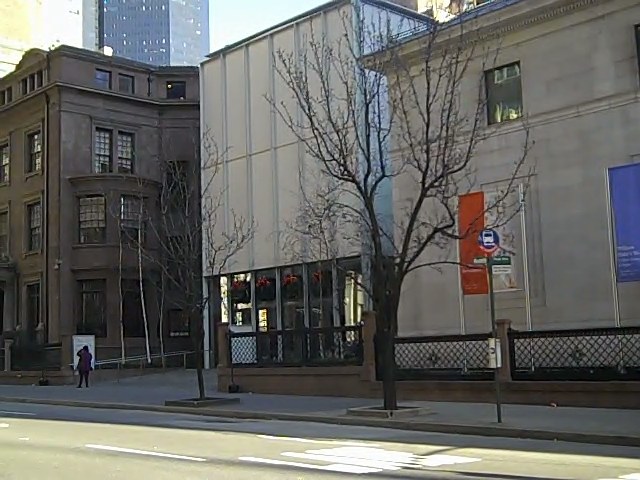
Entrance to new wing from Madison Ave

If you are not familiar with the Morgan Library and Museum, some information about its history might be of interest:

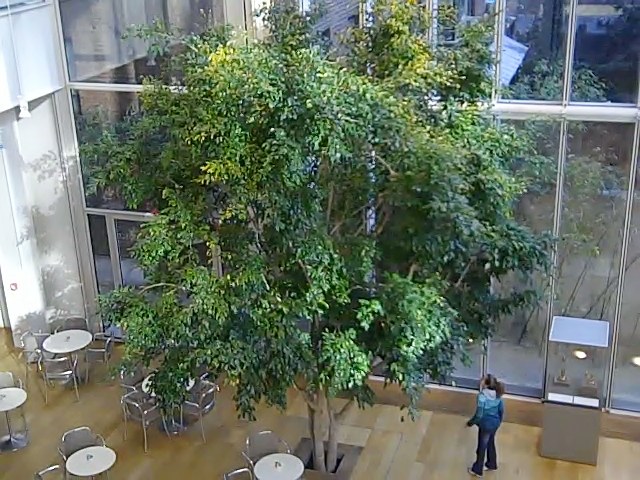
Interior of the new wing

A complex of buildings in the heart of New York City, The Morgan Library & Museum began as the private library of financier Pierpont Morgan, one of the preeminent collectors and cultural benefactors in the United States. Today it is a museum, independent research library, musical venue, architectural landmark, and historic site. More than a century after its founding, the Morgan maintains a unique position in the cultural life of New York City and is considered one of its greatest treasures. With the 2006 reopening of its newly renovated campus, designed by renowned architect Renzo Piano, the Morgan reaffirmed its role as an important repository for the history, art, and literature of Western civilization from 4000 B.C. to the twenty-first century. – Press Release information

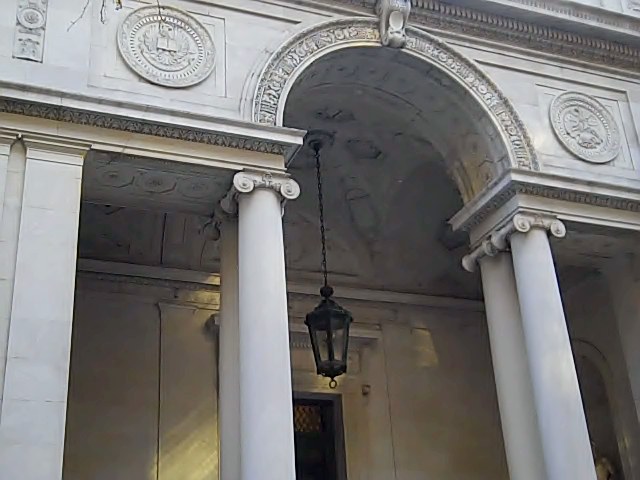
Original entrance

The following links might also interest you:


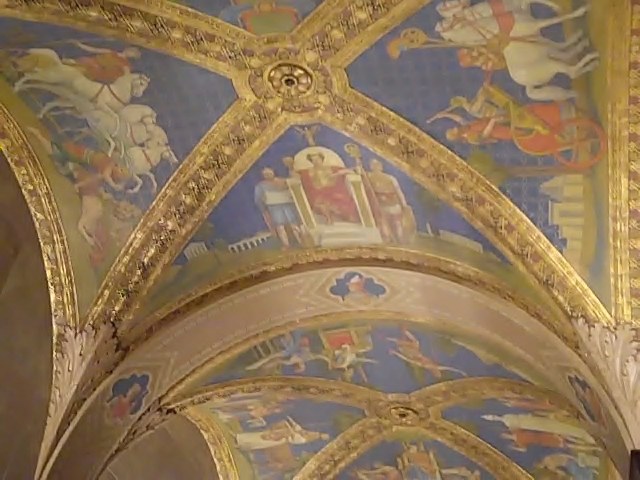
Vaulted Ceiling

Happy New Year, All!

Read Full Post »

Making traditional black butter

Inquiring readers: Reader Cora Harrison recently placed this comment on my blog: “In one letter, Jane [Austen] spoke of serving ‘black butter’ with wigeon and that she thought the butter was bad … Poor Jane, I thought. However, in reading a book called The Feast of Christmas I discovered that black butter was not butter at all, but what I would call a fruit cheese, made from equal quantities of apples, blackcurrants or blackberries and less sugar, and then boiled until it sets – and of course, the colour would be black!”

Her comment so intrigued me, that I decided to look up the topic. Jane wrote to her sister on December 27, 1808:

The first pot [of black butter] was opened when Frank and Mary were here, and proved not at all what it ought to be; it was neither solid nor entirely sweet, and on seeing it Eliza remembered that Miss Austen had said she did not think it had been boiled enough. It was made, you know, when we were absent. Such being the event of the first pot, I would not save the second, and we therefore ate it in unpretending privacy; and though not what it ought to be, part of it was very good.”

The recipe for making black butter, or apple butter as it is commonly known today, harkens back to medieval times. After the winter crop was picked, the preserve was made in huge quantities. In the 18th century, twenty percent of Jersey’s arable land was made up of orchards, and the tradition of producing ‘black butter’ or ‘Le Niere Buerre’ became an annual social  and festive occasion.  Jersey black butter was made from cider apples that were slowly boiled over a fire. Women would peel hundreds of pounds of apples, while the men and children would gather enough wood to keep the fire going for almost two days. After the cider was ‘reduced’ by half, apples, sugar, lemon, liquorice and spices were added. The Jersey tradition of making black butter included singing, dancing, and storytelling all through the night and until early morning. Jersey Island black butter is characterized by the addition of liquorice, which made the preserve quite dark. – RecipeZaar & BBC Jersey Black Butter.

According to Food Legends, black butter “contains no butter, the butter in the name being like the cheese in lemon cheese, more a description of the consistency and application of the product than anything else; and second, it is not really black, indeed a great deal of effort goes into avoiding the burning that would change the dark brown mass to black.” The following is likely Jane Austen’s recipe for Black Butter. Traditionally, the preserve is spread on bread, or it can be eaten by itself:

    Take 4 pounds of full ripe apples, and peel and core them. Meanwhile put into a pan 2 pints of sweet cider, and boil until it reduces by half. Put the apples, chopped small, to the cider. Cook slowly stirring frequently, until the fruit is tender, as you can crush beneath the back of a spoon. Then work the apple through a sieve, and return to the pan adding 1lb beaten (granulated) sugar and spices as following, 1 teaspoon clove well ground, 2 teaspoons cinnamon well ground, 1 saltspoon allspice well ground. Cook over low fire for about ¾ hour, stirring until mixture thickens and turns a rich brown. Pour the butter into into small clean jars, and cover with clarified butter when cold. Seal and keep for three months before using. By this time the butter will have turned almost black, and have a most delicious flavour. – Copyright Maria Hubert von Staufer March 1995

Black butter on bread

This recipe, which Cora must have at first thought Jane Austen was referring to, is a black butter that is generally served with fish, such as skate or salmon:

Black Butter: Put into a frying pan the necessary amount of butter, and cook it until it has a brown color and begins to smoke. At this moment add a large pinch of concassed parsley leaves and spread it immediately over the object to be treated. – Chest of Books

More on the topic:

Read Full Post »

christineInquiring readers, Several weeks ago, Chris asked me to link to her blog. Looking at it and reading her posts, I asked her to keep me updated on her work, which she describes as a personal journey that she is doing “for the pleasure of pursuing a course of study in a structured manner, which I greatly miss from my time in graduate programs. And to have fun and explore, more deeply, the work of a writer I admire and the time period in which she lived.” Below are her thoughts, and a link to her blog, Embarking on a Course of Study, which I encourage you to visit.

Would you, if you could, spend a year entering ‘on a course of serious study’ as Marianne Dashwood vows to do at the end of Sense and Sensibility? If the answer is yes, please join me in an Austen-inspired project of that nature. Specifically, “A writer, reader, and Austen lover spends a year (or more) embarking on a course of study similar to that probably undertaken by Marianne in Sense and Sensibility, without the benefit of Colonel Brandon’s library and with room for diversions, digressions, and (hopefully) fun fieldwork.”

I’ve begun by rereading the novels (which has been both a joy and a frustration at times, and I’m sorry I waited so long to pick them up again!), and Austen’s letters. I’m contacting Austen scholars for reading suggestions and to interview them. So far the Chawton Library has been the most helpful. Sadly, JASNA, not so much.

I have my first interview with a professor at St. Mary’s College here in Maryland, who is offering a class on Austen that examines the important aspects of the time period in which they were written: poliltics, economy, social codes, etc.

I admit the fieldwork so far has been the most fun. I’ve been country dancing (a real thrill, but surprisingly hard to learn and hot/sweaty!), am working on a silk ribbon embroidery project, and am deciding between hat decorating and archery classes. I have the Jane Austen Cookbook, as well, and plan on cooking one or two items for this year’s Thanksgiving dinner. I’ve promised my family not to make pigeon, which I admit I was not sorry to give up.

The reading list is growing and my goal is to alternate the serious with the silly. So – Mrs. Richardson then Sir Walter Scott, and on like that.

I hope to attend the festival in Bath next fall, so will probably need to find a seamstress to make me something fabulous or brave the process myself. Let’s see how well I do with the silk ribbon embroidery first!

This is not a project in the vein of a PhD dissertation or an intellectual discussion, though I welcome ideas, comments, and suggestions of all kinds. I’m trying to stay as true to Marianne as I can, but also see where this path leads me, personally.

Based on my post a few weeks ago (‘The Ruins of the Patapsco Female Institute’), that could be to a class in NYC on walking in heels at ‘Miss Vera’s Finishing School for Boys Who Want to Be Girls.’

You just never know where we’ll end up!

My latest post is on Elinor vs. Marianne. Who would you rather have as a friend? Who are you most like? Would love to hear from you.

Read Full Post »

« Newer Posts - Older Posts »