Feeds:
Posts
Comments

Archive for the ‘Jane Austen’s letters’ Category

July 18th (today) marks the anniversary day of Jane Austen’s death in a rented house in College Street, Winchester. Her life was all too short (December 16, 1775 – July 18, 1817), and her output all too meager for those who wish she had written more novels. This post consists of a series of recollections of Jane’s last days from her, her family, and her biographers:

During her illness, Jane wrote:

“I live chiefly on the sofa, but am allowed to walk from one room to the other. I have been out once in a sedan-chair, and am to repeat it and be promoted to a wheeled chair as the weather serves.”

“On this subject I will only say further that my dearest sister, my tender watchful, indefatigable nurse has not been made ill by her exertions. As to what I owe to her, and to the anxious affection of all my beloved family on this occasion, I can only cry over it, and pray to God to bless them more and more.” 

Her brother Henry wrote that “she supported, during two months, all the varying pain, irksomeness, and tedium,” attendant on her decline “with more than resignation, with a truly elastic cheerfulness.” “She retained,” he says, “her faculties, her memory, her fancy, her temper, and her affections, warm, clear, and unimpaired, to the last . . . . She expired on Friday, July 18 (1817), in the arms of her sister.”

We have followed Miss Austen to Winchester, and have visited the house in College Street where she passed the last weeks of her life. College Street is a narrow picturesque lane, with small old-fashioned houses on one side, terminating in the ancient stone buildings of the College. The garden ground on the opposite side of the street belonged, and still belongs, to the head master. We have entered the “neat little drawing-room with a bow window” which remains unchanged. It is a pretty quaint parlour, with a low ceiling and a narrow doorway. Its white muslin curtains and pots of gay flowers on the window sill lent a cheerful air to the room. We almost fancied we could see Miss Austen seated in the window writing to her nephew, glancing from time to time across the high-walled garden, with its waving trees, to the old red roofs of the Close, with the great grey Cathedral towering above them.- Constance Hill, Jane Austen, Her Homes and Friends
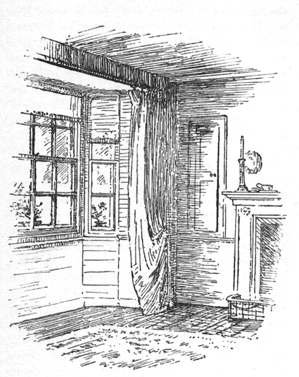
The parlour in College Street

Of her last days, her brother Henry wrote in the introduction of Persuasion and Northanger Abbey, published posthumously:

But the symptoms of a decay, deep and incurable, began to shew themselves in the commencement of 1816. Her decline was at first deceitfully slow; and until the spring of this present year, those who knew their happiness to be involved in her existence could not endure to despair. But in the month of May, 1817, it was found advisable that she should be removed to Winchester for the benefit of constant medical aid, which none even then dared to hope would be permanently beneficial. She supported, during two months, all the varying pain, irksomeness, and tedium, attendant on decaying nature, with more than resignation, with a truly elastic cheerfulness. She retained her faculties, her memory, her fancy, her temper, and her affections, warm, clear, and unimpaired, to the last. Neither her love of God, nor of her fellow creatures flagged for a moment. She made a point of receiving the sacrament before excessive bodily weakness might have rendered her perception unequal to her wishes. She wrote whilst she could hold a pen, and with a pencil when a pen was become too laborious. The day preceding her death she composed some stanzas replete with fancy and vigour. Her last voluntary speech conveyed thanks to her medical attendant; and to the final question asked of her, purporting to know her wants, she replied, “I want nothing but death.”

Jane’s last poem written July 15th:

When Winchester Races

When Winchester races first took their beginning
It is said the good people forgot their old Saint
Not applying at all for the leave of Saint Swithin
And that William of Wykeham’s approval was faint.

The races however were fixed and determined
The company came and the Weather was charming
The Lords and the Ladies were satine’d and ermined
And nobody saw any future alarming.–

But when the old Saint was informed of these doings
He made but one Spring from his Shrine to the Roof
Of the Palace which now lies so sadly in ruins
And then he addressed them all standing aloof.

‘Oh! subjects rebellious! Oh Venta depraved
When once we are buried you think we are gone
But behold me immortal! By vice you’re enslaved
You have sinned and must suffer, ten farther he said

These races and revels and dissolute measures
With which you’re debasing a neighboring Plain
Let them stand–You shall meet with your curse in your pleasures
Set off for your course, I’ll pursue with my rain.

Ye cannot but know my command o’er July
Henceforward I’ll triumph in shewing my powers
Shift your race as you will it shall never be dry
The curse upon Venta is July in showers–‘.

About Jane’s funeral, David Nokes writes in Jane Austen: A Life:

The funeral took place on the morning of Thursday 24 July at Winchester Cathedral. “It is a satisfaction to me,’ Cassandra wrote to Fanny, that her sister’s dear remains were ‘to lie in a building she admired so much – her precious soul I presume to hope reposes in a far superior mansion.’ Only three of the brothers – Edward, Henry and Frank – were present at this ‘last sad ceremony’. Charles, at Easbourne, was too far away to attend; James, too, stayed away. ‘In the sad state of his own health and nerves,’ he said, ‘the trial would be too much for him.’ Women were not expected to attend such melancholy ceremonies; their grief, it was thought, might overcome them. The funeral was held in the early morning; it ‘must be over before ten o’clock,’ Cassandra told Fanny, ‘as the Cathedral service begins at that hour’. Before the coffin was closed, she cut off several lock of Jane’s hair as family mementoes. ‘Everything was conducted with the greatest tranquility,’ she wrote. She and Martha Lloyd ‘watched the little mournful procession the length of the street & when it turned from my sight I had lost her for ever.’ (p. 521)

More about Jane’s last days:

Read Full Post »

Illustration from Modes et Manieres Du Jour, 1798 – 1808

I have changed my mind, & changed the trimmings on my Cap this morning, they are now much as you suggested, – I felt as if I should not prosper if I strayed from your directions, & I think it makes me look more like Lady Conyngham now than it did before, which is all that one lives for now. Jane Austen to Cassandra, December 18-19, 1798

Women during the Regency period wore headdresses outdoors as a matter of course. When a woman married, or if she was a spinster in her late twenties, she would also take to wearing a cap indoors. This image from Wikipedia shows Mme. Seriziat wearing a bergere, or shepherdess-style straw bonnet over a cap, as was the custom back then. When her child was a baby, he might have worn a simple bonnet, as infants still do today.

Aside from sheltering delicate skin from the sun or hair from the elements, or protecting one’s head in drafty rooms, headdresses took on many other functions. They denoted class and economic status, as well as fashion sense and one’s marital state. Hats were also worn as a sign of respect, inside a church, for instance, and this custom remained widely popular until well into the 20th-century.

Lace caps, mob caps, or draped caps, were made of lace, white linen or delicate muslin, and trimmed with ribbon. They could be ruffled, embroidered, or plain, depending on who wore them and their status. A housekeeper, for example, would wear a more elaborate cap than a scullery maid, whose mob cap was simple by comparison. In Pride and Prejudice 1995, Mrs. Bennet wore such frilly caps with so many ruffles and trimmings that they complimented her image as a silly woman. One can imagine how much fancier her caps were than her maid’s!

Trimming and redecorating old bonnets provided a topic of conversation for women of all ages and social strata. In her novels and letters, Jane Austen frequently mentioned trimming new hats and making over old bonnets as a female activity. According to Penelope Byrde in A Frivolous Distinction, it was quite the fad during the last decade of the 18th century to adorn hats and bonnets with artificial fruits and flowers. As Jane Austen wrote Cassandra in June, 1799 (tongue in cheek we suspect):

Flowers are very much worn, & Fruit is still more the thing – Eliz: has a bunch of Strawberries, & I have seen Grapes, Cherries, Plumbs & Apricots – There are likewise Almonds& raisins, french plums & Tamarinds at the Grocers, but I have never seen any of them in hats.

In addition to professional milliners and modistes, there was quite a large cottage industry for making caps, hats, and turbans from home, which provided a meager salary for women who needed the income. The materials used in making headdresses were as varied as their styles: straw (chip or strip), beaver, velvet, silk, crape, satin, muslin or cloth (Byrde, p 6). Trims included ribbons, the above mentioned artificial fruits and flowers, veils, net, lace, or feathers, and even beads, pins, and brooches.

For a more detailed explanation of the headdresses worn during this era and to view additional illustrations, please click on the following links.

  • Hats and Bonnets, Victoriana: Scroll to the bottom of this page to see illustrations from 1811 and 1812.
  • Fileblogs, Regency Caps, Linore Rose Burkhart: Linore describes the various hat styles in this link, along with materials and trims.

For people interested in ordering their own Regency caps, or in trying their hand at making a bonnet, the following links will lead you to patterns, suppliers, and resources:

  • Louise MacDonald Millinery (link suggested by Laurel Ann, see above image). Louise created the caps for Pride & Prejudice 1995, and describes making them for the movie.

Byrde, Penelope, A Frivolous Distinction: Fashion and Needlework in the works of Jane Austen, Bath City Council, 1979.

Four Hundred Years of Fashion, Victoria and Albert Museum, edited by Natalie Rothstein, V&A Publications, 1984.

Read Full Post »

In 1813, Jane Austen wrote to her sister Cassandra:

The invitation to the Fair was general; Edwd* positively declined his share of that, & I was very glad to do the same.-It is likely to be a baddish Fair-not much upon the Stall, & neither Mary O. nor Mary P.-it is hoped that the Portfolio may be in Canty* this morng*.Sackree’s sister found it at Croydon and took it to Town with her, but unluckily did not send it down till she had directions. Fanny C’s. screens can be done nothing with, but there are parts of workbags in the parcel, very important in their way.-Three of the Deedes girls are to be at Goodnestone.-We shall not be much settled till this visit is over-settled as to employment I mean;-Fanny and I are to go on with Modern Europe together, but hitherto have advanced only 25 Pages, something or other has always happened to delay or curtail the reading hour.-I ought to have told you before of a purchase of Edward’s in Town, he desired.Language evolves, and words do not have the same meaning for us as they did in 1813. The author of Adventures in Reading posted an interesting article this week about the language Jane Austen uses. The post reviews a book, The Language of Jane Austen: A Study of Some Aspects of her Vocabulary (1991) by Myra Stokes. Ms. Stokes discusses, for example, that “morning calling hours” generally did not occur before noon*, that the words “London” and “Town” were often interchangeable, or that being sent up or down meant in relation to one’s position in London, not whether one was heading south.

I won’t go into much more detail, for the post is worth reading. As we pursue our love for all things Austen, it is good to be reminded how much the meaning of words have changed and that one must pay particular attention reading a Jane Austen novel, or any work of past times, referring frequently to anthologies or one’s dictionary to get the nuances just right.

*Update on the term ‘Morning Calling Hours’: In The Jane Austen Handbook, Margaret C. Sullivan defines the time when visitors may call in the morning: “between eleven in the morning and three in the afternoon, or the time between rising and eating dinner. “

Read Full Post »

During her short life, Jane Austen was a prolific writer of letters, yet few survive. It is widely known that a majority of Jane’s letters were burned by her sister Cassandra and destroyed by other members of her family. Their reasons were varied. This excerpt from Jim and Ellen Moody’s website: English and Continental Literature, discusses the destruction of these letters and the reasons for it:

Not all the Austens of Jane’s generation and increasingly fewer who belonged to the later generations wanted the family’s private papers destroyed. It was not Jane but Cassandra who burnt ‘the greater part’ of Jane’s letters, and she only committed them to the fire when in 1842 she understood her own death could not be far off. Jane’s letters to Eliza and Henry and hers to them were left in Henry’s hands, and they have not survived. However, Frank, throughout a long mobile life, carefully preserved Jane’s letters to his first wife, Mary Gibson, and her packets of letters to himself and to Martha Lloyd (who became his second wife). It was Frank’s youngest daughter, Fanny-Sophia, who destroyed these and she did so after her father’s death (Family Record, p. 252). She acted without consulting anyone beforehand because by that time mores had changed and other of Frank’s children and grandchildren would have objected. Happily Philadelphia Walker had no direct descendants who felt their reputations or self-esteem put at risk by the existence of Eliza’s letters to her, and she lived long enough so that upon her death these letters fell into the hands of someone disinterested enough to save them, though in a somewhat mutilated state. A record of Jane Austen’s great-grandmother, Elizabeth Weller Austen’s steady courage, which enabled Jane’s branch of the family to maintain the status of gentleman and amass wealth and prestige, survives in a seventeenth century manuscript because several generations of Austens who descended from her second oldest son, the attorney, Francis Austen of Sevenoaks, preserved it (Austen Papers, p. 2).

As a result of the destruction of Jane’s own words, biographers have over the years come to widely different conclusions about Jane’s thoughts and motives. Ellen Moody outlines some of these varying interpretations in the link I have provided.

To read Jane’s letters, click on the following sites:

Read Full Post »

« Newer Posts

