Feeds:
Posts
Comments

Archive for the ‘Jane Austen’s Writing Techniques’ Category

A Book Review by Brenda S. Cox

Austen’s Endings
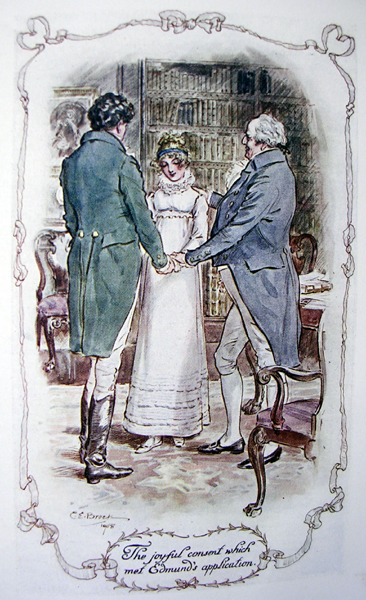
A happy ending, but we don’t see how they got there: Edmund falling in love with Fanny at the end of Mansfield Park disappoints because of the lack of details.

A major complaint that readers have about Austen is her endings. In both Sense and Sensibility and Mansfield Park, we have a sudden romance that is practically a footnote to the last chapter—Marianne marries Colonel Brandon with just, “Marianne found her own happiness in forming his,” and Fanny marries Edmund once he learns “to prefer soft light eyes to sparkling dark ones.” Northanger Abbey introduces a new character, Eleanor’s viscount, to facilitate Henry and Catherine’s marriage.

In Emma and Persuasion we do get some romantic talk (or writing) from the hero. However, in response, Emma says “just what she ought” (which is??), and Anne receives Wentworth’s look “not repulsively.” Then they talk, but we don’t hear their words.

Darcy, of course, simply tells Elizabeth his “affections and wishes are unchanged,” perhaps not willing to risk another disastrous proposal, and Elizabeth “immediately, though not very fluently, gave him to understand that her sentiments had undergone so material a change, since the period to which he alluded, as to make her receive with gratitude and pleasure his present assurances.” But what exactly did she say?

In all cases we have more author commentary than demonstrations, more of what writers call “telling” rather than “showing.”

Movie-makers have had to put words to all these proposals, and fill in some blanks. For example, they show Colonel Brandon rescuing Marianne from the rain, and wooing her with music. But why didn’t Jane Austen, who gave us so many delightful conversations and events, show us all those details herself?

Jane Austen & the Price of Happiness

Jane Austen & the Price of Happiness, by Inger Brodey, explores possible reasons for Austen’s less than romantic endings.

When I listened to Jane Austen and Her Endings: A Visit with Inger Brodey on Austen Chat, I was intrigued by Inger’s thoughts on analyzing those endings of Austen’s novels and trying to figure out why Austen didn’t give us all the details we want. Recently I finally got to buy (at JASP, from Jane Austen Books), and read, Jane Austen & the Price of Happiness by Inger Sigrun Brodkjær Brodey.

It’s a fascinating book, and written quite accessibly. (I found only a couple of unfamiliar academic terms*; in general it’s written in everyday English.) The illustrations are fun, including cartoons, images from movies, and more.

Each chapter analyzes one of the novels, in the order they were written, so we see the development of Austen’s techniques. Brodey looks at various aspect of each novel with new insights and considers the impact of the ending. Then she looks at some popular adaptations of that novel, mostly films plus a few books. She considers how they handle the ending and whether their endings fit Austen’s goals.

Her chapter titles give you some idea of her thoughts:

  • Introduction: “Perfect Felicity”
  • Chapter 1: “Commonplace Happiness” (Northanger Abbey)
  • Chapter 2: “Expecting Literary Justice” (Sense and Sensibility)
  • Chapter 3: “The Limits of Romance” (Pride and Prejudice)
  • Chapter 4: “The Thin Veil of Comedy” (Mansfield Park)
  • Chapter 5: “The Art of English Happiness” (Emma)
  • Chapter 6: “Resources for Solitude” (Persuasion)
  • Conclusion: “Coauthoring Happiness”

Brodey says that, for one thing, Austen is trying to show readers that their expectations of romantic idealism come from the sort of sensibility she satirizes. Austen disrupts those expectations. She shows us that the romantic outcomes we want, expect, and demand are not inevitable: this is fiction. Her stories are realistic, with characters operating in ordinary, everyday life, but the “happily ever afters,” the “perfect happiness,” may or may not happen in real life.

There are other reasons for Austen’s nuanced endings, which I’ll leave you to discover from Inger’s book. However, I’ll share a few highlights from the chapter on Mansfield Park, as an example of some of the many insights in the book.

“The Thin Veil of Comedy” Chapter on Mansfield Park
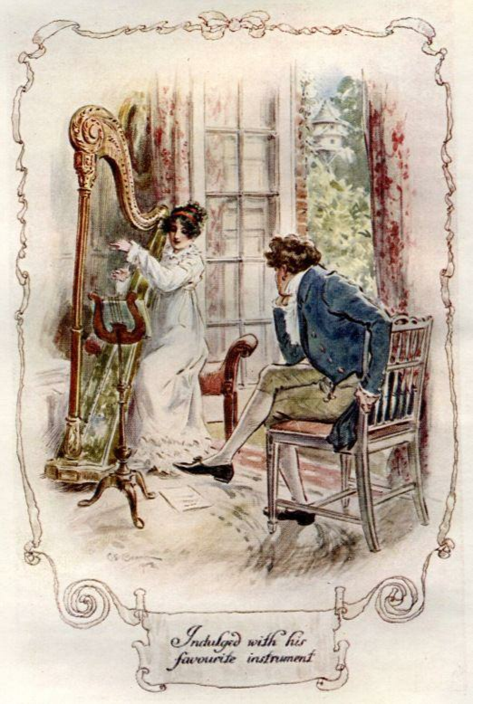
Readers are expected to be attracted by Mary Crawford’s charm, which hides her poor moral values.

Mansfield Park was published after the light, bright, and sparkling Pride and Prejudice. It deals with harder truths. Brodey claims Austen’s “novels alternate between the bright and witty heroines whose primary obstacles are internal, and the more understated, misunderstood, and wiser heroines whose primary obstacles are external” (p. 138). I had to think about this one, but it’s true—Catherine Morland is not witty, but she does face internal obstacles of her own credulousness and illusions; Elinor Dashwood is wise and misunderstood; Elizabeth Bennet, obviously bright and witty, needs to overcome her pride and prejudices; Fanny Price is also wise but understated and faces external challenges; Emma is again bright and witty and needs to overcome her own pride; Anne Elliot is quiet but wise.

Austen shows, especially in Mansfield Park, that charm can be dangerous. Mary Crawford is lively and charming like Elizabeth Bennet. She and her brother Henry charm Edmund, Maria, and Julia, as well as readers, just as Wickham charmed Elizabeth. However, charm without a strong moral foundation leads to disaster. Austen is challenging her readers “to love the less prepossessing characters and see beyond the false power of charm.” 
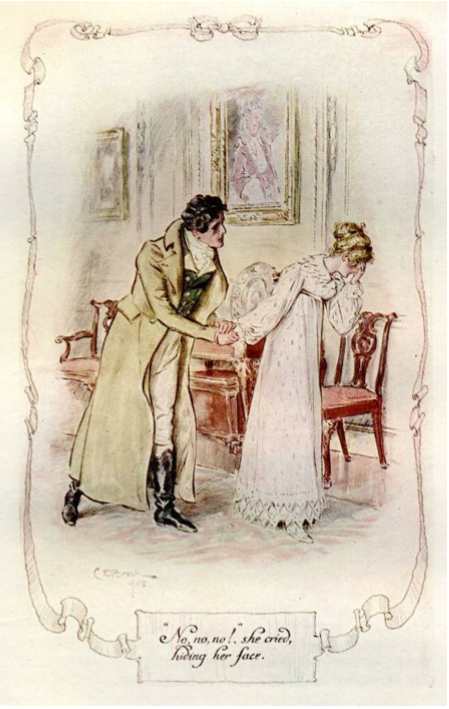
Henry Crawford might have changed due to his love for Fanny, and might have earned her love, but he did not.

The final chapter of Mansfield Park tells us outcomes for many characters, who are apparently as important as Edmund and Fanny. We see the reformation of some, such as Tom Bertram and Sir Thomas Bertram. Austen reveals the sad but not completely tragic endings of those who were not willing to change, including Henry and Mary Crawford. Henry could even have had an alternate ending, with a happy marriage to Fanny, if he had been willing to persevere in his resolutions of self-improvement. Brodey says, “It somewhat diminishes [Fanny’s] marriage to Edmund to know that a marriage to Henry would not have been disastrous. Once again, Austen surprises the reader out of extravagant expectations of the novel. We get shades of gray where we hope for black and white, realism where we crave romance” (p. 148).

As in other endings, Austen intrudes in the first person, saying “My Fanny indeed at this very time, I have the satisfaction of knowing, must have been happy in spite of everything.” Austen reminds us that this is fiction and that she, as the author, is controlling the ending. She also refers to Fanny as a living human being, though. In showing her own attachment to Fanny (“my Fanny”), she “models the attachment that she believes Fanny deserves” (p. 147).

She challenges our readerly expectations of fantasy endings, including a sense that “second attachments are degrading for romantic heroines” (p. 149); shades of Marianne Dashwood! We believe that Edmund and Fanny will be happy together, even though it is Edmund’s “second attachment.” They do not need some intense eternal passion to experience happiness.

I hope these brief points pulled from one chapter might give you a little more understanding and appreciation of Mansfield Park. I encourage you to read all of Jane Austen & the Price of Happiness. I think you will find it fascinating and illuminating, as I did!


*Here’s one word I learned from this book: apophasis. It means “raising an issue by claiming not to mention it,” or, as Brodey puts it, “tell[ing] the reader what will not be told.” Austen’s endings often use this technique. For example, near the end of Mansfield Park: “But there was happiness elsewhere which no description can reach. Let no one presume to give the feelings of a young woman [Fanny] on receiving the assurance of that affection of which she has scarcely allowed herself to entertain a hope.” As Brodey says, it’s an annoying technique. But Austen has her reasons.


Brenda S. Cox is the author of Fashionable Goodness: Christianity in Jane Austen’s England. She also blogs at Faith, Science, Joy, and Jane Austen.
Read Full Post »

Jane Austen and the Creation of Modern Fiction: Six Novels in “a Style Entirely New,” explores Jane Austen’s development as a fiction writer.

by Brenda S. Cox

A few days ago I reviewed Collins Hemingway’s fascinating new book on the development of Austen’s writing techniques, Jane Austen and the Creation of Modern Fiction: Six Novels in “a Style Entirely New.”  Today we meet with the author to get his perspectives on the book.

Collins Hemingway began his analysis of Jane Austen’s writing techniques as he wrote a fiction trilogy speculating on the “lost years” of Austen’s life, The Marriage of Miss Jane Austen.

I asked Collins Hemingway to tell us more about Jane Austen and the Creation of Modern Fiction.

JAW: What led you to write this book, Collins?

Collins: I’ve read Austen all my life, but I did not read much commentary during my 25-year high-tech career. When I came back to Austen fulltime, I read a ton of Austen scholarship from the last 20 years. I noticed that there wasn’t much about her writing, as writing. Scholars would mention a technique and use it as a launch point for broader criticism. With rare exceptions, they would not analyze the technique itself or how it affected the reader. I saw this as an area in which I could add something new.

JAW: You have, of course, written a fiction series, The Marriage of Miss Jane Austen. How did your experiences writing fiction about Austen feed into your development of Jane Austen and the Creation of Modern Fiction?

Collins: Writing the novels led directly to this book, though it took several years of hard reading, notetaking, and writing to flesh out the meat over the bones. I have shared that story on my blog.

JAW: The book is full of great insights. For you, what was one of the most helpful, something that helped you see Austen’s novels in a new way?

Collins: After completing the fiction trilogy, I went a step further, going through each of Austen’s six novels line by line, noting everything of interest to a writer. I ended up with 20 to 30 pages of handwritten notes on each one. Then I began to consolidate various topics. For instance, I ended up with five pages of notes just on description, collated from all her books, including the juvenilia. Then I examined the patterns in different aspects of writing and tried to understand how the patterns fit within and between each book.

As the patterns began to organize themselves, I realized that there was a distinct trend from early to late. In each book, Austen learned something, then applied it in the succeeding books. Like Virginia Woolf examining the early works and the unfinished works, I began to see the internal structures of each book. (As my wife would caution—in my opinion.) I could see how Austen was feeling her way along in the early works, then painting like a master in the later ones.

JAW: You’ve pointed out the strengths and weaknesses of each of Austen’s novels. It appears that you see Emma as the most “perfect” novel, as other commentators do. But for you personally, which novel do you tend to enjoy re-reading the most, and why?

Collins: Depends on my mood. P&P for its sheer energy, and for Liz bowing to no one, ever. Emma for its magnificence, page by page. Persuasion for the depth of Anne’s feeling. MP, though it is in no way my favorite, when I just want to admire the structural purity and the work she put into it.

JAW: You talk about many techniques of modern fiction that Jane Austen helped to develop and show how they developed in her novels over time. Could you briefly list for us some of those techniques, so readers can see some of the treats they have in store?

Collins: She was a master of dialogue probably from the day she first picked up a quill pen. Description. Behavior. Character motivation and interaction. Complex plots (without castles, brigands, or shipwrecks.) Ever deeper and subtler ways to get into her characters’ minds.

JAW: What is one takeaway that you want readers to have when they finish reading your book?

Collins: What Austen accomplished would make any author proud. But the fact that she learned all that she did on her own, away from other writers, pulling the best from a small number of others (such as Richardson, in a very specific way), building on a few good things from tradition, figuring out the rest on her own—it’s astonishing. And she did it in her too short 41.5 years of life!

JAW: What was the most fun part of the book to write?

Collins: My breakthrough in really understanding the internals came through descriptions. They unlocked the issues in NA and S&S, showed how radically different P&P was from the earlier two, and became miraculously mature in MP. This was the most fun. Especially when I realized the difference in the way Austen treated Lady Russell and Anne as they entered Bath in Persuasion. It took my breath away to see what Austen had done.


You may want to read my review if you missed it earlier. This is a fascinating book if you want to better understand Jane Austen’s modern writing techniques and how she developed them herself. Jane Austen and the Creation of Modern Fiction is available from Amazon and from Jane Austen Books. Jane Austen Books is currently offering it at a substantial discount.


Brenda S. Cox is the author of Fashionable Goodness: Christianity in Jane Austen’s England. She also blogs at Faith, Science, Joy, and Jane Austen.

Read Full Post »

By Brenda S. Cox

I thoroughly enjoyed Jane Austen and the Creation of Modern Fiction: Six Novels in “a Style Entirely New,” by Collins Hemingway. As a fiction writer himself, Hemingway examines Austen’s novels, in the order she wrote them, to analyze the techniques she pioneered. He observes her abilities growing from novel to novel, as she experiments and succeeds in creating the worlds and characters we so love.

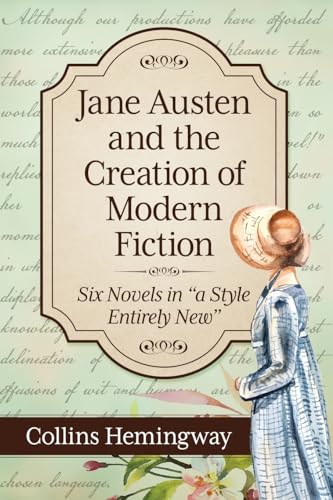
Collins Hemingway’s new book, Jane Austen and the Creation of Modern Fiction: Six Novels in “a Style Entirely New, gives fascinating insights into Austen’s development of modern techniques of fiction writing.

A New Style?

Did Jane Austen develop a new style of novel-writing? Her contemporary reviewers thought so. They felt compelled to give long contrasts between the previous style of novel-writing, full of intensity and improbability, with Jane Austen’s new realistic style. Sir Walter Scott in his 1815 review of Emma said Austen “draws the characters and incidents introduced more immediately from the current of everyday life.” Rev. Richard Whately wrote in his 1821 review of Northanger Abbey and Persuasion, “A new style of novel has arisen. . . . The substitute for these excitements [of unlikely adventures] . . . was the art of copying from nature as she really exists in the common walks of life.” Both these reviews are worth reading (follow the links above) to see how Austen’s contemporaries struggled to describe what she was, and wasn’t, doing in her novels.

The third volume of Austen’s Juvenilia includes a penciled note inside the front cover, “Effusions of Fancy by a very Young Lady consisting of Tales in a Style entirely new.” Peter Sabor says this inscription is written in Jane’s father’s handwriting, though others have speculated that it may have been written by Cassandra or even by Jane herself, tongue-in-cheek.

Author Collins Hemingway told me, “The epigram seems most likely to me to be from her father. . . . To me, the quotation is Mr. Austen enjoying and encouraging Jane’s raw power and comedy, her sheer audacity in sending up the pulp fiction of the day with her various teenage writings. I saw a strong parallel to her adult fiction. Her juvenilia showed that she understood that traditional fiction didn’t cut it. Her adult fiction shows that she learned how to write good novels—something new at the time.”

Jane Austen Learning (or Inventing) the Craft of Writing Fiction

Jane Austen and the Creation of Modern Fiction starts out with a preface for more academic readers (feel free to skip it if that’s not you), then an introduction for us all, which begins:

“I wrote this book so that people can read Jane Austen with fresh eyes. I wanted booklovers to view her not as a literary or cultural icon but as a writer, someone who puts words to paper to try to touch another person’s heart. I wanted people to see her as a human being who struggled to master her craft as anyone in any field, regardless of talent, must do. . . . As both a student of literature and a writer, I wanted to know how Austen affects readers. I wanted to know how she created remarkably  real people interacting in remarkably realistic situations. This is what writers care about, and what readers respond to.”

Yes.

Hemingway starts with an exploration of the context of Austen’s writing, how she “straddled the old and new literary order, ultimately pivoting the novel from improbable adventures to deep penetration of the minds of her heroines.” (These early chapters are necessarily a bit more difficult, as they compare Austen with her contemporaries, who most of us have not read—and here we can see why Austen is so much more accessible than other writers of her time!)

Then he brings us deep into our beloved Austen–following her development of description in her earliest novels, Northanger Abbey and Sense and Sensibility. In Pride and Prejudice, she continues to develop “pocket descriptions,” which are “pithy, telling details.” For example, Elizabeth Bennet’s jumping over stiles and puddles and arriving at Netherfield with “weary ancles” and “dirty stockings” is a pocket description that shows us a lot about Elizabeth.

Sense and Sensibility was originally written in the popular “epistolary” form, as a series of letters. Letters give a sense of distance, as the character is writing about events that have already happened, rather than the author drawing readers directly into events. A chapter analyzes how Austen made the transition from letters into narrative. For example, Edward Ferrars is a “blurry” presence in the early chapters, which are closer to the letter format. By the end of the novel, though, Austen has added vivid, immediate scenes. So, in the final proposal scene, we see Edward as “the very real and anguished presence of a human being.”

My favorite chapter is the one on “The Marvelous Complexity of Mansfield Park.” Hemingway’s discussion helps readers appreciate its elaborate scenes, complex characters, and interconnected plotlines. He particularly explores the depths of Fanny Price’s thoughts and feelings.

Fanny’s “responses, which for the most part only the reader observes, show her to be by far the most complex individual Austen ever creates. Outwardly, she is a saint. Inwardly, she is as confused and angry as any person who is regularly embarrassed or put down. Her raw feelings sometimes overpower her Christian charity and patience.” Austen even uses the furnishings of Fanny’s room to show her interior life. Fanny constantly examines her own motives, trying to find the right path.

Every chapter includes new insights into Austen’s novels, her writing techniques, and her development as an author.

Persuasion

One area of the book that Janeites might find a little uncomfortable is the section on Persuasion. Collins Hemingway discusses the revision process—authors generally rewrite their books multiple times. He points out several areas in Persuasion that could be considered imperfect. For example, Mrs. Smith is not quite consistent. Why does she encourage Anne to marry Mr. Elliot, then reveal how horrible he is? And why does Lady Russell mostly disappear from the second half of the book?

Austen might have fixed these issues with a major rewrite. (I suggest she also might have changed Charles Hayter’s name, so we wouldn’t have two adult characters named Charles, besides Charles Musgrove’s son Little Charles.) But Hemingway suggests that perhaps her health was failing already, and she did not have the time and energy for major revision. She had already replaced the original ending with the beautiful one we know and love. And, in “the quiet passion of Anne Elliot,” she had already given readers “a depth of character never seen before.”

If Austen had begun another revision to fix smaller structural issues, she might not have had a publishable version available when she died. So, Hemingway persuades us that Austen wrapped up the work, as it stood, to give the world another work of art and to help provide for her mother and sister after her death. As Hemingway states, “Like Emma, Jane is faultless despite her faults.”

Any lover of Austen will learn a lot from Jane Austen and the Creation of Modern Fiction. I particularly recommend it to writers (like myself), who will enjoy seeing Austen’s techniques and their development. Any of you who love digging deeper into Austen’s novels will find new delights here.

On Monday, we’ll interview the author to get his perspectives on the book.

Jane Austen and the Creation of Modern Fiction is available from Amazon and from Jane Austen Books. Jane Austen Books is currently offering it at a substantial discount.

Gentle readers, what aspect of Austen’s writing do you most admire? Her settings, characters, plots, style, humor, or something else?

Brenda S. Cox is the author of Fashionable Goodness: Christianity in Jane Austen’s England. She also blogs at Faith, Science, Joy, and Jane Austen.

Read Full Post »

