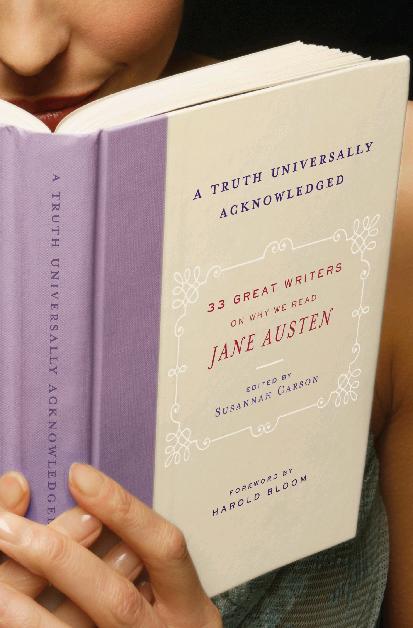
 I had just about given up on reading advance copies of Jane Austen sequels, prequels, and mash-ups, when A Truth Universally Acknowledged: 33 Great Writers on Why We Read Jane Austen, edited by Susannah Carson and published by Random House, arrived in my mailbox. A sigh of relief swept over me as I opened the mailer and saw that I had received a serious book about Jane Austen’s body of work – I would not be subjected to reading another mash-up of vampires and zombies, or a sequel with Mr & Mrs Darcy making babies.
I prefer to read literary appraisals written by professional writers. They often express their thoughts about other writers more clearly than academics, whose use of lofty terms, elaborate theories, and learned analysis in their critiques tends to befuddle all but a handful of their colleagues and students. Except for her own essay, editor Susannah Carson (a doctoral candidate) takes a back seat to Virginia Woolf, E.M. Forster, Alain de Botton, Jay McInerney, Anna Quindlen, and Eudora Welty. Esteemed literary critic, Harold Bloom, wrote the foreword. As I read this new book, my gratitude towards these eloquent writers grew.
 L-R: Alain de Botton, Anna Quinlan, Harold Bloom, Eudora Welty, E.M.Forster, and Virginia Woolf

Each of the book’s thirty-three essays gave me a new insight about Jane Austen’s novels. While I did not agree with every writer’s take on Jane’s work, I felt that I had been exposed to a variety of new ideas. I’m not sure Jane is quite the paragon of moral virtue as depicted by James Collins. Nor do her novels necessarily end happily ever after. (Witness the number of unsuccessful marriages in her books, and her newly engaged/married characters still have the majority of their lives to live.) Not all her mothers are awful, nor is Mr. Bennet an especially noteworthy father. Regardless of my disagreements, I felt after finishing the book that I had attended a two-day symposium in which bright literary minds discussed and debated my favorite author.
 L-R: Benjamin Nugent, Amy Heckerling, C.S.Lewis, AS Byat, J.B. Priestley, & Margot Livesey

Ms. Carson chose essays from both classic and contemporary writers, all of whom are ardent admirers of Jane’s writing. Some essays are long, and some are short, a nice mix. I would have preferred to read essays from a few detractors as well, for unlimited admiration can sometimes seem treacly. Still, I was as thrilled with Eudora Welty’s observations on the “real secret of the six novels’already long life,” as with director Amy Heckerling’s adaptation of the movie “Clueless” from Emma. Amy Bloom, whose “Terrible Jane” was my favorite essay, asserted that Jane knew her own worth as a writer and that, far from being the mild and shy spinster her Victorian family tried to reinvent after her death, she was a witty, fallible, full-blooded, and clear-sighted woman who liked a good party, hated being poor, and was often unkind. (Cassandra did not quite succeed in cutting out all of Jane’s acerbic observations in her letters.)
 In her introductory essay, Ms. Carson (r) asked the question: Why do we read Jane Austen? Why indeed? As I read the essays, I began to understand that above all, Jane Austen makes me smile, think and ponder, and reach eagerly for the next page. She created characters that I want to revisit over and over again. As I have aged and grown wiser (presumably), her novels revealed new layers of depth and insights that I had not noticed before. This book has enriched my enjoyment of Jane, and as far as I’m concerned that’s all that matters. I give it three out of three Regency fans.
 Inquiring readers, Several weeks ago, Chris asked me to link to her blog. Looking at it and reading her posts, I asked her to keep me updated on her work, which she describes as a personal journey that she is doing “for the pleasure of pursuing a course of study in a structured manner, which I greatly miss from my time in graduate programs. And to have fun and explore, more deeply, the work of a writer I admire and the time period in which she lived.” Below are her thoughts, and a link to her blog,







 Jane Austen's World