By Brenda S. Cox
“Lovely & too charming Fair one, notwithstanding your forbidding Squint, your greazy tresses & your swelling Back, which are more frightfull than imagination can paint or pen describe, I cannot refrain from expressing my raptures, at the engaging Qualities of your Mind, which so amply atone for the Horror with which your first appearance must ever inspire the unwary visitor.
“Your sentiments so nobly expressed on the different excellencies of Indian & English Muslins, & the judicious preference you give the former, have excited in me an admiration of which I can alone give an adequate idea, by assuring you it is nearly equal to what I feel for myself.”–“Frederic & Elfrida,” chapter 2, Jane Austen’s Juvenilia
A few days ago I began telling you about a linguistics conference focused on Jane Austen’s delightful efforts as a teenage writer. Besides the main talks, we got to explore many aspects of Austen’s brilliant use of language.
Jane Austen’s Grammar, Punctuation, and Education
Several talks reported on analyses of certain types of words, such as intensifiers (very, extremely, etc.), which are often used ironically in the Juvenilia. Phrases indicating prohibition, obligation, or permission are used more often by women than by men in Austen’s early works. One talk examined the language used in sister relationships, comparing Elizabeth and Jane Bennet’s conversations with Anne Elliot and Mary Musgrove’s discussions.
Two talks focused on education at the time. These traced Austen’s own experiences with two brief bouts in boarding school to the comments in her novels criticizing such schools. Austen repeatedly challenged the current systems of women’s education. For example, in Emma, Austen wrote:
“Mrs. Goddard was the mistress of a School-not of a seminary, or an establishment, or any thing which professed, in long sentences of refined nonsense, to combine liberal acquirements with elegant morality upon new principles and new systems—and where young ladies for enormous pay might be screwed out of health and into vanity-but a real, honest, old-fashioned Boarding-school, where a reasonable quantity of accomplishments were sold at a reasonable price, and where girls might be sent to be out of the way and scramble themselves into a little education, without any danger of coming back prodigies. Mrs. Goddard’s school was in high repute—and very deservedly.”–Emma
Parentheses
I had never noticed how Austen used parentheses (also called round brackets) as stage directions. Victorina González-Díaz showed us that Austen used parentheses for body movement (smiling), attributions (said I), or both (said he with a saucy smile). Early on, Austen used parentheses in the Juvenilia mostly for speech attributions and combined forms. As accepted conventions changed, she moved to using them mostly for body movements in her mature novels. Specific characters, like Mrs. Elton, get parenthetical expressions to help characterize them. In Volume 2 of Emma, for example, Mrs. Elton says:
“The thing is determined, that is (laughing affectedly) as far as I can presume to determine anything without the concurrence of my lord and master.”–Mrs. Elton
Jane Austen’s Self-Editing
Another talk I appreciated was Breckyn Wood’s on “Jane Austen the Editor.” The original manuscripts of the Juvenilia show many editing changes that Austen made to her own work (Jane Austen: Teenage Writings, edited by Kathryn Sutherland, lists these edits). Wood showed how Austen’s editing process as she worked on her early writings helped her develop the style she used later in her novels.
Wood first pointed out, as van Ostade confirmed, that spelling and punctuation were not at all standardized in Austen’s time. The “errors” Austen made were similar to the spelling and punctuation of other great authors of her time, including Wordsworth and Sir Walter Scott. (Did you know that we have six original examples of Shakespeare’s signature, and he spells his own name differently in each one??)

So when Austen wrote Love and Freindship, she wasn’t making a childish mistake. She was using an accepted alternate spelling.
Austen’s self-edits were made for various reasons. In one story, Austen changed “She began to fear” to “She began to tremble.” This is a modern writing convention, where we prefer to “show” rather than “tell”—she is showing the character’s fear, rather than telling us the character was afraid.
In another place Austen added alliteration (using the same initial sounds), changing “rouge” to “patches” in “Frederic & Elfrida,” resulting in:
“Charlotte . . . walked to Mrs. Fitzroy’s to take leave of the amiable Rebecca, whom she found surrounded by Patches, Powder, Pomatum, & Paint, with which she was vainly endeavouring to remedy the natural plainness of her face.”
In other cases, Austen increased the silliness of these spoofs. For example, she originally had a young man sending a large Newfoundland dog home to his family every year, but changed that to every month, to make it even more ridiculous.
Austen was careful in her choice of words and phrases throughout the Juvenilia, developing the wonderful style we see in the mature novels.
Language Change
My own talk was on language change in Jane Austen’s religious vocabulary. I focused on words that have changed meaning since Austen’s time, so that we may misunderstand them as readers today. Some, like rector, vicar, and curate, have changed because the Church of England’s structure has changed. Obvious religious words, like atone in the quote that opens this post, are used ironically. Others, like exert, duty, and principle, once had strongly religious meanings, but their emphasis has changed because of cultural changes. The Juvenilia uses these words mostly as satire, showing characters who had made sensibility into their own religion. My talk is posted on my blog.
Who knew that the science of linguistics could add so much to our understanding of Jane Austen’s work and world?
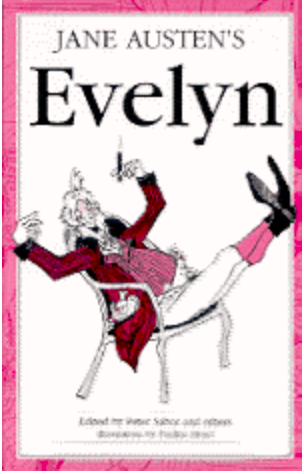
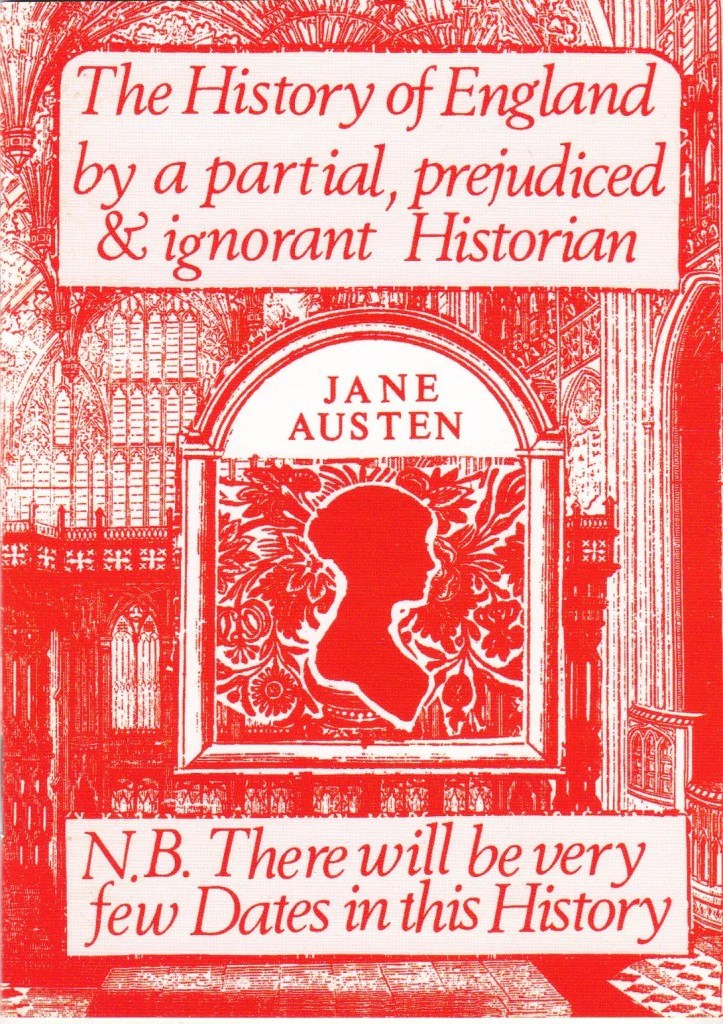
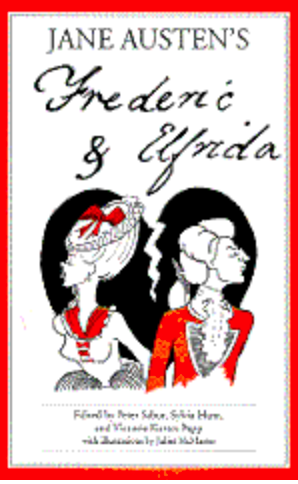
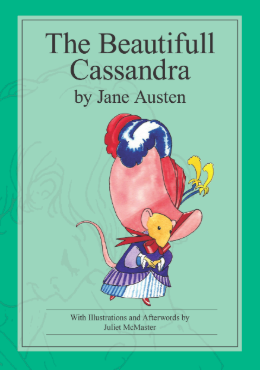
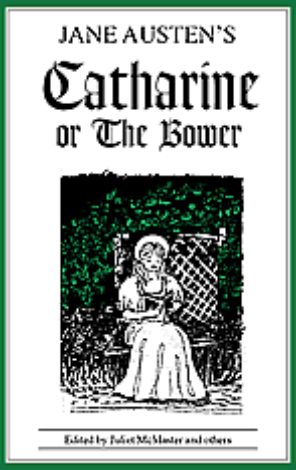
If you want to read or re-read the Juvenilia for yourself, you might try Jane Austen: Teenage Writings, edited by Kathryn Sutherland. Or, you might go for some of the lovely illustrated volumes from Juvenilia Press. I’ve used some of those covers to illustrate this post. I have even bought some of those delightful storybooks for my grandchildren. They are available from Juvenilia Press in Australia or from Jane Austen Books in the US.
“Cassandra smiled & whispered to herself ‘This is a day well spent.’”—”The Beautifull Cassandra,” Jane Austen’s Juvenilia
If you’ve read the Juvenilia, which story is your favorite, and why?
Online articles on Jane Austen’s use of language
(Note that for jstor, you can get an individual membership free and read many articles each month.)
The Language of Jane Austen’s Teenage Writings: Part 1
For abstracts of the conference talks, see “Linguistic Approaches to Jane Austen’s Childhood.”
- Jane Austen’s Subtly Subversive Linguistics, Chi Luu. A linguist argues that Jane Austen’s popularity has more to do with her use of language than her plots.
- Good Tenses Make Good Neighbors: Or, How Grammar and Linguistics Shaped Austen’s Moral Worldview, Breckyn Wood, Persuasions On-Line, Winter 2024
- Very Austen: Accounting for the Language of Emma, Janine Barchas, Austen’s use of the word “very.” She uses it 2-3 times as much in Emma as she does in her other novels, with an average of more than once per page. Why? (Note that you can get a free individual membership to jstor that allows you to read many articles each month.)
- Jane Austen’s English, K.C. Phillipps. Ways Austen played with words, innovated, and followed or did not follow grammatical conventions.
- Jane Austen’s Speech Acts and Language Based Societies, Candace Nolan-Grant (Speech acts are acts performed entirely with words, such as proposals or promises.)
- Jane Austen’s “Must”: The Will and the Word, Zelda Boyd. Austen’s use of modals like “must,” “may,” “shall,” to mock and to change what “must” happen.
- Jane Austen and Samuel Johnson’s Dictionary
- Defining the World: The Extraordinary Story of Dr. Johnson’s Dictionary, Henry Hitchings
- The Professor and the Madman: A Tale of Murder, Insanity, and the Making of the Oxford English Dictionary, Simon Winchester. A little after Austen’s time, but starts with Samuel Johnson, who was during her time.
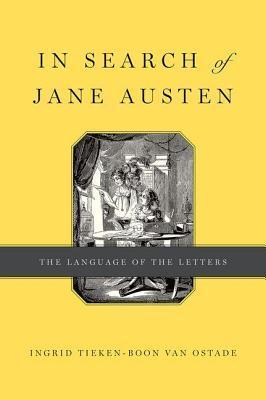
- In Search of Jane Austen: The Language of the Letters, by Ingrid Tieken-Boon van Ostede. Expensive, but you may be able to access it through a library or a research service such as Galileo.
This list is included in the Social Customs tab above, under Language and Linguistics.
Brenda S. Cox is the author of Fashionable Goodness: Christianity in Jane Austen’s England. She also blogs at Faith, Science, Joy, and Jane Austen.








 Jane Austen's World