Feeds:
Posts
Comments

Archive for the ‘Music review’ Category

Interview by Brenda S. Cox

“no one can be really esteemed accomplished [without] a thorough knowledge of music, singing, drawing, dancing, and the modern languages”–Pride and Prejudice

Jane Austen and Company, who have given us many fascinating series of talks, have been focusing on Austen and music this year. We asked Inger Brodey, Eric Bontempo, and Susan Ellen Ford to tell us more about that.

JAW: Thanks for joining us, Inger, Eric, and Susan. I understand that the three of you are directing the Jane Austen & Company program. Jane Austen & Co has been doing a series on Music and the Regency this year. Readers can watch and listen to the recordings here. Can you tell us about that?

Jane Austen & Co. did a series on Music in the Regency during 2025, and you can still enjoy the recordings online for free.

Eric:

Sure! Music making and music appreciation could be complicated—even contested—activities during the late eighteenth and early nineteenth centuries. In 2025, Jane Austen & Co. wanted to look at aspects of public and domestic music in the Regency period, and zero in on Jane Austen’s own musical experience. Back in February, we kicked things off with Jeff Nigro’s talk on “Georgian Fangirls” and the influence that Italian castrati had on Regency Music in England. Then, Gillian Dooley discussed music in Austen’s life and work, including some of what Austen would have played and sang. Kathryn Libin moved our series outward to women and musical education during this period. In April, Laura Klein discussed the evolution of keyboard music during this period and considered the music Austen was practicing when she was writing.

This fall, we’ve added three more events to the series. Lidia Chang from Colorado College gave an insightful talk on “Frivolity, Foppery, and the English Gentleman at Music.” And just two weeks ago, Jeanice Brooks from the University of Southampton delighted us with her talk exploring how music making shaped perceptions of people and lands far beyond the British home. The grand finale of the series came in late November when Penelope Appleyard and Jonathan Delbridge revealed the new song they have commissioned, recorded, and released to celebrate Jane Austen’s 250th Anniversary.

JAW: Tell us a little about one of those recorded events that our readers might enjoy listening to.

Grand finale of Music and the Regency, “A Song for Jane”

Eric: I think our grand finale to “Music and the Regency” is definitely worth watching. The 90-minute episode has a little bit of everything: Penelope Appleyard and Jonathan Delbridge performed live, and you can watch their stunning renditions of songs that Jane Austen loved and copied down in her family’s music books. They performed “Robin Adair” and a “Song for Burns” before delighting us with their recently commissioned setting of Austen’s teenage poem “Ode to Pity.”

In between performances, they walked us through the historical context of these songs, the musical instrument being played by Jonathan, and their connection to Jane Austen and her novels. It was fascinating, and if you watch until the end, you’ll notice that the audience Q&A kept the momentum going!

JAW: What are a few interesting things that you personally have learned from that series?
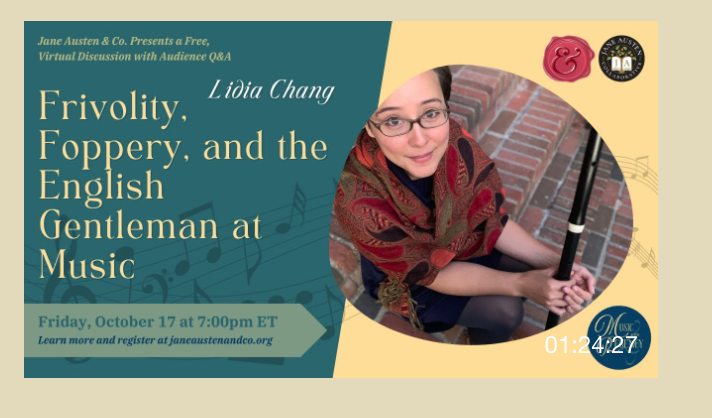
Lidia Chang’s episode on music and gender

Susan: One of my favorite episodes was the interview with Lidia Chang. She taught me a great deal about music and gender. I was interested to hear about how seldom amateur men would perform music, compared to women. She also drew connections to the few examples from the novels where men perform for private audiences.

JAW: What will the next series be?

Susan: Jane Austen & Company is launching a brand new series focusing on Jane Austen’s “Unsung Characters.” We are envisioning a series of presentations that explores Austen’s minor characters and the un-thought-of connections that may tie them together. We will be announcing the list of speakers and presentations soon!

JAW: A few months ago I reviewed your lovely new site, Jane Austen’s Desk. How is that going?
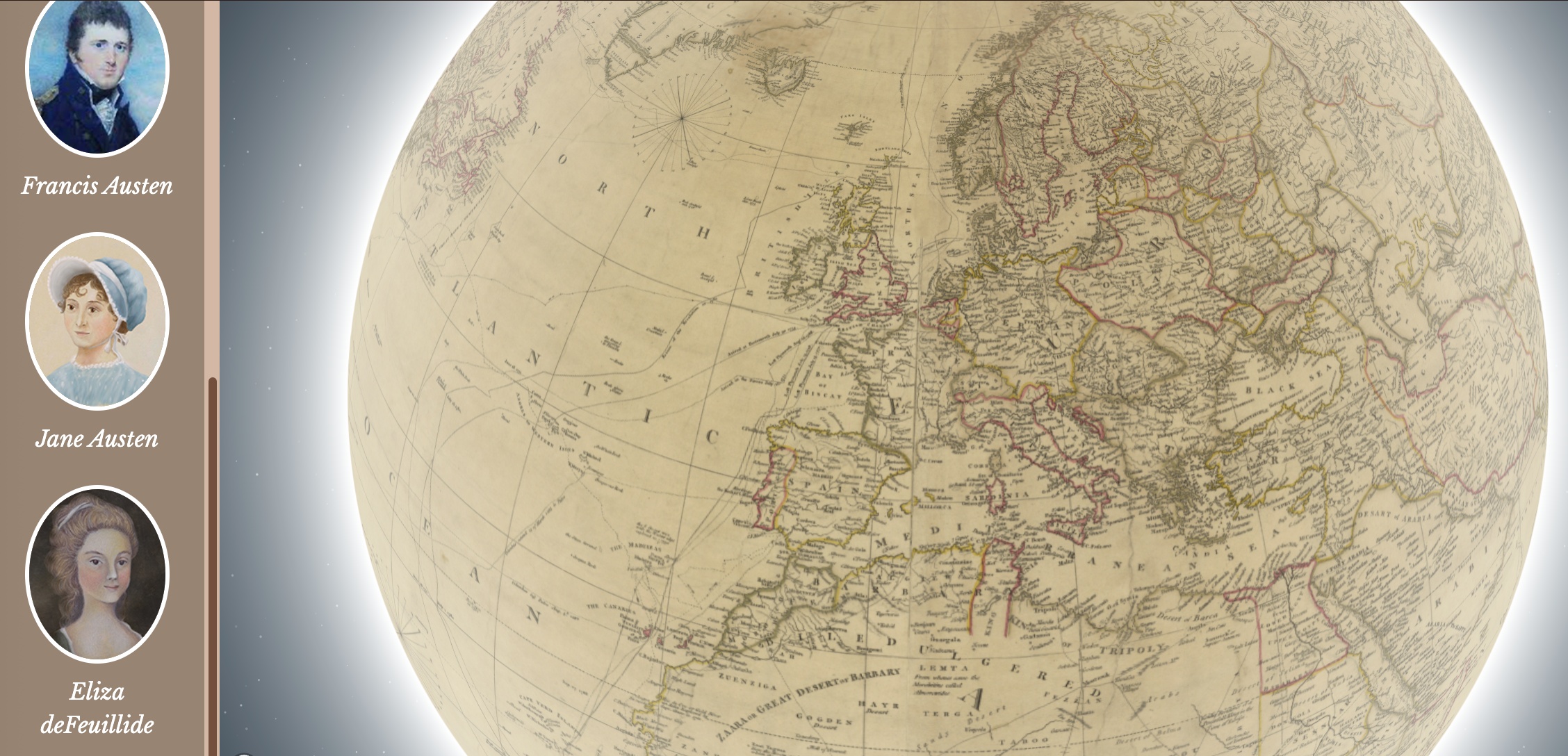
Eliza de Feuillide is now in the travel section of Jane Austen’s Desk.

Inger: Yes, we were very grateful for your review! Since then, we have added a few things to Jane Austen’s Desk. Most importantly, we’ve added a new traveller: Eliza De Feuillide, Austen’s first cousin and sister-in-law. We included a new hand-drawn portrait of her and programmed in most of her travels during Austen’s lifetime. We really wanted another female traveller, along with Fanny Palmer Austen, to indicate what we are calling Austen’s “vicarious travels.”  We are countering the image of Austen living a sheltered existence by showing visual, interactive representations of how much her correspondents travelled, giving her vivid, second-hand experience of diverse regions of the world. 

Susan: In honor of our new holiday campaign to raise funds, we also added some professionally recorded Christmas music, performed by Laura Klein on a period harpsicord, and some holiday greenery.  Have you seen them yet? (You have to ignore, momentarily, the unseasonable weather for March 30.)

Under the painting for travel sits a thus-far mostly silent pianoforte on the website Jane Austen’s Desk. We can participate in bringing it to life!

JAW: I understand you are raising money for adding music to that site. What are you hoping to add? How will that enrich the site?

Inger: Music was key to Jane Austen’s creative process. As you know, in her years at Chawton Cottage, she got up early in the mornings to play her pianoforte and compose her thoughts. This Kickstarter will raise the funds necessary to give tribute to the specific music Austen knew, loved, and transcribed by hand. We will add interactive tools with access to this music to our free website, making it come alive for all kinds of Janeites. The music will be performed by professional performers on historical instruments. We will provide historic illustrations, information about composers and specific pieces, and crisp images of Austen’s own sheet music.

An exciting part of the plan is to link the mentions of music in the novels to recordings by Laura Klein, and vice versa. So when you read about Mary Crawford playing a glee, for example, you can play an example and learn about what glees are. It’s an important dimension of our plan to show how the many different parts of Austen’s lived experience come together in her masterful novels.

JAW: That sounds fantastic, Inger. Why do you need to raise the money with a Kickstarter?

Inger: The design and building of our site has been primarily funded by two “Digital Projects for the Public” grants from the National Endowment for the Humanities. We were hoping for the largest, phase 3 grant in this line, but the whole program has been cancelled at the NEH, so we are forced to look elsewhere for our funding.  What we really need is a patroness! 

JAW: Lady Catherine de Bourgh, take note. Or perhaps someone who has “more true enjoyment of music” than she does, or “better natural taste”! How can our readers contribute, if they wish?

Inger: Our Kickstarter campaign is at: https://www.kickstarter.com/projects/janeaustencoll/adding-music-to-jane-austens-desk. On that site there are also two videos: one about our team that is making Jane Austen’s Desk and the other about the goals of our project. Kickstarter campaigns are all or nothing, so if we don’t meet our target by December 28th, then we don’t receive any of the promised funding! It’s a little nerve-wracking!

JAW: We very much hope you get all your need! Readers and music lovers, here’s an opportunity to contribute. Inger, Eric, and Susan, thanks for all your hard work to make so much great material available to us in such a fun way. (I vote that you do embroidery next 😊, but the music, “a very innocent diversion,” will be delightful!)


Brenda S. Cox is the author of Fashionable Goodness: Christianity in Jane Austen’s England. She also blogs at Faith, Science, Joy, and Jane Austen.

Read Full Post »

Jane Austen’s Music Library – Broadwood Junction in concert at the Bruno Walter Auditorium, New York City, October 28, 2017, with musicians Francis Liu; violin, Patrick T. Jones; fortepiano; Sarah Stone; cello and Lucy Dhegrae; mezzo soprano, by Patricia N. Saffran.

Broadwood junction2 copy

Photo courtesy of Broadwood Junction – at the square piano

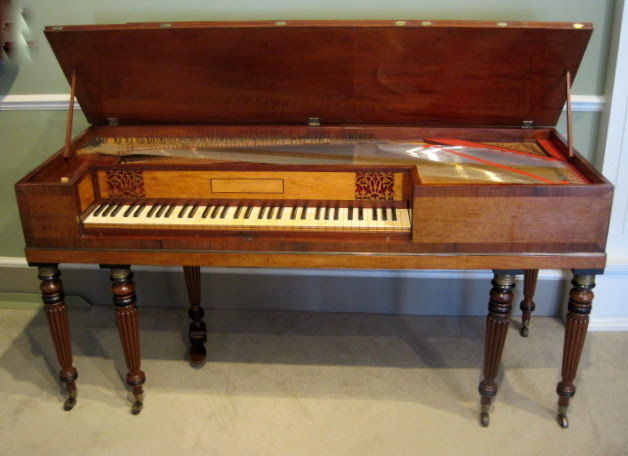
The concert opened with a passage read from Jane Austen’s Emma which included the mysterious arrival of an expensive square piano, a gift from an unknown donor, to the Fairfax household that could not afford such a piano, “a very elegant looking instrument-not a grand, but a large-sized square piano-forte.” In the early 1800s, the instrument described would have been a tastefully decorated Broadwood square piano with a damper pedal and would have cost £35, or £2,408 today.

broadwood square piano

Broadwood square piano.

The musicians proceeded to explain that their own Broadwood square piano was out of commission and Patrick T. Jones would be playing on a borrowed German fortepiano. The group, which consists of alumni from Juilliard’s Historical Performance program, was formed when a Broadwood square piano from 1809 was spotted at an estate auction in Virginia, and they quickly snapped it up. Broadwood square pianos, with their quiet sound, had been mass produced for the home. Violinist Francis Liu then explained that the program would consist of Jane Austen’s own music books, some of which she copied herself in a refined readable hand from borrowed sheet music. Her music library is now on-line for the public to read at the University of Southampton, UK, website.

The first piece was George Kiallmark’s Robin Adair, Theme and Variations for Piano of the Scottish song, and with Lucy Dhegrae then singing Robin Adair.

Ignaz Pleyel’s Trio was next from 1793, originally scored for harpsichord. This was followed by Thomas Arne’s beautiful Cymon and Iphigenia, cantata for tenor originally, and instruments. In between pieces, the musicians read more passages from Jane Austen about music, from novels and letters.

Except for the popular and noisy “The Battle of Prague” by Frantisek Kotzwara, the remaining pieces by Joseph Wölfl, James Hook and several Anonymous vocal selections revealed a lack of musical development. This phenomenon was explained by Francis Liu, “This music is kitsch and entertaining. It was the music that people from good families could easily perform at home. Usually, there would be a girl with good posture at the piano singing. Rarely, a man would accompany her, perhaps on a flute, but not a violin which would have required more skill.”

It is curious that Jane Austen, one of the most sophisticated novelists of all time, would have been enamored of such simple music. When asked after the concert, Mr. Liu explained further, “In a good family, a girl couldn’t play like a professional musician. She wouldn’t have played music performed in the theaters.” That would have put her in the category of demi-monde. It was an aristocratic dictate in society that those from better families could not appear too professional. For gentlemen the exception was to be a  clergyman or an officer, such as a skilled soldier or cavalryman. Women would have been at risk of making a good marriage, a main theme in Jane Austen novels, if they revealed they had genuine musical talent.

Two lovely Jane Austen youtube selections are on YouTube-


More on the topic:


Read Full Post »


Rounds enjoy a wonderful tradition in music. One of my favorites is “Row, row, row your boat.” My most recent favorite round is the information going around the blogosphere about Jane Austen musicals. Here then are a few items of interest.

  • Jane’s Austen’s Emma Becomes a Musical, San Francisco Chronicle: Pride and Prejudice, the musical is mentioned at the end of this article: In Mill Valley, composer-lyricist Rita Abrams and author Josie Brown have put “Pride and Prejudice” to music and are using their Web site, http://www.prideandprejudicemusical.com, to attract a theatrical producer. The complete song available this week is Changing World, when Jane falls ill and must stay at Netherfield. The song is sung by Bingley and Jane, who are falling in love, and Darcy, who is bewitched by Elizabeth’s fine eyes, and Elizabeth, who is hopeful for Jane. It’s a lovely tune, full of the pathos of falling in love with a little fear and trepidation.


Read Full Post »

“Welcome to our neighborhood! Do you find it satisfying?” sing the inhabitants of Meryton and its environs as Pride and Prejudice, the musical, opens. With these words the listener is in for a rollicking good time. Later as Bingley and Darcy sing, “If you don’t have a missus, something will be amiss…If you’re a single he, you’ve got to land a she,” you sit back and relax, wanting to hear more.

This musical does not disappoint. Towards the end of the finale I wanted to learn more about the music and the play itself, so I contacted the creators Josie Brown and Rita Abrams. They kindly answered my questions, which sit below with their answers.

If you are curious to listen the music, Josie and Rita are featuring one full song per week on their website. Click here to enter.

You had so many wonderful scenes to choose from in P&P, how did you distill the musical down to the essence of the story?

JOSIE: The beauty of Austen is that she gives you enough narrative, plot and dialogue to play with. In that regard, the job of the playwright—the one who adapts the story for the stage—is to peel back and condense redundant scenes or unnecessary characters, and pare down Austen’s dialogue, all the while keeping the essence of her thought. The story must be told in around two hours—and with no more than 10-11 characters, for some productions. Almost impossible for an Austen story, right? Considering dialogue and songs, that only allows for 12-16 scenes, over two acts with an intermission. Each scene—each song—must move the plot along, and reveal the essence of the characters. Needless to say I had my work cut out for me, as did Rita when it came to the songs.

The voices on your recording are marvelous. Tell us, how were they chosen? Tenor for hero? Soprano for heroine? Or were other factors at work?

RITA: Yes, we were fortunate to get such wonderful singer-ACTORS! As for choosing the vocalists, we were also lucky that our singers had wide ranges which in some cases could cover several characters. Each character has a definable essence that relates to vocal quality, e.g. Darcy, the weightier of the male leads, needed the depth, richness, even darkness of the baritone. Bingley, being the sunnier, lighter part of the two, suggested the tenor range. The same can be said about their female partners. Elizabeth has more complexity and fullness to her character, while Jane mirrors the brightness and simple optimism of her Bingley. Their voices needed to reflect these qualities. As for the more comic characters of Mr. Collins, Charlotte, Mrs. Bennet, and Lady Catherine de Bourgh, the choices came down to who could do the most convincing—and humorous–renditions, and I tailored the arrangements to suit their voices.

I love the wit in the Mr. Collins and Catherine de Bourgh songs. You really captured their characters in just a few short minutes. How long did it actually take to write these songs?

RITA: Thank you! I’m so glad you share our love for these characters, and their renditions. I didn’t time the writing of each song, but I will say that of all the many songs and shows I’ve ever written, these songs are the closest to my heart, and therefore were the most challenging and painstaking to compose. And forgive me for being presumptuous, but I actually felt like I was in collaboration with Jane Austen, and that because I took the task so seriously, she would have been pleased with the results.

How did you two hook up? Were you friends before you wrote this musical or is this a professional association suggested by an agent or representative?

JOSIE: We met through a mutual friend—John Gray, author of Men Are from Mars, Women Are from Venus. My husband, Martin, and I were working with John on various editorial projects when he was approached by Rita to do a musical based on his bestseller. I’d already seen several of Rita’s cabaret shows, and had always been in awe of her tight, witty wordplay. Now, couple that with her genius at melody and harmony…AWESOME. So of course we encouraged John to say yes to Rita, and we were mandated with overseeing that project, which ran for a year in Las Vegas. During that process I knew someday Rita and I would collaborate on something. However, between our schedules—my books, her commercial songwriting and cabaret shows—it had to be a project worthy of the time and effort. Certainly P&P is that—and I feel we’ve done it justice.

Pride and Prejudice has always been one of my most enjoyable perennial reads over the years. As a novelist, I’ve admired Austen’s ability to achieve depth in both character and plot. Though it wasn’t my major, I’d been a student of musical theatre, and one night after reading P&P, I felt compelled to use the medium of musical theatre to tell this wonderful story. I grabbed my computer and started outlining it as such.

At the time I was not aware that Abe Burrows had tried it, too—back in 1959! That specific project, entitled “First Impressions,” actually made it onto Broadway—alas, to mediocre reviews. In the interim we’ve discovered that there are at least another two or three versions floating around. That’s okay. In the end it is the creators’ abilities to tell the story in a compelling way—through word and song—that will win the hearts and minds of producers. And I’ve no doubt that our version is a winning combination.

Are the words to the musical written first, or does the music inspire the book?

JOSIE: I wrote Act I a year-and-a-half before Rita began composing the music and working on lyrics. Listening to the music, I’m sure you’d find it hard to believe that it took me a while to convince her that she was perfect for this project!

After she cleared her schedule and had re-familiarized herself with the novel—and fell in love with the story again, of course!—Rita read the script, and we met weekly. My job then was to complete Act II, and to be a sounding board for her. During these four-hour sessions, we’d read the script out loud a portion of the script out loud page-by-page, taking special note of any of the “placeholders” I’d put in for the songs, and discuss the emotions the song there should evoke. By the time we next met, Rita would have portions, if not all, of the songs written. I found it a wonderful collaboration. We were both open to suggestions, dialogue or lyric edits.

RITA: When Josie brought the idea of this musical to me, I was just starting several different projects, including a new show of my own. Having had some bad experiences with collaborators, who happened to be of the MALE persuasion, I was excited by the idea of working ALONE. However, Josie’s enthusiasm and optimism were infectious and irresistible. And I finally overcame my reticence, leapt into the Austen universe, and have never looked back. The collaboration turned out to be as joyous as the creation. By the way—my favorite part was when Josie would read the script she was working on in the full voices of the characters. I think she should do her own one-woman version of the show.

Oh—and to the question of which comes first, the words or the music–for me, it happens both ways. For Mr. Collins’ “What is a Man to Do?” the form of a tango sprang to mind immediately, and the words followed. But in pondering the complex grief of the rejected Darcy, I felt that he knew he could never find another woman who would stretch, challenge and gratify him the way Elizabeth would have—and thus the title “The One I Could Have Been With You.”

Where has this musical played? Are any new shows scheduled in the near future? Where?

JOSIE: The musical was just completed this winter. Already we have several known regional theatre companies considering it for an ’09 premiere, so it’s not a matter of if it will happen, but when. Of course, Ms. Place will be the very first on our list to email when that happens.

If anyone wants to arrange for Pride and Prejudice, the musical in their community, what steps will they need to take?

JOSIE & RITA: We welcome them to listen to excerpts at http://www.prideandprejudicemusical.com and then contact us at our email address: P2Musical@yahoo.com . All serious interest will be coordinated with our theatrical agent, Susan Schulman.

Do you provide oversight and suggestions during the planning stages?

JOSIE & RITA: We will be happy to work with any producer or production entity, in any capacity.

Thank you so much for your insights. I can’t wait to see this production in person!

Read Full Post »

Seen over the Ether

Eric and Charlus, two of my blog friends, forwarded items of interest about David Lassman, director of the Jane Austen Festival in Bath, who had submitted several chapters from three of Jane Austen’s novels to a score of publishing houses. They were summarily rejected. In fact, only one editor among the lot spotted the hoax and recognized that the submission had been lifted from Pride and Prejudice. This is more an indictment of how layered the submission process has become, since most query letters and submissions from authors don’t make it past support staff unless the writer has signed up with a well regarded agent or has been invited to submit a proposal.

Interestingly, although the news is only a few days old, this story has already made it into the Museum of Hoaxes website. As always, I found the post on Austen Blog to be the most comprehensive and illuminating. The Daily Mail article is interesting as well, mostly because it includes a photo of Mr. Lassman. My take on this brouhaha is simple: Would Jane Austen’s 19th century prose attract today’s editors? I think not. Let’s face it, literary tastes have changed and Jane’s language is too old-fashioned for today’s market. The test was unfair and not well thought out, but it does point out how difficult it is to attract an editor’s notice. However, the query letter would not have attracted my interest had I been its recipient. There was something too immature and girlish about its tone.

A Jane Austen Play
Changing the subject, Karen Eterovich, who has written a play about Jane on the eve of the publication of Emma titled Cheer from Chawton: a Jane Austen Family Theatrical, is gearing up to show her production around the U.S. as well as in England. Her first stop will be on September 29-30 in Columbia, S.C. Click here to find the rest of the schedule of productions on her website.

Two Pride and Prejudice Musicals
Several weeks ago I place a link on my sidebar to a P&P musical written by Dorothy Lees-Blakey, a professional actress and composer. Click here to listen to 30 seconds samples of her songs. The recording quality is tinny at best, but the songs are fun. Or go to Austen Blog, which links to a site that features songs from another Pride and Prejudice musical written by Rita Abrams and Josie Brown. You can listen to a full song for one week on this site before a new song is posted. The production and quality of these songs is better, but as far as I’m concerned I am glad both musicals exist as I can never get enough P&P!

Vote for Jane Austen
The Book Mine Set is still running a Wednesday Compare, this time pitting Jane Austen against Dr. Seuss. If Jane wins five times in a row, she will be ‘retired’ as undefeated.This is a close race, so place your vote before Tuesday if you are a Jane fan. When you click on the website you will need to scroll down to the Wednesday July 18th post. Update: Our Jane ceded to Dr. Seuss by the slimmest of margins 21-20.

Read Full Post »