Feeds:
Posts
Comments

Archive for the ‘Sense and Sensibility’ Category

Jane Austen fans tend to read her books repeatedly throughout their lives.  In an article in the Guardian UK, Charlotte Higgins describes how her identity with a Jane Austen character changes with age. Here are some of her thoughts:

If you read Jane Austen more or less annually, as I have done since my late teens, you end up marking yourself against the characters. Oh reader, when I first read Pride and Prejudice I was Lydia’s age. I am about to become older than the delightful Mrs Croft in Persuasion. I still hang on to Anne Elliot, though. A tender 27 she may be, but in modern money I reckon you can give her another 10 years.

This is so true. I am starting to identify more with Mrs. Croft and Lady Russell than Anne Elliot. Charlotte Higgins goes on to say:

Persuasion is a very middle-aged novel, with its melancholic flavour and its acknowledgement that yes, you can make a grotesque mess of your life (the romance part I find much less satisfactory than the bleakly comic first three quarters of the book, essentially before one reaches Bath). It is true, however, that you can tell you are middle-aged when you start to empathise with P&P’s Mrs Bennet: with what Sir Walter Elliot would call “the rapid increase of the crow’s foot” comes a sense of sympathy with this character, written off as absurd in one’s heedless youth. At least she is trying to save her daughters from a future of poverty. And she’s certainly not getting any help from that husband of hers.

So true again. Only in recent years have I become impatient with Mr. Bennet and more sympathetic with his silly wife. I have also become more observant of Mrs. Jennings in Sense and Sensibility, of how hospitable she is, how she tries to become a matchmaker to all the unmarried ladies, and how her house is open to guest seemingly all the time. Yes, she is a silly and irritating woman, traits I could not stand when I was young (thus I could not appreciate her other than as a comic relief character), but now I rather like her positive qualities, as I do Mrs. Palmer’s. Elinor Dashwood is aware of Mrs. Palmer’s good nature and would tolerate her better if she weren’t such an unflaggingly cheerful airhead all the time.
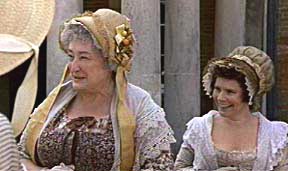
Mrs. Jennings and Mrs. Palmer, Sense and Sensibility

As I get older I see that Lady Catherine de Bourgh is all bluster, and that her authority over Elizabeth Bennet is precisely zero. Young Lizzie is smart enough to know that, but as a 19 year-old reader, I was in awe of Lizzie’s stubborn attitude towards that lady when she stormed to Longbourn to demand Lizzie promise never to marry Mr. Darcy.
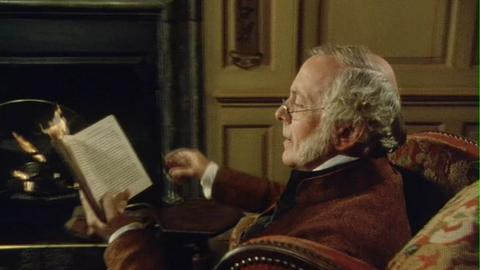
Mr. Bennet reading. Image from Jim and Ellen Moody

There are other ways that my attitude towards Jane Austen’s novels is changing. I notice how few happy marriages are portrayed. Right off the bat I can think of only the Crofts, the Gardiners, the John Knightleys, and the Musgroves. These days, I am more on the side of a pragmatic Charlotte Lucas, who has learned long ago not to look at the world through rose colored glasses, than Elizabeth, who waits for love. To be sure, she snagged her Mr. Darcy, but would Charlotte have had such an opportunity? I think not. I also see that Fanny Price’s strength of character and resolve in the face of so much bullying is a trait to admire; and that Mr. Bennet’s extensive library and unwillingness to compromise a cushy lifestyle were acquired at the expense of his family’s future financial security.

As the years roll by, my tastes and preferences for Jane’s novels are changing. Persuasion and Pride and Prejudice are running neck and neck in my favorite category. P&P used to have the field all to itself. While I loathed Mansfield Park the first time I read it, I don’t mind it so much now, and I find Emma less and less interesting and much too long . Perhaps I should lay the book aside for a few years.

Are your tastes and preferences changing towards Jane Austen’s books and characters as time goes on? How? Curious minds want to know.
Read Full Post »

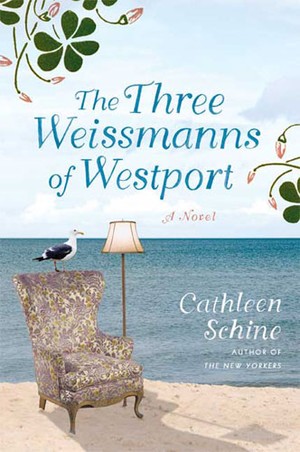
The Three Weissmanns of Westport: A Novel by Cathleen Schine is reviewed by Lady Anne, Vic’s close friend and fellow Janeite.

As a devoted Janeite, I am also known to indulge in the occasional novel based on our Jane’s tidy output. I have engaged in several discussions, some more cheerful than others, about these attempts at updating and revising. Generally, I find them wanting – in voice, or understanding, or grace in writing. And while I understand that the zombies and sea monsters have their fans, I do not count among them.

That being said, I was intrigued by a New York Times review of the Three Weissmanns of Westport. Cathleen Schine, the author, writes in that somewhat undervalued category known as the domestic comedy. She is a graceful, elegant writer, very much of New York. And, said the review, she based this latest book on Sense and Sensibility. Further, the review stated, she did it well.

And I would agree. First of all, this is definitely a 21st Century take. Betty Weissmann is a 75 year old whose husband of close to 50 years is divorcing her for ‘irreconcilable differences.’ That difference is named Felicity and she works in his firm. She is as eager to have the domicile – a wonderful Upper West Side apartment – as Mrs. John Dashwood ever was, and that scene of breathtaking greed plays out just as sparklingly satiric as our Jane’s ever did:

“Naturally I’ll give her the apartment,” Joe said. It seems only right….She’s put so much work into it. It’s her baby.”

Felicity had seen the apartment. In a magazine. It sparkled and gleamed with a comforting Old World charm. Or so the magazine said. To Felicity, it just looked big and luscious…She would like to live in such an apartment…

“It really is a burden, that big old place,” Felicity said. “Poor Betty. I don’t envy her. At her age.”

“She ought to downsize,” Joe said. “We should sell the place, and she can take her share and buy something a little more realistic.”

“Joe, you really are a generous man,” Felicity said. “And self-sacrificing, too.”

He looked at her blankly. He knew he was generous and self-sacrificing, but just for a moment he could not quite make out how this act of taking half the proceeds rather than none fit that description. Then Felicity said, with some alarm, “But what about the taxes? There will be hardly anything left from the sale after taxes. Poor Betty. It will really be a burden on her, much more than on you…At her age,” Felicity murmured again.

And so it was decided. Joe would be generous and keep the apartment.
The Weissmann women – Betty and her daughters: Annie, a librarian and divorced mother of two boys now young men and longer at home; and Miranda, a literary agent who never married, and whose business collapsed in an Oprah-inspired scandal of created memories, leave the City and move into a little beach cottage in Westport, Connecticut, that an old friend and connection makes available to them. The entire collection of characters from Sense and Sensibility appears, each with a new and very contemporary sensibility. This version of Willoughby is a younger man, an aspiring actor who leaves for the Coast with more speed than is flattering when a chance of a TV role comes his way. However, his ex-wife and son play important roles in Miranda’s story. Annie, the sensible librarian has been interested in Felicity’s brother, Frederick, but he cools off, and appears to have been involved with his house sitter, one of a pair of sisters definitely looking for the Big Score. Frederick’s problem is not lack of money like Edward Ferrars, but lack of inner conviction.

The final disposition of the characters is different from Jane’s version, which serves to keep the book fresh. Schine takes the framework of two devoted sisters and their charming, if somewhat flighty mother – neither Betty nor Miranda understands the first thing about money matters including the bankruptcy of Miranda’s business, and Annie handles far more than her fair share of the family burdens. But she does end up with the lovely man at the end – even if he seemed throughout the book to be Col. Brandon. And since I liked him better than I liked Frederick, I was glad. Annie had, just like Elinor did, a lot to put up with, given family, mother, and sister, and she deserves a happy ending.

Much better written than most modern versions of Jane’s books I have read, The Three Weissmanns is an excellent update: not trying to force Jane into modern times, but seeing how the modern times would modify a Jane plot. It works well.

Which is what we would expect.

Gentle readers: Lady Anne is my well-shod and well-clad friend and co-founder of The Janites on the James, a group of opinionated Austenites. We are passionate about Jane Austen, and have agreed to disagree about our interpretation of her novels. Our discussions are lively and laced with drinks from her era: Port, syllabub, fine wine, and, yes, beer. Anything to stave off dysentery and typhoid fever.

Read Full Post »

Inquiring readers: In March I learned from David Cordess that he had created a blog, Following Jane. The blog would be his journal as he read all of Jane Austen’s books in six months. David has completed Northanger Abbey and is now reading Sense and Sensibility.

Here are a few of his observations about NA (going backward):

I finished Northanger Abbey and can honestly say that I’ve discovered the depth and range of the female perspective. Jane sure does know how to encompass and present readers with a quality character. Perhaps that’s why she’s so loved…. Because readers can connect to her characters.

It was interesting to follow along in a story to a female’s perspective. The complexity of how she processes her life, love, and relationships was fascinating to read from a limited, almost 1st person, point of view

I never thought that I’d be romancing my wife and thinking about the validity of my relationships when I opened to page 1 of NA.

Austen has such a way of influencing, enticing, and inviting readers into this authentic and perspective world of society and life. Anyway… those are my thoughts for now.

Once Isabella breaks up w/ James, Catherine comes alive. I can see how pieces of the puzzle begin to connect and how her character makes a drastic leap forward in decisions, relationships, and truth of her own emotions and feelings. A woman coming into her own… Thanks Jane for finally giving your protagonist worth and validity.

Enough quotations from his blog . To actually read David’s progress, go to his website and follow him as he Follows Jane. I also want to share a wonderful comment left on my March post by a Dutchman named Henk (Henk actually left two comments – thank you):

The first four months of this year were dedicated entirely to Jane Austen. I finished with reading P&P a few weeks ago.
The first week of May we introduced good friends of us to England, by camping in the New Forest.
I had made clear before, that one day would be for me, to visit the Jane Austen House in Chawton and the cathedral in Winchester.

Standing at her grave 8 years ago put me on the feminine side of reading, and opened many windows for me, never to be closed again.

They went with us, including their two daughters, 18 and 20.
They were really interested, and because the oldest girl had expressed her recent interest in English reading, I bought P&P for her. ( The book ).

All this was not without emotion, I dare say.

I am 56, and have three sisters a bit older than me.
Somehow the presence of Jane was all around in the house, and how nice it would have been to make a cup of tea for Jane, while she was writing, or walk with her to the kitchen to talk while doing some cooking. The things that brothers do with sisters on the few occasions they meet each other.
I might have a spell till Fall doing other things not JA-related.
But one does not keep a Lady ( Susan ) waiting too long.

Other posts on this topic

Read Full Post »

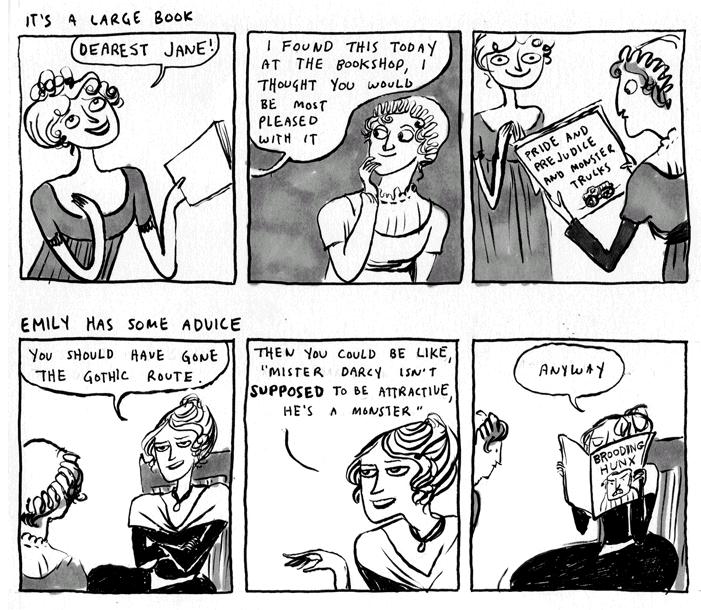
Gentle Readers: Jane Austen has inspired many people to comment on her novels, including comic artists. The recent Jane Austen/Monster Mash Ups provide a fertile field for visual satire. Jane Bites Back and other mash-ups are the inspiration for “Austen’s Revenge” by Liz Wong. (Click on images to enlarge them.)

A comic inspired by the recent Jane Austen Paranormal trend (Pride and Prejudice and Zombies, Sense and Sensibility and Sea Monters, Jane Bites Back, The Immortal Jane Austen, Mr. Darcy, Vampyre, Mr. Darcy’s Hunger… yes, these are all actual published books…).

This is Jane’s revenge for taking such liberties with her work.
The ever popular Kate Beaton is well known for her historical satires, and I have showcased her work before. Most recently she jumped on the monster mash-up bandwagon! I must say that these are pretty funny.

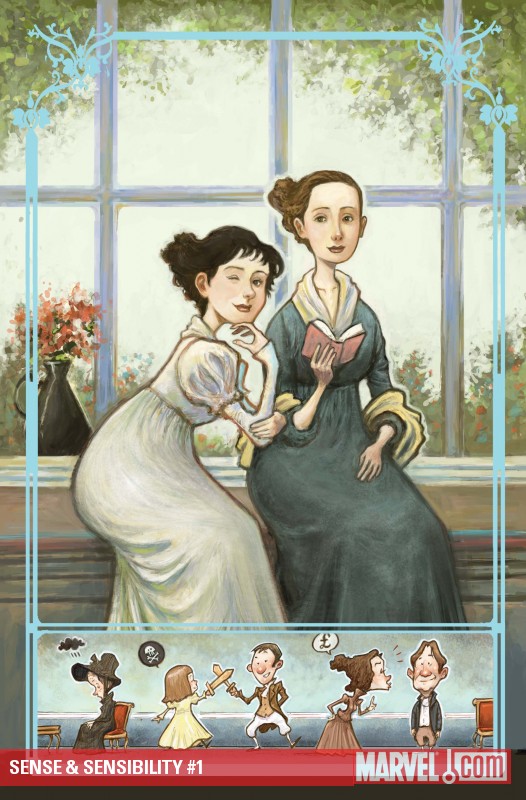
Don’t forget that a new Sense and Sensibility graphic novel will be released by Marvel Comics on May 26th! Sonny Liew drew the illustrations for this new graphic treatment of Marianne and Elinor Dashwood’s story.

Read an interview with Nancy Butler, the master mind behind this comic and Pride and Prejudice, which was published last year and became a huge hit.

Add to DeliciousAdd to DiggAdd to FaceBookAdd to Google BookmarkAdd to RedditAdd to StumbleUponAdd to TechnoratiAdd to Twitter

Read Full Post »

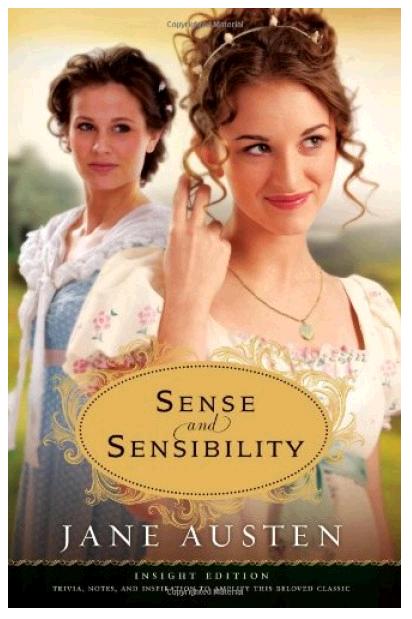
Sense and Sensibility by Jane Austen, the Insight Edition from Bethany House is a lovely annotated version of this classic novel. The intended audience is obviously a young Christian girl or someone who is reading the novel for the first time. The notes sit in the margins; they are not too obtrusive or overly verbose, but they do add a dimension to reading the book. Symbols indicate what sort of comment to expect. For example, a feather tells us that we will learn a tidbit about Jane Austen’s life. A small cross will indicate themes of faith drawn from the novel or her life; a small crown leads to historical facts. (“Consumption: tuberculosis; once referred to as consumption because it “consumed” the body. P. 189.)  Smiley faces tell us about parts of the novel that make the reader smile, and frownies assure us that the character has become nothing but irritating. (On page 133, “ranking our dislike: 1. Fanny; 2. Lady “Passive-aggressive” Middleton, 3. ..”etc.)

Many of the annotations deal with scenes from film adaptations, which help to clarify them in relation to the book (look for the camera symbol). With the inclusion of these film annotations, Bethany House rightly assumes that many people reading Jane Austen for the first time seek out her novels only after seeing a movie based on her novel.

The foreword by Julie Klassen is short and to the point, and the book group questions in the back are neither pompous nor difficult to discuss. In short, this book provides a wonderful introduction to Sense and Sensibility, one of Jane Austen’s earlier novels and, next to Pride and Prejudice and Northanger Abbey, the most accessible to her new fans. Bethany House also offers a Pride and Prejudice edition, which I surmise must contain similar annotations and book group questions.

I highly recommend this book to new readers of Jane Austen, especially those who possess only a cursory knowledge about her life or the Regency era. Before purchasing the book for yourself or a friend or loved one, you should aware of the many notes that pertain to faith. The quotes are informative and not preachy, as on p. 145: “The hard core of morality and even of religion seems to me to be just what makes good comedy possible…where there is no norm, nothing can be ridiculous…” C.S. Lewis, “A Note on Jane Austen, Essays in Criticism.” This edition of Sense and Sensibility points out how Jane’s faith informs her writing and her life, which is natural given that her father and two of her brother were men of the cloth.

In reading this book I am enjoying my revisit with Marianne and Elinor, and the shenanigans of the devious Lucy Steele and mean-spirited Fanny Dashwood. I still find Willoughby’s conduct reprehensible for a man in love, but Colonel Brandon, though a tad boring, makes my heart patter with his devotion and strength of character . The margin notes, written by Jane Austen fans (not scholars)  have enriched my enjoyment of this edition, and thus I give it three out of three Regency fans.

About Bethany House: Bethany House Publishers, a division of Baker Publishing Group, has been publishing Christian fiction books for 50 years. Nearly 120 titles are published annually, including historical and contemporary fiction, Christian living, family, health, devotional, children’s, classics, and theology subjects.

Sense and Sensibility, insight ed. by Jane Austen
ISBN: 978-0-7642-0740-2
Price: $14.99
Format: Paperback
Division: Bethany House

Read Full Post »

« Newer Posts - Older Posts »