Feeds:
Posts
Comments

Archive for the ‘Sense and Sensibility’ Category

IMDb has become an indispensable site for those of us who love movies. I especially love the trivia the site features about each film. Take Emma 2009, for example. Costumes that were recycled from other films are listed there. Let’s look at a few:

Johdi May's purple coat

The purple coat Jodhi May (Mrs. Weston) wears on market day in Highbury is the same costume Hattie Morahan (Elinor Dashwood) wears when she arrives at Barton Cottage in “Sense & Sensibility” (2008).

Elinor in purple pelisse

The dark Spencer worn by Louise Dylan (Harriet Smith) to visit the poor is the same costume Lucy Scott wears in “Pride and Prejudice”(1995).

Harriet Smith (Louise Dylan) in dark spencer

The off-white dress with floral embroidery on the bodice worn by Christina Cole (Mrs. Elton) for her big entrance in church is the same costume worn by Cesca Martin in “The Regency House Party” (2004) during her “engagement,” and by Natasha Little (Becky Sharp) at Park Lane in “Vanity Fair” (1998).

Christina Cole as Mrs. Elton, Her Entrance in Church

The gray gown with gold bow print worn by Tamsin Greig (Miss Bates) to Miss Taylor’s wedding is the same costume worn by Anna Massey (Aunt Norris) in “Mansfield Park” (1983), Phyllida Law (Mrs. Bates) in Emma (1996), Lindsay Duncan (Mrs. Price) when Fanny leaves home in Mansfield Park (1999), Janine Duvitski (Mrs. Meagles) in “Little Dorrit” (2008), and Linda Bassett (Mrs. Jennings) in London in “Sense & Sensibility” (2008).

Miss Bates in gray pelisse and Emma in a floral gown

The floral print dress worn by Romola Garai (Emma) to Miss Taylor’s wedding is the same costume worn by Dagmara Dominczyk (Mercedès Iguanada) for Edmond’s homecoming at the beginning of The Count of Monte Cristo (2002).

Johdi May in lilac floral colored wrap dress

The lilac colored floral wrap dress Jodhi May (Anne Taylor/Weston) wears at Hartfield is the same costume worn by Denise Black (Mrs.Brocklebank) in “To the Ends of the Earth” (2005), and Alex Kingston (Mrs.Bennet) in “Lost in Austen” (2008).

Wearing a floral waistcoat at the Cole's party, Jonny Lee Miller as Mr. Knightley

The blue floral waistcoat Jonny Lee Miller (Mr.Knightley) wears at the Coles’ party is the same costume worn by Joseph Beattie (Henry Crawford) in Mansfield Park (2007) (TV).

Henry and Mary Crawford

For more recycled fashion comparisons, go to this link.

Read Full Post »

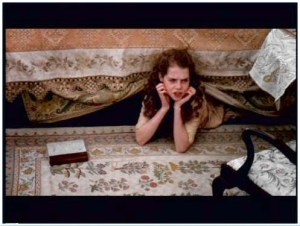
We continue our revisit with Sense and Sensibility and visual review of Part 2 of the movie (click here for Part 1) wherein Mrs. Ferrars is suitably creepy and mean, and Marianne’s tear ducts gush more water than the fountains at Chatsworth House. While many details in Jane’s novel were changed in this production, the film’s length was satisfying. Strangely I found many echoes of Emma Thompson’s and Ang Lee’s excellent 1995 film in this adaptation as well.

Margaret hiding in the library is a scene taken from the 1995 film.

Margaret hiding in the library is a scene taken from the 1995 film.

Lucy and Anne Steele had different accents. While Lucy seemed more refined, Anne stole the show.

Lucy and Anne Steele spoke in different accents. While Lucy seemed more refined, Anne was comedic.

Henry Dashwood, much older than in Jane's novel, seems a bit embarassed wearing those curls and collar.

Henry Dashwood, much older than in Jane's novel, seems a bit embarrassed wearing long curls and a frilly collar.

Edward chopping wood in the rain.

Working off his frustration, Edward chops wood in the rain.

Elinor talks to Edward in the rain.

Elinor, confused with Edward's behavior, talks to him in the rain.

In fact most of the outdoor shots were filmed in the rain.

In fact most of the outdoor shots were filmed in the rain.

In London Marianne looks for Willoughby in vain.

Newly arrived in London, Marianne looks for Willoughby in vain.

Lucy and Anne ogle the nasty beasts at the assembly.

Lucy and Anne ogle the nasty beasts, as Anne describes the men at the ball.

When she finds him she is seriously displeased.

When Marianne sees Willoughby she overcome.

Marianne finally receives a letter from Willoughby.

Marianne finally receives a tepid letter of explanation from Willoughby.

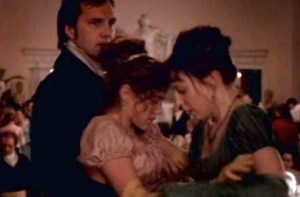
Edward awkwardly offers his arm to his betrothed in front of Elinor.

Edward awkwardly offers his arm to his betrothed in front of Elinor.

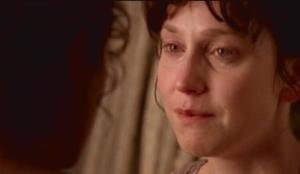
Elinor confesses to Marianne how unhappy she has been.

Elinor confesses to Marianne how unhappy she has been.

Mrs. Ferrars is seriously displeased with Edward when he confesses his engagement to Lucy.

Mrs. Ferrars is seriously displeased with Edward when he confesses his engagement to Lucy.

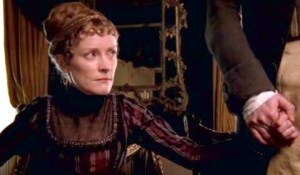
Fanny Dashwood, equally upset, holds onto her husband's hand.

Fanny Dashwood, equally upset with the news, clenches her husband's hand.

Marianne wants to leave London.

Marianne cannot wait to leave London for home.

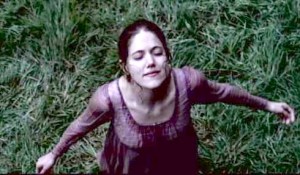
Walking to Willoughby's house, Marianne is refreshed by the rain.

She walks to Willoughby's house in the rain and catches a lung infection, more reminiscent of the 1995 film than Jane's novel.

The colonel is beside himself with worry.

The colonel is beside himself with worry.

Charity Wakefield, looking suitably wan, properly thanks Colonel Brandon.

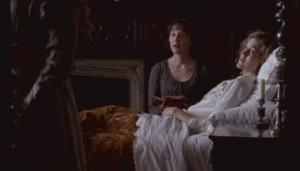
Marianne looked suitably wan in bed, but very pretty when she thanks the colonel.

An anguished Willoughby tries to convince Elinor that he truly cared for Marianne.

An anguished Willoughby tries to convince Elinor that he truly cared for Marianne.

The film ends on a happy and romantic note in a scene that is eerily similar to 1995's Sense and Sensibility.

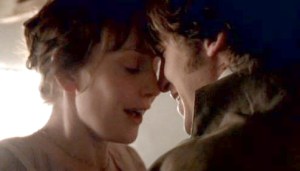
The film ends on a happy and romantic note in a scene that is eerily similar to 1995's Sense and Sensibility.

The colonel carries his bride across the threshold.

The colonel carries his bride across the threshold.

My other Sense and Sensibility posts sit here, including Sense and Sensibility Soaked.

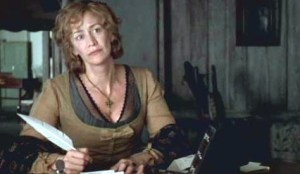
Post script: Where was Janet McTeer/Mrs. Dashwood? A fine actress, she wasn’t given much camera time except for reaction shots.

Think I'll add a few more Mrs. Dashwood lines in the script. Wonder if anyone will notice?

Think I'll add a few more Mrs. Dashwood lines in the script. Wonder if anyone will notice?

Read Full Post »

This link to All Edges Gilt features a Johann Zoffanny illustration of Jane Austen based on a disputed painting, the Rice portrait by Ozias Humphry. Zoffanny’s fronticepiece is found in a 1906 publication of Sense and Sensibility. In Johann’s clumsy drawing, Jane’s head is too large and her feet are too small. The rest of the proportions are close enough.

Humphry’s portrait famously failed to sell at a Christie’s auction in New York in April, 2007.

Read Full Post »

In my private library I own many versions of Jane Austen film adaptations, starting with the BBC Jane Austen Collection. Two of the films, Emma and Persuasion, were made in the early seventies, the other four films were produced in the 1980’s. In the space of one decade the changes in sets, costumes, and acting were remarkable. During the 1970’s the actors would rehearse their roles for several weeks before the movie was filmed on video tape, which was grainy. These 70’s costume dramas had an old-fashioned, static and staged feel to them, and from our modern perspective the 70’s hair styles and make-up were glaringly wrong. It was hard to look past the 70’s teased ringlets and see a Regency lady. By the 1980’s, staged sets were beginning to be replaced by outdoor shots and actual interiors. (Persuasion, 1971 showed Anne Elliot in Bath and Lyme Regis, but these were transition shots.)

My (relative) aversion for these earlier staged films explains why I have not seen the 1971 adaptation of Sense and Sensibility. I checked Netflix to see if the film was available for rent, but one has to purchase the film in order to view it, unless a VHS copy is available at a local library. So, when Professor Ellen Moody wrote about Sense and Sensibility 1971, I asked her if I could showcase her thoughts on my blog. Ellen is an authority on Jane Austen and, just as importantly, on the films based on Jane’s novels. Reading her reviews, I am always struck by how Ellen can view these older BBC films dispassionately and compare and contrast the plots against newer, more sophisticated film adaptations and Jane’s novels. She is not put off by dated staging or costumes, and stilted camera shots; instead she hones in on the characters and how faithful they are to a Jane Austen novel. When she read my previous observations, she responded with these words:

The earlier films are worthy — the way earlier famous painting or illustrations or books are. You have to get into the aesthetics of the era, sort of “see through” them to the core experience. We are doing this for Austen when we read her. I’ve even (by dint of rewatching) learnt to accept the extravagant hairdos of these later 60s early 70s films. The 72 Emma does not have them and I’ve noticed the faultline or divider is around 1972. Before that these hairdoes; after that either historically accurate ones or natural (meaning some mildly historized version of contemporary modern) ones.
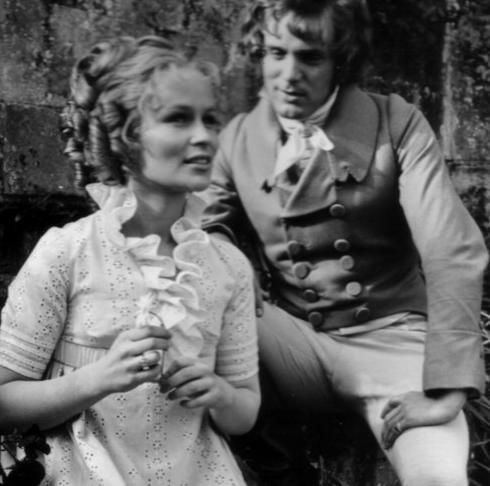
Marianne and Willoughby (Ciaran Madden and Clive Francis )

Here, then, are Ellen’s thoughts about S&S 71:

I’m now closely watching the 1971 Sense and Sensibility, written by Denis Constanduros, and it has many merits. If faithfulness and originality were really prized, it’d be prized. It’s the most original of the S&S adaptations as it had nothing to build on. One can see that Alexander Baron in his 1981 S&S script used the 1971 outline to some extent, such as having Brandon at the ball/assembly where Marianne is snubbed, a scene also used by Andrew Davies for S&S 2008; and it’s faithful to the original proportions. The climax of Jane Austen’s Sense and Sensibility, Volume I is Lucy telling Elinor her secret and triumphing over her (not the snubbing at the ball, not Willoughby’s departure, and certainly no duel); the climax of Austen’s Volume II is Lucy’s invitation to go live with Fanny Dashwood, which is the result of her encounter with the Dashwoods and Mrs Ferrars at the dinner party where Mrs Ferrars snubs Elinor over her fire screen.
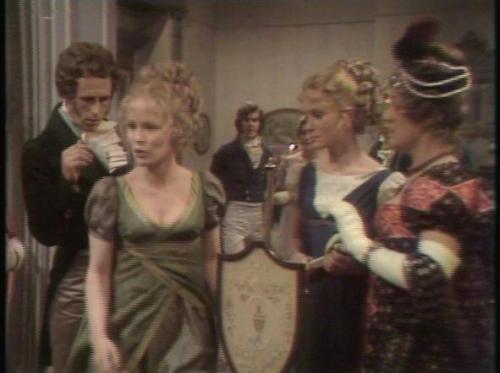
In the book, Willoughby’s desertion of Marianne occurs about half-way through Volume I. Therefore, Volume I climaxes not on Willoughby’s leaving but on Lucy’s revelation she’s engaged to Edward. That’s the deeply painful ending. In the book, Willoughby’s snubbing of Marianne occurs midway in Volume II; the climax of II occurs when Lucy is invited to stay with the Dashwoods in London, after the party where Mrs Ferrars humiliates Elinor. The 71 S&S keeps an equal emphasis on Lucy torturing Elinor and Elinor humiliated at Mrs Ferrars (with Marianne defending her) as it has on Willoughby’s snubbing Marianne. The 95 S&S and 08 S&S lengthen out the stay in Barton cottage and make the London sequence much much shorter; they make the relationships with the women much less emphatic, give it much less time than the relationships of the men and women; the 95 in particular loses the social satire. (I still think it the masterpiece of film art above the others, but it is very different from Austen’s proportions and emphasis.) The 81 keeps the proportions better but downplays the poisonous relationships among the women and social satire.

Of all the S&S film adaptations I’ve watched thus far, the 1971 version does this scene of Mrs Ferrars’s cruelty (even Fanny Dashwood in the book thinks it a bit much) most thoroughly (as it builds Lucy far more thoroughly and keeps Nancy and Lucy’s cruelties to Nancy), and what I want to say is how remarkable it seems to me that it still pains me to go through it. After all these years, I find myself averting my head not to look when Marianne cracks. Elinor has to watch her crack and this is where the gut of the scene lies. The 81 film has this too – to be fair, but the 1981 has not given us the full portrait of Lucy as this one has; the latter film has begun to build up Brandon more and the men.

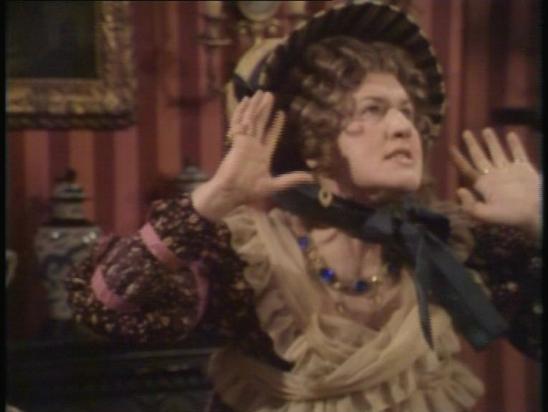
In the 1971 film adaptation of Sense and Sensibility one can watch a close reenactment of the text in Volume I, Chapter 1. What happens there is Mrs Jennings (a comic character) comes in to tell Marianne and Elinor Dashwood what she has heard from someone about what happened with another group of characters. Those who know the novel will know that Mrs Jennings is told her story by a doctor who was called in to treat Fanny Dashwood after Fanny gets hysterical when she learns from Nancy Steele that her sister Lucy is engaged to Edward Ferrars. Mrs Jennings’ speech is inordinately long and in a paper I published I argued this was once originally a long letter written by Mrs Jennings, a comic one to someone else telling this story. The effect of this is to intersperse what happened dramatically with lots of explicit explanation from Mrs Jennings, some of it comic and incongruous and some of it philistine, but much spot on.

In the book we get another long (unusually long) speech by John Dashwood who comes in to tell the rest. Again I argued this was an epistolary narrative, a letter by Mr Dashwood telling another part of the story — about how Edward was disinherited. The scriptwriter, Constanduros, departs by having Mrs Jennings tell the whole. Mrs Jennings is played by an inimitable comic actress named Patricia Routledge who eventually became a Dame and she is just marvelous in this retelling (which is interrupted by the actress who plays Marianne who interperses with “Madame, how can you …” and “Don’t believe her … Don’t listen to her,” which Mrs Jennings interrupts her flow to object to, “It is true. It is, it is! ……)

In the two other S&S (1981 and 1995) the long monologue is scantier, just a bit given to the actress playing Mrs Jennings (Elizabeth Spriggs in the 1981 adaptation, another marvelous actress, who died in early July (click on link), but short so we can get onto the real business that interests scriptwriter Emma Thomson, which is Elinor’s misery and revelation of deep emotion (same goes for the ’81 film if not acted with the same effectiveness). In a way the recent adaptation by Andrew Davies (S&S 2008 ) is closer to Jane’s script in that he dramatizes the matter in what I think were originally two letters. But by doing this he loses not only the comedy but the explicit statement, the penumbra of nuances and inferences to be drawn and we get a strained melodramatic theatrical scene.

While it may seem crude to a modern audience to have this kind of material presented as comic, it is what is in the original book and I think a chapter which shows just this drive towards explicit
explanation, for in Austen we then get the two sisters talking and Elinor does make explicit how she has suffered for four months and tells all and the drama of withholding makes that long explanation believable.

I submit that the popularity of epistolary narrative in the 18th century is testimony to the drive to make explicit what is implicit, to bring what Carol Shields taught us in _Unless_ is the back story (or explanation into the public gaze where normally all one gets is the front (conventional and often untrue) explanation.

It has been said by some literary scholars of the 18th century (long ago by Irvin Ehrenpries and recently in one of John Richetti’s edited volumes on 18th century history and the 18th century novels) that there is a strong drive to give readers an explicit and full explanation of what’s happening in the novel and the procedures used to present them. It’s my view that the drive to the explicit statement may be part of the impetus which creates the epistolary narrative and makes it so popular in the era.
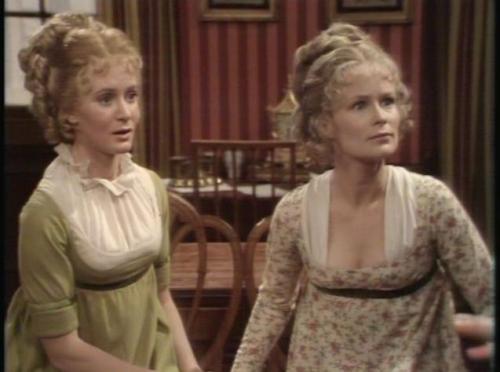
As a postscript, I’d like to add that in the literary criticism of Sense and Sensibility Marianne is nowadays occasionally called the Cassandra figure of the novel. The use of the term would seem to suggest Christa Wolf’s novel [ Cassandra, a masterpiece in German, later 20th century, 1988] and Wolf’s reading of the meaning of the figure have entered the general conversation of feminism and also literary criticism.

Despite the comedy of the ’71 S&S, the actress who plays Marianne (Ciaran Madden) does enact a Cassandra role. When Elinor is humiliated (as I’ve just described), Marianne comes forward to vigorously protest, point out Mrs Ferrars’s lies and support Elinor’s drawing. Alas, human beings being what they are instead of being grateful, she is seen as a pariah to have shouted out these truths. When in the ’71 film Willoughby tries to brush Marianne off in a famous scene at a ball, he cannot as she will not play the social games he expects her to. In this film he does not exactly snub her but tries to hint at ways she can save face for him and her, and she just won’t.

Click here to read Ellen’s post about the film on her blog, Ellen and Jim Have a Blog Too

Read Full Post »

In Sense and Sensibility, a conversation between Marianne and Elinor during Edward Ferrars’ visit to Barton Cottage reveals how much income Marianne considers suitable for setting up house. The Dashwoods had been reduced to living on £500 per year, or around 17,000 pounds in today’s terms. Marianne mentions a sum of £1,800 – 2,000 pounds a year as being adequate in an age when male servants earned from £20 to £60 a year and a female servant from £5 to £15 pounds per year. While these incomes seem desperately low, room and board were usually included. Coal cost 50 pounds per year, and the rent of a medium sized house in London ranged from £12 to £25 per year.* If a family’s income was less than £100 for a single person or £200 for a couple, then the head of the house would probably have to work for a living.

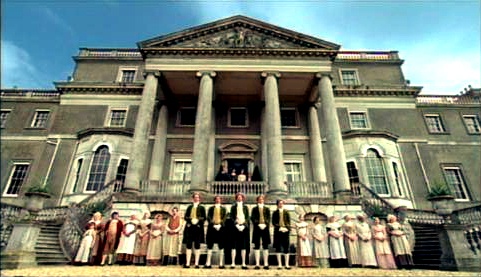
“An income of two thousand pounds was considered quite comfortable, allowing people to maintain a large house, keep horses and a carriage, and employ eleven servants.” (Life in Regency England: More Than Games). Such an income would not have been enough to maintain Norland Park (below), but it would have been quite enough for Willoughby, who married an heiress with £50,000. The interest on that sum would have been £2,000 per year.

Edward: “As moderate as those of the rest of the world, I believe. I wish as well as every body else to be perfectly happy; but, like every body else it must be in my own way. Greatness will not make me so.”

“Strange that it would!” cried Marianne. “What have wealth or grandeur to do with happiness?”

“Grandeur has but little,” said Elinor, “but wealth has much to do with it.”

“Elinor, for shame!” said Marianne, “money can only give happiness where there is nothing else to give it. Beyond a competence, it can afford no real satisfaction, as far as mere self is concerned.”

“Perhaps,” said Elinor, smiling, “we may come to the same point. Your competence and my wealth are very much alike, I dare say; and without them, as the world goes now, we shall both agree that every kind of external comfort must be wanting. Your ideas are only more noble than mine. Come, what is your competence?”

“About eighteen hundred or two thousand a-year; not more than that.”

Elinor laughed. “Two thousand a-year! One is my wealth! I guessed how it would end.”

“And yet two thousand a-year is a very moderate income,” said Marianne.“A family cannot well be maintained on a smaller. I am sure I am not extravagant in my demands. A proper establishment of servants, a carriage, perhaps two, and hunters, cannot be supported on less.”

Elinor smiled again, to hear her sister describing so accurately their future expenses at Combe Magna.

“Hunters!” repeated Edward—“But why must you have hunters? Every body does not hunt.”

Marianne coloured as she replied, “But most people do.”

Knowing her situation and prospects, we see how far fetched Marianne’s statements must sound to Elinor and Edward. A woman without fortune needed luck on her side to snag a husband with such an income: she could not depend on looks alone, although great beauty, such as Lady Emma Hamilton possessed, helped a great deal. If a woman had only beauty, then an extravagant man like Willoughby, who could not live without his hunters, must look else where for a bride. As Stephanie Edelman writes in a JASNA Essay contest:

    Austen demonstrates throughout Sense and Sensibility just how much inheritance influences the marriage market. Willoughby, who “had always been expensive,” intended to “re‑establish [his] circumstances by marrying a woman of fortune”­–Miss Grey, with her “fifty thousand pounds” ‑‑despite his attraction to Marianne. His actions are not surprising, for even Mrs. Jennings explains that “when there is plenty of money on one side, and next to none on the other” romance can take a back seat to economics. Beauty sometimes compensates for a lack of fortune, as Mrs. Jennings hopes when she claims that Marianne would be perfect for Colonel Brandon, “for he was rich and she was handsome”, but a loss of beauty lowers one in the marriage market. Because Marianne worries herself sick over Willoughby and, in John Dashwood’s opinion, “destroys the bloom forever”, he “question[s] whether Marianne now, will marry a man worth more than five or six hundred a‑year, at the utmost”. Thus we see families being formed, not on the basis of love and respect, but on inheritances, yearly incomes, and how much one is willing to pay for beauty. – The Family of Dashwood by Stephanie Edelman

For a fuller explanation of incomes during the Regency era and their relative value today, click on my other post, Pride and Prejudice Economics.

More links on the topic:

*The Period House: Style, Detail, and Decoration: 1774 – 1914, Richard Russell Lawrence and Teresa Chris, Phoenix Illustrated, 1996, 192 pages

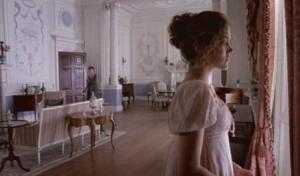
Images: 1st – Sense and Sensibility 2007; 2nd – Sense and Sensibility 1996.

Read Full Post »
« Newer Posts - Older Posts »