Feeds:
Posts
Comments

Archive for the ‘Servants’ Category

The general servant, or maid-of-all-work, is perhaps the only one of her class deserving of commiseration: her life is a solitary one, and in, some places, her work is never done. She is also subject to rougher treatment than either the house or kitchen-maid – Mrs. Isabella Beeton
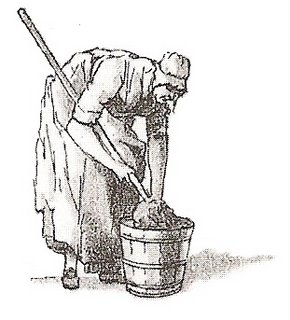
Maid of all work, W.H. Pyne

Maid of all work, W.H. Pyne

Gracie, the maid of all work in Anne Perry’s mystery novels, was lucky. Charlotte Pitt, the wife of Inspector Pitt, was a good and kind mistress who worked alongside her maid and gave gentle instructions. They quickly established a friendly relationship. Charlotte’s kindness did not make Gracie’s work life much easier, but she was luckier than most of her counterparts. In her Book of Household Management, Mrs. Beeton places a maid of all work lower than even a scullery maid. According to Mrs. Beeton, an ambitious scullery maid could learn skills from the kitchen maids and cook and move up the servant ranks, whereas a maid of all work was generally stuck in her position.

As with the scullery maid, the maid of all work was generally a very young girl. She could also be a mature woman so down on her luck that the only other choices open to her were life on the streets or finding shelter in a work house, which was to be avoided at all costs. In Mansfield Park Fanny’s family in Portsmouth is described as being poor, yet even they were able to hire a maid of all work, so you can just imagine what the work conditions were like for these poor women, who literally did everything from cooking, sweeping the floors, hauling water, carrying out slops, looking after the pets and children, laundering, changing the beds, and serving the family at mealtimes. Maids of all work were the first to rise and the last to go to bed. If the house was small, they were lucky to receive a pallet to sleep near the fire in the kitchen. As for time off to rest and recuperate, a maid of all work was at the mercy of her employer.

The following description of a maid of all work comes from ‘The Dictionary of Daily Wants’ – 1858-1859:

MAID OF ALL WORK. – A domestic servant, who undertakes the whole duties of a household without assistance; her duties comprising those of cook, housemaid, nurserymaid, and various other offices, acccording to the exigencies of the establishment. The situation is one which is usually regarded as the hardest worked and worst paid of any branch of domestic servitude; it is, therefore, usually filled by inexperienced servants, or females who are so circumstanced that they are only desirous of securing a home, and of earning sufficient to keep themselves decently clad. In many of these situations, a servant may be very comfortably circumstanced, especially if it be a limited family of regular habits, and where there is a disposition to treat the servant with kindness and consideration.

The duties of a maid of all work being multifarious, it is necessary that she should arise early in the morning; and six or half-past six o’clock is the latest period at which she should remain in bed. She should first light the kitchen fire, and set the kettle over to boil; then she should sweep, dust, and prepare the room in which breakfast is to be taken. Having served the breakfast, she should, while the family are engaged upon that meal, proceed to the various bedchambers, strip the beds, open the windows, &c. This done, she will obtain her own breakfast, and after washing and putting away the things, she will again go upstairs, and finish what remains to be done there.

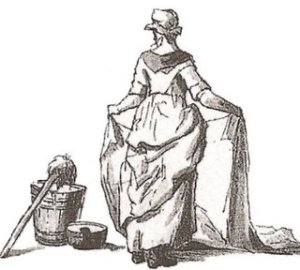
W.H. Pyne, Microcosm of London

W.H. Pyne, Microcosm of London

As the family will in all probability dine early, she must now set about the preliminaries for the dinner, making up the fire, preparing the vegetables, &c. After the dinner is cleared away, and the things washed and put by in their places, she must clean the kitchen; and this done, she is at liberty to attend to her own personal appearance, to wash and dress herself, &c. By this time the preparation for tea will have to be thought of, and this being duly served and cleared away, she must employ herself in needlework in connection with the household, or should there happen to be none requiring to be done, she may embrace this opportunity to attend to her own personal necessities. Supper has then to be attended to; and this finished, the maid of all work should take the chamber candlesticks, hot water, &c., into the sitting-room, and retire to rest as soon as her mistress or the regulation of the establishment will permit her.

The duties here set down can only be regarded as an outline rather than a detail, the habits of every family varying, and thereby regulating the amount of labour demanded, and the order in which the duties are to be performed. As a rule, however, a maid of all work, if she wish to retain her situation, must be industrious, cleanly, and thoughtful; and not only able to work, but to plan.
Read Full Post »

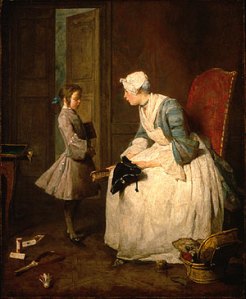
the-governess-1739-jean-simeon-chardin2“With the fortitude of a devoted novitiate, she had resolved at one-and-twenty to complete the sacrifice and retire from all the pleasures of life, of rational intercourse, equal society, peace, and hope, to penance and mortification forever” – Jane Austen about Jane Fairfax in Emma

Working as a governess meant a life of limbo for the poor gentlewoman who was forced to support herself due to reduced financial cirdumstances. Jane Fairfax had every reason to fear her future employment. Governesses were a threat to both their employers and the servants of the house,  reminding their female employers of how close they were to finding themselves in a similar predicament. Because of their genteel upbringing governesses lived a life of isolation, not fitting in with the servants belowstairs, not even the housekeeper, butler, or nanny, who, while they belonged to the upper ranks of servants, came from humble origins. Governesses seldom earned enough to save for their old age, and their services were often exploited and undervalued.  Dinah Birch writes in her review of Other People’s Daughter: The Life and Times of the Governess by Ruth Brandon:

Their “predicament was earnestly debated in journals, advice books and manuals, educational treatises, newspapers, charitable commissions, lectures, reviews and memoirs. She became the object of inadequate charity, useless compassion and offensive condescension. Worse still, she had to endure the sense of having fallen from her proper place in the world, for most governesses had been brought up amid domestic comforts and cheerful expectations.”  

This passage from  The Uneasy World Between describes the governesses’ dilemma succinctly:

The governess was often perceived as being an emotional and social threat. Many gentlewomen were forced into the role by some financial catastrophe, reminding the families they worked for of a terrible possibility. Moreover, their intimacy with children often roused the mother’s hostility, and a war for the child’s love was the result. By the middle of the century, a spate of bank failures had hugely oversupplied the market with under- educated would-be governesses, some of whom were reduced to working for £20 a year, or even for nothing except bed and board. What happened to these when they grew too old to work — perhaps only at 40 — does not bear thinking about. Only very few governesses earned more than £200 a year; Sir George Stephen in 1844 only found a dozen. Charlotte Brontë, paid £20 a year in 1841, was much more typical. The social inequality flowed, however, in an unexpected way. Many governesses, more ladylike than their employers, were expected to give a sheen of social elegance to the children of the nouveaux riches. Resentment tended to flow both from the employers and from the servants’ hall. ‘I don’t like them governesses, Pinner,’ the cook in Vanity Fair says of Becky Sharp. ‘They give themselves the hairs and hupstarts of ladies, and their wages is no better than you nor me.’ The ugly situation was very clear to the more thoughtful women in this class. ‘I should be shut out from society,’ Mary Wollstonecraft wrote, ‘and be debarred the imperfect pleasures of friendship — as I should on every side be surrounded by unequals.’The one truly typical story here, perhaps, is that of a crushed and struggling woman, Nelly Weeton. We only know about her because she wrote a journal, discovered long after her death, cataloguing with great ill-humour and resentment the treatment she received at the hands of her drunken and snobbish employers, her bullying father and brother and ultimately an appalling husband. She’s not an attractive figure, full of self-pity and complaint, but her tragic story shows how much governesses at the bottom end of the market had to put up with.

The classic governess in our collective minds is Jane Eyre. She came from a relatively humble background,  but many a young governess came from a background and breeding that equalled  her employers. This definition written in 1849 in The Living Age  describes how  untenable the situation could be:

“…the real definition of a governess in the English sense is a being who is our equal in birth manners and education but our inferior in worldly wealth.  Take a lady in every meaning of the word born and bred and let her father pass through the gazette and she wants nothing more to suit our highest beau ideal of a guide and instructress to our children…There is no other class which so cruelly requires its members to be in birth mind and manners above their station in order to fit them for their station. From this peculiarity in their very qualifications for office result all the peculiar and most painful anomalies of their professional existence. The line which severs the governess from her employers is not one which will take care of itself, as in the case of a servant.

Governesses depended on the kindness of their employers. Emma’s governess, Miss Taylor, who later became Mrs. Weston, was fortunate enough to be treated like a member of the family. One surmises  that she was one of the few to make closer to the  £200 per year described above, than the average of  £20 pounds per year that most governesses earned. In real life, Agnes Porter (c. 1750-1814) was one of the lucky women to be treated with respect when she worked as a governess to the children and grandchildren of the second Earl of Ilchester. She wrote down her thoughts as an unmarried, employed gentlewoman in journals and letters that have been published. A devoted parent, Lord Ilchester took his children with him on on trips, leaving Agnes with enough  free time to entertain friends in her private apartments. She was also invited to dine  in with the family or spend an evening with them.  While Agnes’s experience was a relatively good one, she still would have preferred to be married. Becoming someone’s wife was a desirable goal, since prospects were bleak for a woman who was not “the property’ by anyone. ‘I could not forbear partially and deeply reflecting on the ills that single women are exposed to, even at the hour of death, from being the property of no one.’ ” (Information from: A Governess in the Age of Jane Austen: The Journals and Letters of Agnes Porter). 

In 1886, novelist Wilkie Collins wrote the following dialogue about the governess, Miss Westerfield,  in The Evil Genius: The Story:

Mrs. Linley returned to the subject of the governess.

“I don’t at all say what my mother says,” she resumed; “but was it not just a little indiscreet to engage Miss Westerfield without any references?”

“Unless I am utterly mistaken,” Linley replied, “you would have been quite as indiscreet, in my place. If you had seen the horrible woman who persecuted and insulted her–”

His wife interrupted him. “How did all this happen, Herbert? Who first introduced you to Miss Westerfield?”

Linley mentioned the advertisement, and described his interview with the schoolmistress. Having next acknowledged that he had received a visit from Miss Westerfield herself, he repeated all that she had been able to tell him of her father’s wasted life and melancholy end. Really interested by this time, Mrs. Linley was eager for more information. Her husband hesitated. “I would rather you heard the rest of it from Miss Westerfield,” he said, “in my absence.”

“Why in your absence?”

“Because she can speak to you more freely, when I am not present. Hear her tell her own story, and then let me know whether you think I have made a mistake. I submit to your decision beforehand, whichever way it may incline.”

The implication, of course, was that anyone with compassion would have hired Miss Westerfield. Learn more about the governess in the following links:

Read Full Post »

young-girl-of-spirit-constance-hillIn December 1859, Florence Nightingale wrote this letter of recommendation to Parthenope Verney:
My dear [Parthenope Verney]

It occurred to me after writing yesterday if you are going to set up a needlewoman under the housekeeper, Mary Jenkins, Bathwoman, Dr. W. Johnson’s, Great Malvern, has a niece, living at Oxford, a first-rate needlewoman, eldest girl of a very large family, who wants or wanted a place. If she is at all like my good old friend, her aunt, she would be a very valuable servant. Perhaps her needlework would be almost too good for your place. I believe she is a qualified “young lady’s maid,” though when I heard of her, she had never been “out,” i.e., in service. Perhaps she has a place. I think it answers very well in a large house to have as much as possible done at home, as little as possible “put out.”

This domestic job as needlewoman – mending, embroidering, making clothes – sounds benign compared to the custom of the Regency and Victorian eras to overwork seamstresses. While plying the needle was a common domestic activity (Jane Austen was known to possess a particular talent in this direction), working class seamstresses were appallingly overworked and underpaid, especially during the heyday of the Industrial Revolution. Many women toiled for long hours in poor lighting conditions, with some going blind from their employment. An apprentice seamstress in a milliner’s shop worked under slightly better conditions, but during the Season when demand for new and fashionable dresses was high, these women would also be pressed to work into the wee hours of the night to complete an order.

The above illustration of Jane Austen sewing comes from Jane Austen: Her Homes and Her Friends by Constance Hill. In Chapter XX, Constance makes the following observation about Jane Austen’s skill as a needlewoman:

Her needlework was exquisite. We have seen a muslin scarf embroidered by her in satin-stitch, and have held in our hands a tiny housewife of fairy-like proportions, which Jane worked at the age of sixteen as a gift for a friend. It consists of a narrow strip of flowered silk, embroidered at the back, which measures four inches by one and a quarter, and is furnished with minikin needles and fine thread. At one end there is a tiny pocket, containing a slip of paper upon which are some verses in diminutive handwriting with the date “Jany. 1792.” The little housewife, when rolled up, is tied with narrow ribbon. “Having been never used and carefully preserved, it is as fresh and bright as when it was first made.

For more on this topic, click on my other post The Life of a Seamstress.

Read Full Post »

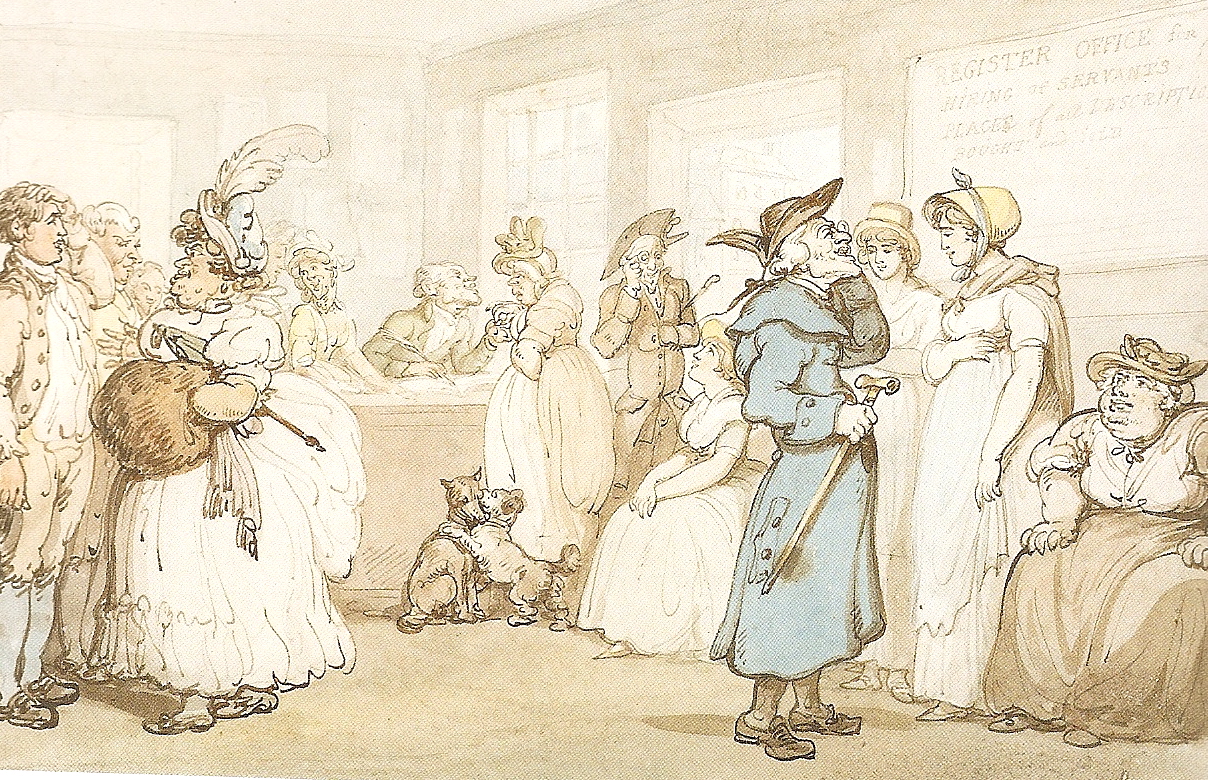
Register Office for the Hiring of Servants, Thomas Rowlandson, c. 1800-05

Contrary to the image of a faithful servant who spends the better part of his life in service to his master, the domestic trade was in reality a transitory one. Servants could be hired and asked to start within a day. They could also be fired on the spot without references.

Servants came and went at a great rate; in the late seventeenth and early eighteenth centuries, ‘most men had left service before they were forty. This was partly because employers did not want middle -aged footmen or valets, but also because servants themselves tended to see the work as part of the life-cycle rather than a career for life.’ – *Below Stairs, p 95

In Memoirs of an Eighteenth-Century Footman, John MacDonald writes: “When I had been a week in London, I met the Irish Chairman that carried Mr Hamilton and Major Joass when in London. I said to him, ‘Do you hear of any place for me?’ ‘By G-d, Johnny, I do; go to Major Libbelier; he lodges at a hair-dresser’s in Lower Grosvenor Street; go to him, Johnny, early tomorrow morning.’ I went – the maid told him I was below. ‘Call him up.’ ‘Well, sir, what are your commands?’ ‘Where you ever in Ireland?’ ‘Look to my recommendations.’ ‘I know Colonel Skeene, and Major Joass in particular. Then you have been through Ireland?’ ‘I have, sir.’ ‘Very well, I’ll give you fourteen shillings a week; and if I go to Ireland, I’ll give you sixpence more a day on the road.’ I dressed him and he was pleased.”

The best way to hire a servant was to find one through an advertisement. A personal character, reference, testimonial or note written by a former employer was essential before taking someone on.

It is not a safe plan to go to a Registry unless you know all about it first, though there are some which are really trustworthy. But a servant who once finds his or her way to a Registry Office is almost always unsettled, and no sooner in a place than looking out for another. The average London wages may be set down as: Butlers, £40 to £100; Footmen, £20 to £40; Pages, £8 to £15; Cooks, £18 to £50; House. maids, £10 to £25; Parlour-maids. £12 to £30; “General Servants,” Anglice Maids of all Work, £6 to £15. [Note: these are 1840’s wages.] A month’s notice required before leaving or dismissing; but in the latter case a month’s wages (and board wages if demanded) will suffice. For serious misconduct a servant can be discharged without notice. When left in town, additional board wages will be required at the rate of about 10s. per week. Victorian London – Dickens

Read about the working conditions of servants in my previous posts. Click here

*Source: Below Stairs: 400 Years of Servants’ Portraits, Giles Waterfield, anne French, with matthew Craske, Foreword by Julian Fellowes, National Portrait Gallery, London, 2003.

Read Full Post »

They would see, [Sir john] said, only one gentleman there besides himself; a particular friend who was staying at the park, but who was neither very young nor very gay. He hoped they would all excuse the smallness of the party, and could assure them it should never happen so again. He had been to several families that morning in hopes of procuring some addition to their number, but it was moonlight and every body was full of engagements. – Sir John Middleton, Chapter 7, Sense and Sensibility

In his reference to moonlight, Sir John was speaking about the habit in the Regency Era of arranging evening visits and social events during the full moon. Although 400,000 times less bright than the noon sun, a full moon would still light the landscape enough for riding or walking. In war time, generals refrained from moving their troops under such a bright night sky, preferring the cloak of complete darkness under a lesser moon.

Of course no amount of planning could predict a cloudy sky. For such an event, the carriages were outfitted with carriage lamps. Before street lighting became prevalent, footmen (for the wealthy) or link-boys (for hire), carrying lit tapers or torches would run in front of the carriage or accompany a pedestrian to illuminate the road or sidewalk. (Georgian Index) According to Samuel Pepys, “links were torches of tow or pitch to light the way.” Toward mid-century, such torches would be discarded, and night travelers would be accompanied by an escort who would hold a lantern aloft on a pole.

In many old towns—London, Bath, York, Edinboro’, &c.,—“link-boy-slabs” and “extinguishers” may be seen in position, but I have searched in vain for such a relic in Nottingham. They must have been fairly plentiful at one time, for there are numerous references in the Borough Records to “link-boys” who carried torches, to light the way for the “chairmen who carried passengers in sedan-chairs —a mode of conveyance in vogue throughout the 18th century, and still lingering in use within the recollection of some of our older members. (According to Deering Hackney sedans were used for hire to carry persons who are taken sick from home, and ancient ladies to church and visiting, as also young ones in rainy weather.”) Nottingham in the 18th Century

In the Sir Joshua Reynolds painting above of Cupid as a Link boy (1773, Albright-Knox Gallery, Buffalo), one art historian conjectured that, due to his sad, vapid expression, the young model was an actual link boy.

I see Inigo Jones’s great arches
in my mind’s eye, his water-inky clouds,
the paraphernalia of a royal masque;
dung and detritus in the crazy streets,
the big coaches bellying in their skirts
pothole to pothole, and the men of fire,
the link-boys slouching and the rainy wind.

-Geoffrey Hill, Treatise of Power

By 1750, oil lamps were prevalent in the streets of London and by 1807 gas lights were introduced in that crowded metropolis. Click here for my other post about lighting during the Regency Era, Lighting the Darkness.

Third image from the Georgian Index

Read Full Post »

« Newer Posts - Older Posts »

