Feeds:
Posts
Comments

Archive for the ‘Victorian Era’ Category

Gentle Readers,
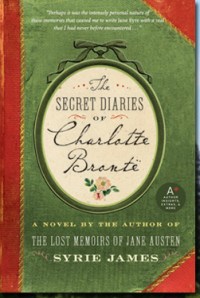
Author Syrie James has been answering reader questions on Jane Austen Today about her new novel, The Secret Diaries of Charlotte Brontë. A sampling of these questions and Syrie’s very informative answers sit in this post. Syrie will also be giving away a copy of her book. All you need to do is leave a question before the end of today at this link. Only readers who live in the United States or Canada are eligible for the drawing.

syrie james the secret diaries

Question: How do you think Charlotte Brontë would have felt being showcased on a blog for and about Jane Austen? It is well known that Charlotte had no love for Jane’s novels or writing style.

Syrie James: I think that Charlotte would be astonished to find herself showcased anywhere at all today! Trying to imagine her response to the worldwide adoration of her novel “Jane Eyre,” not to mention the computer and the internet, simply boggles the mind. Although Charlotte found Jane Austen’s novels lacking in passion and deeply felt emotion, she did admire Austen’s ability to construct a story, saying that Austen employed “an exquisite sense of means to an end.”

Question: What did you use as your sources for Charlotte Bronte’s life? Did you think that Elizabeth Gaskell’s biography was still relevant? I absolutely loved The Lost Memoirs of Jane Austen — definitely one of my favorite Austen-inspired works. I felt you’d absolutely captured Austen’s “voice.” In writing a novel based on Bronte next, did you find it difficult to transition to a new narrator? Did Austen ever “slip” back into your writing?

Syrie James: It was thrilling to write in Charlotte’s voice! To prepare, I read all of Charlotte’s novels over and over, and more than 400 of her preserved letters. Then I just let the novel flow. The difficult part was to avoid Americanisms and anachronisms, which meant checking words throughout the text to be sure they existed and were employed in England in 1854. I found it easier to write in Charlotte’s voice than Jane Austen’s, because Charlotte was far more passionate! I have a shelf full of dozens of Brontë biographies which I used as sources (in addition to Charlotte’s voluminous preserved correspondence), but one of the best is “The Brontës” by Juliet Barker.

Although we know that Mrs. Gaskell was prejudiced in Charlotte’s favor (having been her dear friend), her biography is absolutely relevant and in fact remarkable, since she actually knew Charlotte, visited all the locations in the story herself, and personally interviewed many of the key people in Charlotte’s life.

Question: Besides the literary research, what other methods did you employ in helping to bring about the authenticity of the book? I really loved The Lost Memoirs of Jane Austen.

Syrie James: I am so glad you loved The Lost Memoirs of Jane Austen and hope you enjoy The Secret Diaries of Charlotte Brontë just as much, for it was truly a work of my heart. In addition to reading dozens of Brontë biographies, everything I could find about Mr. Nicholls, all of Charlotte’s correspondence, most of the Brontë poetry (they wrote hundreds of poems), and all of the sisters’ novels, I also studied the art of the Brontës (Charlotte, Emily, and Anne were all accomplished artists). I spent two days visiting the Brontë Parsonage Museum in Haworth, England– which is the house where Charlotte and her family lived almost her entire life, and is filled with their possessions. I haunted the rooms where Charlotte lived and worked, walked the lanes that she walked, visited the church where her family is buried, and really soaked up the atmosphere of the place. I was also granted a private tour of Roe Head School (from attic to cellar!), a very influential school which Charlotte attended, and which you will read about in my novel. It was invaluable to have those images in my mind when I wrote the book. After that, I just imagined myself in Charlotte’s shoes, and did my best to channel her remarkable spirit while telling her story!

Question: My question is what was your original inspiration to go for the diary style of writing?

Syrie James: I decided to “go for the diary style of writing” with my first novel, The Lost Memoirs of Jane Austen, because I the story I wanted to tell was so personal. I felt that readers would connect more to Jane if they could read the untold story of her love affair, and how it influenced her return to writing, in the first person point of view–as if from her own pen. The first book was so well-received, it seemed only natural to write my next novel in the same manner, this time relating the true story of the author of another one of my all-time favorite novels, “Jane Eyre”!

How did Charlotte Brontë come to write that novel, and all her other books? How much of her work was based on her life? Did she ever fall in love and marry? How is it that three sisters living in the wilds of Yorkshire came to become published authors at the exact same time, writing novels that are still so beloved and popular today? I wanted to write that story as if Charlotte was telling it herself.

Question: What inspires you to choose a topic/subject to write about? In your research, did you discover anything surprising about the Brontës?
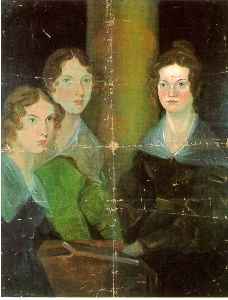
brontes-1Syrie James: For my first two books, I chose challenging topics which meant a great deal to me. I decided to “become” my favorite authors, so that I could not only tell their love stories, but also showcase their love of writing and their personal struggles on the road to becoming published authors–a subject I could truly relate to.

You asked, “did you discover anything surprising about the Brontës?” Everything I learned surprised me, because when I started my research I knew nothing about them! I was astonished to discover the incredible volume of writing the Brontës did as children, and what wonderful artists and poets the sisters were. I was surprised to learn that Charlotte was secretly in love with a married man, and that he was the partial inspiration for many of the heroes in her novels. I was touched to learn that Mr. Nicholls was secretly in love with Charlotte for so many years, before he had the nerve to propose. It’s a remarkable story, and the Brontës were a complicated and fascinating family.

Question: My question is completely tongue in cheek…I recently visited Haworth and was blown away by those little tiny books that contained Charlotte and her siblings juvenelia. When you wrote the Secret Diaries, did you feel compelled to write it with pen and ink in a microscopic hand? Looking forward to reading this book–sounds absolutely terrific.

Syrie James: It’s funny that you should mention those tiny little books that Charlotte and her siblings wrote as children. My husband and I actually got to hold one of those microscopic books and read it (it was about 1 inch x 2 inches), when we were granted a private viewing at the Brontë Parsonage library. How they ever wrote in such a tiny hand is beyond me.

Question: I have not read a Jane Austen book but have watch the movies. I love them. I am just beginning to read books from the Regency-era. Do you have any other authors you recommend? Which book should I begin with that has been written by Jane Austen? Why?

Syrie James: I always recommend that newcomers to Jane Austen begin with Pride and Prejudice. It’s a classic story, extremely well-written, perfectly plotted, has unforgettable characters, and it pulls you in from the very first chapter.

Thank you for taking the time to answer these questions, Syrie. Look for my review of The Secret Diaries of Charlotte Brontë this weekend.

Read Full Post »

Society was aware of Mr and Mrs Merdle. Society had said ‘Let us license them; let us know them.

The Merdles and Sparkler

The Merdles and Sparkler

Mr Merdle was immensely rich; a man of prodigious enterprise; a Midas without the ears, who turned all he touched to gold. He was in everything good, from banking to building. He was in Parliament, of course. He was in the City, necessarily. He was Chairman of this, Trustee of that, President of the other. The weightiest of men had said to projectors, ‘Now, what name have you got? Have you got Merdle?’ And, the reply being in the negative, had said, ‘Then I won’t look at you.’

This great and fortunate man had provided that extensive bosom which required so much room to be unfeeling enough in, with a nest of crimson and gold some fifteen years before. It was not a bosom to repose upon, but it was a capital bosom to hang jewels upon. Mr Merdle wanted something to hang jewels upon, and he bought it for the purpose. Storr and Mortimer might have married on the same speculation.

Like all his other speculations, it was sound and successful. The jewels showed to the richest advantage. The bosom moving in Society with the jewels displayed upon it, attracted general admiration. Society approving, Mr Merdle was satisfied. He was the most disinterested of men,–did everything for Society, and got as little for himself out of all his gain and care, as a man might. – Charles Dickens, Book the First: Poverty, Chapter 21: Mr Merdle’s Complaint

Mr. Merdle kisses Fanny's hand

Mr. Merdle kisses Fanny's hand

For those who have not read the book or seen the last installment, spoilers ahead:

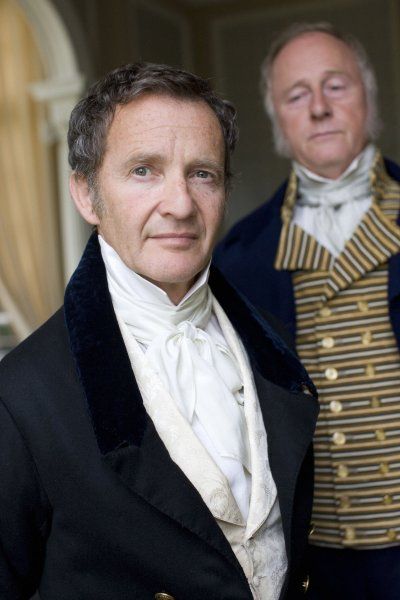
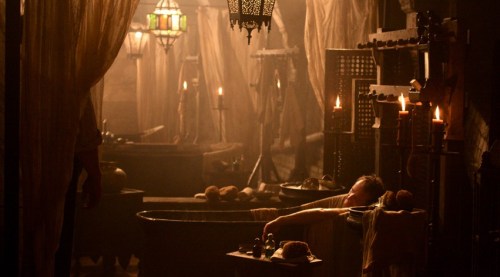
The Merdles  take front and center stage at the start of the last installment of PBS Masterpiece Classic’s Little Dorrit, fulfilling the promises that this film’s theme of bankruptcy and fallen fortunes is a relevant one in today’s world. Mr. Merdle, played by Anton Lesser, was the Man of the Age. He made money for his investors seemingly out of thin air and they loved him for it. Yet Mr. Merdle (the last name is a play on the French word Merde, meaning shit) seemed to be chronically unhappy, despite his showy wife, elegant house, and sterling reputation.  The viewer soon learns what had been keeping him preoccupied: he was stealing from one fund to pay for another (shades of Bernard Madoff), and issuing shares without collatoral.  His house of cards tumbled down, and along with it, all his investors. Instead of facing the consequences, Merdle committed suicide with a pen knife he has borrowed from his daughter-in-law Fanny. To deaden the pain of stabbing his jugular vein with a blunt knive, he drank laudanum, leaving others to literally clean up his messes. Merdle’s demise affected a score of people, but except for the money they lost and their uncertain financial future, his wife, daughter-in-law and stepson did not seem greatly affected by his suicide. Fanny wondered when her pen knife would be returned and the butler took off  soon after learning that the family was bankrupt, leaving his post without notice. With a few deft touches, Charles Dickens showed how quickly the mighty can fall and that the world really doesn’t give a shit except in the instance where it is affected.

Anton Lesser and Nick Jones as Mr. Merdle and his butler

Anton Lesser and Nick Jones as Mr. Merdle and his butler

Most people could and still can lose other people’s money without much conscience, but during this and the Regency era debt was considered to be a matter of honor (would that it was today).  Social historian Eric Hobsbawm argued that “Bankruptcy was, according to economic theory, the penalty of inefficient businessmen, and its spectre haunts the novels of Victorian England.”  (Victorian Web) Mounting debts affected people in different ways. George Brummel fled to France in 1817 rather than face debtor’s prison when he fell out of favor with the Prince Regent and could not repay his creditors. He was not the only gentleman to flee to the continent due to insolvency. The cost of gambling, bad investments, horses, carriages, fine food and a decent wardrobe could tip a modest – even a great – fortune over the edge. Other individuals, like William Dorrit and Arthur Clennam, were sent to debtor’s prison. Some chose suicide, like Mr. Merdle, leaving their families to face the consequences.

Bath house where Merdle committed suicide

Bath house where Merdle committed suicide

The tale of Little Dorrit is not only based on Dicken’s personal experience of watching his father incarcerated in the Marshalsea, but the novel is also set against the backdrop of real bank failures:

Little Dorrit was originally published between 1855 and 1857 (many of Dickens’ works first appeared in serial form) at a time when the collapse of the Royal British Bank was receiving much publicity. The collapse was a result of the bank having channelled most of its capital into Welsh gold mines in the vain hope the Wales would prove to be the next California. (The discoveries which sparked the California Gold Rush had been made in 1848). After the bank’s collapse it was discovered that the directors had made secret loans to themselves and their friends.

Dickens used the preface to Little Dorrit to defend what he called “that extravagant conception, Mr. Merdle, by alluding to “a certain Irish bank” – the Tipperary Bank which failed in 1857 – and he also mentioned “the curious coincidence” that the public examination of the former directors of the Royal British Bank took place when he was finishing the book. – The Financial Fiction Genre

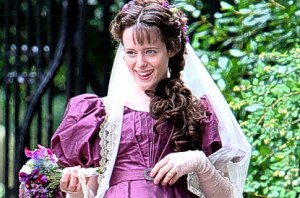
Arthur and Amy on their wedding day

Arthur and Amy on their wedding day

After losing his and his partner’s investments in Merdle’s schemes, Arthur Clennam (Matthew Mcfadyen) went willingly to the Marshalsea instead of escaping his obligations. After his debts were paid he settled for a “modest life of usefulness and happiness” by marrying Amy Dorrit (Claire Foy).

More links:

Missed an episode? Watch episodes online at this link through May 3rd.

A happy ending after all

A happy ending after all

Read Full Post »

Though older and heavier than as a spoiled scoundrel in The Way We Live Now and heartthrob, Mr. Darcy, Matthew’s turn as kind-hearted Arthur Clennam in PBS Masterpiece Classic’s Little Dorrit is outstanding. No one has played the character better in my opinion.

My reviews of Little Dorrit:

Read Full Post »

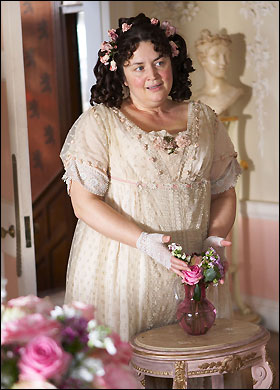
One comedic touch in the otherwise unrelentingly sad and dark Litte Dorrit is Flora Finching, Arthur Clennam’s youthful love. As he walks into her father’s house,  a flickering memory of her beautiful figure comes to his mind … which is instantly displaced by the real Flora entering the room. To his horror she has become silly, old, and fat. While her youth has dimmed, her youthful air and self-image have not:

Flora, always tall, had grown to be very broad too, and short of breath; but that was not much. Flora, whom he had left a lily, had become a peony; but that was not much. Flora, who had seemed enchanting in all she said and thought, was diffuse and silly. That was much. Flora, who had been spoiled and artless long ago, was determined to be spoiled and artless now. That was a fatal blow.

Ruth Jones as Flora Finching in Little Dorrit, 2008

Ruth Jones as Flora Finching in Little Dorrit, 2008

Maria Beadnell

Maria Beadnell

The character of Flora Finching is based on a true person in Charles Dickens’ life. In 1830, when Dickens was 18 years old he fell madly in love with Maria Beadnell, the pretty and flirtatious daughter of a highly successful banker. He courted her for three years, but her parents objected to Charles, who was a struggling young court reporter, and Maria broke off their relationship.  Dickens was heartbroken over the break up and never forgot Maria. It is said that Dora Spenlow in David Copperfield was based on his memory of her.

Dickens and Maria began to exchange letters in 1855, when she contacted him 20 years later. She was now Mrs. Henry Winter and described herself as being “toothless, fat, old and ugly.” Dickens, whose marriage was in trouble, did not believe her description. After he and Maria exchanged several passionate letters, Dickens arranged for his wife Katherine to invite Mr. and Mrs. Henry Winter to a private dinner.  He was appalled to find out that Maria had indeed altered as she said. She was in her forties, fat, and dull.* After this meeting, in which she gave him her cold, and in which he rebuffed her flirtatious attempts, his letters to her became short and formal.  Later, when she again tried to renew the relationship, he broke it off for good.

Maria Beadnell later in life

Maria Beadnell later in life

In a BBC Press Pack, actress Ruth Jones, who plays Flora, says of the character:

“She has real energy and enthusiasm and love of life – I adore that about her. But she is also very complex. She is a sad person trying to make the best of the lot she has been saddled with.

“Life has stood still for Flora while Arthur has been away. She still dresses like a little girl, but now has lines under her eyes and has put on weight.

“She is now this rather matronly woman who is still a vision in pink. But I like the fact that she is not bitter about being left behind.”

There is an affecting authenticity about the fact that Flora is unable to move on.

In later years Dickens observed about his youthful love: “We all have our Floras, mine is living, and extremely fat.” How did Charles Dickens fare in the looks department? The image on the right was made in 1858, a year after the last installment of  Little Dorrit was published.

Charles Dickens as a youth and as a man

Charles Dickens as a youth and as a man

Watch Little Dorrit on PBS’s Masterpiece Classic from now until April 26th. Click here for details.

Read Full Post »

young-girl-of-spirit-constance-hillIn December 1859, Florence Nightingale wrote this letter of recommendation to Parthenope Verney:

My dear [Parthenope Verney]

It occurred to me after writing yesterday if you are going to set up a needlewoman under the housekeeper, Mary Jenkins, Bathwoman, Dr. W. Johnson’s, Great Malvern, has a niece, living at Oxford, a first-rate needlewoman, eldest girl of a very large family, who wants or wanted a place. If she is at all like my good old friend, her aunt, she would be a very valuable servant. Perhaps her needlework would be almost too good for your place. I believe she is a qualified “young lady’s maid,” though when I heard of her, she had never been “out,” i.e., in service. Perhaps she has a place. I think it answers very well in a large house to have as much as possible done at home, as little as possible “put out.”

This domestic job as needlewoman – mending, embroidering, making clothes – sounds benign compared to the custom of the Regency and Victorian eras to overwork seamstresses. While plying the needle was a common domestic activity (Jane Austen was known to possess a particular talent in this direction), working class seamstresses were appallingly overworked and underpaid, especially during the heyday of the Industrial Revolution. Many women toiled for long hours in poor lighting conditions, with some going blind from their employment. An apprentice seamstress in a milliner’s shop worked under slightly better conditions, but during the Season when demand for new and fashionable dresses was high, these women would also be pressed to work into the wee hours of the night to complete an order.

The above illustration of Jane Austen sewing comes from Jane Austen: Her Homes and Her Friends by Constance Hill. In Chapter XX, Constance makes the following observation about Jane Austen’s skill as a needlewoman:

Her needlework was exquisite. We have seen a muslin scarf embroidered by her in satin-stitch, and have held in our hands a tiny housewife of fairy-like proportions, which Jane worked at the age of sixteen as a gift for a friend. It consists of a narrow strip of flowered silk, embroidered at the back, which measures four inches by one and a quarter, and is furnished with minikin needles and fine thread. At one end there is a tiny pocket, containing a slip of paper upon which are some verses in diminutive handwriting with the date “Jany. 1792.” The little housewife, when rolled up, is tied with narrow ribbon. “Having been never used and carefully preserved, it is as fresh and bright as when it was first made.

For more on this topic, click on my other post The Life of a Seamstress.

Read Full Post »

« Newer Posts - Older Posts »