Feeds:
Posts
Comments

The Duchess: Three Perspectives

Keira Knightley in The Duchess

Keira Knightley in The Duchess

Sometimes interviews go one way, and sometimes another, as Diana Birchall reveals on her blog, Light, Bright, and Sparkling. In it she discusses her talk with writer Amanda Foreman and producer Gaby Tana, and how some of her questions were left unanswered.  Linked with Diana’s telling insights, is Ellen Moody’s expert analysis of the movie, book, and the Duchess of Devonshire’s life. Click here to read it on Ellen and Jim Have a Blog Too.

The Duchess of Devonshire’s Gossip Guide also offers a post about meeting author Amanda Foreman. Click here to read it.

Georgian Prints Online, and More

Rowlandson, studio art forger, 1790's

Rowlandson, studio art forger, 1790

Dear Readers,

As you know, I link to many fabulous sites. One of them is the Lordprice Collection, which has just changed its web address. The site’s owner, Tony Price, contacted me to tell me about the change and the many Georgian prints his site offers for sale. Mr. Price also included the following information:

I run the Lordprice Collection, which among other picture and web-related enterprises offers framed pictures to the public from my website. I have just undergone an upgrade, which has led to a change in all of the URLs. Would you be so kind as to change the link to: http://www.lordprice.co.uk/georgian.html?

I would be particularly pleased if you put in a link to the Thomas Rowlandson page, as he is my no. 1 favourite illustrator of all time; I have plenty more Rowlandsons to put up, when I get the time, so that would incentivise me to do so and thus spread the knowledge of his particular genius.

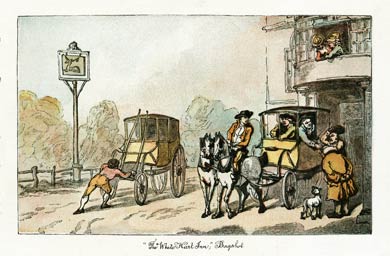
Rowlandson, White Hart Bagshot, 1790's

Rowlandson, White Hart Bagshot, 1790

I have visited your side of the Pond a couple of times and heartily endorse your liking for the Isabelle Stewart Gardner museum – I went there only once, in 1981, but it remains my favourite. I’m surprised that you don’t mention my favourite London museum, the Sir John Soane (www.soane.org), which to me is the ultimate Georgian experience. But how can you not have Hogarth as one of your favourite artists?

Tony Price, The Lordprice Collection
+44 (0)7801 837129
pix@lordprice.com
http://www.lordprice.co.uk

Mr. Price, consider the changes made, and thank you for allowing me to use the images from this fantastic site!  I see that you read my biography page. Although I did not list Hogarth, I think his paintings are divine. I have rather a soft spot for 17th and 18th century paintings, you see, and Hogarth ranks among the best. Vic

Rowlandson prints from the Lordprice Connection

Lost in Austen

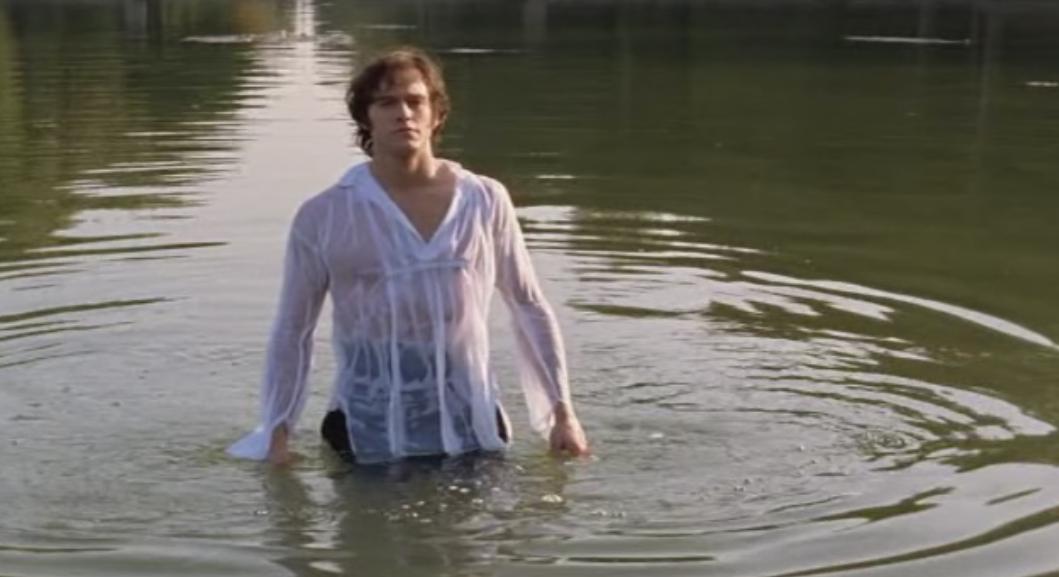
Click here for the review of Lost in Austen, Episode 3. Meanwhile, enjoy one of the many visual jokes this film makes of other JA movie adaptations.

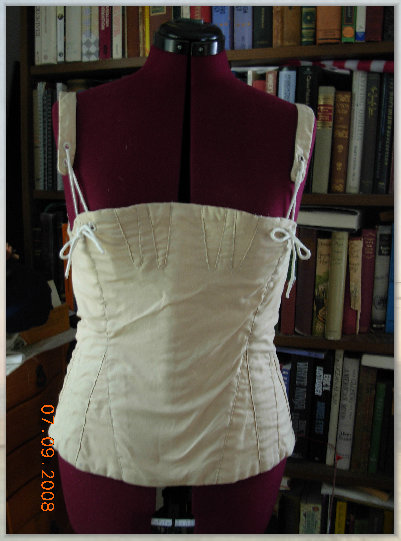
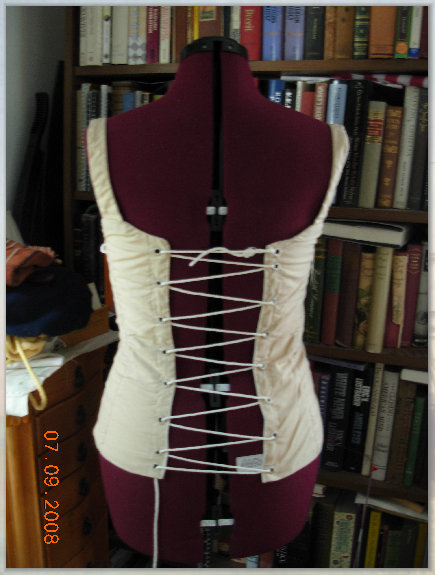
Stays from a pattern by the Mantua Maker

Stays from a pattern by the Mantua Maker

Inquiring readers, last week author Marjorie Gilbert kindly described how she created her empire gown. This week she continues the interview, describing how she made stays (corset) to wear underneath her dress.

Vic: You mentioned choosing a neutral color for under the muslin dress, since the fabric was thin and rather see-through. Didn’t the stays feel a bit bulky? How do the busks feel when you wear the stays? Do they restrict your movement in bending over? Why did you choose this pattern?

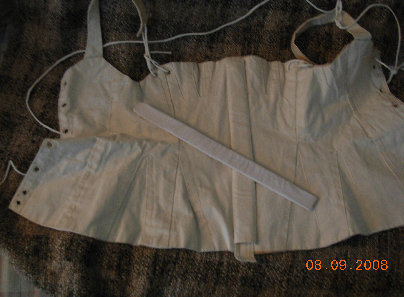
The busk is made up of two paint stirrers wrapped in bleached muslin

The busk is made up of two paint stirrers wrapped in bleached muslin

Marjorie: The stays don’t feel bulky at all, especially when they’re tightly laced. There’s only one busk that is made up of two Sherwin William paint stirrers wrapped tightly in muslin. This is because though the paint stirrers had the necessary 14 inches in length, they didn’t have the thickness or stiffness I needed. We saw a busk that Herman Melville brought back from his time spent on the whaling ship while visiting the Maine Maritime Museum. His was made of whalebone and was scrimshawed. Mine is more modest and cost $0.00. Because the busk is padded by the muslin and the busk pocket, it doesn’t feel bad at all. If anything, it encourages a more upright posture. It is a little more difficult to bend over.

I chose the pattern for the stays because Deb Salisbury, the Mantua Maker, recommended it. Because the gown I chose to make spanned the Empire and Directoire period, the stays that would have been worn with it would have been Regency rather than Georgian. Apparently, as Deb informed me, Georgian stays made one flatter, while the Regency stays encourage more north and south action, if you know what I mean.
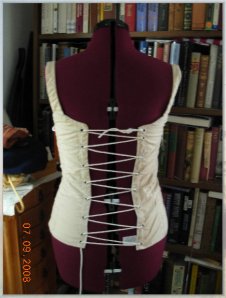
Stays loosely laced

Stays loosely laced

Vic: An actress once said in an interview that when you put on an authentic costume with all the undergarments and accessories, you become a different person and that your actions become informed by the garment itself. Do you take on a different persona as well when you don your outfit?

Marjorie: I find that I walk more slowly and stand straighter when wearing the gown and the stays. I don’t necessarily feel like a different person because I wear the gown mainly to book signings where I am focused more on engaging all and sundry in conversation and trying to sell them in my book.

Vic: Delicately speaking, how difficult is it to, er, relieve oneself when one is so trussed up and when one has to deal with a train and all that fabric?

Marjorie: As to the necessities: I always empty my bladder before getting dressed in the stays and the gown. So far, I haven’t needed to use the necessities while wearing them.

Vic: Who acts as your ladies maid in tying up the laces and how long does it take you to get into the outfit?

Marjorie: My husband has that office.

Putting on the stays took a while because I had tried to use grommets for the eyelets instead of hand finishing them. While my husband tried to thread the lacing through the holes, grommets fell like rain, and we discovered that the length of lacing was too short. We had to start all over with another piece of string. (My lacing is a roll of cotton [?] string that was here when we moved into the house). Now that I hand finished all the eyelets and we know what length the lacing should be, the whole process should be far easier. The other portion that takes a while is craning my neck down so that I can pin up the bodice piece in such a way that the pins themselves aren’t visible. Very tricky. The day I wore the stays with a gown (for a book signing in Penn Yan New York) it took about twenty minutes to get ready, not including putting my hair in a bun. When I wore the gown without the stays, it took 15 minutes in all, including putting up my hair in a bun.

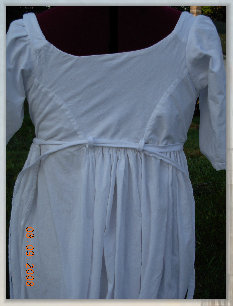
Passing the ties through the belt loop

Passing the ties through the belt loop

Vic: We know that the upper crust had help. How did the ordinary woman get in and out of her stays? Or was the wearing of stays and busks an aristocratic affectation? Did the lower classes simply contend themselves with wearing chemises?

Marjorie: I think that the lower classes had help also. Maids would help each other, a mother would help her daughter, and vise versa. The fashion rather required something like stays beneath it to help give the gown its shape. I found this google book resource that might help answer the question. There were some front lacing stays, but for the most part, the stays laced in the back. While it’s possible to put them on by yourself, it’s tricky.

Vic: Thank you, Marjorie, for your insightful interviews. You’ve given us much to think about.

Inquiring readers who would like to learn more about Marjorie’s gown and stays, and how the gown is put together can click on Marjorie’s sites below.

Marjorie Gilbert
author of THE RETURN, a historical novel set in Georgian England

Marjorie Gilbert fully dressed in her empire gown

Marjorie Gilbert fully dressed in her empire gown

Click here for more information on the topic:
May I Recommend …

My recent Alibris purchases include the following:

Taste: The Story of Britain Through Its Cooking by Kate Culquhoun. This book is a social history of Britain told through the developments of its cooking. It encompasses royal feasts and street food, the skinning of eels, and the making of strawberry jelly. More interestingly,  it mixes the tales of culinary stars with ordinary cooks. The book is filled with tidbits like this:

Soon boilers like the one at Bretton Hall in Yorkshire were being installed at the backs of ranges to supply ready hot water and steam for cooking. Then Joseph Langmead patented a design from which all future closed ranges would develop, using flues to spread a more even though still inefficient heat to the side oven. p235

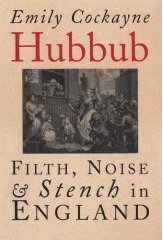
Hubbub: Filth, Noise & Stench in England, 1660-1770 by Emily Cockayne addresses the noisy, messy, and smelly metropolis that was London in the 18th Century. Using a vast array of sources, from novels to records of urban administration to diaries, Emily Cockayne populates her book with anecdotes from the quirky lives of the famous and the obscure.

Street lamps were high maintenance. The lighters needed to carry ladders and other apparatus. Contractors topped up the reservoirs with oil, trimmed wicks and lit the lamps at specified hours. p 224

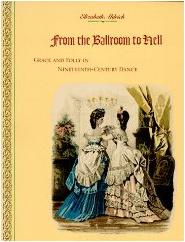
From the Ballroom to Hell: Grace and Folly in Nineteenth-Century Dance, by Elizabeth Aldrich. “Dancing and etiquette are inseparable,” wrote one 19th-century dancing master quoted in this scholarly glimpse into ballrooms past. Newly moneyed Americans of that era craved guidance on how to comport themselves, and publishers responded with scores of manuals on etiquette, fashion and dance instruction. As dance historian Aldrich demonstrates through more than 100 excerpts from these guides, balls and dance offer a key to understanding the social aspirations of the period.

Nineteenth-century men and women were preoccupied with learning the proper way of conducting themselves not only in the ballroom but in all social interactions. But it was precisely in the ballroom that ladies and gentlemen best demonstrated their mastery of the rules of etiquette and social intercourse. p xvii