Feeds:
Posts
Comments

Posts Tagged ‘Cookery’

It’s spring, and the Baltimore Sun’s John McIntyre recommends some drinks with the author in his blog: gin with Fitzgerald, tea with Dr. Johnson, and madeira with Jane Austen. He chose madeira for Jane because it is “a little sweeter and lighter than sherry, which would also be suitable.” Other popular fortified wines of the time were sherry and port. Only gentleman drank the latter, as well as claret, an expensive French bordeaux.

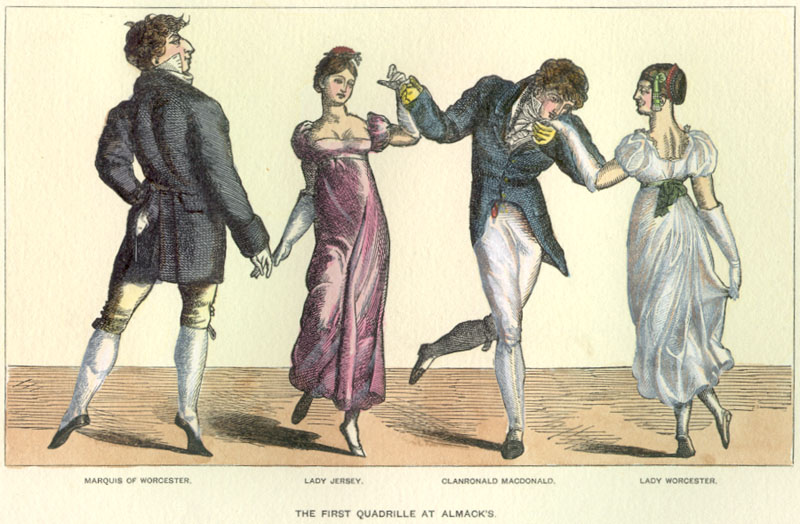
The patronesses of Almack’s served orgeat and ratafia, two sugary sweet drinks. Refreshments at this tony establishment were supposed to be insipid, but both drinks have strong flavors.

Orgeat syrup, made with almond extract, sugar, and orange flower water, was (and still is) added as a flavoring to punch, hot chocolate, coffee, sparking water, or cocktails. This thick, sticky, and opaque milky liquid would have been considered too sweet by itself, and a small amount went a long way. A non-alcoholic orgeat lemonade would have consisted of orgeat syrup, lemonade, and soda water, and might well have been the sort of drink served at an Assembly.

Ratafia, which denotes almost any alcoholic or flavored water, could be made in several ways – distilled or with an infusion of fruits and spices. Ratafia’s alcoholic base would have consisted of marc brandy and the unfermented juice of the grape. The length of time for fermentation for this drink varies. A liquer made in mid-December, for example, could be ready to serve two months later on Valentine’s Day. One recipe for dark brown ratafia suggested that it be stored in an oak barrel for at least two years.

Capillaire, another drink of that era, seems similar to ratafia in that it is described as any simple syrup flavored with orange flowers. I was not able to find out more about this drink, other than as a vague reference.
As mentioned above, Mr. McIntyre chose madeira for Jane. This sweet, fortified wine was hugely popular during the late 18th and early 19th centuries, especially in Colonial America. Brandy was added to the wine to stop the conversion of alcohol from the sugars in the grapes.

British laws prohibited the exportation of wines to the colonies except for Madeira. This brandy-laced wine became so popular in colonial America that nearly 25% of all Madeira wine was shipped there. An interesting chemical reaction occurred inside the casks during the long, hot, and rocky sea voyage across the ocean – the wine improved vastly in flavor. “Why these wines, exposed to constant rocking, extreme heat, and the barrels often found soaking in bilge water, were not ruined, is a mystery.” (Into Wine) It was popularly thought at the time that for Madeira to age well, the wine had to cross the equator in order to heat up sufficiently. In those days, as now, the wine was offered as an aparatif, or with cheese or desserts after dinner.

Cordial waters or Liquers d’Italien had enjoyed a long reputation as wholesome, medicinal drinks, and personal recipes abounded. One 1820 recipe for Yellow Escubac included adding the following ingredients:

One ounce of saffron, one ounce of Damascus raisins, one ounce of cinnamon, three pounds of sugar, one ounce of liquorice, one ounce of corianders, three pints of brandy, two pints of water. Pound these ingredients, and dissolve the sugar in two pints of water; put the whole in ajar to infuse for a month, taking care to stir it up every second day, or third at farthest. – From: G.A. Jarrin, The Italian Confectioner (London: 1820)

Unlike Mr. McIntyre, I would have chosen a slightly different drink for Jane, a French wine perhaps, or, as Jane wrote to Cassandra, the orange wine, which would want “our care soon.” Whatever her choice of drink, a lady was not supposed to get drunk or tipsy, but as Dr. Jennifer Kloester allows, in an age that was generous in serving drink, sobriety would not have been easy state to maintain:

In general, upper-class women did not get drunk, although the prevalence of alcohol in society sometimes made this difficult. The arrack-punch served at Vauxhall Gardens was drunk by both men and women, despite a reputation for potency. It was said to have been made from the grains of the Benjamin flower mixed with rum and was freely imbibed on gala nights. Some men preferred to mix their own punch as Freddy did in Cotillion and rum punch (rum, lemon, arrack and sugar), Regent’s punch (various fruits, rum, brandy, hock, Curaçao, Madeira and champagne) and Negus (port, lemon, sugar and spices) were popular brews. Fortified wines such as Madeira and sherry were also popular with men and some women during the Regency but red wines such as claret, burgundy and port tended to be the more exclusive province of male drinkers. Brandy, gin and rum were drunk by upper-class men, although they often chose to drink the rougher forms of these spirits in the less salubrious surroundings of the inns and taverns of the poorer quarters of London. – Georgette Heyer’s Regency World

Learn more about Madeira and other alcoholic drinks that could be served to ladies of the Regency era in these links:

Dance image from Wikimedia Commons.

Read Full Post »

“Who you callin’ a silly bub, and what’s that you’re offering me?”– Mentioned on three occasions in Samuel Pepys’ diary — in 1662, 1663 and 1668

When we think of Christmases past, including the traditions and foods that Jane Austen and her kin would have enjoyed, we think of yule logs, kissing boughs, and festive drinks, such as apple toddy, milk punch, and syllabub, a less potent alcoholic and cream mixture than eggnog.

Over time, the precise recipes have changed. According to British Culture, British Customs, and British Traditions, “In the seventeenth century, a milkmaid would send a stream of new, warm milk directly from a cow into a bowl of spiced cider or ale. A light curd would form on top with a lovely whey underneath. This, according to Elizabeth David, was the original syllabub. Today’s syllabub is more solid (its origins can also be traced to the seventeenth century, albeit to the upper classes) and mixes sherry and/or brandy, sugar, lemon, nutmeg, and double cream into a custard-like dessert or an eggnog-like beverage, depending upon the cook.”

“In the hour or two that the syllabub was set aside, a curd formed over the ale. With the possible addition of a layer of cream on top, the syllabub was ready to drink. The solids that formed on top of a syllabub were eaten with a spoon, the wine at the bottom drunk.”* Historic Food offers another detailed account of the history and making of this fascinating drink. I’ve also found a stanza from a traditional song that includes drinking syllabub under a cow, which sits below.

You hawk, you hunt, you lie upon pallets,
You eat, you drink (the Lord knows how !);We sit upon hillocks, and pick up our sallets, And drink up a syllabub under a cow.

With a fading.

In The Universal Cook: And City and Country Housekeeper, John Francis Collingwood and John Woollams, the Principal Cooks at The Crown and Anchor Tavern in the Strand in the late 18th century, offer precisely such a recipe for syllabub. One supposes that these instructions might be difficult to follow today except for the most determined country person:

A Syllabub Under a Cow

Having put a bottle of red or white wine, ale or cyder, into a China bowl, sweeten it with sugar, and grate in some nutmeg. Then hold it under the cow, and milk into it until it has a fine froth on the top. Strew over it a handful of currants cleaned, washed, and picked, and plumbed before the fire.

Over half a century later, Mrs. Beeton includes this syllabub recipe in her historic and groundbreaking cookery and household management book:

To Make Syllabub

900ml (1½ pints) Milk
600ml (1 pint) Sherry or White Wine
½ Grated Nutmeg
Sugar, to taste

Put the wine into a bowl, with the grated nutmeg and plenty of caster sugar add the milk and whisk.
Clotted cream may be laid on the top, with ground cinnamon or nutmeg and sugar.
A little brandy may be added to the wine before the milk is put in.
In some counties, cider is substituted for the wine, when this is used, brandy must always be added.
Warm milk may be poured on from a spouted jug or teapot, but it must be held very high.

Sufficient for 5 or 6 persons.
Seasonable at any time.

Find more information about syllabub in these links:

Click here for my other holiday posts.

Image from Historic Foods

Technorati Tags: , ,

Read Full Post »

Wassailing goes back to pre-Christian times in a tradition meant to bring luck for the coming year. Wassail gets its name from the Old English term “waes hael”, meaning “be well”. At the start of each year, the Saxon lord of the manor would shout ‘waes hael’. The assembled crowd would reply ‘drinc hael’, meaning ‘drink and be healthy’. In cider producing regions, the wassailers went from door to door, with a wassail bowl filled with spiced ale, and sang and drank to the health of those they visited. In return people in the houses gave them drink, money and Christmas food. Traditionally Wassailing was held on Old ‘Twelvy’ Night, before the Georgian Calendar aligned the calendar year to the solar year. The true date for Wassailing, therefore, was the 17th of January.

Listen to a traditional wassailing song on this YouTube link.

In cider producing regions, the tradition varied, and was known as the wassailing of trees:

…it was the custom for the Devonshire people on the eve of Twelfth Day to go after supper into the orchard with a large milk-pan full of cyder with roasted apples in it. Each person took what was called a clayen cup, i.e. an earthenware cup full of cyder, and standing under each of the more fruitful trees, sung —

“Health to thee, good apple-tree,
Well to bear, pocket-fulls, hat-fulls,
Peck-fulls, bushel-bag-fulls.”

After drinking part of the contents of the cup, he threw the rest, with the fragments of the roasted apples, at the trees, amid the shouting of the company. Another song sung on such occasions was

“Here’s to thee, old apple-tree,
Whence thou may’st bud, and whence thou may’st blow,
And whence thou may’st bear apples enow
Hats full! caps full!
Bushel-bushel-sacks full,
And my pockets full, too, huzza!”

From Wassailing

Update: Tim writes: Wassailing refers to the practice of both door-to-door carol-singing on Christmas Eve and the apple wassailing on Old Twelth Night. The naming comes from the common imbibing of the wassail. Both traditions co-exist and the carolling occurs not just in cider-growing areas.

Thanks for the information, Tim. I should have been clearer about the distinction between the two traditions at the start of this post. These days wassailing does mean carolling, but it did not always have this connotation.

Wassail Bowl
La Belle Cuisine, Recipe from the Gourmet Archives

4 cups apple cider
1/2 cup firmly packed dark brown sugar
1/2 cup dark rum
1/4 cup brandy
1 tablespoon orange liqueur
1/4 teaspoon cinnamon
1/4 teaspoon ground cloves
1/8 teaspoon ground allspice
Salt to taste
1/2 lemon, thinly sliced
1/2 orange, thinly sliced
Whipped cream
Freshly grated nutmeg

In a saucepan bring the apple cider to a boil over medium heat, add
the brown sugar and cook mixture, stirring, until the sugar is dissolved.
Remove pan from heat and add the rum, brandy, orange liqueur,
cinnamon, cloves, allspice, salt, and fruit slices. Heat mixture over
moderate heat, stirring, 2 minutes. Pour the wassail into wine glasses
and top it with whipped cream and freshly grated nutmeg.

View my other holiday posts: A Jane Austen Christmas, Yule Log, New Year’s Eve, Boxing Day, Christmas Pudding, etc. here.

Read Full Post »

Harvest Festival

In an era before refrigeration and long term food storage, people ate produce that was fresh and in season. When fresh fruits and vegetables were in poor supply, dishes were heavy in meat and protein. This situation was less likely to be true for the wealthy, who were able to replenish their tables with fresh fruits and vegetables grown in their own greenhouses.

Mrs. Hannah Glasse lists fresh foods by month in her classic cookery book, The Art of Cookery. Here is her list of available foods for November.

FISH.—Brill, carp, cod, crabs, eels, gudgeons, haddocks, oysters, pike, soles, tench, turbot, whiting.

MEAT.—Beef, mutton, veal, doe venison.

POULTRY.—Chickens, fowls, geese, larks, pigeons, pullets, rabbits, teal, turkeys, widgeons, wild duck.

GAME.—Hares, partridges, pheasants, snipes, woodcocks.

VEGETABLES.—Beetroot, cabbages, carrots, celery, lettuces, late cucumbers, onions, potatoes, salading, spinach, sprouts,—various herbs.

FRUIT.—Apples, bullaces, chestnuts, filberts, grapes, pears, walnuts.


    BBC Food also lists fresh foods in season: parsnips, beetroot, pumpkins, swede*, cabbage, leeks, potatoes, teal, goose, venison, grouse, oyster, chestnuts, cranberries, pears, and quinces. Click on the link to find recipes using these ingredients. *Swedes are a traditional British food. You can read more about them in The British Kitchen, and find a few recipes for preparing them as well. Click here for a Heritage recipe for fish pie. Whether in the U.S. or across The Pond, I wish you a very Happy Thanksgiving Day.These links discuss the Harvest Festival in more detail.

  • Harvest Festival

Read Full Post »

The Historic Foods website offers a splendid Georgian recipe of gooseberries cut as hops and preserved in syrup.

The first printed version of this once popular recipe is found in Elizabeth Smith’s The Compleat Housewife (London: 1727). The instructions seem complex, but the results, as you can see, are visually delightful. In earlier times gooseberries were dried and candied, or made into a sauce served with fish or goose meat.

For a detailed history of the gooseberry, click on the link above.

Watercolour of Gooseberries by Pamela Sweda

Read Full Post »

« Newer Posts - Older Posts »