Feeds:
Posts
Comments

Posts Tagged ‘Elizabeth Bennet’

Elizabeth continued her walk alone, crossing field after field at a quick pace, jumping over stiles and springing over puddles with impatient activity, and finding herself at last within view of the house, with weary ankles, dirty stockings, and a face glowing with the warmth of exercise. – Jane Austen, Pride and Prejudice, Chapter Six
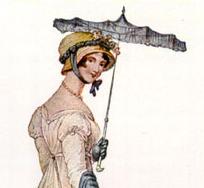
Exercise, cleanliness, and good skin care were as important in the 19th century as today. Back then a proper lady would not leave the house without covering her head with a bonnet, protecting her hands with gloves, and shading her skin with a parasol. Pale white skin had been highly prized for centuries, for it set a lady of quality apart from the working classes. Some women used dangerous cosmetics made of lead oxide to whiten their skin. These lotions, when used repeatedly, could lead to death or paralysis. It made more sense to follow a natural and safer regimen for preserving one’s looks:

“When the freshness of virgin youth vanishes; when Delia passes her teens, and fastly approaches her thirtieth year, she may then consider herself in the noon of the day, but the sun which shines so brightly on her beauties, declines while he displays them, and a few short years, and the jocund step, the airy habit, the sportive manner, all must pass away with the flight of Time. Before this happens, it would be well for her to remember that is is wise er to throw a shadow over her yet unimpaired charms, than to hold them in the light till they are seen to decay. (The Mirror of Graces, A Lady of Distinction, 1811, p 30)
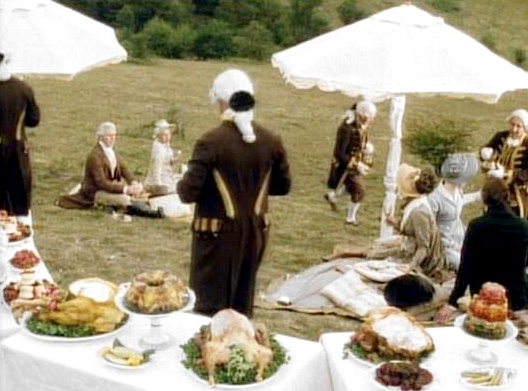
Such a shadow would be provided by a parasol, a canopy over a carriage, or an awning when eating out of doors. Exercise, while considered healthy, would have been performed in moderation. Daily walks were encouraged, but too vigorous an exertion was not deemed wise. A lady should not exercise to the point of sweating or turning her face red, as Elizabeth Bennet did when she walked three miles to Netherfield to be with her sick sister. In this regard, a Lady of Distinction noted:

The preservation of an agreeable complexion (which always presupposes health,) is not the most insignificant of exterior charms….The frequent and sudden changes from heat to cold, by abruptly exciting or repressing the regular secretions of the skin, roughen its texture, injure its hue, and often deform it with unseemly, though transitory, eruptions. All this is increased by the habit ladies have of exposing themselves unveiled, and frequently without bonnets, in the open air. The head and face have no defense against the attacks of the surrounding atmosphere, and the effects are obvious. (The Mirror of Graces, P 42)

Almost a century later, the Household Companion: The Home Book Of Etiquette, written by Alice A. Johnson, Mrs. Janet McKenzie Hill, and Dr. Henry HartShorne extolled a similar beauty regimen. In addition to protecting the skin from the sun and encouraging mild forms of exercise, the book also recommended adequate sleep. The authors quoted a charming old lady, who …

… revealed the secret of her fair and rosy complexion to a group of young women as follows : ” Late hours,” said she, ” and oversleeping ruin the complexion. Go to bed early, arise early, and you will grow old slowly, and retain your good looks to an advanced age. If, however, your position forces you into society and you are obliged to be up late at night, sleep an hour every afternoon. Before going to bed take a hot bath and remain in the water only a few moments. Then drink a cup of bouillon, and a small glass of Malaga wine. Sleep will soon follow, and last until the natural time of awakening, which is about ten o’clock in the morning under these circumstances. Take a cold plunge or sponge bath, a light breakfast of café au lait, and bread without any butter.” She continued: “Out-of-door exercise is an absolute necessity, but must not be carried to excess. A daily walk is excellent, and it is scarcely necessary to say that whole days of lawn tennis, croquet, etc., are not favorable to the complexion.”

One imagines that this elderly lady had heard these beauty tips from female friends and relatives who had lived during the early 19th century. Milky white skin remained a hallmark of beauty until the 1920s when Coco Chanel created a stir with the tan she acquired on the Duke of Westminster’s yacht.

  • 2nd image: picnic on Boxhill, Emma 1996

Read Full Post »

As I researched material for yesterday’s post about Pride and Prejudice 2005, I ran across several articles that listed the actresses who played Elizabeth Bennet during the 20th century. These lists (click here and here) are excellent, but because they concentrate on films, they largely miss the contribution of one important actress, Celia Johnson, a British stage actress who played Lizzy in 1936. Online references to that play are so obscure that Celia’s performance is generally overlooked.

Celia played Elizabeth Bennet opposite Hugh Williams as Mr. Darcy at the St. James’s Theatre in London. Helen Jerome adapted this successful dramatization, titled Pride and Prejudice: A Sentimental Comedy in Three Acts, which continues to be performed today. As an interesting aside, Helen Jerome contributed to the screenplay of the 1940 film version of Pride and Prejudice, and it was said that Celia, who was born just four years after Greer Garson, was not particularly fond of her rival. The reasons were not given.

According to this detailed biographical account by Ian (?) Lloyd, Celia usually played ordinary women in normal settings, but she “was a huge success as Elizabeth Bennet in the hit Pride and Prejudice, in which she played the romantic heroine for once, and not the downtrodden or wronged woman.”
To British audiences of another generation, Celia was a well-known and highly regarded stage actress during the 1940’s and 50’s. She also made a few films shortly after World War II. Film aficionados might recall her turn as Trevor Howard’s love interest in Brief Encounter (see image above), and as a supporting actress in The Prime of Miss Jean Brodie, her last film. People in the UK can still listen to her narration of Pride and Prejudice by ordering the audio cassette. To learn more about Celia, click on the following links:

Post Script: I have added the information about the play to Pride and Prejudice in Wikipedia.


Read Full Post »

The PBS Masterpiece Classic airing of the three installments of Pride and Prejudice 1995 is over, and Emma (with Kate Beckinsale) won’t be shown until March 23rd. For those of you experiencing Jane Austen viewer withdrawal symptoms, visit the Jane Austen blog from KCTS 9 to catch up with their insights. Or you may choose to compare the 1995 P&P version with the 2005 movie. Screen captures and movie clips sit below.


Pride and Prejudice, 2005: Click here to view a series of lovely screenshots of Longbourn, Meryton, Netherfield Park, and Pemberley, and see music videos as well. Then view the YouTube clips of some of the movie scenes below:

Was Keira Knightley perfect for the role of Lizzy? Click here to read a perspective that states she was too glamorous for the role.

This six-minute YouTube interview with Keira Knightley is about P&P and Mr. Darcy.

Read Full Post »

A single man of large fortune; four or five thousand a year. What a fine thing for our girls! – Mrs. Bennet on Mr. Bingley’s income, Pride and Prejudice, Volume One, Chapter One

One of the hardest concepts for today’s readers to grasp in Jane Austen’s novels are the economic realities of the times. What do her numbers mean in modern terms? What was the standard of living during the regency era? When Olivia Williams as Jane Austen blurted to her brother Henry in Miss Austen Regrets, “Sense and Sensibility has brought me £140. May I not be proud of that?” – how can we translate that sentence so that it would hold some meaning for us?

A currency converter provided by the National Archives in the U.K. provides a rough idea of what these 1810 figures mean. Further clarification from experts will round out our understanding. Please keep in mind that the sums in the third column of the chart are merely approximations. At this precise time U.S. citizens should multiply these figures by two to derive a dollar amount. I am not an expert, and I will leave more detailed explanations to economists like Brad de Long.

To put some of these sums into perspective, the average annual income for an English laborer or farmer in 1800 was around 15-20 pounds. To live comfortably, an English gentleman like Mr. Bennet, would require around 300 pounds per year per individual, or over fifteen times the amount for a working man who supported his family. As you can see from the figures, as long as Mr. Bennet lived, his family was comfortably off. But the situation would change drastically the moment he died. After that unhappy event, Mrs. Bennet would be expected to live off the 4% interest of her £5,000 marriage settlement, or £200 per year. No wonder she became shrill every time she thought of her unmarried daughters, for Mr. Bennet’s entire yearly £2,000 income and his house were entailed to Mr. Collins. After Mrs. Bennet’s death, Lizzy would receive just 1/5 of her mother’s marriage portion, and she would bring to her marriage only 40 pounds per year.

Today it is hard to accurately determine the spending power of these sums (see the different estimates of Mr. Bingley’s income in the example below). Factors that influence spending power are war, inflation, cost of goods, housing and the geographic area in which the dwellings were located. In any event, Mr. Darcy’s and Mr. Bingley’s incomes would still be regarded as exceedingly fine. In fact, Mr. Darcy’s 10,000 per year represents only 4% interest of his vast fortune. And Mr. Bingley, though he receives only 4,000 per year, inherited almost 3.4 million pounds from his tradesman father in today’s terms.

…the income would normally come from agricultural profits on land or from other property and investments (in Bingley’s case it turns out the be the latter). It is not easy to translate incomes of the time into today’s money. By some calculations, the effects of inflation mean that a pound in Jane Austen’s time has the same value as almost forty pounds today; if so, Bingley’s income would be the equivalent of 150,000 to 200,000 a year in today’s pounds (or around $250,000-$300,000 in current U.S. money). Altered economic condition, however, make estimates like this tricky: for example, goods tended to be much dearer at that time, in relative terms, while labor tended to be much cheaper. In addition, average incomes in this period, even when adjusted for inflation, were much lower than today, so Bingley’s income represents a far sharper deviation from the prevailing norm than its current equivalent would be.” – Shapard, Annotated Pride and Prejudice, P 5

One can now understand why in Sense and Sensibility Mrs. Dashwood and her daughters were forced to economize. When John Dashwood, under his wife’s influence, reneged on his promise to his dying father to contribute substantial sums of money to his step family, the women were forced to live on 500 pounds per year. This paltry sum would have barely covered their living expenses had it not been for Sir John Middleton’s generosity in inviting his cousin to live in a cottage on his estate.

Like the Dashwood women, Jane Austen, her mother, and sister also experienced chronic money worry. However, through the sale of her books Jane was able to earn a much needed supplemental income. While the £140 she earned from the sales of Sense and Sensibility does not sound like much, it represents close to $9,800 in today’s U.S. sums. In fact, the proceeds from the sale of her four books netted her over 23,000 pounds or around 46,000 dollars towards the end of her life. After her brother Henry’s financial reversals, this money must have been a welcome boon indeed.

Now that you’ve gained some understanding of what these sums of money mean, please read the following statement made by Mrs. Bennet in Volume 3 of Pride and Prejudice, Chapter 17:

Dear, dear Lizzy. A house in town! Every thing that is charming! Three daughters married! Ten thousand a year! Oh, Lord! What will become of me. I shall go distracted.

How much does ten thousand a year in 1810 represent?
a) £339, 600
b) $680,000
c) A princely sum
d) In relative terms, all of the above

Georgianna Darcy’s marriage portion is 30,000. How much annual income would this sum derive?

a) £3,000
b) £12,000
c) £1,200
d) £120
Sources and resources:

  • Shapard, David M., The Annotated Pride and Prejudice, Jane Austen, Anchor Books, 2004
*References, Acknowledgements, Links, and Abbreviations, For the Male Voices Web Site
**Literary Study Tour: Jane Austen, 1998
***Ian Littlewood, Jane Austen: A Critical Assessment, p 205, 1998

Addendum:

To learn more about the ‘Cost of Living in Jane Austen’s England: Vulgar Economy’, click here . This article from the Jane Austen Centre goes into further detail about the Mrs. and Misses Dashwoods’ economic situation.

Read Full Post »

Oh what a fun site this is! Its creator has assembled a host of interesting facts about P&P ’95, some of which are highlighted below:

        • Jane Austen figured largely in the BAFTA television award ceremony 1996. Jennifer Ehle and Colin Firth’s perfomances as Elizabeth Bennet and Mr Darcy, and Benjamin Whitrow’s portrayal of long-suffering Mr Bennet, earned them Best Actress and Best Actor nominations. In the end, Jennifer Ehle was the only one to receive an award for best actress.
        • Colin Firth: “When Pride and Prejudice was offered I just thought, without even having read it ‘Oh, that old warhorse’ and I unwrapped the huge envelope with great trepidation. I think I was only about five pages in when I was hooked. It was remarkable. I don’t think any script has fired me up quite as much, just in the most basic, romantic-story terms”
        • Colin Firth in The Times while still filming P&P: “There’ll be people who will object strongly simply because it’s my face instead of the one they have in their mind. Everyone believes he is dark, though I don’t believe Jane Austen ever described him as such. So they’ve dyed me dark. You have to be very careful not to make him either too idiosyncratic or too bland, and the danger is that you don’t dare to do anything at all. So you have to take over and say, ‘To hell with it, he’s mine now. I own this character and he has to be me’.”
        • In a Blog Critics interview, Jennifer Ehle says: “The relationship between Mr. Bennet and Lizzie was always my favorite part of the book. It was, for me growing up, the love story in the book; and I would weep whenever I reread it and would get to the bit where Lizzie tells Mr. Bennet that Darcy is the best man she has ever known. It is such an important part of the whole female fantasy of the story — the favorite daughter who idolizes her father above all men and then, when he fails to protect Lydia from herself, is exposed as a mere human being.” Update: Find her answers to a hundred questions in a PDF document at Jennifer Ehle Fan Blog.

        • Although she often believed to be British, [Jennifer] actually was born and raised in North Carolina. Both her parents are well-known. Her father, John Ehle, is a novelist while her mother, Rosemary Harris (above with Jennifer in a recent photo) is an acclaimed actress.
        • Jennifer Ehle played George Clooney’s girlfriend in Michael Clayton, although no one will see her performance. In Entertainment Weekly, George weakly explains the reason why her role was cut: “We shot it with Jennifer Ehle — she gave a wonderful performance,” George Clooney told Entertainment Weekly. “And the more we did it, we realized you have to isolate this character more. And having a girlfriend, he’s not in as much trouble.” George then wrote Jennifer a note to apologise for being cut. “I didn’t cut it, but I still felt bad about it.”

        Read Full Post »

        « Newer Posts

