Feeds:
Posts
Comments

Posts Tagged ‘Georgette Heyer’

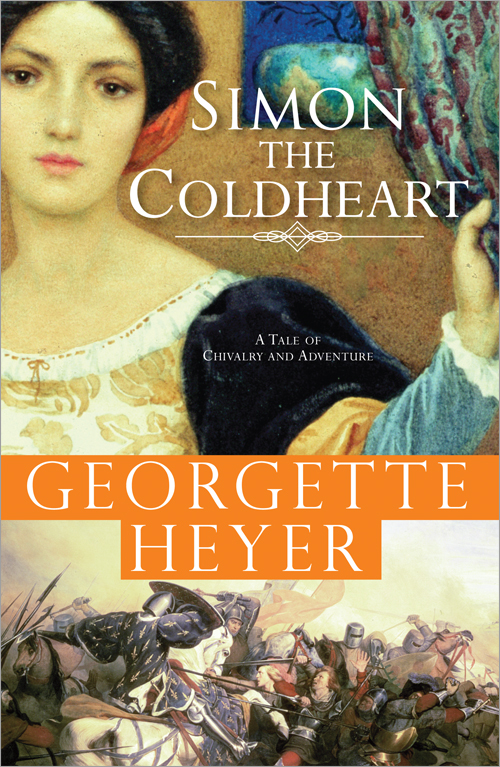
Layout 1Inquiring readers, Simon the Coldheart, an early Georgette Heyer novel, was reviewed by my co-founder of our Jane Austen book group. Lady Anne would be the first person to admit that she is addicted to reading Ms. Heyer’s novels. Her collection of Georgette Heyer’s novels is complete – she owns all her regency romance novels, mysteries, and historical novels. (With 51 titles, that is saying something.)  This is Lady Anne’s review of one of Georgette Heyer’s earliest novels, which will be reissued by SourceBooks just in time for this holiday season.

No one gets period better than Georgette Heyer. Whether she is writing about England in the Regency era or the 15th Century, she has the details and the language perfectly.

In Simon the Coldheart Heyer uses period language to excellent effect. The story, characterized as a tale of chivalry and adventure, tells of young Simon, a base-born bastard of one Geoffrey of Malvallet, as he is off to make his way in the world. Our young hero is not one to feel sorry for his accident of birth, nor does he look to his father to support him. Simon instead styles himself Beauvallet – a nice little wordplay — and seeks to become a member of the household of one of his father’s enemies.
Matters would have gone ill with Simon but for the appearance of a boy, a little younger than himself, who came strolling towards them, followed by two liver-coloured hounds. He was dark, and magnificently clad, and he carried himself with an air of languid arrogance.

“Hola there! he called, and the soldiers fell away from Simon, leaving him to stand alone, arms folded and head turned to survey the newcomer.

The boy came up gracefully, looking at Simon with a questioning lift to his brows.

“What is this?” he asked. “Who are you who strike our men?”

Simon stepped forward.

“So please you sir, I seek my Lord the Earl.”

One of the men, he whom Simon had dealt that lusty blow, started to speak, but was hushed by an imperious gesture from the boy. He smiled at Simon with a mixture of friendliness and hauteur.

“I am Alan of Montlice,” he said. “What want you of my father?”

Simon doffed his cap, showing his thick, straight hair clubbed across his brow and at the nape of his brown neck. He bowed awkwardly.

I want employment, sir, he replied.

Simon is strong and sure of himself. His great confidence amuses and charms Fulk of Montlice, in whose household he seeks to live, and he is awarded a place. Fulk’s son is about Simon’s age, and the two very different young men become close friends. No jealousy or tiresome infighting here.

The book is set in the early 15th Century, and before long, we find ourselves with King Henry IV and young Prince Hal fighting Hotspur and Owen Glendower, in that famous uprising. Young Simon proves himself in battle – no surprise – and comes to the rescue of his half-brother, the young Geoffrey of Malvallet. The rescue earns him a knighthood and begins another surprising friendship, this time with his half-brother. During the next few years, Simon is a knight in the household of Fulk, and young Alan of Montlice, always in love, despairs over Simon. But Simon is looking for a home. On the day that he finds a baronetcy in disarray, he also learns of a plot against King Henry. Gathering some of the men of Montlice around him, he goes to London to tell Henry, and so is awarded the home he needs. His father comes to ask him to live in his household, but he refuses. Because he goes his solitary way, he earns the soubriquet of Coldheart.

But here, Heyer is on firm psychological ground. The base-born child of a servant-girl who died in his childhood is likely to keep his own council and wish to establish his own line. At our first meeting of Simon he claims to be going to his goal, and throughout the book, he stays clear on that. He does not have the luxury of excuses, or whining, or wasting time over women or poetry. He is intent on making his way. It could be an interesting portrait of a complex person, but Heyer only alludes to it. Her business is with the history, and the fun of a group of young men.

Soon enough, Prince Hal, now King Henry V, calls on Simon, his half-brother Geoffrey, and his great friend Alan to assist with the war in France. This is Shakespeare’s Henry at Agincourt, and the battles that Simon and his men fight are a continuation of that part of the Hundred Year’ War. Like his King, Simon meets a strong-willed Frenchwoman at Belremy, and in the end, of course, the lady Margaret falls before Simon and Simon is Coldheart no more. Ultimately, King Henry makes Simon his lieutenant and warden of the lands and marches of Normandy. Heyer, ever the careful scholar, notes in a footnote that in fact the Earls of March and Salisbury held that title.

Simon the Coldheart is an early book, originally published in 1925. As always, Heyer’s details describe the period, and in this book, she takes the further step of using language suited to the time: slightly inverted, filled with pomp and chivalry. It adds greatly to total experience. The book is a romp, fun for those of us who loved the transformation of Prince Hal into Henry, and fun for anyone who would want to read of that bygone age of chivalry. Click here to order the book.

Click on More Book Links Here:

Our Other Georgette Heyer Reviews Sit Below

These Georgette Heyer books, available this holiday season, will be reviewed on this blog and Jane Austen Today.

Cotillion, Simon the Coldheart, The Reluctant Widow, Faro's Daugher, and The Conqueror

Cotillion, Simon the Coldheart, The Reluctant Widow, Faro's Daughter, and The Conqueror


Read Full Post »

It’s been years since I’ve run across the word “clodpole”, which Georgette Heyer uses to great effect in Cotillion, one of the splendid Regency romance novels that Sourcebooks had brought out and is available for order, including as an E-book, in this link. Half the fun of reading Ms. Heyer’s books is discovering which of her stereotypical characters will court or insult each other in that ironic British upper class way we Heyer fans have come to love.

cotillion

In Cotillion we meet a veritable bevy of the typical Heyer characters:

  • Eccentric, old and tight-fisted uncle? Check.
  • Young and pretty heiress? Check.
  • Silly spinster chaperone? Check.
  • Buffoonish impoverished earl? Check.
  • Darkly handsome rake? Check.
  • Foppish Pink of the Ton? Check.
  • Long-suffering but pleasantly surprised father? Check.
  • Beautiful but vapid beauty in distress? Check.

The list of Heyer archetypes goes on and on, but we don’t care. We WANT the familiarity of Georgette Heyer’s typical characters, for they play off each other so well. Like an audience at a concert that has been performed in other music halls, we are interested in how this new orchestration of a well-known arrangement will compare to the others. In Cotillion, Heyer’s particular brand of Regency music reaches the heights of perfection. The rich uncle hopes that by bequeathing his entire estate to his orphaned ward, Kitty, he will force his favorite nephew, Jack, to vie for her hand in marriage. For the sake of equality,  Jack must propose alongside his other male cousins so that all may have an equal chance. But Jack won’t be manipulated and forced to court Kitty. An inveterate gambler,  he bets that Kitty and the considerable fortune she stands to inherit will always be available to him, for she has had an unhidden crush on him since the schoolroom. Jack didn’t count on the one variable that would put a spoke in his plans: Kitty’s anger at his absence and her stubborn determination to teach him a lesson.

Enter the Honourable Frederick Standen. The reader first meets this Exquisite in typical Heyer style:

The young gentleman who alighted from the chaise must have been recognized at sight by the discerning as a Pink of the Ton, for although his judgment, which, in all matters of Fashion, was extremely nice, had forbidden him to travel into the country arrayed in the long-tailed coat of blue superfine, the pantaloons of delicate yellow, and the tasselled Hessian boots which marked him in the Metroplolis as a veritable Tulip, or Bond Street Beau, none but a regular Dash, patronizing the most exclusive of tailors, could have presented himself in so exquisitely moulded a riding-coat, such peerless breeches, or such effulgent top-boots.

Freddy, though fond of Kitty, is not in love with her, and he is out of his depth when it comes to countering her will. Before he knows it he is engaged to her and has promised her a month in London before she must return to her uncle’s stuffy old mansion. Ms. Heyer takes her time setting up this fun plot, but knowing the particulars will be important, for when she sets events in motion they roll along seemingly of their own accord and with some unexpected twists that are sure to delight.

Can Frederick successfully introduce his faux Intended to his family and Society without having to submit to the Shackles of Marriage?

Will Jack be able to forgive Kitty for (unsuccessfully) trying to make him jealous?

Will Kitty, a total Innocent when it comes to London Society, be able to stay out of trouble?

As the plot thickens, we are treated to one priceless scene after another, including those of Kitty dragging Freddy to all the Sights of London. Our fastidious Freddy is aghast when forced to enter the musty rooms of the Egyptian Hall, and feels downright incensed when viewing the Elgin Marbles. “Why, they have no heads!” he expostulates, feeling very put upon at having to escort Kitty to places that he’d never intended to see or ever see again. He’d have much preferred to take her to Astley’s Amphitheatre or the Royal Circus, but both edifices did not open until Easter Monday.

Freddy’s family adds spice to this hugely enjoyable novel. His sister Meg, whose taste in Fashion is questionable; his mother, who spends most of the novel tending to her sick children; and his father, whose encounters with his son are all too brief and rare, add to the deliciousness of this convoluted plot. The title of the book hints at plot developments that are not so obvious at first, for when dancing the Cotillion, partners must switch and change within the dance formations.  If you are looking for a book to read during the Thanksgiving holidays, I cannot recommend Cotillion enough, for its conclusion is as satisfying as its very promising beginning.

Read Full Post »

Miss Annis Wychwood, at twenty-nine, has long been on the shelf, but this bothers her not at all. She is rich and still beautiful and she enjoys living independently in Bath, except for the tiresome female cousin, who her very proper brother insists must live with her.

When Annis offers sanctuary to the very young runaway heiress Miss Lucilla Carleton, no one at all thinks this is a good idea. With the exception of Miss Carleton’s overbearing guardian, Mr. Oliver Carleton, whose reputation as the rudest man in London precedes him. Outrageous as he is, the charming Annis ends up finding him absolutely irresistible. – Sourcebooks blurb

I discovered Georgette Heyer just after I graduated from college. Having run out of new Jane Austen novels to read, I began to search for other regency stories set in similar settings. One day at the library, I stumbled across Charity Girl and Arabella, and my love affair with all things Georgette began.

In those days I was barely older than the youngest of Heyer’s heroines, and could identify closely with The Grand Sophy. I reveled in Georgette’s world filled with bored aristocratic gentlemen who, usually as they traveled by coach or horse to a country inn or walked the streets in London in the middle of the night, stumbled across an innocent and disarming chit who needed rescuing. This plot device was a popular one with the author. Another one of Georgette’s plots was that of the “older” beautiful, rich, and independent spinster (almost on the shelf, but not quite) who is determined to live her life as she likes it and skirt convention when she can. Because she has independent means, she rules her roost and will brook no interference from any man. Invariably, these strong willed women meet their match in an even richer, stronger-willed man, usually a Duke or Earl, but not always as in a Lady of Quality.

I learned about Bath through Georgette Heyer’s eyes, not Jane Austen’s. Oh, Jane mentioned Molland’s on Milsom Street, and her characters take the waters in the Pump Room and attend assembly balls in the Upper and Lower Rooms. But Jane is spare in her descriptions, and could barely be bothered to describe dresses, fripperies, and interiors, or how well a man’s broad shoulders fit into his tailored coat, or that his valet polishes his tasseled Wellington boots with champagne. Georgette revels in these descriptions, and takes them to the extreme. Her characters are rather shallow and predictable, and she uses the same “type” over and over again. However, one doesn’t read a Georgette Heyer novel to learn something new and wondrous about the human character – one reads her stories to learn about Regency manners and mores, and how bored the aristocrats are with their privileged lifestyles, and about carriage rides in Hyde Park, and intrigues in Bath, and elopements to Gretna Green, and for descriptions of satin ball gowns and sprigged muslin day dresses. Georgette’s world is filled with high perch phaetons, and visits to Gentleman Jackson’s salon and Astley’s Amphitheatre, and a night at the opera. When I think of Georgette’s descriptions of matrons, I think of formidable ladies dressed in puce and ostrich feathers, bosoms heaving, and faces pinched with displeasure. Or I think of an older, fluffier, high maintenance woman dressed too young for her age, wearing too many ruffles, always fainting or expostulating about something inconsequential, and driving everyone but our heroine to distraction.

Jane Austen’s novels are meaty and take a long time to digest; Georgette’s frothy, sparkling, and often funny romances are as light and sugary as a meringue, and just as filling, which is to say that one becomes hungry to read more after having just finished the previous book. I have read all of Georgette’s regency romances, but I can barely recall one plot from the other, whereas Jane’s six novels are different and distinct. There is no confusing Persuasion with Pride and Prejudice!


To give Georgette her due, she KNOWS her stuff. Not only was her own “breeding” impeccable, but she married well. She and her husband rented rooms in a grand house in Mayfair, and they knew London inside and out. Georgette visited museums, and filled her notebooks (right) with drawings of costumes, uniforms, carriages, and the like. One of the characteristic that sets Georgette’s books apart from all other romance novels is her use of language and aristocratic cant. She made up many of her phrases, including “A Banbury Tale,” but they sound so authentic that other authors began to copy her, much to her dismay. A frustrated historian, who yearned to be recognized for her serious historical novels, she lived long enough to see her regency romances take off in popularity, and printed in many languages all over the world. Her artist of choice for her hard cover book jackets was Barbosa, (illustration of second book cover) whose talent for portraying the regency world was incomparable.

Georgette and her husband rented space in Albany House in Mayfair, London for 24 years. Turned into bachelor chambers in the early 19th century, its famous renters included Lord Byron and Lord Macaulay.

Georgette is a sweet romance writer, which means that she writes no X-rated sex scenes. In fact, she writes no sex scenes at all. Her characters might kiss and hug, but that is towards the end of the story to seal the deal. Unfortunately, Georgette’s light-hearted books have inspired other, lesser writers, like Barbara Cartland, whose awful repetitive romances about barely post-pubescent heroines with heart-shaped faces and huge liquid eyes are barely digestible. Writers like Cartland have given the entire genre a bad name. As with all genre writers, there are good ones and bad ones. Georgette’s works stand out as among the best. Having said that, her plots about 18-year-old misses catching the interest of 38-year-old dukes attract me the least. When I was young I could barely stomach the age difference, and now that I am longer in the tooth and a tad world weary, I refuse to read them. However, her novels about the older feisty heroine of independent means verbally sparring with her hero still strike my fancy.

Which brings me to the real topic of this post: a review. If you haven’t read a Georgette Heyer book, and you are of a certain age, I would like to recommend that you first read a Lady of Quality, which combines both of Georgette’s two basic plots. The book starts predictably, with our older, stubborn heroine, Miss Annis Wychwood, who has set up her own house in Bath (in a fashionable part of town, of course), returning from a visit with her brother and sister-in-law.  Her chaperone is a meek mannered spinster cousin, who doesn’t dare to cross her rich patroness, which is exactly how Annis had planned it. The hero of the story is Oliver Carleton, the uncle and legal guardian of a silly chit, (Lucilla) who has run away. Annis becomes her protector, which sets up frequent opportunities for Annis and Oliver to verbally spar with one another.

He came forward to shake hands with Miss Wychwood, paying no immediate heed to Lucilla, following her into the parlour. “You can’t think of how relieved I am to see that you haven’t brought your cousin with you,” he said, by way of greeting. “I have been cursing myself these three hours for not having made it plain to her that I was not including her in my invitation to you! I couldn’t have endured an evening spent in the company of such an unconscionable gabble-monger!”

“Oh, but you did!” she told him. “She took you in the greatest dislike, and can’t be blamed for having done so, or for having uttered some pretty sever strictures on your total want of conduct. You must own, if there is any truth in you, that you were shockingly uncivil to her!”

“I can’t tolerate chattering bores,” he said. “If she took me in such dislike, I’m amazed that she permitted you to come here without her chaperonage.”

“She would certainly have stopped me if she could have done it, for she does not think you are a proper person for me to know!”

“Good God! Does she suspect me of trying to seduce you? She may be easy on that head: I never seduce ladies of quality!” He turned from her as he spoke, and put up his glass to cast a critical look over Lucilla. “Well, niece?” he said. “What a troublesome chit you are! But I’m glad to see that your appearance at least is much improved since I last saw you. I thought that you were bidding fair to grow into a Homely Joan, but I was wrong: your are no longer pudding-faced, and you’ve lost your freckles. Accept my felicitations!”

“I was not pudding-faced!”

“Oh, believe me, you were! You hadn’t lost your puppy-fat.”

Her bosom heaved with indignation, but Miss Wychwood intervened, recommending her not to rise to that, or any other fly of her uncle’s casting. She added severely: “And as for you, sir, I beg you will refrain from making any more remarks expressly designed to put Lucilla all on end, and to render me acutely uncomfortable!”

“I wouldn’t do that for the world,” he assured her.

“Then don’t be so rag-mannered!” she retorted.

An experienced reader of romance novels can divine the plot from this short scene, in which Lucilla is induced to speak to her uncle after having run away from him. One thing leads to another, with many plot twists and misunderstandings and heaving of bosoms, until Georgette neatly ties up her various threads, and her hero and heroine live happily ever after. The author was nearly seventy years old when she sent this note to her publisher about the book’s progress:

“I’ve left [Carleton] making himself thoroughly obnoxious to Lord Beckenham in the Pump Room, and must go back to him, and think of a few more poisonously rude things for him to say…I have only to add that Mr. Carleton is not merely the rudest man in London, but has also the reputation of being a Sad Rake, to convince you that he has all the right ingredients of a Heyer-Hero.” (Hodge, p 196*)

SourceBooks is issuing a select number of Georgette Heyer novels in Trade Paper for the first time. Click here to enter the site and see the selections. If you find my description of the book intriguing, then you will not be disappointed reading it. Georgette’s breezy romances are a perfect accompaniment for a summer’s day at the beach or a relaxed afternoon in your lawn chair.

For additional information about Georgette Heyer, click on the links below:

  • *The Private World of Georgette Heyer, Jane Aiken Hodge, The Bodley Head, London, 1984. Quote and illustration of Heyer’s notebook and house are from this book.

Read Full Post »

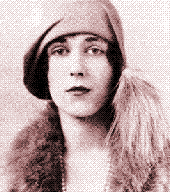
Georgette Heyer (1902-1974)

Georgette Heyer was a prolific writer of witty Regency romances, and historical and crime novels. Her knowledge of history and social customs is unequaled, and her use of cant is original and colorful (but a bit confusing for the novice fan.) Find a thoughtful synopsis of her books on this site. 

For my Georgette Heyer reviews, please click on the following links:

For more information about Georgette, click on:

Go to Wikipedia, which describes her life and work.

Read more about her in the The Private World of Georgette Heyer


Read Full Post »

« Newer Posts