With The Old Curiosity Shop, Masterpiece Classic aired its last special for the 2009 season last night. Which film was your favorite? Curious minds want to know.
Posts Tagged ‘Masterpiece Classic’
Poll: Favorite Masterpiece Classic
Posted in jane austen, PBS Movie Adaptation, tagged Charles Dickens, Little Dorrit, Masterpiece Classic, Movie Poll, Old Curiosity Shop, PBS Masterpiece Classic, Sense and Sensibility, Wuthering Heights on May 4, 2009| 5 Comments »

Little Dorrit: The Father of the Marshalsea – The Prison Within the Prisoner
Posted in Jane Austen's World, Movie review, Regency Life, Regency World, tagged Charles Dickens, John Dickens, John Howard, Little Dorrit, Marshalsea, Marshalsea Debtor's Prison, Masterpiece Classic, PBS Masterpiece Classic, Tom Courtenay, William Dorrit on April 6, 2009| 10 Comments »
Dickens recounts how when his father and he went into the prison they both wept very much and his father warned him that if a man had 20 pounds a year and spent 19 pounds, 19 shillings and sixpence, he would be happy, but that a shilling spent the other way would make him wretched. – A.S. Byat, Within Those Walls

Born in prison
The first surprise I encountered watching Little Dorrit on Masterpiece Classic was to see little Amy born in the Marshalsea, the debtor’s prison to which her father had been sentenced for owing £400. William Dorritt, also know as the “Father of the Marshalsea”, was incarcerated for 23 years, slowly rotting from the inside out and living a life without hope of becoming a free man again. He was allowed to bring in his family, a tradition of those bygone days. Sadly, Mrs. Dorrit died before her husband could repay his debt. Amy has never known a life other than in prison.
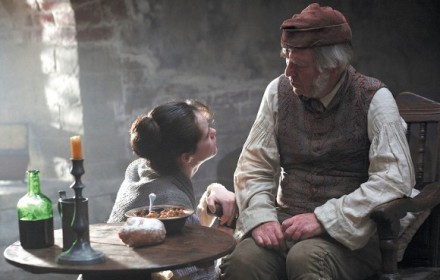
Life without hope for William Dorrit
John Howard, a reformer, visited Marshalsea eight times between 1774 and 1783, and made the following observations:
There are in the whole near sixty rooms; and yet only six of them left for common-side debtors. Of the other rooms – five were let to a man who was not a prisoner; in one of them he kept a chandler’s shop, in two he lived with his family; the other two he let to prisoners….The chamber rent wants regulation, for in several rooms where four lie in two beds, and in some rooms where two lie in one bed, each pays 3 p 6d for his lodgings.
The prison is greatly out of repair. No infirmary. The court is well supplied with water. In it the prisoners play at rackets etc., and in a little back court, the Park, at skittles.
In March 1775 when the number of prisoners was 175, there were with them in this incommodious prison wives and children 46. – The Chronicles of London, Saint and Darley, New York, 1994, p 150.

The prison had not much changed when Charles Dickens lived there, for William Dorrit’s nightmare was his own. In 1824, when Dickens was twelve, his father, John, had been taken there for debts he could not repay. Instead of going to school, Dickens left the Marshalsea each day to work at Warren’s boot-blacking factory, where he was paid six shillings a week.
The family [Dickens] writes, lived more comfortably in prison than they had done for a long time out of it, They were waited on still by the maid of all work from Bayham Street, the orphan girl from Chatham workhouse from whose sharp little worldly, yet also kindly, ways I took my first impressions of the Marchioness in The Old Curiosity Shop. Old and new London a narrative of its history, its people and its places By Walter Thornbury, Edward Walford
His father’s experience in the Marshalsea left an indelible impression. Dickens must have written these lines from the heart: “She looked down into the living grave on which the sun had risen, with her father in it.” Unlike William Dorrit, who spent nearly a quarter of a century in prison, John Dickens walked out after six months when one of his relatives died and left enough money in the will to pay off the debt.
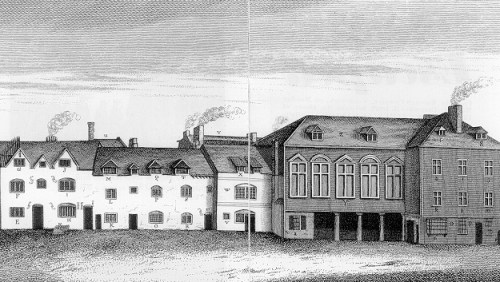
"It was an oblong pile of barrack building, partitioned into squalid houses standing back to back, so that there were no back rooms; environed by a narrow paved yard, hemmed in by high walls duly spiked at top."
Once a man of substance, William Dorrit (played by Tom Courtenay) tried to live with some dignity inside the high spiked walls, but much of his self-consequence came at the expense of his youngest daughter, Amy (Little Dorrit), who devoted her young life catering to her father. “In his deepest heart he knows that he’s made an utter mess of his and his beloved children’s lives, but he would never openly admit to this failure. For his sake, the family all keep up the pretence of respectability.” ( BBC) Even at his lowest ebb, William Dorrit finds comfort in the title of “Father of the Marshalsea.” He adheres to social standards, blinding himself to his son’s Edward’s dissolute lifestyle and daughter Fanny’s less than acceptable career as a dancer, and dines in state on the food that Amy has set aside from her own repasts.
The family’s ability to come and go from prison within the curfew hours so surprised me that I wanted to research the topic. Only the debtor remained imprisoned. In reality, as Dickens attests, life inside those walls was not much worse than life outside it – for the destitute. The friendship between Amy and John Chivery was genuine. John performed his duties with humanity, and Amy recognized that the Assistant Turnkey was simply following orders.

Leaving the Marshalsea in state
Even when freed, William Dorrit does not step outside his prison. When he is finally released, due to an inheritance found through Arthur Clennam’s perseverance, his heart is as pinched as his confined world had once been. Charles Dickens wrote about the character:
Crushed at first by his imprisonment, he had soon found a dull relief in it. He was under lock and key; but the lock and key that kept him in, kept numbers of his troubles out. If he had been a man with strength of purpose to face those troubles and fight them, he might have broken the net that held him, or broken his heart; but being what he was, he languidly slipped into this smooth descent, and never more took one step upward.
Instead of thanking Arthur, he avoids him and puts on airs of grandiosity. His children are given lessons of deportment by Mrs. General as they traipse across Europe on a Grand Tour. They are lessons in futility, for Fanny and Edward are beyond help, and Amy is uninterested in the trappings of wealth. And yet despite his opulent surroundings, William was unable to escape the effects of the Marshalsea and his mind remained imprisoned. He returns to London, but instead of enjoying the high life, he is constantly plagued by reminders of his past and falls into a great depression.

William Dorrit in London
In real life, a man who was confined in the Marshalsea just like William Dorrit, reacted to his imprisonment in a much different way. John Howard recalled:
Mr. Henry Allnot, who was many years hence a prisoner here, had during his confinement a large estate bequeathed to him. He learnt sympathy by his sufferings, and left £100 a year for discharging poor debtors from hence whose debts do not exceed £4. As he bound his manor of Goring in Oxfordshire for charitable uses, this is called the Oxford charity. Many are cleared by it every year. – The Chronicles of London, p. 150
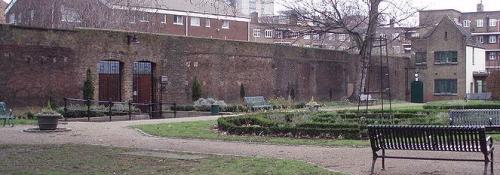
Marshalsea Prison was closed in 1842, and all that remains today is a long brick wall and two gated arches.
In 1856 whilst engaged in the purchase of Gad’s Hill, Charles Dickens paid a visit to the Marshalsea, then in the course of demolition, to see what traces were left of the prison of which he had received such early and vivid impressions as a boy, and which he had been able to rebuild almost brick by brick in Little Dorritt by the aid of his wonderfully retentive memory. He writes to his friend John Forster, “Went to the Borough yesterday morning before going to Gad’s Hill to see if I could find any ruins of the Marshalsea. Found a great part of the original building now Marshalsea Place. I found the rooms that had been in my mind’s eye in the story…There is a room there still standing that I think of taking. It is the room through which the ever memorable signers of Captain Porter’s petition filed off in my boyhood. The spikes are gone and the wall is lowered, and any body can go out now who likes to go and is not bed ridden.” Old and new London a narrative of its history, its people and its places By Walter Thornbury, Edward Walford
- BBC: Little Dorrit
- BBC Press Pack
- Knowledge of London: The Marshalsea
- Little Dorrit: Charles Dickens Page
My other Little Dorrit Reviews:
Little Dorrit on PBS Masterpiece Classic
Posted in Jane Austen's World, Movie review, Popular culture, Regency Life, Regency World, tagged Arthur Clennam, Charles Dickens, Flora Finching, Little Dorrit, Little Dorrit Images, Masterpiece Classic, Matthew Macfadyen, PBS Movie Adaptation, watch little dorrit online on March 29, 2009| 9 Comments »
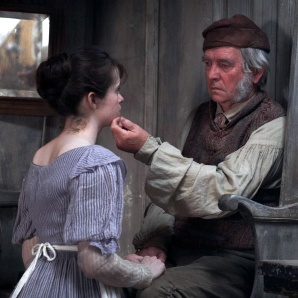 Charles Dickens wrote Little Dorrit during the mid 19th century, but he placed the story at a time when his father was imprisoned in the Marshalsea, a debtor’s prison. PBS will be airing a 5-installment series of Little Dorrit starting tonight at 9 p.m. EST and ending April 26th. If you have missed any episodes, you can watch them online at this link.
The film is stunning; the acting is outstanding; and this story of greed, ponzi schemes, lost fortunes, insurmountable debts, and wrecked lives resonates in today’s financial climate. In the next few weeks I will be posting a series of thoughts and reviews about this film, which is set in the Regency Period. The links sit below this slide show.
- Click here to read Little Dorrit and the Grand Tour
- Click here to read my post about William Dorrit, the Father of the Marshalsea
- Click here to read my post about the character of Flora Finching, and how she is based on Charles Dickens’ first love.
- Review on Remotely Connected
- Click here for screencaps of Episode One, and here for more screencaps and icons.
Sense and Sensibility 2008 Rebroadcast: Review and New Images
Posted in jane austen, Movie review, Popular culture, tagged Masterpiece Classic, PBS Movie Review, Sense & Sensibility 2008 on February 1, 2009| 13 Comments »
Sense and Sensibility will have its second airing on PBS Masterpiece Classic tonight at 9 PM EST. For those who prefer not to watch the Super Bowl, this film provides a fine alternative viewing. Click here for my review, Sense and Sensibility Makes Sense for the Most Part. Click below to view the trailer for Part One:
I have since added more images from this adaptation to my collection.

The opening scene was a bit confusing. Who was making love and why? Does not this actress resemble Hattie Morahan?

The Dashwoods lived in a grand house when Mr. Dashwood unexpectedly died.
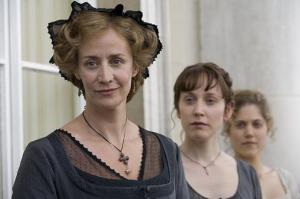
Poor Mrs. Dashwood, Elinor and Marianne were still in deep mourning when ...
. . . John and Fanny Dashwood (who was suitably creepy and mean), showed up with very little notice.

Fanny deserved to eat this unappetizing fish ...

... and to wear this terrible hairdo.

Edward was handsomer than expected ...

and so was Colonel Brandon.

In fact, both were more attractive than Willoughby, which is not what Jane Austen intended.

Sir John Middleton ...
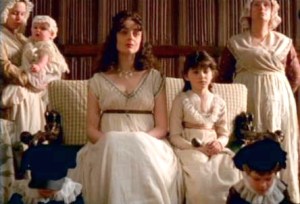
... had quite a handsome family. We see them in so few movie adaptations.

Mrs. Jennings was as vulgar and effusive as ever.
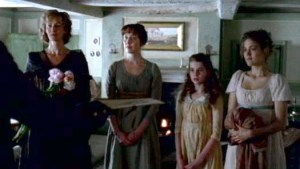
Barton Cottage was quite a comedown from Norland Park.
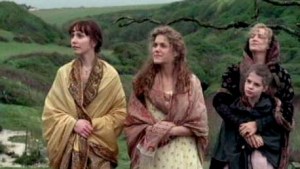
But the Dashwood ladies managed to make the best of the situation.
Stay tuned for more images next week … at this link.
Wuthering Heights, Review One: Bats in Heathcliff’s Belfry
Posted in jane austen, Jane Austen's World, Movie review, Popular culture, tagged Charlotte Riley, Heathcliff, Masterpiece Classic, PBS Movie Review, Tom Hardy, Wuthering Heights on January 17, 2009| 10 Comments »
 Inquiring Readers: This tongue in cheek review of Wuthering Heights, showing on PBS January 18th & 25th, has been written in the spirit of fun (and illumination!). In it Dr. Phyl, Oprey’s favorite tele-psychobabbler, analyzes Heathcliff and Cathy. My more serious analysis of Heathcliff (Review Two) sits on Remotely Connected, a PBS blogger site. Enjoy.
Dear Dr. Phyl,
Catherine Earnshaw and Heathcliff have had a long and stormy relationship. After Cathy’s death, Heathcliff dealt badly with her loss, seeking revenge. One might say he handled himself in a most ungentlemanlike manner. Miss Emily Brontë, an interested bystander, wrote a book about this unique tale, which I am sending on to you. After you have read Wuthering Heights, would you mind answering a few questions? Wouldn’t you agree that loving someone too much is a bad thing? And aren’t women more prone to going crazy over a lost love than men? In other words, how realistic is this story?
Thanking you in advance, Ms. Place
Dear Ms. Place,
To answer your second point first, let me state categorically that in this day and age men have as much right to go crazy as women. Males might exhibit this character trait differently, but crazy is as crazy does.
In my long career as a tele-psychobabbler, I must say that I encounter an assortment of juvenile behaviors among my featured guests, but few possess even 1/10th of Heathcliff’s charged and emotionally unhealthy obsessions. He is as nuts as they come and I write these words with awe and respect. Seldom has a man with so many problems been able to keep up a normal façade for very long, and Heathcliff managed to fool enough people and hold them in his thrall until he could destroy them.
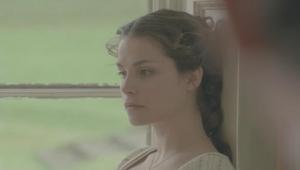 Let’s get my assessment of Cathy Linton née Earnshaw’s character out of the way. She was merely guilty of acting like a self-centered, spoiled, and willful brat. Tighter lacings and a rigid schedule pursuing ladylike endeavors would have tamed her unruly nature. Had I been her personal psychobabbler, I would have prescribed vigorous exercises in the form of housework and mucking horse stalls to tone down her narcissistic tendencies. That girl was seriously willful and needed to get an inner life. Unfortunately she died before self-actualization became possible.
As for Heathcliff, he suffers from a rare condition called Continuous Revenge Seeker Disorder, or CRSD. Every human suffering from this persistent unvegetative state has died tragically. A childhood trauma precipitates this disease, leaving all CRSD sufferers with an acute sense of insecurity and low self-esteem. Heathcliff’s traumas were manifold. He had to scrounge for a living on the street when he was a mere child. Then his stepbrother’s jealousy tainted his burgeoning relationship with Mr. Earnshaw, his protector. After that good man’s death, Heathcliff’s life at Wuthering Heights became a nightmare. He had gone from Gypsy child to cherished stepson to servant in the space of a few years and his fragile ego just couldn’t take this constant see-sawing of emotions. And then Cathy, his soulmate, goes all squirrelly on him and starts coming on to another man. Some people weep and give up; but Heathcliff vowed revenge and felt stronger as a result, a classic trait of the CRSD sufferer.
 Cathy’s obsessively close relationship with Heathcliff sealed the CRSD deal. That poor motherless and loveless boy could no more fight off Cathy’s charms than a hog can resist a nice puddle of mud. It would have been better if he had hooked up with Tess of the D’urbervilles. Now there’s a woman whose miserable experiences and continual bad luck could have coaxed him out of his self-pity, but fate had Cathy in store for this man and that was his downfall. As for his relationship with Cathy, when people start saying things like “you torment me” to each other, that’s just not healthy! Normal couples don’t spend all their time stressing, testing, and obsessing. They keep their neediness to themselves! They GROW UP!
You didn’t mention the Linton siblings in your letter. These two mealy-mouthed milque toasties chose mates that were entirely wrong for them. Hadn’t anyone bothered to teach them the warning signs of an unhealthy relationship? One minute kind, next minute cruel. Gets jealous for no reason. And angry, sulky, or withdrawing. The Lintons began changing their own behavior to keep the peace, and Isabella went so far as to think that her love for Heathcliff would be strong enough to CHANGE him. Talk about unrealistic expectations! Well she got her comeuppance, so you can’t help but feel sorry for her, because for him she was just a means to revenge. What amazes me, Ms. Place, is that this book, which is about a dysfunctional relationship that destroys lives, has become a popular and enduring classic. Now how cockamamie is that? And my guess as to why people aren’t embracing my new book – Normal Thoughts for Ordinary People -with the same enthusiasm as for this over the top gothic drivel is as good as yours.
 After Cathy married Edgar, Heathcliff ran off, got rich, and returned to torment Cathy by pretending to court Isabella. Right there that tells us that bats have entered Heathcliff’s belfry. The scene in which Ms. Brontë described Cathy dying in Heathcliff’s arms, with him clinging to her and growling at her and telling her things like “haunt me” and “I love my murderer” indicates that Heathcliff’s bats have turned rabid. Honestogod, were these folks for real or were they a figment of someone’s imagination?
I understand that a new production of Wuthering Heights is scheduled to be aired on PBS on January 18th and 25th. I’ll ask my staff to schedule Heathcliff for my show. Considering some of the loony bin guests I’ve had on recently, he will fit right in.
Sincerely,
Dr. Phyl
If you missed the first airing of Wuthering Heights, you can view past episodes at this link starting the 19th.
-
Join 7,216 other subscribers
-
2025 AGM in Baltimore
-

-
Items of Interest
Blog Stats
- 18,531,038 hits
- Follow Jane Austen's World on WordPress.com
-
RECOMMENDED BOOKS AND RESOURCES
-
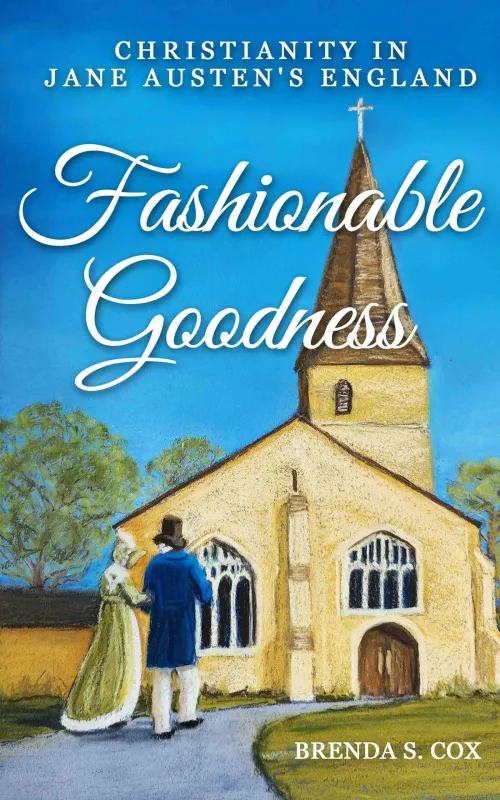
Fashionable Goodness: Christianity in Jane Austen's England is now available! By JAW contributor Brenda S. Cox. See Review. Available from Amazon and Jane Austen Books. 
We also recommend JAW contributor Rachel Dodge's devotionals based on Jane Austen's prayers and classic literature. Reviews:
Praying With Jane: 31 Days Through the Prayers of Jane Austen
The Anne of Green Gables DevotionalThe Little Women Devotional
The Secret Garden Devotional
The Tour of Doctor Syntax. Edited by Ben Wiebracht. Read the review of the book at this link. Click to order the book on Amazon US or Amazon UK or Jane Austen Books FREE Student Membership to JASNA
Available through December 31st, 2025. Click on image for details, and share this poster with other teachers and students!

The Obituary of Charlotte Collins by Andrew Capes

Click on image to read the story.
Comments
“My idea of good company…is the company of clever, well-informed people, who have a great deal of conversation.” – Jane Austen, Persuasion

Gentle readers: Please feel free to post your comments and continue the conversation! Due to SPAM, we will no longer accept comments on posts after 30 days of publication. In some instances, links will be removed from comments as well.
Administrators and Contributors
Pin It!

Top Posts
-
Recent Posts
Links to Jane Austen Blogs
May we suggest?
Hello, my name is Vic and I live in Maryland, USA. I have adored Jane Austen almost all of my life. I am a proud lifetime member of the Jane Austen Society of North America. This blog is a personal blog written and edited by me and my team. We do not accept any form of cash advertising, sponsorship, or paid topic insertions. However, we do accept and keep books and CDs to review.
If you would like to share a new site, or point out an error, please email us. (Yes, we are fallible. We'll own up to our mistakes and will make the corrections with a polite smile on our faces.) Write us at

Thank you for visiting this blog. Your comments and suggestions are most welcome.
Project Gutenberg: eBook of Stage-coach and Mail in Days of Yore, Volume 2 (of 2), by Charles G. Harper
STAGE-COACH AND MAIL IN DAYS OF YORE: A PICTURESQUE HISTORY
OF THE COACHING AGE, VOL. II, By CHARLES G. HARPER. 1903. Click on this link.
Top Posts & Pages
- Men's hair styles at the turn of the 19th century
- Pictorial History of Regency Hairstyles
- Regency Fashion: Men's Breeches, Pantaloons, and Trousers
- Regency Fashion: The Muslin and Net Period
- Social Customs During the Regency
- Sanditon, Season 3: Well, it's finally over
- George Austen as a Father
- Highclere Castle Floor Plan: The Real Downton Abbey
- Regency Hygiene: The Bourdaloue
- Dancing at the Netherfield Ball: Pride and Prejudice
Tour Chawton Cottage on YouTube
-
Disclaimer: Our team makes no profit from this blog. We may receive books (physical or digitized) for review purposes.
-
Copyright Statement: © Jane Austen's World blog, 2009-2024. Unauthorized use and/or duplication of this material without express and written permission from this blog’s author and/or owners is strictly prohibited. Excerpts and links may be used, provided that full and clear credit is given to Jane Austen's World with appropriate and specific direction to the original content.




 Jane Austen's World