Feeds:
Posts
Comments

Posts Tagged ‘Prince Regent’

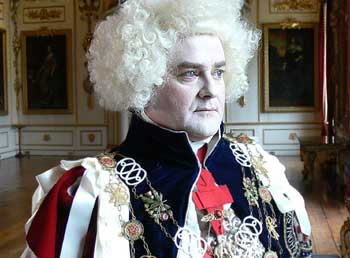
tying-cravatA recent post on this blog mentioned the film, Beau Brummell: This Charming Man. One scene in the movie was particularly memorable. In it the prince regent, played by Hugh Bonneville, asked Beau Brummell (James Purefoy) how he tied his cravat. Instead of showing him, the Beau invited the prince to watch him dress. Mr. Brummell was known for his sartorial splendor and for his meticulousness in tying a rectangular linen cloth.

The adoption of increasingly complex neckties by fashionable young men in the 1810s and 1820s swiftly attracted the attention of satirists and caricaturists. Brummell’s own legend revolved around a description of his morning dressing rituals, whereby his valet would present a gathered audience of friends and followers with Brummell’s failed knots on a silver platter – evidence of the master’s perfectionism in matters of the wardrobe.  – The London Look

Brummel was the bane of his washerwoman and long-suffering valet, discarding a dozen snowy white, painstakingly ironed linens before he had achieved the perfect look. But he wasn’t the only “exquisite” who strove for perfection.

A German prince, visiting London at the turn of the century, noted: “an elegant then requires per week, twenty shirts, twenty-four pocket handkerchiefs, nine or ten pairs of ‘summer trousers,’ thirty neck handkerchiefs (unless he wears black ones), a dozen waistcoats, stockings à discretion.” – Poet of Cloth

During Beau Brummel’s reign as the premier dandy, no self respecting gentleman would wear less than three fresh cravats in a day. This was in an age when the household duty most dreaded by women was laundering and ironing clothes.  Brummell was also known for his many innovations in tying the cravat. His biographer Captain Jesse wrote that Brummell’s collars were

“always fixed to his shirts and so large that before being folded down they completely hid the face and head; the neckcloth was almost a foot in height, the collar was fastened down to its proper size and Brummell standing before the glass, by the gradual declension of his lower jaw, creased the cravat to reasonable dimensions.” – Accessories of Dress, Katherine Morris Lester, Bess Viola Oerke, Helen Westermann, P 218.

This was easier said than done, for the fastidious Brummell was seldom satisfied with his creases in his first or second attempts. The Duke of Wellington, also a respected dandy, was known to wear only white cravats on the field of battle. Napoleon, who typically wore black stock, ironically chose to wear a white cravat for the first time during Waterloo in the Duke’s honor. From 1815 on the cravat was also known as a tie.

The Neckclothitania was published in September 1818 as a satirical document that poked fun at the most popular cravat styles of the time. Some of the cravats shown in the pamphlet were so elaborate and ridiculous that they clashed with Brummell’s idea that “style was essential in the quality of one’s linen rather than the extremity of it”. By 1818 colors were becoming fashionable, whereas in Brummell’s day only the purest white (blanc d’innoncence virginale) was acceptable.* The cloth for cravats was made of starched linen, though as some of the cravats styles evolved, a more relaxed, unstarched cloth was required for a looser, draped effect. By the 1830’s silk was used for neckcloths, as it still is used for today. In 1818, only a year after Brummell left for France, other cravat colors were introduced.

From Neckclothitania or Tietania, being an essay on Starchers, by One of the Cloth, published by J.J. Stockdale, Sept. 1st. 1818, engraved by George Cruikshank.

From Neckclothitania or Tietania, being an essay on Starchers, by One of the Cloth, published by J.J. Stockdale, Sept. 1st. 1818, engraved by George Cruikshank.

The following descriptions are directly from Neckclothitania:
The Oriental
The Oriental made with a very stiff and rigid cloth, so that there cannot be the least danger of its yielding or bending to the exertions and sudden twists of the head and neck. -Care should be taken that not a single indenture or crease should be visible in this tie; it must present a round, smooth, and even surface – the least deviation from this rule, will prevent its being so named. This neck-cloth ought not to be attempted, unless full confidence and reliance can be placed in its stiffness.-it must not be made with coloured neck-cloths, but of the most brilliant white. It is this particular tie which is alluded to in the following lines.

‘There, had ye marked their neck-cloth’s slivery glow,
Transcend the Cygnet’s towering crest of snow.’

The Mathematical
The Mathematical Tie (or Triangular Tie), is far less severe than the former. There are three creases in it. One coming down from under each ear, till it meets the kust or bow of the neckcloth, and a third in an horizontal direction, stretching from one of the side indentures to the other. The height, that is how far, or near the chin is left to the wearers pleasure. This tie does not occassion many accidents.The colour best suited to it, is called couleur de la cuisse d’une nymphe emue.’

Osbaldeston Tie
The Osbaldeston Tie differs greatly from most others. This neck-cloth is first laid on the back of the neck; the ends are then brought forward and tied in a large knot, the breadth of which must be at least four inches and two inches deep. This tie is well adapted for summer; because instead of going round the neck twice, it confines itself to once. The best colours are ethereal azure.

Napoleon Tie
Why this particular Tie was called Napoleon, I have not yet been able to learn, nor can I even guess, never having heard that the French Emperor was famous for making a tie – I have, indeed, heard it said, that he wore one of this sort on his return from Elba and on board the Northumberland, but how far this information is correct, I do not know. It is first laid as in the former, on the back of the neck, the ends being fastened to the braces, or carried under the arms and tied on the back. It has a very pretty appearance, giving the wearer a languishingly amourous look. The violet colour, and la couleur des levres d’amour are the best suited for it.

American Tie
The American Tie differs little from the Mathematical except that the collateral indentures do not extend so near to the ear, and that there is no horizontal or middle crease in it. The best colour is ocean green.

Mail Coach Tie
The Mail Coach or Waterfall, is made by tying it with a single knot, and then bringing one of the ends over, so as completely to hide the knot, and spreading it out, and turning it down in the waistcoat. The neck-cloth ought to be very large to make this Tie properly – It is worn by all stage-coachmen, guards, the swells of the fancy, and ruffians. To be quite the thing, there should be no starch, or at least very little in it – A Kushmeer shawl is the best, I may even say, the only thing with which it can be made. The Mailcoach was best made out of a cashmere shawl and had one end brought over the knot, spread out and tucked into the waist. This style was particularly popular with members of the ‘Four-in-Hand Club’.

The Trone d’Amour
The The trone d’Amour is the most austere after the Oriental Tie – It must be extremely well stiffened with starch. It is formed by one single horizontal dent in the middle. Colour, Yeux de fille en extase.

Irish Tie
This one resembles in some degree the Mathematical, with, however, this difference, that the horizontal indentture is placed below the point of junction formed by the collateral creases, instead of being above. The colour is Cerulean Blue

The Ballroom Tie
The Ballroom Tie when well put on is quite delicious – It unites the qualities of the Mathematical and Irish, having two collateral dents and two horizontal ones, the one above as in the former, the other below as in the latter. It has no knot but is fastened as the Napoleon. This should never of course be made with colours but with the purest and most brilliant blanc d’innocence virginale .

horse-collarHorse Collar Tie
The Horse Collar has become, from some unaccountable reason, very universal. I can only attribute it to the inability of its wearers to make any other. It is certainly the worst and most vulgar, and I should not have given it a place in these pages were it not for the purpose of cautioning my readers, from ever wearing it – It has the appearance of a great half-moon, or horse collar – I sincerely hope it will soon be dropped entirely – nam super omnes vitandum est.

Hunting Tie
The Hunting or Diana Tie, (not that I suppose Diana ever did wear a Tie) is formed by two collateral dents on each side, and meeting in the middle, without any horizontal ones – it is generally accompanied by a crossing of the ends, as in the Ball Room and Napoleon. Its colour Isabella – This cloth is worn sometimes with a Gordian Knot.

Maharatta Tie
The Maharatta or Nabog Tie, is very cool, as it is always made with fine muslin neck-cloths. It is placed on the back of the neck, the ends are then brought forward, and joined as a chain link, the remainder is then turned back, and fastened behind. Its colour, Eau d’Ispahan.

By 1828 Beau Brummell had lived in France for 9 years, a disgraced exile. But his influence in men’s fashion lived on.

His collar was copied and grew to extreme heights that covered the ears and were held away from the neck by whale bone stiffeners, and meant men could no longer turn their heads to see, but had to turn their entire bodies. It did however spawn an industry of publications and experts who taught men of fashion how to tie their cravats. – The Regency Neckcloth

The book The Art of Tying the Cravat (demonstrated in sixteen lessons as shown in the illustration below) was originally published in 1828 by H. Le Blanc Esq.

Plate B, The Art of Tying the Cravat

Plate B, The Art of Tying the Cravat

The fronticepiece of Mr. Le Blanc’s book shows an engraving of the author wearing an elaborate white cravat, the acme of full dress London fashion in 1828. In that year there were 32 types of cravats. Those made of black silk or satin were for general wear, while white cravats with spots or squares were considered half dress. The plain white cravat was admitted at balls or soirees where colored cravats were prohibited.
Text not available
The art of tying the cravat demonstrated in sixteen lessons, including thirty-two different styles, By H. Le Blanc.

The following description comes from The Art of Tying the Cravat:

americaineTHE Cravate Americaine is extremely pretty and easily formed, provided the handkerchief is well starched. When it is correctly formed it presents the appearance of a column destined to support a Corinthian capital. This style has many admirers here, and also among our friends the fashionables of the New World, who pride themselves on its name which they call Independence; this title may to a certain point be disputed, as the neck is fixed in a kind of vice which entirely prohibits any very free movements –  The Art of Tying the Cravat

Read more about this topic at these links:

Read Full Post »

James Purefoy as Beau Brummell

James Purefoy as Beau Brummell

In 2006 the BBC commissioned four films in celebration of The Century That Made UsBeau Brummell: This Charming Man is the tale of a self-made man whose innovations in male dress influenced men’s fashions for all time. James Purefoy plays the  handsome masculine dandy who dared to think of himself as the prince regent’s social equal. The prince, who was at first amused by Brummell, would watch him shave and dress in the morning. Then one day Brummell overstepped his bounds and insulted the prince. He quickly fell out of favor. Mired in debts he could not pay and with his gambling out of control, Brummell fled to France in 1816. He died in poverty in a mendicant hospital for the insane in 1840.

Hugh Bonneville as the Prince Regent before his transformation from fop to dandy

Hugh Bonneville as the Prince Regent before his transformation from fop to dandy

The prince regent after Beau Brummel ltransformed him

The prince regent after Beau Brummell transformed him

The film concentrates on a period in Brummell’s life when he reigned supreme as a fashion arbiter. While I found the story fascinating to watch, I thought the music ugly and distracting and totally unsuited to the 18th century. Beau Brummell: This Charming Man can be rented through netflix or purchased as a DVD. The following YouTube scenes provide a good overview of the film. The first clip is the movie’s trailer.

In the next scene, Beau Brummell describes the dandy style as “No wigs, no powders. We don’t use scent. The dandy uses trousers. The dandy washes. The dandy is clean, the dandy is neat.”

This video clip is the most interesting of all. While Brummell stands in front of his mirror shaving in the nude, the dandy set looks on. In this scene they are awaiting the prince regent’s arrival.

beau_brummell_dvd_cover

Read Full Post »

London grew by leaps and bounds during the 18th century, becoming the largest city in Europe with a population of over one million people. Formal squares sprung up in the tony West End, where it became de rigeur for the upper classes to rent a “First rate” townhouse and spend the Season in “Town.” These Palladian-influenced townhouses, though a vast improvement over the helter-skelter, hodgepodge buildings of medieval London, were not huge by today’s standards. Four stories high and at least over 900 square feet in size, town dwellings were much smaller than a family’s country house counterpart.
london-townhouse-plan
Successful parties and dances were deemed to be crushes and squeezes when over a hundred invited guests attempted to circulate in townhouses no more than two rooms wide. As with theatre or stadium traffic today, it would often take an hour for a carriage to queue up before it reached the front door and could disgorge its passengers. The guests would then be announced by the butler (in stentorious tones, no doubt) as they entered inside. Jane Austen described a crush in the Upper Assembly Rooms in Bath as Mrs. Allen and Catherine Morland made their way around the rooms, and such a situation was frequently mentioned in Georgette Heyer’s novels.   The illustration by George Cruikshank below visually sums up the experience:

Image from Wikimedia Commons

Image from Wikimedia Commons

“The inconveniences of a crowded drawing room”, a famous May 6th 1818 caricature by George Cruikshank. Shows a crowded royal “drawing room” reception (in a London palace). The woman at the left (whose train is being stepped on) is wearing the old-fashioned hooped “court dress” (abolished 1820), while the man in the door is wearing formal breeches (many of the other men are wearing military uniforms). The moustache of the man on the right had connotations of foreign (Continental) and/or military dandyism at the time. – Wikimedia

Even Carlton House was not immune to crushes, where George IV as Prince Regent entertained his guests on a massive scale. On one occasion he opened the lavish banqueting room to the public. The prince regent had acquired a 4,000-piece Grand Service made of silver gilt, which included 140 dishes, 288 silver plates and a variety of cutlery from goldsmith, Rundell, Bridge, and Rundell at a cost of £60,000 (more than £3million in today’s money). Heavily in debt, this profligate prince held a banquet on June 19, 1811 for 2,000 people at Carlton House to celebrate his elevation to Prince Regent, though he excluded the queen, his wife, and Princess Charlotte, his daughter. His mother chose not to attend.

The guests were invited to arrive at 9 pm for a dinner which did not commence until 2 am, and they found the most extraordinary thing they had ever seen. Along the length of the building was a table, 200 ft long, with a stream running down the middle of it. Not only was this babbling brook lined with banks of moss and aquatic flowers, but it even had real fish swimming in it.

Beyond the main building, extra rooms and marquees had been erected to cope with the numbers while covered walks through the gardens were lined with rose-filled trellises and mirrors. The tradesmen’s bills for temporary fittings alone came to £2,585 (more than £130,000 today).

‘Nothing was ever half so magnificent,’ wrote one guest, Thomas Moore. ‘It was, in reality, all that they try to imitate in the gorgeous scenery of the theatre.’

The source of the artificial river was a fountain in the Gothic Conservatory. Above this fountain, in a feather-backed mahogany chair, sat the Prince Regent himself, dressed in the uniform of a Field Marshal. George III had always refused to give his son the rank of Field Marshal, but now the heir to the throne was also Regent, he bestowed it on himself anyway.

Behind the Prince, an enormous display of gold and silver plate had been piled high, just in case anyone needed reminding of his wealth and status. But because the Prince had yet to buy much of the Grand Service, even he was still a little short of silver for a party of this magnitude.*

To accommodate such an enormous number of guests, the prince had to borrow seven tons of gold and silver plate for the occasion. Sixty servants waited on the guests, some of whom stayed until 5:30 AM. The prince opened the palace to the public for three days afterwards. Instead of diminishing, the crowds arrived in increasing numbers, creating chaos.

State banquet room, Buckingham Palace

State banquet room, Buckingham Palace

‘The condescension of the Prince in extending the permission to view the arrangements for the late fete at Carlton House has nearly been attended with fatal consequences,’ reported one newspaper.

‘Wednesday being the last day of the public being admitted, many persons took their station at the gates so early as seven o’clock. By twelve, the line of carriages reached down St James’s Street, as far as Piccadilly, and the crowd of pedestrians halfway up the Haymarket.

At three o’clock the crowd had so much increased that the Guards were forced to give way; several ladies were unfortunately thrown down and trampled upon; and we regret to learn that some were seriously hurt, among whom were Miss Shum of Bedford Square, and a young lady, daughter of a gentleman at the British Museum.

‘Another young lady presented a shocking spectacle; she had been trodden on till her face was quite black from strangulation, and every part of her body bruised to such a degree as to leave little hopes of her recovery.’

The crush led to acute embarrassment as people lost their clothes – or control of their bladders. As the Rev G.N. Wright observed, those ‘fortunate enough to escape personal injury, suffered in their dress; and few of them could leave Carlton House until they had obtained fresh garments’.*

The prince’s brother climbed a wall and told the crowd that there would be no further public admission, and the crowd dispersed, but not before leaving an indelible impression. Prinny continued to add to his Grand Service and held another grand fete in the Duke of Wellington’s honor five years later.

More links on this topic

  • *Article about the Buckingham Palace fete: Mail Online (Banquet image from this site)

Read Full Post »

For centuries, gambling was viewed as a vice typical of the upper classes, but during the Regency this way of passing the time became an even more accepted practice. Card games were played at private parties and at public assemblies, where both sexes indulged in these activities. While the games were often harmless and played for fun, high stakes betting could lead to vice, shocking losses, and crippling addiction. Men gambled and lost vast sums in the men’s clubs in St. James’s, often losing their inheritance. Politicians seeking to deter such an exchange of lands, which undermined the stability of property, held a double standard towards those whom they deemed worthy of winning such wealth:

Regency card party

Regency card party

If a landowner chose to ‘make a sport’ of his property and to lose it, say, at the game of hazard, to another son of broad acres, that was his prerogative. But if, on the other hand, he was foolish enough to throw away what he had inherited to low-born adventurers or, worse, to Jewish moneylenders, the loss was invariably considered serious. The nation’s rulers judged it a threat to their own kind when an estate or any significant portion of one passed into the ‘wrong hands’. The Regency Underworld, Donald A. Lowe, p. 128, ISBN 0-7509-2121-8

Cruikshank, Interior of Modern Hell

Cruikshank, Interior of Modern Hell

One gets the sense that Jane Austen and her social set played cards for amusement and to wile away a pleasant hour or two with friends and family. For some ladies, gambling for profit was an acceptable way of supplementing a fixed income:

Well-off women with no other income sometimes allowed their houses to be turned into gambling houses. The two best known at the end of the eighteenth century, Lady Archer and Lady Buckingamshire, were only the most prominent of a circle of “faro” ladies who owned banks in private homes.- Roll the Bones: The History of Gambling, David G. Schwartz, p. 162, ISBN 1-592-40208-9

Although the two ladies claimed that their aristocratic birth gave them license to run gambling operations, they were subject to ridicule. Lady Buckinghamshire slept with a cache of weapons to protect her bank, and Lady Archer was known for wearing too much makeup. Faro began to decline in popularity, and by the early 19th century, young ladies in boarding school were learning whist and casino. Young gentlemen continued to play hazard, baccarat, and whist in men’s gaming clubs, also known as Hells.

ladygodinaprint

The politician Charles Fox, able to play for long periods without sleep, lost his fortune at the gaming tables. Horace Walpole described one of Fox’s marathon gambling sessions:

He had sat up playing Hazard at Almack’s from Tuesday evening, 4th February [1778], till five in the afternoon of Wednesday 5th. An hour before he had recovered £12,000 that he had lost, and by dinner, which was at five o’clock, he had ended losing £11,000. On Thursday he spoke, went to dinner at past eleven at night; from thence to White’s, where he drank till seven the next morning; thence to Almack’s, where he won £6,000; and between three and four in the afternoon he set out for Newmarket. His brother Stephen lost £11,000 two nights after, and Charles £10,000 more on the 13th; so that in three nights the two brothers, the eldest not twenty-five, lost £32,000. – Lowe, p 129.

Fox’s father, Lord Holland, paid off his son’s debt to the princely tune of £140,000. (In today’s terms this sum would be astronomical – depending on the inflation converter you used, you would multiply the sum by 97 to get at the value of 1780 money today.) The Prince of Wales, in rebellion against his frugal father, modeled his own conduct after that of Fox. Known for his extravagant lifestyle, Prinny set the pace for hedonistic living as Regent and King.

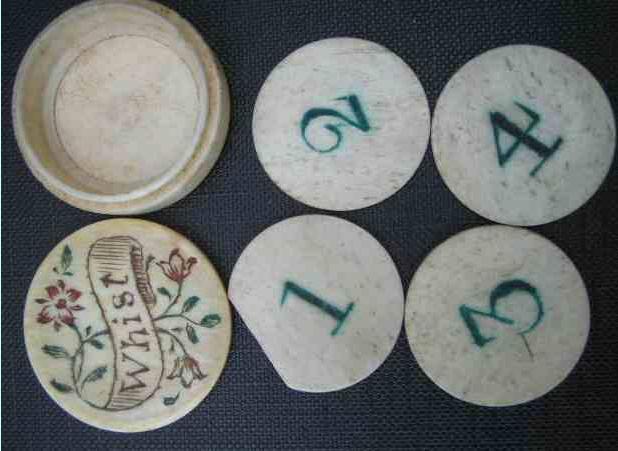
whist-markersWhist Markers

More links on gambling and games in the Regency Era:

Read Full Post »

“That fellow Weston,” said Brummell, “is an inimitable fellow — a little defective perhaps in his ‘linings,’ but irreproachable for principle and button-holes. He came to London, Sir, without a shilling; and he counts more realized thousands than our fat friend does ‘frogs’ on his Brandenburg. He is not only rich, but brave; not only brave, but courteous; and not alone courteous, but candid. – Beau Brummel

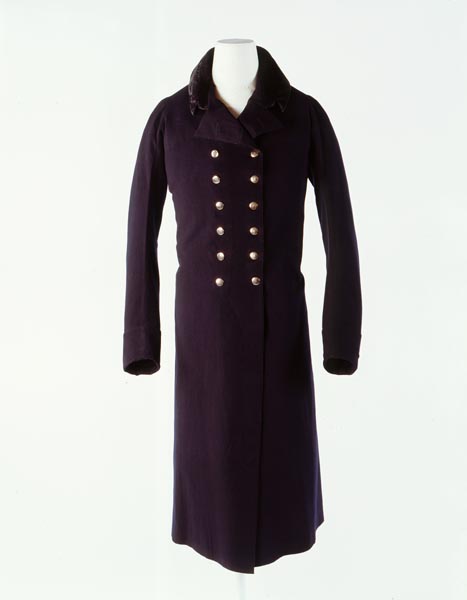
Man's Great Coat by John Weston, 1803-1810

Man

John Weston, Regency London’s most expensive tailor and draper to George, Prince of Wales, was frequently mentioned by Georgette Heyer in her novels. While Ms. Heyer peppered her novels with Weston’s name, I was actually unable to find much about him. This caption from the exhibit a the Museum of London, describes the greatcoat at right: 1803, tailored by John Weston of 38 Old Bond Street.

The prince was passionately interested in clothes and patronised London’s most skilful craftsmen. This slim fitting double-breasted coat, which has a silk velvet collar, is made of high quality British wool facecloth. Charles Jennens, a London button maker, supplied the gilt buttons.

The coat was discovered at Coutts Bank, where the tailor had deposited it for an unknown client, in 1956. A letter accompanying the coat described it as, ‘an exceed[ingly] good blue cloth great coat … made in ev[e]ry respect in the best manner’.

Men of fashion felt a sort of religious awe as they passed over the threshold of Weston, Brummell’s tailor, in Old Bond-street

Read more about London’s tailors at these links:

  • Jean Louis Bazalgette: Fascinating biography of one of the Prince Regent’s earlier, lesser known tailors. (Cached information.)

Read Full Post »

« Newer Posts - Older Posts »