 T’is the season to purchase books for a Christmas gift or to curl up with a novel in front of a fire as the cold weather settles in. The first book I suggested for your consideration was The Harlot’s Progress: Yorkshire Molly, by Peter Mottley, the first in a trilogy and a fictional actualization of Hogarth’s series of etchings called “The Harlot’s Progress”. My friend, Lady Anne, wrote a review about the second holiday book, These Old Shades by Georgette Heyer, a perennial favorite.

Regency Cheshire by Sue Wilkes
The third book on my recommendation list this holiday season is Regency Cheshire by Sue Wilkes, a history book about the Regency period in Cheshire during the early 19th Century. All I ask of a history book is accurate information about an era or region in which I am interested, and tidbits of information that will enlighten my knowledge of the past in an interesting way. This book offers both. I tend not to read history books from front to back, one of my bigger failings. I will start a chapter in the middle of a book and towards the end, before attempting the first chapters, and Regency Cheshire lends itself well to this practice. I knew very little about Cheshire before I began to read it, and am now curious to visit the area. In no particular order, here are some of the facts related in the book that I found interesting:
“Mad Jack” Mytton, the Squire of Halston Hall, drank seven bottles of port wine per day and kept two bulldogs and a pet bear. One day, Mad Jack got hiccups while drunk. Attempting to frighten them away, he set his shirt on fire with a lighted candle, an incident he survived. – p 72-73
An ailing George III celebrated his jubilee in October 1809. Churchbells rang and flags flew in Macclesfield, where a public dinner was held in his honor for 1,200 people; an ox was roasted in Chester, and the streets were decorated with patterns of colored sand in Knutsford. – p22
Chester hosted the Earl of Chester Plate, a racing event that began in 1802. Inns and private rooms filled up rapidly before race meetings, and special balls, assemblies and plays were held during race week. Along with genteel folks came beggars, blind fiddlers, and unwelcome pick-pockets. – p 71
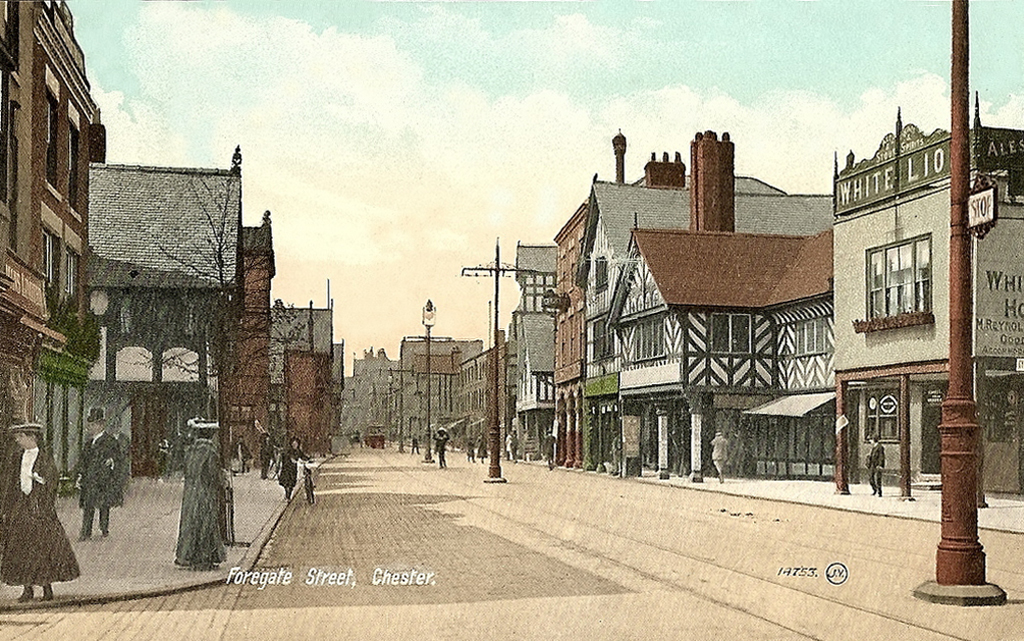
Chester circa 1900
“About 92,000 cows were kept for diary production in the first decade of the nineteenth century and approximately 11,500 tons of cheese were produced each year…Cows were milked twice a day at six o’clock in the morning and evening. The annual yield of cheese from each cow varied hugely, from 50 lb. to over 500 lb, depending on the season, quality of the soil and pasture, time of year, and how well the stock was over-wintered. About eight quarts of milk were needed to produce one pound of cheese.” – p 176-177
“Child workers helped throwsters in workshops or ‘shades’…The throwster’s helper, usually a boy, then ran to the other end of the room, carrying the other ends of the silk threads on bobbins….The throwsters twisted the silk threads by spinning the wheel. Their young helpers ran miles barefoot every day.” – p. 198
“John Wakefield, a gentleman and salt proprietor at Winnington, was accused of of fatally stabbing 21-year-old Richard Maddock, a handsome Northwich flatman. Maddock’s sweetheart, Elizabeth Woodward, a ‘smart, good-looking girl’, aged about twenty and a servant in the Wakefield’s home, was a key witness for the prosecution. John Wakefield fell desperately in love with her and offered to take Elizabeth to London, and ‘keep me as a lady’, she testified. On the night of 8 September 1817, Wakefield discovered Maddock in the house with Elizabeth. There was a violent struggle. Later, another flatman found Maddock dying about seventy yards from the house. The jury found Wakefield guilty of manslaughter, but the judge gave him just six months in the ‘common gaol’.”- p 112
There are more fascinating stories about Regency Cheshire in this fact-filled, informative, and well-written book. If you have any interest in the Regency era or Chester in the 19th Century, I highly recommend it. Click here to order the book in the UK.
More on the topic:







 Jane Austen's World