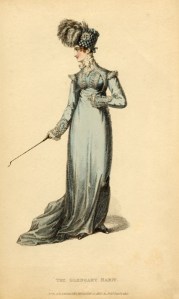
Glengarry riding habit, 1817, Ackermann
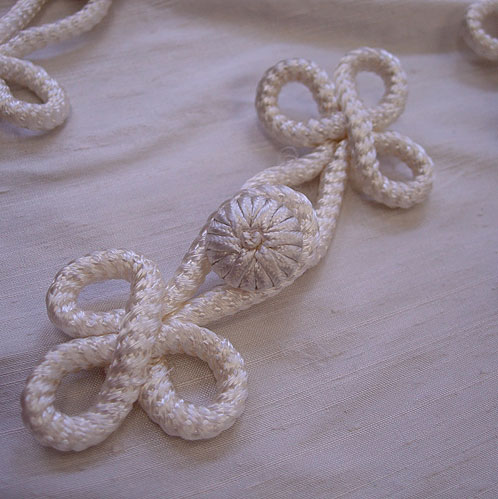
During the first two decades of the nineteenth century, riding habits echoed the high-waisted empire styles that prevailed and the fashion trends that were currently in vogue. The light blue Glengarry riding habit of 1817 (at right) is typical of the fashion of the day. The military-inspired dress was trimmed with lace, braids (image at bottom of post), and frogs. The hat was made of cork, a sensible light weight material, which was visually overpowered by the plumes of feathers that arched over the wearer’s face. Unlike later riding habits, regency riding costumes came in a variety of colors:
It must be remembered that riding dress fashions had not yet fixed on dark colors. Every tint of bright color was used, even figured materials. . . Cloth was of course the general material, but velvet was also used and even silk. There seemed to be no limit to the equipments and trimmings of habits. Where undersleeves were worn in full dress, they appear on the habits. If fichus were the mode, fichus were worn on horseback, while artificial flowers decked riding hats, as well as long feathers. Necklaces even appear, and frequently chatelaines with watches and various trinkets. I have seen several old French and English fashion plates in which the rider carried a carefully spread fan. If ruffs were worn in full dress, ruffs appeared on horseback. If embroidery was worn, the habit was embroidered. Two Centuries of Costume in America, MDCXX-MDCCCXX By Alice Morse Earle
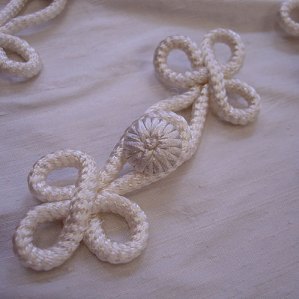
Frog fastening
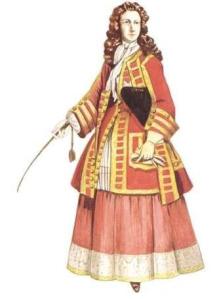
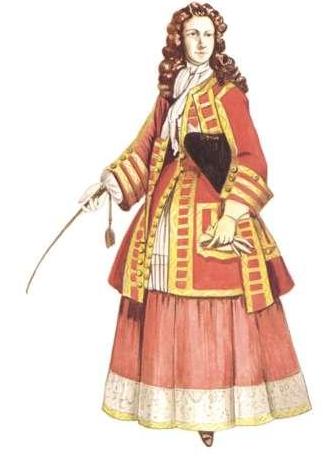
Lady in riding habit, 1720
Braiding and frog fastenings of the era were heavily influenced by the return of English troops from Egypt. Frogs had been used in the East since ancient times, and added a dashing, even exotic touch.
The masculine influence in riding habits began near the end of the 17th Century when ladies adopted masculine coats and waistcoats for riding and hunting. The tailored tops were paired with feminine petticoats, as in this illustration. Horse riding had always been an important and fashionable sport for the upper classes, but these masculine-inspired riding habits were condemned from the start by critics who argued that the bold outfits belied a woman’s innate modesty. Some women began to wear them in the most unexpected places.
Samuel Pepys wrote famously in his diary on June 11, 1666:
Walking in the galleries at White Hall, I find the Ladies of Honour dressed in their riding garbs, with coats and doublets with deep skirts, just, for all the world, like mine; and buttoned their doublets up to the breast, with periwigs under their hats; so that, only for a long petticoat dragging under their men’s coats, nobody could take them for women in any point whatever; which was an odde sight, and a sight did not please me.
It took a long time for these outfits to become generally accepted. Almost eighty years after Samuel Pepys wrote his remarks, Samuel Richardson reminded women in his Familiar Letters on Important Occasions (1741) that:
as sure as any thing intrepid, free, and in a prudent degree bold, becomes a man: so whatever is soft, tender, and modest, renders your sex amiable. In this one instance we do not prefer our own likeness; and the less you resemble us, the more you are sure to charm: For a masculine woman is a character as little creditable as becoming. (Women of Quality, Ingrid H. Tague, 2002, p 52.)
Not all men of the era became chagrined at the thought of a woman in mannish attire. In 1670, Cardinal Dubois, a Frenchman, wrote in his Mémoires:
Mme de Fontanges – let us follow our young beauty as she goes hunting with her prince. That day she was wearing an expensively embroidered riding habit and a hat covered with the most beautiful plumes procurable. She looked so elegant in this costume none other could have suited her better. Nicole-Cargill-Kipar’s Late 17th Century Clothing History
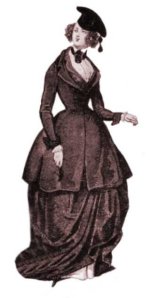
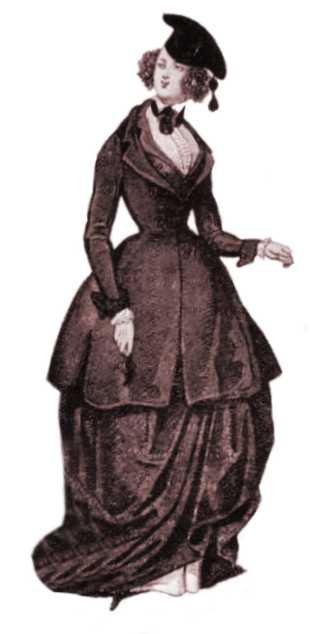
Riding costume, 1841
Despite their doubtful propriety, ladies continued to wear riding outfits, and as the 18th century progressed these costumes began to be more accepted. With the changing fashion, the silhouette became more frilly and femininized and began to take on a higher waistline. In fashion plates the riding costume would be accessorized with a riding crop to distinguish the outfit from carriage costumes, which were made with similar sturdy, long-wearing cloth. By the end of the nineteenth century riding costumes had come full circle and taken on a more somber, tailored, and masculine look. Ladies’s riding habits began to be fashioned by men’s tailors as well as dressmakers. In a New York Times article from June 1901, the author wrote: “the lady on horseback is as much of a man, down to the saddle, as circumstances permit.”
This description of the Glengarry Riding Habit (top image) was written in Ackermann’s Repository, September, 1817. A dressmaker named Miss M’Donald was responsible for its creation.
It is composed of the finest pale blue cloth, and richly ornamented with frogs and braiding to correspond. The front, which is braided on each side, fastens under the body of the habit, which slopes down on each side in a very novel style, and in such a manner as to define the figure to considerable advantage. The epaulettes and jacket are braided to correspond with the front., as is also the bottom of the sleeve, which is braided nearly half-way up the arm. The habit shirt is composed of cambric, with a high standing collar, trimmed with lace. The cravat is of soft muslin, richly worked at the ends and tied in a full bow, and there are narrow lace ruffles at the wrists. The headdress takes the form of the Glengary cap, composed of blue satin, and trimmed with plaited ribbon of various shades of blue, and a superb plume of feathers. Blue kid gloves are worn and half-boots. Sources: Riding Habits, Candice Hern, and Nineteenth-Century Costume and Fashion, Herbert Norris and Oswald Curtis.
Images of Riding Habits in the Regency Era:
History of Riding Habits
More links:
Image of 1841 riding habit from Redingote Fashion History.
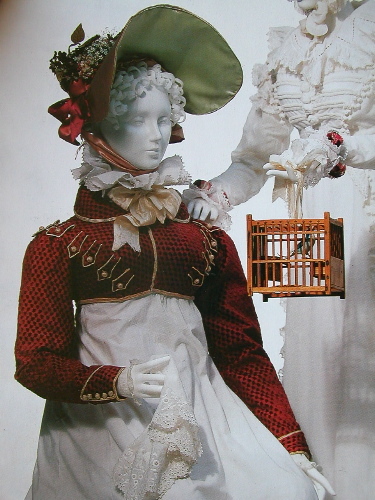
Military influence in the Spencer jacket, with braided piping, 1815. Image: Kyoto Costume Institute.
Read Full Post »



 The author of this recent post writes about the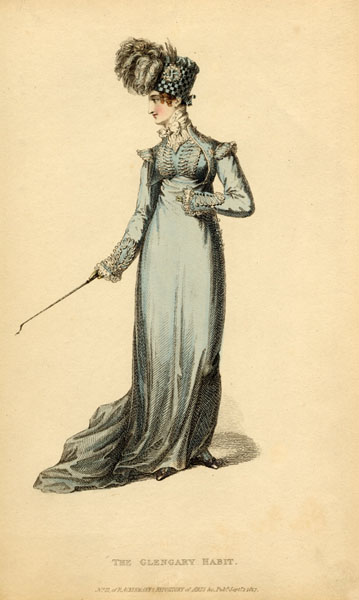








 Jane Austen's World