Feeds:
Posts
Comments

Posts Tagged ‘Regency London’

William Henry Pyne (1769 – 1843)

Many of the illustrations of London and the working class that we see of the regency era can be atttibuted to the artist and writer, William Henry Pyne. W.H. Pyne, the son of a leather seller and weaver, chronicled the working class in The Costumes of Great Britain. In his heyday he created a series of books for the publisher Rudolph Ackermann. Unfortunately, like James Gillray, Mr. Pyne’s illustrations ceased to be popular towards the end of his life, and he died in poverty.

    To learn more about W.H. Pyne, click on these links:

  • The World in Miniature: England, Scotland, and Ireland, edited by W.H. Pyne, containing a description of the character, manners, customs, dress, diversions, and other peculiarities of the inhabitants of Great Britain. In Four Volumes; illustrated with eighty-four coloured engravings, Volume 1, London, 1827, Printed for R. Ackermann, Repository of Arts, Strand.

Illustrations by Pyne: Blue Coat Boy, and Mail Coach from the Microcosm of London. Illustration of Bill Sticker from the World in Miniature.

Read Full Post »

Now industry awakes her busy sons,
Shops open, coaches roll, carts shake the ground,
And all the streets with passing cries resound.

– John Gay, Walking the Streets of London

Oh, how should I describe my three short days in London when I went on a deliberate search for the sites, establishments and objects that existed in the Regency era? We chose a location at the edge of Mayfair, in a hotel on Half Moon Street, just a half block from Piccadilly and Green Park, a once popular dueling spot. We were also just around the corner from Shepherd Market, that wonderful tucked-in and hidden section of pubs, restaurants, and shops few tourists frequent.

The Art of Walking the Streets of London, Hand-coloured etching by George Cruickshank after George Moutard Woodward, 1813

As I walked these familiar streets (for this was my fourth visit to this particular area of London), I turned onto St. James’s Street and looked inside the famous bow window at White’s, where Beau Brummel used to hold court. Inside, I spied a stout gentleman reclining in a comfortable leather chair reading the paper. Black and white prints of estimable personages lined the wall behind him.

I moved on and turned left on Jermyn Street, with its rows of shops boasting Regency style bow windows. For sale in these small, select stores were custom made shirts, ties, men’s suits, and shoes. I strolled past the surprisingly small statue of Beau Brummel, which faces the entrance to Piccadilly Arcade, and headed straight for Floris, the perfume shop established in 1750. I entered its historic interior, where mementos of that time are displayed in mahogany and glass showcases. Luck was on my side, for 10 0z. bottles of lavender scented room spray was on sale.
I promptly purchased three for my close Janeite friends, and acquired a Floris blue shopping bag in the process.

I then crossed the street to Fortnum and Mason and entered this venerable store, established in 1707, through the arched doorway on the Picadilly side. Like Floris, this shop boasts several royal warrants. Although I was tempted by merchandise on every floor, especially the food court, I purchased only a tea strainer for a respectable sum. I stayed long enough to hear the store’s famous (but modern) clock (3) strike its chimes on the hour, and watch the statues of Mr. Fortnum and Mr. Mason appear from their hidden compartments. My next stop was Hatchard’s Bookshop, established in 1797. “Our customers have included some of Britain’s greatest political, social and literary figures – from Queen Charlotte, Disraeli and Wellington to Kipling, Wilde and Lord Byron…”


Looking up Air Street from Piccadilly, Image from the Georgian Index

I went slightly wild in this establishment, purchasing The Hell-Fire Clubs by Geoffrey Ashe, Decency & Disorder: The Age of Cant 1789-1837 by Ben Wilson, The Courtesan’s Revenge by Frances Wilson, England’s Mistress: The Infamous Life of Emma Hamilton by Kate Williams, Luxury and Pleasure in Eighteenth-Century Britain by Maxine Berg, and English Society in the 18th Century by Roy Porter.

Laden with a bag of books and almost sated, for I was heady with the thought that these shops and institutions had existed in Jane Austen’s time, I strolled back to the hotel via Regent Street and historic Bond Street. I still had two more days of sightseeing to go, and I was a woman on a mission.

Image from Maggie May’s Costume History Pages

The next day I visited the Victoria and Albert Museum, and studied five amazingly beautiful regency gowns, as well as furniture and objects d’art from the Georgian, Regency, and Victorian Eras displayed in unique yet educational arrangements. Again I visited the bookstore, purchasing a Gentleman’s Book of Etiquette: Rules for Perfect Conduct, Life as a Victorian Lady by Pamela Horn, a cookery book with old recipes, and Four Hundred Years of Fashion, a V&A catalog.
On the last day of my all too short trip, I visited the National Portrait Gallery and headed straight for Cassandra’s watercolour of Jane on the fourth floor. I almost missed it. The portrait is so tiny (scarcely larger than 4″x6″) and sits hidden, protected from damaging UV rays by an exhibition box that is open on only one side. I could not believe how small, delicate and faded this portrait was. Cassandra must have used a finely pointed sable brush in order to paint Jane’s features, which partly explains why the portrait is so crude. She only needed to make a minor mistake in order to skew Jane’s features. The other explanation is that Cassandra was not a particularly good artist. However, I was more than satisfied to view this resemblance of Jane’s face, for it is the only one I have seen up close.

Before I left the museum, I purchased Dr. Johnson, His Club and Other Friends by Jenny Uglow and Below Stairs: 400 Years of Servants’ Portraits, an NPG catalog.

Having no room left in my luggage, I nevertheless purchased a few more history books at the airport. The moment I returned home, I noticed a package on my hall table and opened it eagerly. Inside was a used edition of Jane Austen by Elizabeth Jenkins. My ravenous appetite for all things Austen has been temporarily slaked. From past experience, it will be a few years before I get the overwhelming itch to experience Regency London again.

Read Full Post »

Louis Simond, a Frenchman who lived in the United States, landed in Falmouth on Christmas Eve, 1809 to begin a twenty-one month journey of the British Isles. During his tour, Louis set down his observations, which resulted in a well-received book, Journal of a Tour and Residence in Great Britain during the Years 1810 and 1811 by a Native of France with Remarks on the Country, its Arts Literature, and Politics, and on the Manners and Customs of its Inhabitants. The following passage in the book describes the custom of drinking milk in London:

In the morning all is calm–not a mouse stirring before ten o’clock; the shops then begin to open. Milk-women, with their pails perfectly neat, suspended at the extremities of a yoke, carefully shaped to fit the shoulders, and surrounded with small tin measures of cream, ring at every door, with reiterated pulls, to hasten the maid-servants, who come half asleep to receive a measure as big as an egg, being the allowance of a family; for it is necessary to explain, that milk is not here either food or drink, but a tincture–an elixir exhibited in drops, five or six at most, in a cup to tea, morning and evening. It would be difficult to say what taste or what quality these drops may impart; but so it is; and nobody thinks of questioning the propriety of the custom.– Louis Simond, An American in Regency England, The History Book Club, London, 1968, p 29-30.

The doling out of tiny portions of milk in the early nineteenth century could be explained by the Corn Laws, which protected the cultivation of land. Because of this law, less land became available for grazing cattle, resulting in a reduction of milk. (Liquid Pleasures: A Review). Milk prices must have risen steeply as well. Regardless of the available supply, milkmaids would walk through London, aiming their cries at the servants of the house, who worked belowstairs:

Milk Below Maids! Will you buy any milk today Mistress? Any milk today Mistress? Will you have any milk maids? Milk Below!

Many of the estimated 8,000 milk cows were housed in dairy buildings scattered throughout this densely populated city. One can imagine that the conditions were anything but sanitary. (Cries of London – Milkmaids, Regency World). Cows also grazed in the meadows and grasslands of parks and pleasure gardens, such as Vauxhall. They were milked at noon, and the warm, fresh milk was sold for a penny a mug. (Parks and Pleasure Gardens of Regency London, JASA)

Read Full Post »

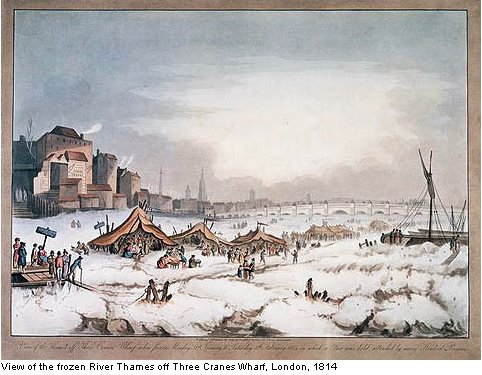
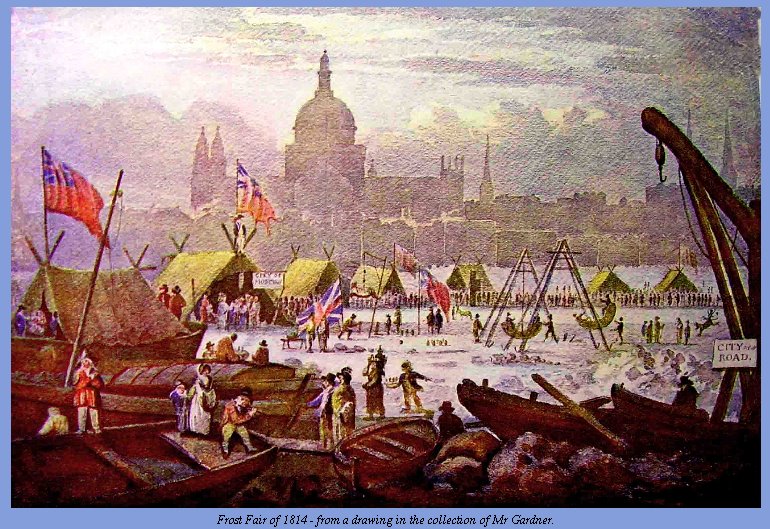
During a mini ice age two hundred years ago, the winters were so cold that the river Thames would freeze in solid sheets of ice. The old London Bridge was bulkier than the new London Bridge built in 1823, and it acted like a dam. After the new bridge was built and the old one was demolished, and after embankments were erected (which narrowed the channel), the river flowed too swiftly for the waters to freeze.

But in the days of yore, a Frost Fair was held whenever the river iced over. People ventured out on the ice, vendors set up stalls, and a variety of entertainments were offered. The last time such an event occurred in 1814, Jane Austen was still alive. She must also have felt the chill of that cold February in which London experienced the hardest frost it had known in centuries.

And this is what they did with the Great Frost. By February, as Lord William Pitt Lennox tells us in his Recollections, the Thames between London Bridge and Blackfriars became a thoroughly solid surface of ice. There were notices at the ends of all the local streets announcing that it was safe to cross the ice, and, as in times of Elizabeth 1, full advantage was taken of this new area and the public interest in it. As before, there now sprang up a Frost Fair. The people moved across the river by way of what was called Freezeland Street. On either side, crowded together, were booths for bakers, butchers, barbers and cooks. There were swings, bookstalls, skittle alleys, toyshops, almost everything that might be found in an ordinary fair. There were even gambling establishments and the ‘wheel of fortune, and pricking the garter; pedlars, hawkers of ballads, fruit, oysters, perambulating pie-men; and purveyers of the usual luxuries, gin beer, brandy-balls and gingerbread.’The Prince of Pleasure and His Regency, J.B. Priestley, p 113.

Read more on the topic at these links

This post was updated in this link.

Read Full Post »

…dirt accumulated faster than all measures to contain it: Cattle were still driven through the streets to and from Smithfield Market until the mid-nineteenth century and horse-drawn vehicles added to the labours of the sweepers stationed at street crossings. Smoke from brick kilns and thousands of sea coal fires polluted the air. In 1813 Henry Austen’s new home above his offices at No. 10 Henrietta Street appeared to Jane to be ‘all dirt & confusion.’ – Jane Austen in Context, Edited by Janet Todd, p 207-208

During Jane Austen’s time and into the earliest days of the twentieth century, crossing sweepers made a living sweeping pedestrian crossings, stoops, and sidewalks of horse manure and litter. Before motorized transport, London boasted over 100,000 horses traversing its streets daily, each one eating a fibrous diet. The crossing sweeper’s job was to shovel the muck, keeping the streets clean for ladies whose long dresses and delicate slippers might get soiled and for gentlemen in their fine raiments.


During “Boney’s” time of terror (Napoleonic Wars), the job of crossing sweeper was often strenuous, and it was said that crossing sweepers could build up a considerable fortune to dig a “channel of viscous mud, a foot deep, through which, so late as the time when George the Third was king, the carts and carriages had literally to plough their way.” In those days, the crossing sweeper had to dig trenches to allow carriages and pedestrians to pass through poorly maintained and muddy roads. As the roads improved, so did the lot of the crossing sweeper, who earned less and less for a job that was to become relatively easier. A good crossing sweeper in an excellent location could still earn a decent living, however. – Chambers, Edinburgh Journal, No. 437, Volume 17, New Series, May 15, 1852

Henry Mayhew described the advantages of this lowly occupation for the London poor:

  • 1st, the smallness of the capital required in order to commence the business;
  • 2ndly, the excuse the apparent occupation it affords for soliciting gratuities without being considered in the light of a street-beggar;
  • And 3rdly, the benefits arising from being constantly seen in the same place, and thus exciting the sympathy of the neighbouring householders, till small weekly allowances or “pensions” are obtained. – Henry Mayhew, London Labour and the London Poor: Volume 2, Crossing-Sweepers

According to the Leeds Industrial Museum, “Children often had more than one way to make money. When it was dry and the streets were not muddy the crossing sweepers, for instance, would do occasional work like catching and opening cabs for people. In the evening they would go outside theatres and operas and tumble for money. Girls mixed ballade singing or lace selling.”

At one time there were so many crossing sweepers that a pedestrian was accosted for money on every stoop and corner, and it would cost a pretty penny to walk from one end of town to another. In 1881, Richard Rowe wrote in London Streets:

IF anyone wants to realize, as the phrase goes, the little army of crossing-sweepers we have in London, let him take a walk – say for a mile or two – on a muddy day, and give a penny to every one who touches hat, makes a bob, as if shutting up like a spy-glass, or trots after him, trailing broom in one hand, and tugging at tangled forelock with the other. I remember when it would have cost anyone, disposed to give in this way, between a shilling and eighteen- pence to walk from the Archway Tavern, Highgate Hill, to Highbury Cock and back. For anyone of a squeezable temperament, therefore, it was decidedly cheaper to take the bus. It is simply as a statistical experiment, just for once in a way, that I recommend this penny-giving. It would be a great misfortune if all crossing-sweepers had pennies given them indiscriminately. I would not make a clean sweep of the sweepers, but I should like to see their ranks thinned considerably – viz., by the elimination of the adults who are able, and the young who might be trained to do something better than what, in the most favourable instances, is little better than a make-believe of work, as a pretext for begging, either directly or by suggestion.


Crossing sweepers worked diligently on both sides of the Atlantic Ocean. In 1882, a New York matron lamented in a letter to the editor of the New York Times about a new regulation that prevented crossing sweepers from working (double click on the image to read it) :

To read more about this fascinating topic, click on the following links:

Click here for an interesting backlink to this post.

Read Full Post »

« Newer Posts - Older Posts »