Feeds:
Posts
Comments

Posts Tagged ‘SourceBooks’

Inquiring readers: This is my second review this year of a Georgette Heyer book to help you while away the winter doldrums. When SourceBooks sent Frederica my way I went into paroxysms of joy, for I recalled loving the book when I first read it just out of college. Years later I like it even better. frederica

After reading Frederica I thanked my lucky stars that Georgette Heyer was such a prolific writer and that she lived a long life. She wrote over 50 books, most of them quite entertaining, and the knowledge that I still have so many to choose from leaves me quite content (At present I am reading The Convenient Marriage and I have just finished Black Sheep). When I first encountered Frederica I was the same age as the book’s heroine – 24 – and wished for myself a mate as dashing and capable as the Marquis of Alverstoke, the hero.

Frederica’s plot is rather simple. Frederica, a single woman who is raising her younger siblings in the country after their parents’ deaths, has brought her beautiful sister Charis to London so that the latter can attract a rich and eligible husband. Considering herself too old for the marriage mart, Frederica’s self-deprecating, no-nonsense attitude charms 37-year-old Lord Alverstoke, who has despaired of ever finding a woman he can both respect and love.

We meet Lord Alverstoke, a nonpareil and Corinthian of the first order, at a time when he is beset by his two sisters to help them introduce their daughters to Society in a proper and extravagant manner. Both sisters expect him to pay fully for the privilege of hosting their coming out at his mansion. Enter Frederica who, with the slimmest claims upon his purse and loyalty, asks him for a favor. The Marquis, seeing a possibility of riling his unloving sisters, agrees to sponsor the Incomparable Charis, a dimwitted but sweet-natured beauty, at his niece’s coming out ball. Frederica’s plans for her brothers and sister and their unpredictable antics overset the marquis’s self-centered life and manage to bestir him out of his perpetual boredom.

Then came Frederica, upsetting his cool calculations, thrusting responsibilities upon him, intruding more and more into the ordered pattern of his life, and casting him into a state of unwelcome doubt. And, try as he would, he could discover no reason for this uncomfortable change in himself. She had more countenance than beauty; she employed no arts to attract him; she was heedless of convention; she was matter-of-fact, and managing, and not at all the sort of female whom he had ever wished to encourage. Furthermore, (now he came to think of it), she had foisted two troublesome schoolboys on to him, which was the last thing in the world he wanted!
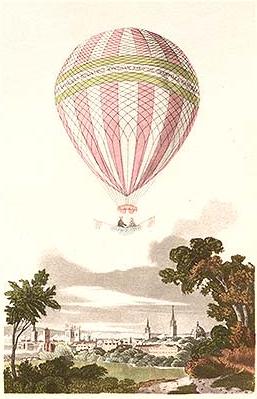
balloonHeyer’s rich detail of life in London during the heyday of the Industrial Revolution sets this novel apart from the others. The book’s events occur after Beau Brummel’s gambling debts drove him to France in 1716-1817, the last year of Jane Austen’s life. This was a heady era of scientific discoveries and invention that changed the world forever. Through young Felix’s brilliant mind we see the wonders of the age unfold in the form of steam engines, scientific collections, and balloon travel. Sixteen-year-old Jessamy’s earnestness in studying to become a man of the cloth represents the burdens that befall a second son who knows he must make his own way in the world, but he is still boyish enough to get into trouble on occasion. And Harry, the eldest brother, set down from Oxford for his antics, is too frivolous to set a good example as heir. Under ordinary circumstances he is more than happy to leave the decision-making to Frederica. Under extraordinary circumstances he is more than likely to bungle events, including endorsing an ill-judged elopement.

Heyer introduces her usual panoply of comedic characters – the selfish sister whose demands on her brother are unreasonable and grating; the foppish dandies in their outrageous attire who flock around the new Incomparable – Charis (she of the dim mind but sweet, unspoiled disposition); the competent and capable male secretary who can be depended upon to take care of complex matters and smooth the way for the marquis, yet who is romantic enough to fall foolishly in love; and the sensible, loving sister who sees immediately which way the wind is blowing when it comes to her brother Alverstoke’s heart. Frederica might not be as beautiful as Charis, but she possesses such style and class that Lady Jersey promptly grants the two girls vouchers for that most exclusive of clubs: Almack’s.

Georgette’s description of the novel to her publisher is telling:

This book, written in Miss Heyer’s lightest vein, is the story of the adventures in Regency London of the Merriville family: Frederica, riding the whirlwind and directing the storm; Harry, rusticated from Oxford, and embarking with enthusiasm on the more perilous amusements pursued by young gentlemen of ton: the divine Charis, too tenderhearted to discourage the advances of her numerous suitors; Jessamy, destined for the Church and wavering, adolescent style, between excessive virtue and a natural exuberance of spirits; and Felix, a schoolboy with a passion for scientific experiment. In Frederica, Miss Heyer has created one of her most engaging heroines, and in the Marquis of Alverstoke, a bored cynic who becomes involved in all the imbroglios of a lively family, a hero whose sense of humour makes him an excellent foil for Frederica. (Jane Aiken Hodge, The Private World of Georgette Heyer)

velocipedeThe plot of this book is simply delightful. Frederica’s “Baluchistan” hound and her two youngest brothers manage to wrap the reader around their paws and grubby fingers with very little effort. More importantly, the trio charms the marquis, whose ennui is legendary.

Georgette is at her best writing about young boys and dogs. We chuckle when Frederica’s dog escapes its leash and runs amuck among the milk cows in Green Park, and laugh when a parade of incensed “victims” follow Frederica and the hound to the front steps of Alverstoke’s door. His aplomb in sizing the situation up in a tenth of a second is worth the book’s purchase. We hold our breath when Felix clings to a rising balloon for dear life as it loosens from its moorings. We feel sympathy for Jessamy – who acts his age for once – for all the damage he causes with his runaway velocipede. Frederica, so honest and serious and self effacing, is a breath of fresh air among the many heroines we encounter in an endless parade of romance novels. Her intelligence and earnestness are a perfect foil to Alverstoke’s light-hearted and self-deprecating banter. We love her all the more because she never quite sees the marquis in the negative light that he knows he deserves, and for her ability to make the best of any situation.

The novel ends on a most satisfying note, and I can think of no better way of spending a chilly winter evening – wrapped in a down comforter with my pooch sleeping by my side – than reading this gem of a book.

Order the book from SourceBooks at this link.

My Other Georgette Heyer Reviews Sit Below

Read Full Post »

It’s been years since I’ve run across the word “clodpole”, which Georgette Heyer uses to great effect in Cotillion, one of the splendid Regency romance novels that Sourcebooks had brought out and is available for order, including as an E-book, in this link. Half the fun of reading Ms. Heyer’s books is discovering which of her stereotypical characters will court or insult each other in that ironic British upper class way we Heyer fans have come to love.

cotillion

In Cotillion we meet a veritable bevy of the typical Heyer characters:

  • Eccentric, old and tight-fisted uncle? Check.
  • Young and pretty heiress? Check.
  • Silly spinster chaperone? Check.
  • Buffoonish impoverished earl? Check.
  • Darkly handsome rake? Check.
  • Foppish Pink of the Ton? Check.
  • Long-suffering but pleasantly surprised father? Check.
  • Beautiful but vapid beauty in distress? Check.

The list of Heyer archetypes goes on and on, but we don’t care. We WANT the familiarity of Georgette Heyer’s typical characters, for they play off each other so well. Like an audience at a concert that has been performed in other music halls, we are interested in how this new orchestration of a well-known arrangement will compare to the others. In Cotillion, Heyer’s particular brand of Regency music reaches the heights of perfection. The rich uncle hopes that by bequeathing his entire estate to his orphaned ward, Kitty, he will force his favorite nephew, Jack, to vie for her hand in marriage. For the sake of equality,  Jack must propose alongside his other male cousins so that all may have an equal chance. But Jack won’t be manipulated and forced to court Kitty. An inveterate gambler,  he bets that Kitty and the considerable fortune she stands to inherit will always be available to him, for she has had an unhidden crush on him since the schoolroom. Jack didn’t count on the one variable that would put a spoke in his plans: Kitty’s anger at his absence and her stubborn determination to teach him a lesson.

Enter the Honourable Frederick Standen. The reader first meets this Exquisite in typical Heyer style:

The young gentleman who alighted from the chaise must have been recognized at sight by the discerning as a Pink of the Ton, for although his judgment, which, in all matters of Fashion, was extremely nice, had forbidden him to travel into the country arrayed in the long-tailed coat of blue superfine, the pantaloons of delicate yellow, and the tasselled Hessian boots which marked him in the Metroplolis as a veritable Tulip, or Bond Street Beau, none but a regular Dash, patronizing the most exclusive of tailors, could have presented himself in so exquisitely moulded a riding-coat, such peerless breeches, or such effulgent top-boots.

Freddy, though fond of Kitty, is not in love with her, and he is out of his depth when it comes to countering her will. Before he knows it he is engaged to her and has promised her a month in London before she must return to her uncle’s stuffy old mansion. Ms. Heyer takes her time setting up this fun plot, but knowing the particulars will be important, for when she sets events in motion they roll along seemingly of their own accord and with some unexpected twists that are sure to delight.

Can Frederick successfully introduce his faux Intended to his family and Society without having to submit to the Shackles of Marriage?

Will Jack be able to forgive Kitty for (unsuccessfully) trying to make him jealous?

Will Kitty, a total Innocent when it comes to London Society, be able to stay out of trouble?

As the plot thickens, we are treated to one priceless scene after another, including those of Kitty dragging Freddy to all the Sights of London. Our fastidious Freddy is aghast when forced to enter the musty rooms of the Egyptian Hall, and feels downright incensed when viewing the Elgin Marbles. “Why, they have no heads!” he expostulates, feeling very put upon at having to escort Kitty to places that he’d never intended to see or ever see again. He’d have much preferred to take her to Astley’s Amphitheatre or the Royal Circus, but both edifices did not open until Easter Monday.

Freddy’s family adds spice to this hugely enjoyable novel. His sister Meg, whose taste in Fashion is questionable; his mother, who spends most of the novel tending to her sick children; and his father, whose encounters with his son are all too brief and rare, add to the deliciousness of this convoluted plot. The title of the book hints at plot developments that are not so obvious at first, for when dancing the Cotillion, partners must switch and change within the dance formations.  If you are looking for a book to read during the Thanksgiving holidays, I cannot recommend Cotillion enough, for its conclusion is as satisfying as its very promising beginning.

Read Full Post »

Inquiring reader,

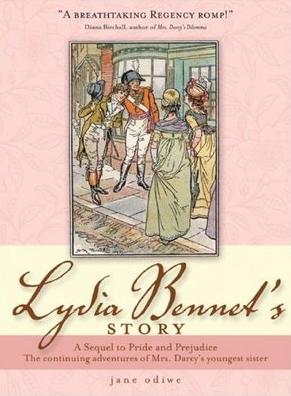
Last year I met Jane Odiwe online. We immediately struck up an email friendship discussing all things Jane Austen. She had just written Lydia Bennet’s Story, which came out in the U.K. Sourcebooks will be bringing out the book this month with a new and beautiful cover. Jane not only writes, but she also paints lovely watercolours and maintains several blogs and websites. Below is my interview with Jane. I have also added links of interest at the bottom.

1. Jane, you have such a wonderful light and deft touch with watercolours, a difficult medium at best: Have you always painted? And were you schooled? Where, and for how long?
I have painted as long as I can remember, sitting with my mother at the kitchen table. It was also a love of hers which she passed on to me. I went to art school in Sutton Coldfield, studying at Foundation level and then at Degree level in Birmingham, England, five years all together. Mine was an unusual degree, I was able to indulge my love of History, Art History and Literature whilst specialising in Fine Art. Watercolour and oils are my favourite medium.

2. Have you always been a Jane Austen fan? When did you first encounter her works?
I remember seeing the old black and white version of Pride and Prejudice on television when I was very young and dressing up in my mother’s nightgown. I was very taken with the dancing at the time and all the fashion which I loved. I read the book later but I was inspired to re-read all of Jane’s works after the lovely Pride and Prejudice production starring Jennifer Ehle and Colin Firth. I think Jane and Elizabeth were my mother’s favourites, as my first names are Jane Elizabeth!

3. In order to create these works, you’ve had to combine a working knowledge of anatomy, history, historical places, Jane’s biography, and an intimate knowledge of her writings. That is quite a feat. Why did you decide to embark on such a difficult and exacting project?
I have always enjoyed reading the biographies written about Jane Austen but there never seemed to be enough pictures and of course, one of the reasons is, that they simply don’t exist. There is the little watercolour painting of Jane Austen in the National Portrait Gallery, the silhouette that is said to be of her and Cassandra’s other painting of Jane, sitting with her back to us but they do not give us a real idea of what she looked like. I was intrigued by her letters and her romance with Tom Lefroy and the first painting I did was of them dancing together. I painted it for the sheer pleasure of ‘seeing’ them together; I think it was an attempt to depict her happiness at being with the young man she seemed to like best. All the written descriptions of Jane seem to bear little resemblance to Cassandra’s painting; I wanted to see a younger Jane at the time when she experienced her first love and was starting to enjoy balls and attention from young men. I based Jane Austen’s portrait on Cassandra’s painting but I admit I wanted to see her smile. She had such a wonderful sense of humour, I wanted to try and show a happier Jane. I never thought of my Effusions of Fancy paintings in terms of an exacting project. I didn’t expect anyone else would ever see them and they were a purely personal tribute. However, when I thought about putting the pictures into a book, I did want to try and change people’s idea that Jane was a quiet spinster in a mob cap and I thought one of the ways I could do that was to attempt a painting of a younger woman with her hair dressed as though she is about to go dancing.
4. Regarding this painting of the Austen family, tell me a bit about your working process. I can see that you studied the actual paintings of each family member. How did you incorporate so many likenesses in one composition? Did you sketch each portrait separately first? Or did you work from an overall composition?
Because we only ever see the portraits of the family members by themselves, I wanted to picture the Austens all together around the table, showing them as the close family I believe them to have been. I started with the silhouettes of Mr and Mrs Austen. Silhouettes give us such a tantalising glimpse of a person without revealing the whole; I had no other reference for Mrs Austen but there is a lovely portrait of Jane’s father, with his white hair, which helped enormously. I used my knowledge of figure drawing and many painting references to find bodies for the heads and tried to bear in mind what I had read about their characters. Henry, for example, is depicted in the only portrait that exists of him as being a very sober looking clergyman with receding hair. Everything I have ever read about him illustrates quite a different character; handsome, fun loving, slightly reckless and witty. I painted another portrait of Henry to see if I could find the ‘handsome’ Henry and incorporated this into the painting. Edward’s portraits at Chawton are wonderful and I have studied them many times. I imagine Edward resembled his mother in looks and also has those ruddy cheeks which Jane is supposed to have had. Edward did not really grow up with the other children as he was sent to live with his richer relations and I wanted to indicate this; he is slightly aloof, not sitting with the immediate family but protective of his mother. Lovely Frank, the seafaring brother who took his mother and sisters into his home after Mr Austen died, has his arms around Henry and his sisters. I imagine him to have been very dependable and loving and wanted to portray this aspect of his character. James, the poet, I think was probably quite earnest and serious. I think he looks lost in his own thoughts. Charles, another sailor looks very dashing in the portraits I
have seen of him, I wanted to show him with a bit of a smile, as though he is about to laugh at something his mother has just said. Jane and Cassandra are talking to each other and laughing at some shared amusement. I really wanted to show how close they were, two young girls having fun and chatting, nineteen to the dozen. I used a painting and a silhouette said to be of
Cassandra for my painting, I believe she was a pretty girl. I would like to do another family portrait one of the days which tells another story, perhaps illustrating a well known event in their lives.

5. Do you feel that all your hard work in this area is paying off? If you knew then what you know now, what would you do differently?
I’ve ‘met’ so many lovely people as a result of producing my little book and cards, (many through my web site and from different countries) and for me this is my greatest pleasure. If someone writes to tell me that they have enjoyed my work, that is the biggest payoff for me. Other people’s lives are always interesting to me and I like to keep in touch and hear their news.

I wouldn’t do anything differently, I’ve enjoyed the whole process of creating the paintings but perhaps I would like to add or do different versions of the same ideas. It’s essential to keep striving to improve and continue to study, I think. I would like to do a larger version of Effusions of Fancy with more paintings, perhaps telling the story of all of Jane’s life. More time to accomplish everything I would wish would be lovely, but time has a habit of running away!

6. Is this a full time career? Or are you squeezing this extraordinary passion into an already full schedule?
It is a full time career, but I also work with my husband to help earn our bread and butter! He is a graphic designer and he often needs an illustration to help with his work. At this time of year I am usually to be found drawing Christmas trees, baubles, popping champagne bottles etc. for restaurant menus, Christmas cards and invitations etc. After Christmas, it’s Valentine’s day and so it goes on. I really enjoy this type of work. I am very lucky to be able to work with my husband, doing illustrations that I enjoy working on. I get a huge thrill out of seeing my work out in public.

7. Any advice you would give to budding authors/illustrators?
You need to be passionate about your work and have a tough skin. You will face many rejections and possible hurtful comments as well as enjoy success. Try to remember why you started on this journey in the first place, believe in what you do and don’t give up, which is easy to say but not always easy to put into practice!

8. Aside from Lydia Bennett’s Journal, what other projects are you currently working on?
I’ve just completed a little map for Deirdre Le Faye’s book, Jane Austen’s Steventon, which was a lovely job to do and at present I am putting together menus for the wonderful Scottish Branch Jane Austen Birthday Lunch in December.

I’m having a great time writing a new novel, which of course is another Jane Austen sequel. It is another ‘Story’ of one of Jane’s characters but this time inspired by Sense and Sensibility. I hope this will be ready in the spring. I’m off to Devon soon to do some research. This is one of my favourite reasons for writing, although I often find it takes over!

In addition to all her other plans and activities, Jane wrote, “I’m also very excited to tell you that my Jane Austen illustrations are to be used in a documentary feature on the DVD of The Jane Austen Book Club. They asked to use about 16 of them, so I can’t wait to see what they’ve done with them.” We can’t either, Jane!

Update: Here are Jane’s thoughts about her new Sense and Sensibility sequel, out in 2009:

I am really thrilled to be able to tell you that my second novel, Mrs Brandon’s Invitation will be published by Sourcebooks next year. It will be coming out in September, which seems such a long time to wait to see it in print, but will fit so perfectly within the time frame of the book, that I will just have to learn to be more patient.

As the title suggests, Mrs Brandon’s Invitation is a sequel to Jane Austen’s Sense and Sensibility. The story principally centres around Marianne (nee Dashwood) who has been married to Colonel Brandon for three years and that of her younger sister Margaret, but most of the characters are there, plus a few new ones. I have so enjoyed writing this one, interweaving the stories of two heroines against the backdrops of Delaford in the Autumn, Lyme and London in winter. It was such fun to write the characters of Mrs Jennings and Lucy Ferrars, along with her sister Anne Steele. Colonel Brandon’s sister, husband and son make an appearance at Whitwell and this is where the mischief starts. I am often inspired by a secondary character or mention of one in the original books and I decided to introduce the family. If you remember, Mrs Jennings refers to Colonel Brandon’s sister as residing in Avignon at the time of Sense and Sensibility. With her son Henry coming home from university, it was time to bring the Lawrence family back to Whitwell.

Here is a little taster of what is to come.

No one is more delighted by the appearance of an eligible suitor for her sister Margaret Dashwood than Marianne Brandon, until it becomes clear that not only the happiness of the match, but also that of her own marriage are bound and ensnared by the secrets and lies that belong to the past. First attachments, false impressions, resentments and misconceptions, are the elements that conspire to jeopardise the happiness of the Brandon family at Delaford Park, along with the added predicament of Mrs Brandon’s first love John Willoughby returning to the neighbourhood.

Read Full Post »

Michele Ann Young

Michele Ann Young

Inquiring readers: One of my favorite go-to blogs is Regency RambleMichele Ann Young never disappoints me with the choice of her topics or depth of her research about England or the regency era. In addition, the photos of her frequent trips to England provide endless and original variety. Michele is also an author, and her new novel, The Lady Flees Her Lord, is coming out from Sourcebooks in October (in about two weeks). Having admired Michele for so long, and knowing her book is about to come out, I thought this was a perfect time to have a chat with her.

Vic: Hello Michele, thank you for taking time out to answer my questions!

Michele: First I would like to thank you for inviting me to your blog. What a pleasure and a privilege. I am always so pleased when you pop by the Regency Ramble and leave me a note.

Vic: (Blush) I wish I could visit it more often, but whenever I do I look forward to reading your regular features, which you repeat with regularity, like the regency fashion for a particular month, the flora and fauna that are in season, and your travel specials. Most recently I loved your Regency footwear posts, and thought your posts about regency money were fascinating. I especially liked the images of old money, and believe it is the first time I have seen a farthing! Tell me a bit about your research in each of these areas. What are some of your favorite sources and why?

Michele: I first started the regency ramble because I wanted somewhere to keep track visually of things I thought might be useful for scene setting in my books as well as factual information. I thought others might like it too.


Walking dresses, September 1805, Lady's Monthly Museum

Walking dresses, September 1805, Lady's Monthly Museum

The regular fashion feature came about because I wanted to see how fashions changed throughout the time period (the long regency, so really Prinny), and how fashions changed month to month. So I started collecting all the fashion pictures I could find in two folders, one organized by year and one by month. I decided to put the fashions on the blog in the month in which they were worn.

A similar thing occurred with the flora and fauna blog, though it tends to be more flora and insects, because most of my information comes from a Naturists Diary and then I go hunting for pictures. I am looking for a good source for fauna but use some of my own knowledge to then search out the information on particular animals.

My special trip blogs started out fairly haphazardly, but now I carefully document each picture, as best I can in situ and then look up more information for the text. I visit as many old buildings, cities, castles as I can on each trip I make. I like to find interesting places in addition to London where I can set my books, for example Royal Tunbridge Wells and Dover.

Ladies shoes, 1800

Ladies shoes, 1800

The shoe museum was a bonus. A friend invited me to go with her for the day, and I had so much fun, because they really had lots of stuff. And we all love shoes.

As I write my stories, I discover things I need to know, and then I blog about them. It helps me three ways, one, to actually do the research and absorb the information, two, to get visual impressions that I can recall when I am writing and three, to keep track and find it again. I have scores of computer files on myriad topics, but they are often dry texts that I hunt through to find a specific piece of information. But then I have to bring them to life. And often blogging about them, helps me do that.

With regard to resources:

I am lucky to belong to a university library, so I have lots of access to diaries and books that might not be available in the general library system. I belong to the Beaumonde chapter of RWA and they are very generous with their resources and information. I also subscribe to the Moonstone Research Publication Newsletters and have received permission to post a limited number of fashions pictures from that list each month. I also collect my own plates when I can afford them. And I buy lots and lots of books, rare books, used books. I scour second hand bookshops everywhere I go.

Vic: Are you English or American? It seems to me that you naturally straddle both worlds.

Michele: I am English originally. I grew up in England and Scotland. I left there to come to Canada when I got married. I now travel back to England every year to visit family and of course to do my research.

Vic: Is your blog, Regency Ramble, a natural extension of the research you do for your novels? Or is your interest in historical detail a separate passion?

Regency Ramble definitely started because I decided to write novels in the era, because that is what I love to read. But I majored in history at college, European Economic History, primarily after the Regency era. I love all historical topics. I am fascinated with the Tudors, and the Stewarts. I like the Victorian era, but I feel it is too close to today to keep me entranced. I have oodles of general history books covering all eras. But because there is so much to learn about the Regency, it keeps me fully occupied.

Vic: When did you decide to become a writer, and how did you settle on historical romance?

Michele: I wrote my first novel in 2000. I wrote it for something to do during a period of forced inactivity. The story that came into my mind was a regency and I finished it. It wasn’t very good, but I discovered I loved the process and set about to learn about the craft of writing.

I like stories about relationships. And I like happy endings. It turns out that these are romances, although I didn’t realize that when I started. I am also writing a historical novel which does not have a central relationship, or at least not in the first book, since I am planning a single protagonist series also set in 1809 through to 1815. Whether it will sell, I’m not sure.

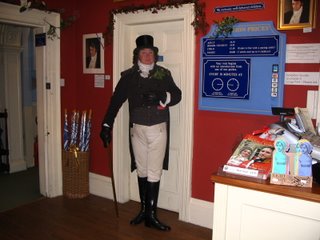
Jane Austen Centre gift shop, Bath 2007

Jane Austen Centre gift shop, Bath 2007

Vic: Tell me a little about your creative process. Do you come up with the plot first and then research the period, or do the two go together? Are you a disciplined writer or do you wait for inspiration?

Michele: I tend to get a scene in my head with one or both main characters. Usually the opening scene of the book. For No Regrets it was a picture of a man riding into a medieval kitchen that was being used as a scullery for a hunt ball. The woman in the kitchen was someone he’d been trying to talk to for a while. For my new book, The Lady Flees Her Lord, the scene was a woman trying to escape her husband.

These opening scenes pose all kinds of questions and I follow where they lead. Sometimes my research will generate that opening scene. I do a lot of reading of history books for interest. Occasionally I will research an important point along the way, if it might make or break the plot. Otherwise, I highlight something I want to double-check and go back to it later.

I write in a linear fashion from there to the end, with no idea of the plot until it happens. This often requires major rewrites, when the story takes an unexpected turn that messes up the beginning.

I am a full time writer and I write every weekday starting at 9 am until about three. I have several contracts to fulfill, so I have to be disciplined. I do email and research and promotional things later in the day.

Vic: Who are your favorite Jane Austen hero and heroine, and why?

Michele: I have to say Lizzie Bennet and Mr. Darcy. I enjoy her other characters, but those two are standouts for me.

Vic: Thank you for your thoughtful answers, Michele. Before ending this interview, I have one final question. I see that Sourcebooks will come out with your novel in October. What can people look forward to when they read The Lady Flees Her Lord?

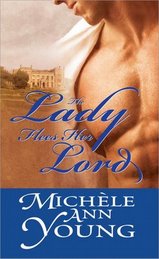
The Lady Flees her Lord by Michele Ann Young

The Lady Flees her Lord by Michele Ann Young

Michele: Physically and emotionally abused because she has failed to produce an heir, the plump Lucinda, Lady Denbigh, is running from her husband. A softhearted collector of strays, she rescues a street urchin on her way and posing as a widow, she seeks refuge in the quiet Kent countryside…

Lord Hugo Wanstead, with a wound that won’t heal, and a death on his conscience, he finds his estate impoverished, his sleep torn by nightmares, and brandy his only solace.

When he meets Lucinda, he finds her beautiful, body and soul, and thinks she just might give him something to live for…

Together they can begin to heal, but not until she is free of her violent past…

One reviewer said: Our author has given us a little slice of Heaven molded from a minuscule slice of Hell. Our emotions are played like a violin with endearing words, breath taking scenes and a virtuous sense of right and wrong. The authors writing style is highly comparable with Jane Austin but with more of today’s romance mentality. Lush and loving, heart wrenching beautiful, one could only hope to have a Lord Hugo Wanstead to desire us so truly and deeply.

Vic: Good luck with your new book. I wish you much success and a best seller!

Michele: Thanks so much.

Read Full Post »

Inquiring Readers, Although SourceBooks came out with Old Friends and New Fancies last summer, we waited to review this first Jane Austen sequel by Sybil Brinton until now. Reviewed by Lady Anne

The only real problem with Jane Austen is that she left us with a paucity of books to read and re-read. Most of us find that our favorites shift and change as we age, and all of us want more to read by our favorite.

Sybil Brinton, an Englishwoman born in the 1870s, was the first to address this problem in her book, Old Friends and New Fancies. First published in 1913, the novel rounds up unmarried characters from Austen’s works and provides cross-novel romantic entanglement. Her main characters are Georgiana Darcy, Colonel Fitzwilliam, and Kitty Bennet, all, of course, from Pride and Prejudice. During the course of several months, living the lifestyle of their class and time, these three meet characters from Austen’s other books. It is great fun to see them in Bath, London, and at the various estates to and from which they all travel. Here’s Lady Catherine de Bourgh, characterizing Persuasion’s Sir Walter Elliot as a “foolish old beau,” (I loved that!) and creating a huge scene in her inimitable style, urged on by Lucy Steele Ferrars and her sister Anne of Sense and Sensibility, still causing trouble by their malicious gossip, aided and abetted by Mr. Yates from Mansfield Park. Well-meaning old Mrs. Jennings, from Sense and Sensibility is still making her tiresome jokes about her young friends’ beaux, and Emma Woodhouse Knightly is still trying to run everyone’s lives for them. She and her husband are now living in London, Highbury being too small a stage for her activities. An inveterate matchmaker (one might have thought she would learn, but we do remember Jane introducing Emma as one who thought very highly of herself), Emma here plays havoc with Kitty Bennet. Kitty is still foolish, mostly interested in balls and clothes, but we have hope that she might mature with grace. She and Georgiana, much the same age and sharing family ties, become confidantes, although certainly they have little in common other than an attractive naval officer, William Price from Mansfield Park. The Darcys are quite concerned about their sister Georgiana, who remains shy and a little withdrawn, but becomes an interesting and thoughtful character as drawn by Brinton, and a more interesting foil for Kitty than Lydia was. Colonel Fitzwilliam, Darcy’s helpful cousin in Pride and Prejudice, meets and falls hard for the enigmatic Mary Crawford of Mansfield Park. Brinton’s Colonel is, perhaps, a little more unsure of himself (being that dreaded phenomenon, a younger son) than I would have made him, but he too gets a thoughtful delineation.

Mother and Child, fashion plate from My Grandmother's Gowns, 1886

Mother and Child, fashion plate from My Grandmother's Gowns, 1886

One of the best things about Old Friends and New Fancies is that Brinton gently maintains the tone of Jane Austen’s voice. The stories unfold in a leisurely pace; these people, generally of the same class and station, would likely meet each other, and the various characters fall in with people with whom they share similar interests. We can recognize that Elizabeth Bennet Darcy and Anne Elliot Wentworth would like each other, and are pleased that Elinor Dashwood Ferrars and her Edward have been given the living near Pemberley. The other characters, in new situations and among their peers, generally act as we would expect them to. We are happy to see Sir Walter get a strong come-uppance and chuckle at Elizabeth Elliot’s latest hope for a wealthy, handsome husband.

Austen is more satiric and sharper in her observations than Brinton; this book is a gentle resolution of several of the unwed finding their happily ever after among characters from the other books. As such, it is a friendly exercise and truer to Jane’s tone and ideals than most of the current Austeniana. While it is not necessary to be knowledgeable about all of Austen’s books to enjoy Old Friends and New Fancies, it does help, and Brinton’s opinions of Austen’s characters can only be understood if you know the originals.

Old Friends and New Fancies, surely a work of love, is the only book written by Sybil Brinton. I enjoyed it thoroughly, and reminded myself that it is long past time that I re-read Mansfield Park.

Little is known about Sybil Grace Brinton herself. The daughter of a wealthy Kidderminster carpet manufacturer, she was born in 1874 at Stourport-on-Severn, Worcestershire, married in 1908, had no children, suffered from poor health all her life, and died in 1928, without writing another book.

John Adey, a genealogist who runs the Stourport-based Family History Research Ltd, could find out little more about her, despite weeks of searching. “There’s no known photograph of her,” he says. “And it’s odd that even now, the family can’t tell you much about her.” – Times Online, Old Friends and New Fancies

About Lady Anne, the reviewer: A confirmed Janeite and co-founder of Janeites on the James (our Jane Austen group), an expert on all things Georgette Heyer and the Regency Era, a lady well read and well bred, Lady Anne is known for her discerning eye for both literature and her breath-taking garments made by a select mantua maker. Cloth’d and coifed, Lady Anne knows few equals, and when she enters a room she is a commanding presence. She is also Ms. Place’s special friend and confidante.

  • Click here to read a review about the second Jane Austen sequel, Pemberley Shades by D.A. Bonavia-Hunt, on Austenprose.

Read Full Post »

« Newer Posts - Older Posts »