Feeds:
Posts
Comments

Posts Tagged ‘Tony Grant’

Inquiring readers,

During the Covid-19 lock down, I’ve missed traveling around my country. I intended to go abroad as well, but had to lay those plans aside. The internet affords me a way to satisfy my wanderlust.

Today as I e-searched Jane Austen’s gardens and her family’s use of fruits and herbs in making wines and home medicines, I discovered this lovely blog by author Susan Branch. Susan visited Chawton Cottage in 2012. Her photos and delightful narrative of her trip add to those I featured from blog contributors Tony Grant and Rachel Dodge. I’m publishing the first 20% of Susan’s post and will then link to her blog. Enjoy!

Image of Susan Branch's blog and post of her journey to Chawton Cottage

Image of Susan Branch’s blog and post of her journey to Chawton Cottage in 2012

Jane Austen

On our last day in England in the spring of 2012, just a few hours before boarding the Queen Mary 2 for our trip home, we stopped to visit Jane Austen’s house in a little country town called Chawton. I can’t say we saved the best for last, because everything we saw was “best.”  But this house was wonderful and better than I ever imagined it could be.  It’s in Hampshire, centrally located in the south of  England (very close to Southampton) — you can see it on the map on page six of my book chronicling this magical trip called   A FINE ROMANCE.

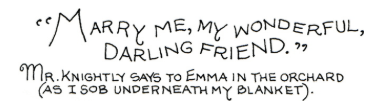
"Marry me, my wonderful darling friend" Quote by Mr. Knightley to Emma in the orchard

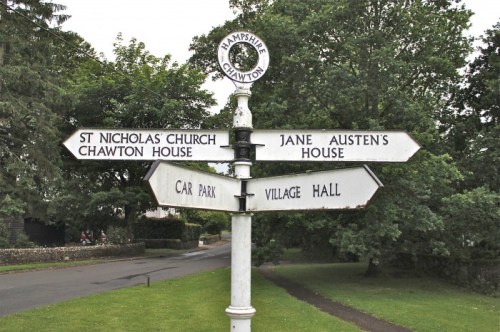
Crossroads

Sign to Chawton Cottage, the car park St. Nicholas church and Chawton House, and the village. Image courtesy Susan Branch.

First off, you have to know how this quiet neighborhood sounded this day!  The only sound missing is “my-toe-hurts-bet-tee” the nature national anthem of England, but there were wood pigeons cooing liltingly from every branch!

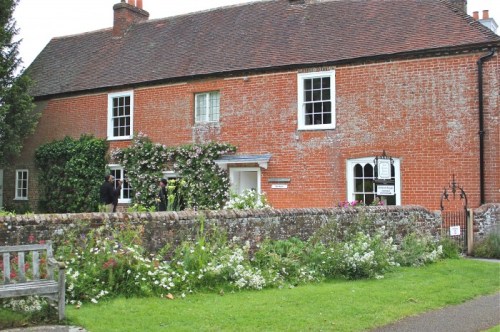
Chawton Cottage

Chawton Cottage with a view of the visitor entrance. Image courtesy of Susan Branch.

This is the 17th century house where Jane Austen did some of her most important work.  She lived here from 1809 to 1817, and published four novels during that time, Pride and Prejudice, Emma, Sense and Sensibility, and Mansfield Park.

How beautiful!  Let’s go find a parking space!

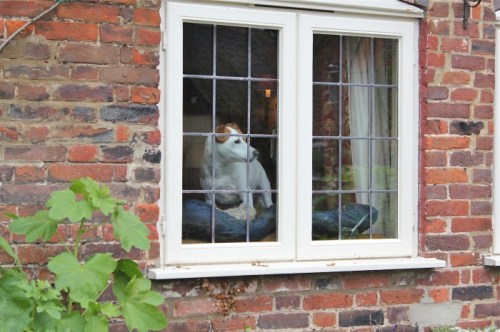
A Jack Russell terrier views Chawton Cottage from a house across the street. Image courtesy of Susan Branch.

A Jack Russell terrier views Chawton Cottage from a house across the street. Image courtesy of Susan Branch.

After parking, we walked for a little bit through the leafy old neighborhood and something interesting happened.  I took a picture of this little Jack Russell in a window of the house across the street from Jane’s and posted it here on the blog.  Later, after we returned home, I received an email from the owner of this house!  Her name is Mary and the dog’s name is Basil!  Mary had just happened upon our blog.  Isn’t that amazing? What a small world!  She’s actually written a cute children’s book about Basil which she sent to me . . .

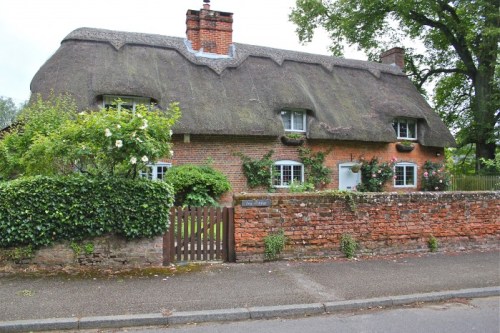
Thatched roof cottage in Chawton. Image courtesy of Susan Branch.

Thatched roof cottage in Chawton. Image courtesy of Susan Branch.

 Many of the homes in Chawton have thatched roofs like Mary’s.  It’s a darling town ~ and we only had one afternoon. I wish we’d saved more time for this ~ there’s a lot of wonderfulness to see here.  Keep that in mind for when you go and have at least one full day.

To read the rest of this fascinating post, please click here  to enter Susan’s blog. Note her journey through Chawton village, the rooms through the cottage, and her walk in the gardens.

well behaved women rarely make history signBTW, I noticed on Susan’s sidebar a saying that I keep in my office. Sisters always have a way of finding each other!!

Other posts on this blog about Chawton Cottage and Chawton House

Read Full Post »

Inquiring Readers,

After experiencing years of an Austen drought on the large and small screen, we are treated to two adaptations within a half year–Sanditon and the newly released Emma.

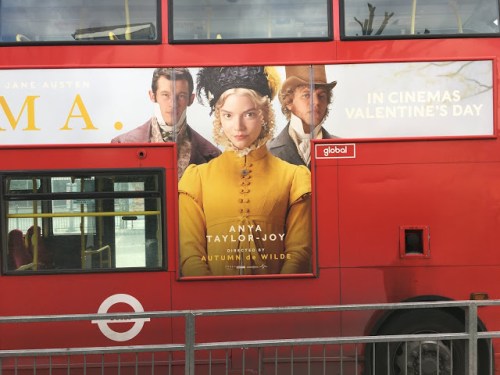
Emma film poster on a London bus. Photo courtesy of Tony Grant

Emma film poster on a London bus. Photo courtesy of Tony Grant

Emma, the film will air in theaters in my region on March 6th. Sadly, I won’t see the film until late next week, but my British friend Tony Grant has reviewed it. He writes in part:

My thoughts were, will Autumn de Wilde’s Emma get Austen’s subtleties concerning the different relationships right? Will the actors be any good? All is lost if they can’t cut the mustard. What might we get out of this Emma that speaks to us in 2020? Will the film tell Jane Austen’s story well?

The film begins, focusing in from an expansive bucolic scene of green pastures and wooded areas to an iconic 18thcentury mansion, Hartfield. We hone down to a gothic styled greenhouse and enter to a scene of peace and calm and meditative background music as Emma, played by Anya Taylor Joy, slowly, carefully moves, almost like floating in a dream, examining her blooming red roses while servant girls hover, secateurs poised ready to snip the stem of any flower Emma thinks fit. Anya Taylor’s eyes look and roam and pierce us to our souls. Oh! those eyes. She pauses, she considers, she moves on and decides, “That one.” And the flower is cut. This opening scene is very clever and says in this silent dreamlike ballet of a scene all that Austen says in the opening words of her novel.

Emma Woodhouse, handsome, clever and rich, with a comfortable home and happy disposition, seemed to unite some of the best blessings of existence; and had lived nearly twenty one years in the world with very little to distress or vex her.” 

The film is lit  brightly and the colours, not just of the costumes, but of the scenery too has a pale pastel sheen, which can only be achieved through the cinematography.–-To read the rest of Tony Grant’s review, click this link to London Calling, his blog.

In anticipation of seeing the film, I’ve been reading Robert Rodi’s take on Emma in Bitch in a Bonnet: Reclaiming Jane Austen from the stiffs, the snobs, the simps and the saps. (Yes, he’s that sarcastic, but witty, wise, and fun.) I particularly liked this passage, which shows Emma’s animus towards Augusta Elton shortly after she paid Mr. Elton and his new missus a visit:

Eventually Mrs. Elton return the visit, and Emma has plenty of time for her options to coalesce. And she really, really, really does not like this chick. Not. One. Little. Bit.

Rodi then goes on to quote this Austen passage:

“The quarter of an hour quite convinced her that Mrs. Elton was a vain woman, extremely well satisfied with herself, and thinking much of her own importance; that she want to shine and be very superior…”

Rodi does not stop there, but I paused at these words for a long moment. The qualities Emma dislikes about Mrs. Elton are the same qualities she possesses. Augusta, of course is different from Emma. She’s coarse, grasping, and aggressively power hungry, whereas Emma is the well-bred young lady described in the movie’s publicity: a well meaning but selfish young woman [who] meddles in the love lives of her friends.

The comic characters in Emma are among Austen’s finest, and I look forward in revisiting them in this film, especially in the forms of Miranda Hart as Miss Bates and Bill Nighy as Mr. Woodhouse.


This slideshow requires JavaScript.

Although I won’t see the film for some time, please feel free to leave your opinions if you have them.

Meanwhile, enjoy Tony Grant’s review at the top of this blog!


Read Full Post »

Inquiring readers: One reason I love Tony Grant’s submissions is the wonderful original images that he takes of the sites he discusses – in this instance, Bath and Persuasion, Jane Austen’s final and arguably her best novel. Enjoy the article, as well as Tony’s photographic images.

I think Persuasion is Jane Austen’s most mature novel. It deals with patriarchy, misogyny, narcissism, snobbery, class structure, schemes to move up the class ladder, and the consequences of moving down the class ladder.  It also portrays the strength of a good woman. Persuasion begins to subvert the old ways of doing things. The novel covers the whole gamut of life and shows what it is to be a Georgian, with resonances for our own time in the status of women.

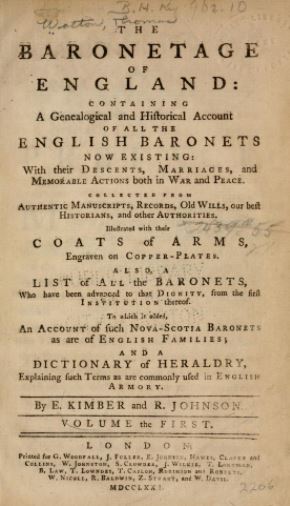
The Baronetage_internetarchive

The Baronetage from the Internet archive

Persuasion starts with Sir Walter Elliot perusing his favorite book, The Baronetage, which is about primogeniture – a system where the family’s fortune was left to the eldest son when the father died. Primogeniture lasted for centuries and was an example of patriarchy that encouraged misogyny, but society and the world were changing during Austen’s era.

The Elliot’s ancestry is described in The Baronetage and Sir Walter reads the entry concerning his family obsessively. He is exceedingly vain about his position in life and his looks. As Jane describes him: “Vanity was the beginning and end of Sir Walter Elliot’s character.”

After Lady Elliot’s death, Sir Walter spends beyond his means, a foolish habit that will lead to his financial ruin if he does not curb his lifestyle. His agent, Mr. Shepherd, strongly advises Sir Walter to rent out Kellynch Hall and move to Bath to save what little of his inheritance remains. Once there, the ever vain and critical Sir Walter encounters few women who meet his exacting standards of beauty:

“He had frequently observed as he walked, that one handsome face would be followed by thirty, or five and thirty frights; and once as he stood in a shop in Bond Street, he had counted eighty-seven women go by, one after another, without their being a tolerable face among them.”

The Baronetage

Sir Walter’s social maneuverings in Bath are dictated by the principles laid out in The Baronetage. In Georgian society there was some movement within the middle classes and the lower aristocracy. Sir Walter is in danger of being reduced in importance because of his financial difficulties, brought about after his wife’s death. Lady Elliot had kept Sir Walter’s expenses in check and he soon faced financial ruin without her sensible influence.

The Baronetage lists a still-born son for Sir Walter and Lady Elliot. Ever conscious of the succession of his line, Elizabeth, Mary, and Anne count for nothing as far as inheritance goes.  Sir Walter, therefore, desires to renew relations with Mr. William Elliot, his godson and heir. This relationship, however, has a “very awkward history,” with Mr. Elliot, in a most ungentleman-like fashion, abandoning his courtship of his cousin Elizabeth in favor of marriage to an older, rich woman of no distinction. Consequently, the family ceased all contact with the presumptive heir.

Sir Walter also discovers that his cousin, Viscountess Dalrymple, has arrived in Bath. Because of a past misunderstanding – he had ignored the news of her husband’s death – he lost contact with her.  Sir Walter now thinks it an excellent idea to boost the importance of himself and his family by renewing contact with the Viscountess.  An association with her would elevate the Elliots in the eyes of Bath Society.

Sir Walter has no regard for people of no importance and with no influence. He pours scorn on his youngest daughter, Anne, regarding her friendship with an old school acquaintance, Mrs. Smith, who lives in a poor area of Bath. Anne has none of her father’s social ambitions. She would rather spend an evening with Mrs. Smith, who is widowed and impoverished. Mrs. Smith, who is careful with her limited finances, is a cheerful, intelligent and kind person, qualities that attract Anne but mean nothing to Sir Walter.  Anne continues her relationship with Mrs. Smith despite her father’s protestations, and doesn’t think associating with Viscountess Dalrymple a good idea at all.

Bath’s Urban Geography and Status

Urban geography plays an important role in Persuasion. When it comes to Bath, status depends on where you live and in what street.

Sir Walter Elliot and his three daughters, along with Mrs. Clay, the snaggle-toothed, widowed daughter of Mr. Shepherd, and a mere companion to Elizabeth, move to Camden Place, a fine Georgian terrace in the northern part of Bath. This terrace overlooks the rest of Bath, an ideal place for snobbish Sir Walter to look down upon the city. The geographic location fits Sir Walter’s belief in himself, both morally and emotionally.

Westgate Buildings are situated close to the Roman Baths at the bottom of the hill in town. Mrs. Smith lodges in two rooms amongst the shops and makes do in the hustle and bustle and turmoil of town noises and traffic.

Mr. Elliot and friends stay in Marlborough Buildings, a terrace of fine houses that slope down steeply from the west side of The Royal Crescent, the most salubrious address in Bath. Mr. Elliot visits Sir Walter in Camden Place after a visit in Landsdowne Crescent. Landsdowne Crescent is also one of the northern crescents above Bath, directly north of The Royal Crescent, to the west of Camden Place and on an equal footing to Camden Place.

Viscountess Dalrymple and her daughter, the Honorable Miss Carteret, stay in style in Laura Place. Laura Place is a set of four elegant terraces that surround a lozenge shaped “circus” with “Laura Fountain,” in the centre.

Great Pulteney Street leads off it towards Sydney Gardens and the Holbourne Museum. To the west of Laura Place is Pulteney Bridge, once known as Old Bridge, over which Lady Russell and Anne Elliot pass into Bath.

As one passes over the bridge and the River Avon, one almost immediately encounters Bath Abbey.

The Lower Assembly Rooms are a little to the left. Mrs. Smith’s lodgings in Westgate Buildings are also close to the Abbey, but in the town.

Laura Place is outside the town, on the opposite banks of The Avon, in an area of splendid elegance and wide avenues. Obscurely, Camden Place is high on the hills directly above Laura Place where Sir Walter can certainly keep an eye on things.

Lady Russell, an old friend of Lady Elliot, is a sensible, wise person who takes a sort of unofficial care of the Elliots after the death of their mother, especially of Anne, for whom she has a special fondness. She personally brings Anne to Bath after Sir Walter, Mary and Mrs. Clay have already settled in. Lady Russell, a widower, occupies a town house in Rivers Street, which is close to Camden Place. The street is comprised of elegant town houses, probably smaller than those of Camden Place. Rivers Street suits Lady Russell. It is a place of genteel comfort for a sensible person of means who lives according to her fortune and within her budget.


This slideshow requires JavaScript.

Anne Elliot

Lady Russell is one of the more stable, pleasant and thoughtful characters in Persuasion. She is “… of steady age and character, and extremely well provided for.”

Anne Elliot, her protegee, had “an elegance of mind and sweetness of character, which must have placed her high with any people of real understanding, was nobody with the father or sister: “

To Lady Russell Anne was “…a most dear and highly valued god-daughter, favorite and friend. Lady Russell loved them all; but it was only in Anne that she could fancy the mother to revive again.”

Compared to Anne, Viscountess Dalrymple and her daughter Miss Carteret “…were nothing. There was no superiority of manner, accomplishment or understanding. Lady Dalrymple had had acquired the name of,” a charming woman,” because she had a smile and a civil answer for everybody. Miss Carteret, with still less to say, was so plain and so awkward, that she could never have been tolerated in Camden Place if it were not for her birth.”

Self-serving Mr. Elliot recognizes Anne’s outstanding qualities. She smiled and said, “My idea of good company, Mr. Elliot, is the company of clever, well informed people, who have a great deal of conversation, that is what I call good company.”

“You are mistaken,” said he gently, “that is not good company, that is the best. Good company requires only birth, education and manners, and with regard to education is not very nice. Birth and good manners are essential; but a little learning is by no means a dangerous thing in good company…”

Persuasion and the changing order

There is something subversive going on in Persuasion. Underlying the novel is The Baronetage and Sir Walter’s rule of life, which lead to the cause of Elizabeth’s pain. Hereditary, class, position are the yardsticks by which Sir Walter lives, but adherence to the old order doesn’t do him or Elizabeth the best of service.

Anne, Mr. Elliot, Mrs. Clay, Mrs. Smith and the three naval captains, Wentworth, Harville and Benwick either overtly or inadvertently create the vision of a new world, where affection and love are the primary drivers. Ordinary people were being noticed. The Industrial Revolution 1760 to 1740 had social and economic ramifications far beyond its time. Wilberforce and his cronies were campaigning for the abolition of slavery. Science was making great bounds forwards. Gilbert White, who died in 1793 and who lived at Selborne, a mere three miles from Chawton, Austen’s final home, changed the course of science through his direct observations of wildlife in nature, which set the scientific strategy for Darwin’s first voyage on the Beagle in 1833, a mere 15 years after Jane Austen died. Persuasion seems to presage these developments through the relationships and views challenged and promoted in the novel.

Probably more controversial, especially for the time Jane Austen was writing, are the echoes of The French Revolution. Ideas espoused by the Revolution were bound to be heard and discussed in Britain by such men as Charles James Fox. But what about the women?

Louisa Musgrove’s jump from The Cobb in Lyme onto the cobbled pavement below and striking her head, rendering her unconscious, is suggestive of women like Anne Elliot taking charge and making a decisive contribution over and above men. This theme is similar to the political and social ideology women were advocating in France.

“Is there no one to help me?” were the first words which burst from Captain Wentworth, in a tone of despair, and as if all his own strength were gone.

“Go to him, go to him,” cried Anne [to Captain Benwick], “for heaven’s sake go to him. I can support her myself. Leave me and go to him. Rub her hands, rub her temples; here are salts,- take them, take them.” Captain Benwick obeyed…… everything was done that Anne had prompted…”


This slideshow requires JavaScript.

Surely this scene is in the spirit of Charlotte Corday, Pauline Leon and Theroigne de Mericourt, who agitated for full citizenship for women. Three Royal Naval Captains who commanded Royal Naval men of war became helpless in this emergency, and only a woman, Anne Elliot, direct and assertive, took charge.

Jane Austen’s novel Persuasion was published in 1818 after her death. Anne Bronte’s novel, The Tennant of Wildfell Hall, was published thirty years later in 1848. Both deal with moral issues and patriarchy. The difference between the two is stark. Jane Austen holds a mirror up to society and says: this is the way things are. Nothing really terrible happens in Persuasion. Jane Austen portrays a very gentle revolution.  The Tennant of Wildfell Hall deals with misogyny, patriarchy, and the terrible abuse of a woman. Anne Bronte’s writing is disturbing and visceral; mind and heart changing. Jane Austen’s writing is gently comic, but it’s also getting us there.

Find Tony Grant’s blog, London Calling, at this link. http://general-southerner.blogspot.com/


Read Full Post »

Inquiring readers, Tony Grant, a blogger and contributor to this blog for a decade, has submitted this interesting post about Netley Abbey. He ties history, literature, poetry, and painting to Jane Austen’s fascination with the gothic novel, which led to her writing Northanger Abbey in her wonderfully satiric vein. Enjoy!

My Memories of Netley Abbey

When I was eight years old, I recall one of my grandmothers telling me about the ghosts that haunted Netley Abbey. Netley Abbey is four miles along Southampton Water from where I grew up. I lived in Woolston, a small industrial area of Southampton next to the Itchen River, which flows into Southampton Water at the cities docks. (See Google satellite map image below and Google map image alongside it.)


Within walking distance of where I lived are extensive areas of woodland and farms that specialized in market gardening. Netley Abbey itself is set within woodland near the shore of Southampton Water, not far from The Hamble River and within view of the Isle of Wight.
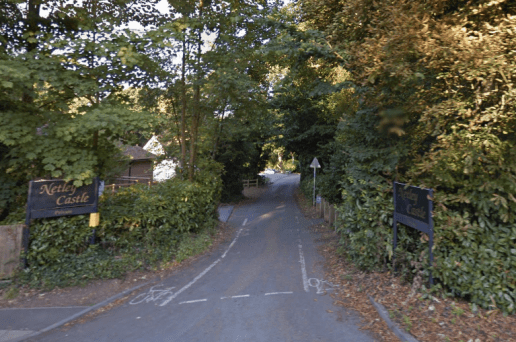
Google street view entrance Netley

Google street view: Entrance to Netley Castle

I remember my grandmother telling me about a White Lady, who has been seen on occasions wafting through the ruins of Netley. She reputedly had been incarcerated within a bricked up space within the Abbey. Quite a horrific thought. She told me also of the dark presence of a black clad monk that sometimes appeared in the ruined entrances to the cloisters within the Abbey’s precinct.
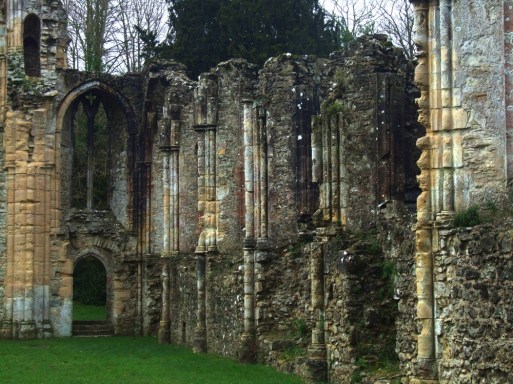
Abbey Church wall and pillars 1

Netley Abbey’s ruined walls and pillars: Image Tony Grant

Another story tells of a builder at the beginning of the 18th century, when the Abbey’s stones and bricks were being recycled as building material, and how part of the arched window at the western end of the abbey church fell on him, fatally injuring him. Stories like this, imagined and real, were useful in keeping Netley Abbey in a substantial state. These stories became vivid images in the mind of a small boy.
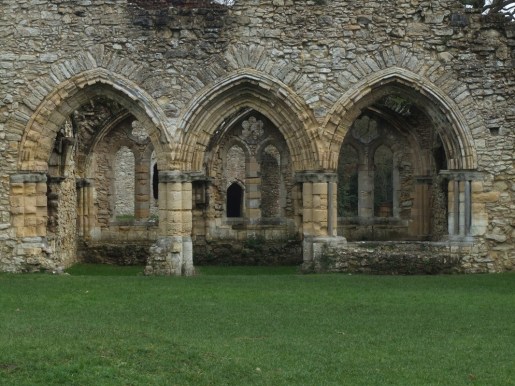
netley3

Netley Abbey arches. Image Tony Grant

My friends and I would walk to Netley or take the green Hants and Dorset bus there. We clambered over the ruins of the Abbey in daylight, imagining what might happen at night, especially in the dim glow of a full moon and with the hooting of owls. Many trees around the Abbey have crows nests high up in their branches and the harsh echo of their shrieking almost always pervades the air around and above the Abbey ruins. I remember our young selves feeling scared and worried but drawn helplessly to this haunted place.

Early History of the Abbey

Netley Abbey is the most complete set of Cistercian monastic ruins in England. Peter de Roches, the Bishop of Winchester founded Netley in 1238. Unfortunately, he died soon after and before building work on the Abbey had begun. However, a group of monks from Beaulieu Abbey in The New Forest arrived in Netley a year later, in 1239, and probably lived in wooden huts while the Abbey was under construction. King Henry III (1216-1272) became the patron of Netley. On one of the remaining stone pillar bases inside the church ruins, a clear inscription shows Henry III’s name.
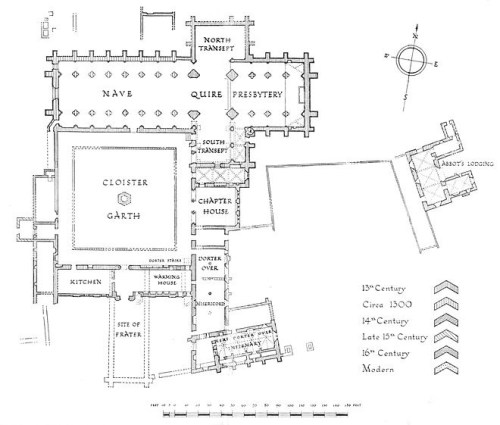
Plan_of_Netley_Abbey (1)

Map of Netley Abbey ca. 1300 – modern times

The Cistercians were an order founded by Robert Molesme in 1089. He was a Benedictine who felt that the Benedictines had abandoned the life of simplicity the rule of St Benedict stated. He set about rectifying this. The monks set up an Abbey at Citeaux in France that gave them their name, Cistercian. They returned to a life of manual work and prayer and dedicated themselves to the ideal of charity and self-sustenance. This is very much the lifestyle the monks at Netley followed.

Fifteen monks and thirty lay brothers lived at Netley, along with officials and servants. They provided sustenance and shelter to travelers and extensively farmed the land around Netley. Interestingly, only a few miles away St. Mary the Virgin, Hound Parish Church, at nearby Hamble le Rice on the Hamble River, was founded by Benedictines separately from the Cistercians at Netley. Bishop Giffard of Winchester had established a cell of Benedictine monks at Hamble Le Rice by the 12th century. These monks came from the Abbey of Tiron in France. (Images below by Tony Grant.)

In 1536 Henry VIII began the suppression of the monasteries in England. The destruction of the monasteries transformed the power and political structures in England. Henry had cut himself off from Rome and had made himself the head of the church in England. He destroyed the monastery system for the wealth they provided and also to suppress political opposition. The monasteries and the church had been a social and political force that in some ways had been more powerful than the monarchy itself. Church property in England had been home to 10,000 monks, nuns, friars and canons. Henry sold the land to landowners. Some of the buildings became churches of the church of England, such as Durham Cathedral. Many were left to ruin ,such as Tintern Abbey in the Wye Valley on the border of England and Wales. The monks who resisted were executed. The majority were pensioned off. Some of the funds Henry gathered were used to set up educational establishments, such as Trinity College Cambridge and Christ Church Oxford. One disastrous result from the dissolution of the monasteries was the destruction of entire monastic libraries, including the loss of many ancient music manuscripts.

The Abbey in the 18th and 19th centuries

Netley Abbey however, was not destroyed but given to Sir William Paulet as a reward for his loyal services. He’d held a number of high profile jobs, including the Treasurer to the Royal Household. Sir William turned the Abbey into a private mansion and reused many of the Abbeys existing buildings. The cloisters became a courtyard. He demolished the monk’s refectory and built an elaborate turreted entrance. The mansion remained inhabited until 1704 when the then owner started selling it off for building materials. The Tudor adaptations were mostly removed in the later 19th century, although sections of brickwork can be found within today’s remaining structure.
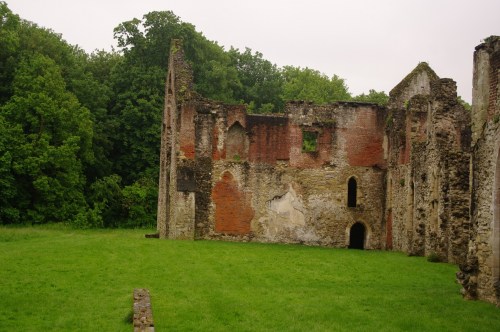
netleyb

Netley Abbey. Image Tony Grant

The Tudors built with brick and these are the few remaining Tudor parts.

The Abbey’s Role in Gothic Revival Architecture
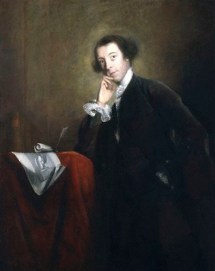
NPG 6520,Horatio ('Horace') Walpole, 4th Earl of Orford,by Sir Joshua Reynolds

Horatio Walpole

Netley Abbey played an important role in the 18th and 19th century Gothic revival. Horace Walpole, the 4th earl of Orford, visited Netley Abbey on September 18th 1755. His original name was Horatio Walpole, (born Sept. 24, 1717, London—died March 2, 1797). He was the son of England’s first prime minister, Sir Robert Walpole. Horace Walpole was an English writer, connoisseur, and collector who was famous in his day for his medieval horror tale, The Castle of Otranto, published in 1764, which initiated the vogue for Gothic romances. He is remembered today as perhaps the most assiduous letter writer in the English language. Walpole wrote to his friend Richard Bentley. He had been staying with his friend, Chute, at The Vyne near Basingstoke. They had departed on a trip to visit Winchester and Southampton. While in Southampton they visited Netley Abbey. Walpole wrote:

“Mr Chute persuaded me to take a jaunt to Winchester and Netley Abbey with the latter of which he is very justly enchanted.”

In his letter, Walpole doesn’t seem to think much about Winchester, “it is a paltry town,” but he enthused about Netley Abbey.

“The ruins are vast, and retain fragments of beautiful fretted roofs pendent in the air, with all variety of Gothic patterns of windows wrapped round and round with ivy — many trees are sprouted up amongst the walls, and only want to be increased with cypresses! A hill rises above the abbey, encircled with wood: the fort, in which we would build a tower for habitation, remains with two small platforms. This little castle is buried from the abbey in a wood, in the very centre, on the edge of the hill: on each side breaks in the view of the Southampton sea, deep blue, glistering with silver and vessels; on one side terminated by Southampton, on the other by Calshot castle; and the Isle of Wight rising above the opposite hills. In short, they are not the ruins of Netley, but of Paradise.— Oh! the purple abbots, what a spot had they chosen to slumber in! The scene is so beautifully tranquil, yet so lively, that they seem only to have retired into the world.”

Thomas Gray, English Poet
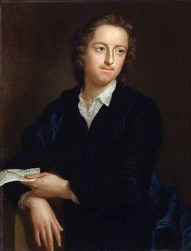
Thomas Gray (26 December 1716 – 30 July 1771)

Thomas Gray

Horace Walpole goes on to mention that his friend Thomas Gray had visited Netley previously. Gray had written a letter about his visit to Netley to the Rev. N. Nichols:

 “Monday, 19th November 1764.

In the bosom of the woods (concealed from profane eyes) lie hid the ruins of Netley Abbey. There may be richer and greater houses of religion, but the abbot is content with his situation. See there, at the top of that hanging meadow under the shade of those old trees that bend into half a circle about it, he is walking slowly (good man!) and bidding his beads for the souls of his benefactors interred in that venerable pile that lies beneath him. Beyond it (the meadow still descending) nods a thicket of oaks, that mask the building and have excluded a view too garish and too luxuriant for a holy eye: only, on either hand, they leave an opening to the blue glittering sea. Did not you observe how, as that white sail shot by and was lost, he turned and crossed himself to drive the tempter from him that had thrown distraction in his way. I should tell you, that the ferryman who rowed me, a lusty young fellow, told me that he would not, for all the world, pass a night at the Abbey (there were such things seen near it), though there was a power of money hid there. From thence I went to Salisbury, Wilton, and Stonehenge; but of these things I say no more, they will be published at the University press.”

Thomas Gray (26 December 1716 – 30 July 1771) was an English poet, letter-writer, classical scholar, and professor at Pembroke College, Cambridge. He is widely known for his, “Elegy Written in a Country Churchyard,”published in 1751.

Gray’s ,”Elegy written in a country churchyard,” was completed in 1750 and first published in 1751.  The poem was completed when Gray was living near St Giles’ parish church at Stoke Poges. It was sent to his friend Horace Walpole, who popularised the poem among London literary circles. Here is an extract that might evoke the atmosphere of Netley.

The curfew tolls the knell of parting day,

The lowing herd wind slowly o’er the lea,

The plowman homeward plods his weary way,

And leaves the world to darkness and to me.

Now fades the glimm’ring landscape on the sight,

And all the air a solemn stillness holds,

Save where the beetle wheels his droning flight,

And drowsy tinklings lull the distant folds;

Save that from yonder ivy-mantled tow’r

The moping owl does to the moon complain

Of such, as wand’ring near her secret bow’r,

Molest her ancient solitary reign.

John Constable

John Constable, RA (11 June 1776 – 31 March 1837)

John Constable

John Constable, 1776 – 1837, is famous for his landscapes, which are mostly of the Suffolk countryside, where he was born and lived. He made many open-air sketches, using these as a basis for his large exhibition paintings, which were worked up in the studio. His pictures are popular today, but they were not well received in England during his lifetime. His most famous pictures include ,”The Hay Wain,” and a series of paintings, sketches and drawings of Salisbury Cathedral from the water meadows. He painted many pictures in the area of East Bergholt, Suffolk, where he was born and brought up.

Constable and his wife visited Netley Abbey, Hampshire on their honeymoon in 1816. One of the drawings made on that occasion was the basis for this much later watercolour.
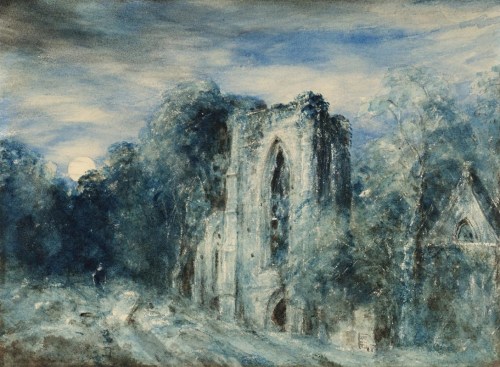
Netley Abbey by Moonlight c.1833 by John Constable 1776-1837

Constable Painting of Netley Abbey, Tate Gallery

It resembles the designs Constable painted in 1833 to illustrate an edition of Gray’s ‘Elegy.’

George Keate

George Keate, another visitor to Netley Abbey, was born on 30 November 1729 at Trowbridge in Wiltshire, where his father had property. He was educated by the Rev. Richard Wooddeson of Kingston upon Thames, together with Gilbert Wakefield, William Hayley, Francis Maseres, and others.

On leaving school, Keate was articled as clerk to Robert Palmer, steward to the Duke of Bedford. He entered the Inner Temple in 1751, was called to the bar in 1753, and in 1791 was made bencher of his inn, but never practised the law. In 1850, when his mother died, he inherited his family’s money. For some years he lived abroad, mainly at Geneva, where he knew Voltaire. By 1755 he was in Rome. After settling in England, Keate, began to write. He was in turn poet, naturalist, antiquary, and artist. A founder member of the Society of Artists in 1761, he left it for the Royal Academy in 1768. Keate was elected Fellow of the Society of Antiquaries of London and Fellow of the Royal Society in 1766. In 1764 he wrote this poem about Netley Abbey entitled,

The Ruins of Netley Abbey. A Poem.” Here is an extract.

More welcome far the Shades of this wild Wood
Skirting with cheerful Green the seabeat Sands,
Where NETLEY, near the Margin of the Flood
In lone Magnificence a Ruin stands.

How chang’d alas! from that rever’d Abode
Which spread in ancient Days so wide a Fame,
When votive Monks these sacred Pavements trod,
And swell’d each Echo with JEHOVAH’S Name!

Now sunk, deserted, and with Weeds o’ergrown,
Yon aged Walls their better Years bewail;
Low on the Ground their loftiest Spires are thrown,
And ev’ry Stone points out a moral Tale.

Mark how the Ivy with Luxuriance bends
Its winding Foliage through the cloister’d Space,
O’er the green Window’s mould’ring Height ascends,
And seems to clasp it with a fond Embrace.—

Anthony Vandyke Copley Fielding

In 1826 Copeley Fielding visited Netley Abbey and produced this water colour.
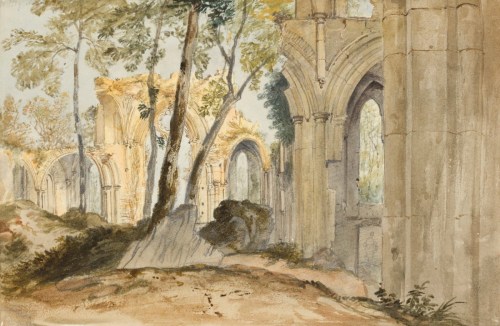
Copeley Fielding Sept 22nd 1826

Copeley Fielding Painting of Netley Abbey, Tate Gallery

Anthony Vandyke Copley Fielding (22 November 1787 – 3 March 1855), commonly called Copley Fielding, was an English painter born in Sowerby, near Halifax, and famous for his watercolour landscapes. At an early age Fielding became a pupil of John Varley. In 1810 he became an associate exhibitor in the Old Water-colour Society, in 1813 a full member, and in 1831 President of that body (later known as the Royal Society of Watercolours), until his death.

In 1824, Copley Fielding won a gold medal at the Paris Salon alongside Richard Parkes Bonington and John Constable. He also engaged largely in teaching the art. He later moved to Park Crescent in Worthing and died in the town in March 1855.

Origins of Gothic Novels
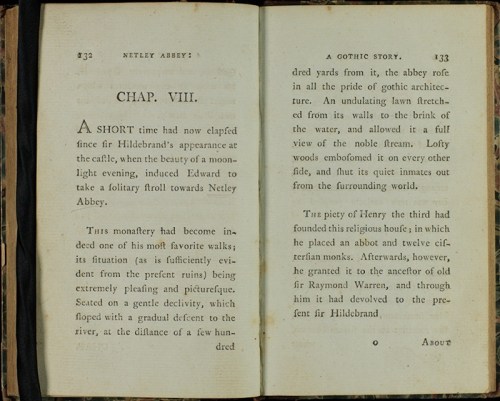
1795 Richard Warner wrote a potboiler entitled Netley Abbey, a Gothic Story in two volumes, featuring skullduggery at the abbey during the middle ages.

Netley Abbey: A Gothic novel by Richard Warner, 1795

John Mullins, in an article about ,”The Origins of the Gothic,” published in 2014 for the British Library, writes,

“Gothic fiction began as a sophisticated joke. Horace Walpole first applied the ,”Gothic,”to a novel in the subtitle-“A Gothic Story,” – or, “The Castle of Otranto,” published in 1764. Mullins writes that when Walpole used the word Gothic he meant ,”barbarous,” as well as, “deriving from the middle ages.
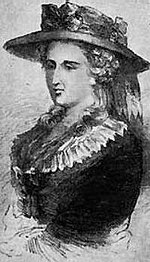
150px-Ann_Radcliffe

Anne Radcliffe, Wikipedia Commons

In the 1790s novelists rediscovered what Walpole had imagined. Anne Radcliffe wrote The Mysteries of Udolpho (1794) She created a brooding aristocratic villain, Montoni, who threatens the resourceful heroine Emily with an unspeakable fate. Radcliffe’s fiction was the natural target for Jane Austen’s satire, Northanger Abbey. Catherine Morland imposes her ,”Gothic,” thoughts and ideas on the real world of the Tilneys.”

Reading novels and novels of the Gothic genre especially are one of Catherine Morland’s greatest pleasures. When meeting her new friend Isabella Thorpe in the Pump Room, Isabella enquires why Catherine is late.

”But my dearest Catherine what have you been doing with yourself all this morning? Have you gone on with Udolpho?”

Catherine had and they began to discuss the plot.

“… and when you have finished Udolpho, we will read the Italian together; and I have made out a list of ten or twelve more of the same kind for you.”

These ”same kind” included, Castle of Wolfenbebavch, Clermont, Mysterious Warnings, Necromancer of the Black Forest, Midnight Bell, Orphan of the Rhine and Horrid Mysteries. Actually the titles alone set a gloomy mysterious dark mood. The enthusiasm of Isabella and Catherine for these novels seem to be echoed by Jane Austen’s tense, breathlessness that emerges from her writing. Is there a tone of cynicism and ridicule too in their listing? Although Austen exaggerates the Gothic genre you can’t help thinking that she must have read all of these novels herself, how else would she know them? Her close mimicking of the genre in Northanger Abbey also points to the realization that she absorbed all the traits of the Gothic genre and was using those effects to her own great delight. I think Jane Austen loved the Gothic genre even as she seems to ridicule it. It was a guilty pleasure to her, perhaps.

Jane Austen – full circle from Netley and Southampton to Northanger Abbey
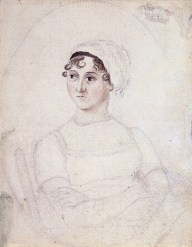
Jane Austen (16 December 1775 – 18 July 1817)

Jane Austen, watercolour by her sister Cassandra, National Portrait Gallery

In 1806, Jane Austen, her mother Cassandra, her sister Cassandra, her friend Martha Lloyd and her brother, Francis’s new bride, Mary Gibson moved into a house in Castle Square Southampton rented from Lord Landsdown. The previous year, 1805, George Austen her father had died in Bath. Her mother, herself and her sister were in straightened circumstances. They had to rely quite heavily on Jane’s brothers for support. Francis was to be away at sea and his new bride, Mary, was already pregnant. She needed the support of the women in the family. Francis was to sail from Portsmouth but being a naval port it was not entirely suitable for his new wife, and his mother and sisters. Southampton, nineteen miles along the coast, was far more genteel.

The Austens knew Southampton and the surrounding areas well. Jane had visited Southampton on a number of occasions before moving there again in 1806. The family would often take trips into the surrounding areas, going to Beaulieu in the New Forest or take boat trips to the Isle of Wight. They would also go by rowing boat from The Itchen Ferry to Netley. Jane writing to Cassandra from Castle Square on Tuesday 25th October 1808,

“ We had a little water party yesterday; I and my two nephews went from the Itchen Ferry up to Northam, where we landed, looked into the 74, and walked home, and it was so much enjoyed that I intend to take them to Netley today; the tide is just right for our going immediately after noonshine but I am afraid there will be rain.”

Edward and George, Jane’s brother Edward’s boys, were staying with Jane at Castle Square. Their mother had died and they were receiving letters from their father about what was to happen. Both boys were naturally upset and Jane took their wellbeing into hand. She appears to have been quite successful keeping the boys occupied with a series of adventures. Netley Abbey must have had an effect on Austen. The Abbey had influenced novelists, poets and artists. Horace Walpole, the originator of the Gothic form, had been impressed by it. We can surmise that her visit to Netley Abbey influenced Jane’s reading of the Gothic novels and so influenced her writing of Northanger Abbey. Or perhaps her fondness for reading Gothic novels influenced her visit to Netley Abbey. It was, after all, a well-known beauty spot.
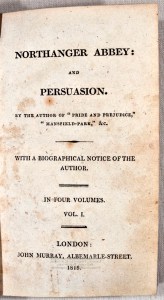
NorthangerPersuasionTitlePage

Northanger Abbey/Persuasion title page, Wikipedia Commons

Northanger Abbey was ready for publication in 1803 but was not published until December 1817 after Jane’s death in July of that year. From the tone of the letter, we can gather Netley was a well-known place to the Austen family. Prior to 1806, Jane had previously lived or stayed in Southampton: In 1783, when Mrs Crawley moved her school to Southampton from Reading; and also in 1793 at the age of 17 to stay with a cousin, Elizabeth Butler Harris, née Austen. Jane celebrated her 18th birthday at a ball at the Dolphin Hotel in Southampton High Street. She may well have been introduced to Netley Abbey on either of those occasions.

Whether Netley Abbey had an influence on Jane’s writing of Northanger Abbey or not, it was a place that had an influence on those connected with the Gothic movement.

Here is a description of Catherine Moorland experiencing Northanger Abbey at night.

“The night was stormy; the wind had been rising at intervals the whole afternoon; and by the time the party broke up, it blew and rained violently. Catherine, as she crossed the hall, listened to the tempest with sensations of aw; and, when she heard it rage round a corner of the ancient building and close with sudden fury a distant door, felt for the firs time that she was really in an Abbey.- Yes, these were characteristic sounds;- they brought to her recollection a countless variety of dreadful situations and horrid scenes, which such buildings had witnessed….”

Bibliography:

Northanger Abbey by Jane Austen, first published 1818, (Penguin Classic 2006.)

Jane Austen’s Letters New Edition) Collected and edited by Deirdre Le Faye Third Edition 1995 Oxford University Press.

Anthony Vandyke Copley Fielding 1787–1855 biography TATE BRITAIN

John Constable 1776–1837 biography TATE BRITAIN

Horace Walpole TO RICHARD BENTLEY, ESQ. Strawberry Hill, September 18, 1755.

George Keate: Wikipaedia: https://en.wikipedia.org/wiki/George_Keate

Netley Abbey   English Heritage.

The Origins of the Gothic,” John Mullins published in 2014 for the British Library.


Read Full Post »
Inquiring readers,

In celebration of the 200 year anniversary of the publication of Jane Austen’s Emma, frequent contributor, Tony Grant, visited Chawton House to view a special exhibit. Read his post about the exhibit on Jane Austen in Vermont in this link. Tony reserved a slew of photos for this blog and added his commentary. I inserted some observations by Constance Hill and Jane’s grand niece to round out this post. Enjoy!

Chawton is a Hampshire village and civil parish. It lies within the area of the South Downs National Park. The 2000 census shows that 380 people live in Chawton.

Google map

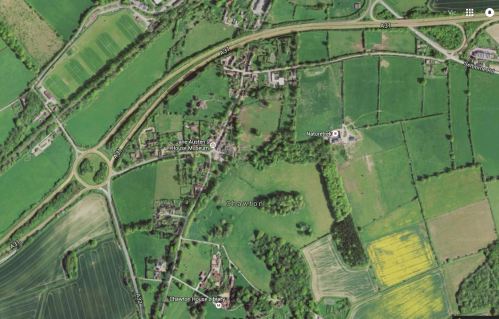
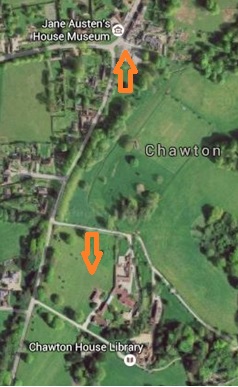
Google map of Chawton, and Chawton Cottage and Chawton House in relation to each other.

Chawton village is first mentioned in 1086 in the Domesday Book which was administered from Winchester, the first capital of England, under William the Conqueror,after 1066. The fact that the village lies on a main route from London to Portsmouth by way of Winchester suggests that because of its important position there must have been a Saxon settlement there before 1066 and possibly going back to Iron Age times. The Normans did instigate the creation of new villages such as at West Meon a few miles south of Chawton but most settlements were continued from previous ages. Its location shows it as perhaps a stopping place on a major route but its prime importance would have been farming.

Farming must have been its main importance right up to and after the second world war. Chawton House and its estate has sheep and horses on it to this day. There are still many farms in the area. However the population today is not what it would have been in the past. In previous centuries there would have been representatives of the whole range of the class system.

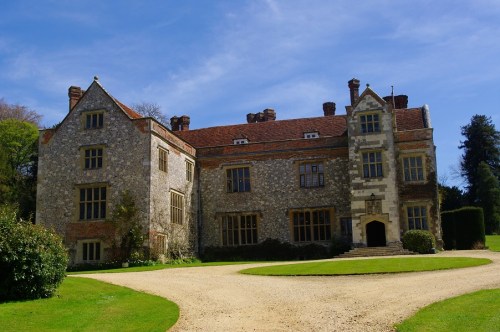
The Great House

The great house at Chawton owned by the Knight family, image by Tony Grant

The Knight family owned the great house and estate and most famously from the early nineteenth century, Edward Knight, Jane Austen’s brother. The middle classes would have been represented by Jane Austen and her family and perhaps the local vicar of the parish of St Nicholas and some minor landowners and farmers. Probably the working class and farm labourer class predominated though. There are plenty of small Victorian cottages, Georgian cottages and cottages dating back to the 16th century and before in Chawton and surrounding areas. These would have been accommodation for farm workers. Nowadays though these cottages surrounded by idealistic country gardens, climbing roses and wisteria, looking picture postcard perfect, are owned by wealthy people who work in the City and use them as weekend homes.

There are examples of large Georgian and Victorian mansions in the village. They can only be owned by company directors or wealthy bankers and other people of that ilk. Looking at estate agent web sites for Chawton, a mansion such as the one you can see at the start of the long driveway that leads to Chawton House, is priced at £2,000,000. The small picture postcard cottages start at about £350,000. The prices of the two properties I have quoted are the top and bottom of the range.

The ordinary, everyday worker is excluded. I am sure there are no farm labourers are living in Chawton these days.This is a shame because local customs are lost. The rich diverse local customs formed over time by families living there for their whole lives, generation after generation, is lost and although Chawton looks lovely today it has lost to a certain extent, its heart. It has lost its soul.

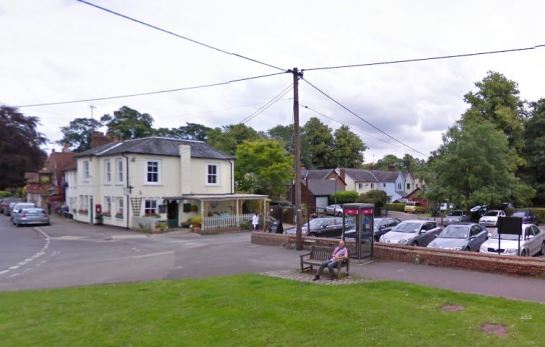
car park

Chawton Car Park, Image Google earth

All is not lost. The other day I walked from the car park, opposite Jane Austen’s cottage next to the Greyfriar pub, along the road to Chawton House Library. On my left, through the trees and across the children’s playground a gentleman was sitting astride a motor mower cutting the grass on the village cricket pitch. I could see that the sight screens were in place for a match and the cricket club flag was flying from the club house flagpole.

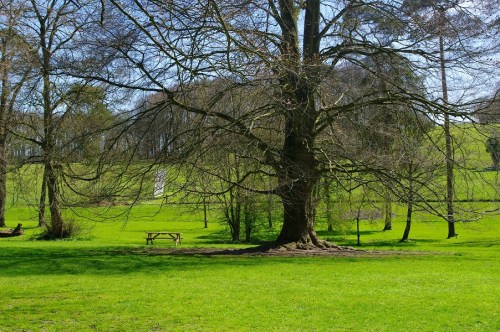
Sight screen on the cricket pitch

Sight of village cricket pitch. Image by Tony Grant

As I approached the Great House I passed Chawton Village Junior School on my right. Put in mind that this was midweek, a Wednesday, and the time was 12.30. The school was in the middle of its lunch break and a whole mass of children were playing in the playground on climbing frames and ladders. They were yelling and whooping and having the time of their lives. I always feel heart warmed at the sound of children. I have spent my whole working life as a teacher teaching them after all. So really there are three things.

Chawton has a great pub, The Greyfriars, it has a wonderful vibrant school and the village a cricket team. A new heart has been created perhaps? Yes, not all is lost.

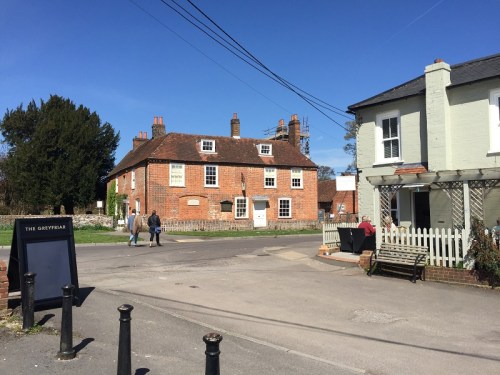
junction

Jane Austen’s Chawton Cottage is straight ahead. To the right is Cassandra’s Cup, a tea house attached to The Greyfriar pub.

Chawton Cottage, a former steward’s cottage, was previously home to local farmers. Between 1781 and 1787, the house was briefly a public house called The New Inn. This pub was the site of two murders. After the second murder, the house was let by Edward Austen Knight to a Bailiff Bridger Seward. (Wikipedia)

Edward then allowed his mother and sisters to move permanently into the residence. Jane lived there with her mother and sister, Cassandra, and long time family friend Martha Lloyd, from 1809 until May 1817, when she moved to Winchester to be near her physician before her death in June of that year. (Wikipedia

Through the window

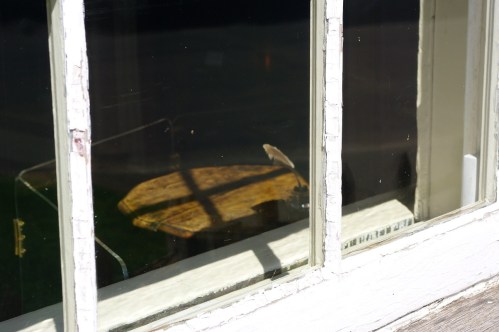
View of Jane Austen’s writing desk from the cottage window. Image Tony Grant

Later in the 18th century, Jane Austen’s brother Edward Austen Knight (who had been adopted by the Knights) succeeded, and in 1809 was able to move his mother and sisters to a cottage in the village. Jane would spend among the most contented, productive years of her life here.


trees

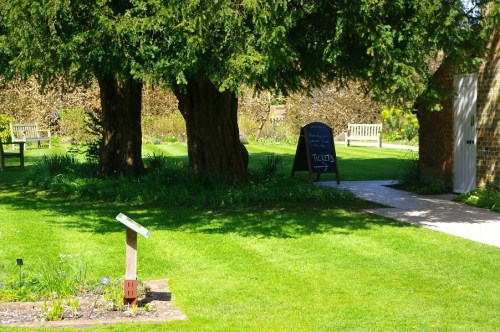
A glimpse of the cottage’s garden.

“I remember the garden well,” writes Miss Lefroy [a grand-daughter of the Rev. James Austen]. “A very high thick hedge divided it from the (Winchester) road, and road it was a pleasant shrubbery walk, with a rough bench or two where no doubt Mrs. Austen and Cassandra and Jane spent many a summer afternoon.”

Miss Lefroy recalls her mother’s happy memories with her Aunt Jane, Aunt Cassandra, and grandmother in Chawton.

“As may be supposed a great deal of intercourse was kept up between Steventon and Chawton. Our grandfather was a most attentive son, and one of the pleasures of my mother’s youth was sometimes riding with him to see her grandmother and aunts through the pretty cross roads and rough lanes, inaccessible to wheels, which lay between the two places . . . In her Aunt Jane, who was the object of her most enthusiastic admiration, she found a sympathy and a companionship which was the delight of her girlhood, and of which she always retained the most grateful remembrance . . . But I will copy my mother’s own account.

‘”The two years before my marriage and the three afterwards, during which we lived near Chawton, were the years in which my great intimacy with her was formed; when the original seventeen years between us seemed reduced to seven or none at all. It was my amusement during part of a summer visit to the cottage to procure novels from the circulating library at Alton, and after running them over to narrate and turn into ridicule their stories to Aunt Jane, much to her amusement, as she sat over some needlework which was nearly always for the poor. We both enjoyed the fun, as did Aunt Cassandra in her quiet way though, as one piece of nonsense led to another, she would exclaim at our folly, and beg us not to make her laugh so much.'” – Constance Hill, Jane Austen: her homes & her friends, 1902.

view from chawton cottage

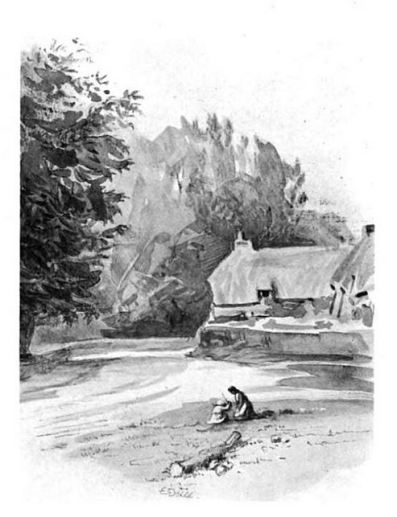
View from Chawton Cottage in the early 19th century painted by Ellen Hill


The village of Chawton lies in a specially beautiful part of Hampshire, about five miles from Gilbert White’s own Selborne, and, like it, famed for its hop fields and its graceful ‘hangers.'”

Chawton Cottage stands at the further end of the village, being the last house on the right-hand side of the way just where the Winchester road branches off from that to Gosport, and where a space of grass and a small pond lie in the fork of those roads.”


Chawton has a single church, St Nicholas. A church has stood on the site in Chawton since at least 1270 when it was mentioned in a diocesan document. The church suffered a disastrous fire in 1871 which destroyed all but the chancel. The rebuilt church was designed by Sir Arthuer Blomfield and is now listed Grade 2.” – (Wikipedia)

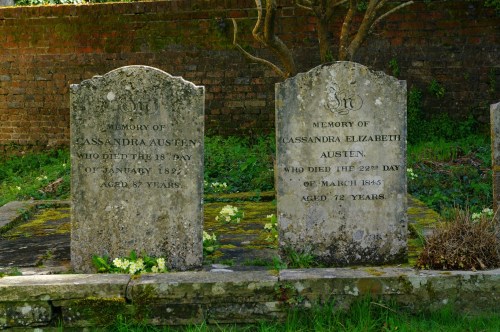
The two Cassandras

The Knight family is buried in the churchyard. Jane Austen’s mother and sister are buried there also.

“The ‘Great House’ and the cottage lie within a few hundred yards of each other, the gates of the park opening upon the Gosport road. The house, a fine old Elizabethan mansion, with its Tudor porch, and its heavy mullioned windows, may be seen by the passer-by, standing on rising ground; while a little below it, in a gentle hollow, lies the old church of Chawton–a small grey stone edifice embowered in trees.”- Constance Hill

chawtoncottage_chawtonhouse

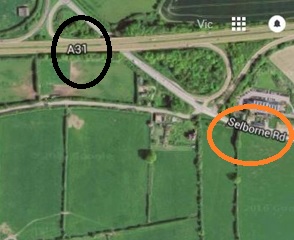
Chawton has only two road exits, one leading to a roundabout connected to the A31 and the A32, and the other to the A339/B3006 Selborne Road.

The village of Chawton lies in a specially beautiful part of Hampshire, about five miles from Gilbert White’s own Selborne, and, like it, famed for its hop field and graceful “hangers”; while within easy reach is the cheerful little town of Alton.” – Hill


Selborne Rd

Read Full Post »

« Newer Posts - Older Posts »