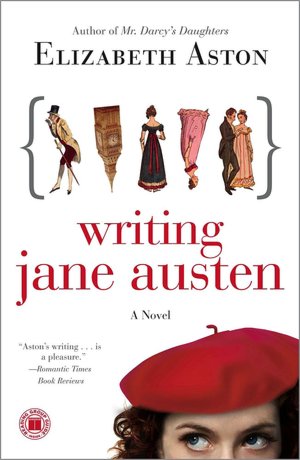
 Have you ever read a book that made you squirm, yell out loud, and want to smash fine china to release your frustration? I usually put such books down and don’t bother to finish them. In this instance I was listening to Writing Jane Austen by Elizabeth Aston in my car and kept punching the on and off button. While I HATED Georgina, the main protagonist, the plot retained my interest just barely enough to keep me going.
Let me say up front that Elizabeth Aston knows her Jane Austen history and has a way with dialogue that is modern, smart, and funny. She also creates vivid characters with names like Henry LeFroy and Mr. Palmer, and has them shopping in stores like Mr. Darcy’s in Bath.
So what is my beef with Writing Jane Austen, which was published in 2010? Simply put, its heroine, Georgina. (I cannot recall her last name and am unwilling to relisten to the first CD to find out.) If an author asks me to spend hours of my life with her heroine, she should provide me with a character that commands my respect and/or interest. I could muster none for Georgina – no respect, no empathy, and absolutely no concern for her well being. In fact, if it hadn’t been for the wonderful young Maude, Henry LeFroy’s sister, I would have stopped listening to the audiobook after the first CD.
It is my firm belief that no well-educated author is as stupid as Georgina, the young woman who has been picked (for no good reason that I can see) to complete Jane Austen’s long lost and unfinished 3,000 word manuscript entitled “Love and Freindship.” Writing Jane Austen makes fun of the publishing industry’s mania for JA sequels, prequels, and mash-ups, and there are moments when Elizabeth Aston gets it completely right. But then I realized that this novel is as cynical as the industry it is lampooning, and with a defective heroine to boot. Either Elizabeth Aston has created dumb Georgina on purpose to ramp up her contempt for money-grubbing publishing houses who have jumped on the Jane Austen bandwagon in pursuit of the almighty dollar, or she actually thinks that her dumb-as-a-post heroine has a few redeeming qualities. Not.
So why do I dislike Georgina so acutely? She lacks intellectual curiosity, has a less than open mind, and repeatedly demonstrates an inability to be practical in the face of a situation over which, if she possessed a smidgen of self-awareness, she has full control. She is immature and uninteresting, a lethal combination. Much of the plot hinges on the fact that Georgina must write a 120,000 word book in the style of Jane Austen within a few months. The problem? She has never read a Jane Austen novel and has no interest in doing so, for she assumes that Jane’s books are a classic version of light chic lit, a genre she despises.
At the novel’s opening, Georgina is between a rock and a hard place. Her first book, a gritty, grim and dark Victorian novel, was forgettable, and her second book has stalled at Chapter One. Her agent threatens to drop her unless she writes Love and Freindship, and she is broke. The publisher’s advance will stave off her creditors and buy her more time to live in England. So, what does Georgina do after she gives in and agrees to write the book? Anything but read a Jane Austen novel. At this point I began to develop an extreme dislike for Georgina that bordered on hatred. How stupid can you get? Elizabeth Aston keeps the reader dangling with this weak plot point: is Georgina EVER going to read a Jane Austen novel and write the damned book?
This wait was stretched out for so long that I nearly spat at my CD player. At one point I yelled, “Enough already, you stupid woman! READ Jane’s books!” Even a brainless monkey would have known that this is the first step one should take when one agrees to mimic a famous author’s writing style. Georgina’s reasons for resisting did not resonate with me. In fact, when she finally picked up Pride and Prejudice and reacted with predictable gooey Jane Austen adoration, the only reason I kept listening to the audiobook was because I was driving along a boring stretch of highway.
What happened next in the book was so totally predictable that I began to laugh: After reading all of Jane Austen’s novels back to back in record time, Georgina now feels inadequate to the task of completing the manuscript of Love and Freindship. And so she is paralyzed with inaction.
Like I cared.
The heroine wasn’t all bad, I grudgingly admit. There were poignant moments, as when Georgina is brought to tears as she recognizes Jane Austen’s genius, or when she sees her writing table in Chawton Cottage and is actually able to muster an insight with her pea brain – that Jane could do so much with so very little.
I could have done without the interminable expositions about writer’s block, and some of the more improbable situations, such as ghostly apparitions of costumed people and carriages that were not integral to anything, except that the author seemed to think it a good idea to plop them in here and there. It is to Ms. Aston’s credit that she kept me listening until, well, almost the very end, for I did not quite finish the book, leaving the last CD in its sleeve. That’s how little I cared about Georgina and her angst about finishing Love and Freindship.
Reading or hearing this novel is akin to watching a TV movie of the week: Here today, gone tomorrow. In 20 years or so, as the Jane mania recedes into memory, you will likely find it for sale for 25 cents on the shelves of a Salvation Army store, while Jane’s excellent novels will still be selling and selling and selling. Thankfully, I borrowed my audio book of Writing Jane Austen from my local library and did not have to part with a cent. If you are still tempted to read the novel, I suggest you do the same.
I am giving this book One Regency Teacup (out of five). In the words of the all-knowing Lady Catherine de Bourgh, “I am most seriously displeased.”







 Jane Austen's World