Feeds:
Posts
Comments

Archive for 2010

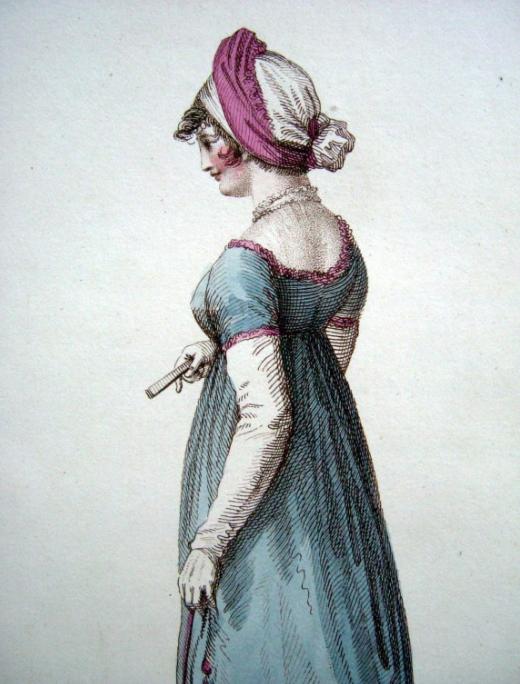
1803 Mirroir de la Mode Evening Dress

In 1803, a woman named Madame Lanchester of Bond Street, published  ‘Le Miroir de la Mode‘. By 1804, scarcely two years after it appeared, the magazine had vanished. (Although The Museum of London has at least one plate published by Madame Lanchester which is dated 1807).  Very little is known about the woman, who had designed for other publications, such as Richard Phillips Fashions of London and Paris.

La Miroir de la Mode was a short-lived, expensive, and large quarto-sized magazine published only from 1803 to 1804, clearly a failed attempt to follow in the footsteps of the defunct Gallery of Fashion, which was also quarto size. The publisher was the famous modiste, Madame Lanchester, who later wrote fashion descriptions and commentary for Ackermann’s Repository. – Word Wenches: Regency Ladies Magazines, Part 3

Ebay is a rich resource for people who are interested  in viewing Regency fashion plates, as this page by Cabrio4 attests. People can purchase their own fashion plates for a reasonable  price, with this particular seller enjoying a reputation of 100% satisfaction. The small image below of a Full Walking Dress  from  ‘Le Miroir de la Mode’, April 1803 (Measures approx: 10.5″ x 8.5″), is extremely rare (and has been sold).

Walking dress, 1803, Mirroir de la Mode

More about the topic

Early Georgian & Regency Fashion Prints to 1806 – Guide written by Cabrio4, eBay seller
Regency Ladies’ Magazines, Part One
Regency Ladies’ Magazines, Part Two
Regency Ladies’ Magazines, Part Three

Read Full Post »

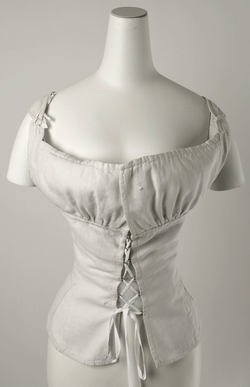
Share/Bookmark// Find examples of Regency dresses and unmentionables in this extensive database by Démodé. The clothes featured in this link are from 1800 through 1830. Examples include corsets, bodices, shifts, underdresses, petticoats, day dresses, spencers, robes, etc, from collections around the world. These images are representative of the Démodé Regency collection.

Corset, Metropolitan Museum, c. 1798-1810

1800 Muslin gown from the V & A Collection

Read Full Post »

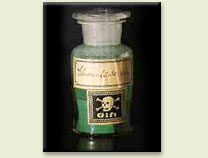
Bottle with emerald green pigment

Once upon a time green paint literally killed people. In 1814 in Schweinfurt, Germany, two men named Russ and Sattler tried to improve on Scheele’s green, a paint made with copper arsenite. The result was a highly toxic pigment called emerald green. Made with arsenic and verdigris, the bright green color became an instant favorite with painters, cloth makers, wall paper designers, and dyers. The first commercial British arsenic was produced at Perran-ar-Worthal in 1812, and at Bissoe in the Carnon Valley in 1834. Their product appealed to the Lancashire cotton industry which used the chemical in pigments and dyes. It was also used by other industries such as glass manufacture (as a decolouriser), in the production of lead-shot, leather tanning, soaps, lampshades, wallpaper manufacture (to create green and yellow print), pharmaceuticals, agriculture for sheep dips, children’s toys, candles, a highly effective rat poison, etc.*

“Manufacture of [emerald green] began in 1814 at the Wilhelm Dye and White Lead Company of Schweinfurt. It was more popular than Scheele’s green and was soon being used for printing on paper and cloth; it even coloured confectionary. –  The Elements of Murder: A History of Poison, John Emsley

Textured Georgian wallpaper

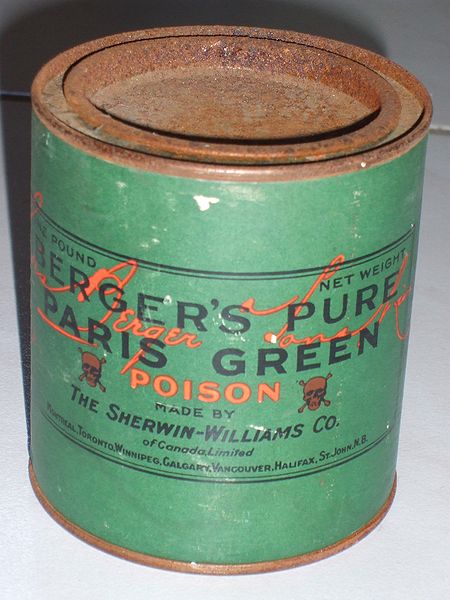
Emerald green was also called Schweinfurt green, Paris green, and Vienna green. The toxicity of dye made with emerald green was not initially recognized, until the recipe was published in 1822, and
“…its poisonous nature was revealed. Manufacturers then changed the recipe, adding other ingredients to lighten the colour, and changing its name accordingly in an effort to disguise its true nature.” – Murder, Emsley
Eventually, the use of this pigment was abandoned when it became generally known that people who wore clothes dyed with the substance tended to die early. To this day the French avoid making green theater costumes.** Emerald green was also used to color confectionary and cake cake decorations:
“The leaves of artificial flowers in particular were coloured with various arsenic greens and they were very popular in Victorian households. The industry making them employed hundreds of young girls, who suffered accordingly from chronic arsenic poisoning…at a banquet held by the Irish Regiment in London in the 1850’s the table decorations were sugar leaves coloured by them. Many of the diners took these home for their children to eat as sweets and several deaths ensued. At another dinner in 1860 a chef was eager to produce a spectacular green blancmange and sent to a local supplier for green dye. He was given Scheele’s green and three of the diners later died.” – Ibid
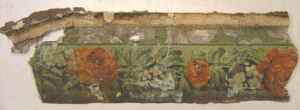
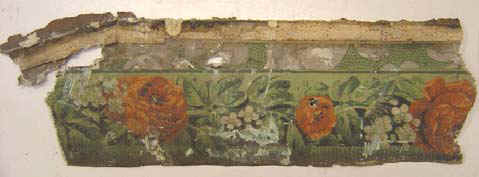
Floral border wallpaper, Ipswich, late 18th c.***

Wallpaper made with Scheele’s green was deadly, By 1830, wallpaper production had risen to 1 million rolls a year in the UK, and by 30 million in 1870. Tests later revealed that four out of five wallpapers contained arsenic. Leopold Gmelin (1788-1853), a famous German chemist, suspected as early as 1815 that wallpaper could poison the atmosphere. He noticed that the substance gave off a mouse-like odor when the paper was slightly damp. Gmelin warned people to strip their rooms of the paper and advocated banning Scheele’s green, but he was too far ahead of his time.
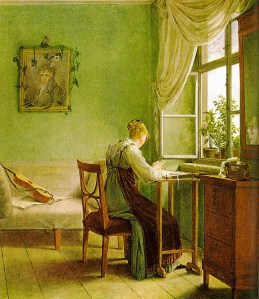
In 1861, Dr W. Fraser tested wallpaper that contained arsenic.The threat, he said, came from breathing the dust of the papers, especially flocked wallpaper. The warnings went unheeded, and by 1871, arsenic production had increased to the point that Britain had become its largest producer and consumer. An addition of a small amount of arsenic, for example, would neutralize iron in glass and give it a green tint. “Potassium chromate (K2CrO4) is yellow and this colour can be imparted to certain glasses. To produce emerald green glass in which a yellowish cast has to be avoided the addition of tin oxide and arsenic is necessary.” (Substances used in the making of colored glass.)

Soon arsenic was exported for the making of pesticides in the United States. Health considerations did not end the use of arsenic-laced wallpaper. By the 1870’s synthetic green dyes began to replace arsenic, and fewer people were placed in danger by its poisonous gases. Experiments at the end of the 19th century proved that arsenic pigments in damp or rotting wallpaper were lethal. The mold that grew on damp wallpaper emitted a toxic odor that smelled of garlic.

The French painter Cezanne had an affinity for using paris green, and it might have been no coincidence that he suffered from severe diabetes. The pigment had a tendency to turn black when exposed to heat and thus it did not become universally popular with artists. Even with scientific evidence of its highly toxic nature, production of emerald green paint was not banned until the 1960’s.

More on the topic

Read Full Post »
The Classics Circuit is taking a Georgette Heyer Tour this month. I thought I would piggyback in a circuitous way, and add my own reviews where they fit in. Such fun! For those who have not read Georgette’s sparkling novels, mostly set during the Regency era, you have missed a treat. Although Ms. Heyer’s writing lacks the depth of Jane Austen’s novels, they are historically accurate and largely FUN to read. Going backwards, here is a recap of the first four days of the tour (I am including only the novels set in the Regency era), with my own reviews thrown in:

March 4  Sparks’ Notes Review: Friday’s Child, My Review of Friday’s Child

March 3 Michelle’s Masterful Musings Review: Devil’s Cub

March 2 Enchanted by Josephine Review: Beauvallet

March 1 Austenprose Review: Georgette Heyer’s Regency World by Jennifer Kloester

March 1 One Librarian’s Book Reviews Review: Frederica; My review of Frederica

Read Full Post »

Inquiring reader, Jane Austen’s World has joined many other blogs in promoting Dawn of the Dreadfuls by Steve Hockensmith, the prequel to Pride and Prejudice and Zombies.  Quirk Books is offering the chance for you to win one of 50 Quirk Classics prize packs. To be eligible, each you must list where you read the review and post it to the Quirk Books site at this link. Pride and Prejudice and Zombies: Dawn of the Dreadfuls (Quirk Books; March 23, 2010; $12.95), by Steve Hockensmith, is an all-new work of fiction inspired by Jane Austen’s characters. My friend, Hillary Major, who reads more books than anyone I know, has graciously condescended to read and review the book.

A Dreadful Prequel, by Hillary Major

Before there was the Alamo, there was Netherfield Hall.

And who would you want by your side in a last stand of the living against the living dead but the sisters Bennet?

Set four years before Pride and Prejudice and Zombies, Dawn of the Dreadfuls finds the Bennet siblings four years younger though already set in their ways: Jane is naively willing to see the best in everyone, Mary is sententious, Kitty a tagalong, and Lydia more lustily flirtatious than any eleven-year-old has a right to be. Elizabeth, however, finds herself at a crossroads when the long dormant undead choose to rise again only weeks before her coming out. Should she trade in her katana for an invitation to Mrs. Goswick’s ball? Should she content herself as the disciple of the handsome Master Hawksworth, her instructor in the deadly arts? Should she exercise her intellect by joining the Dr. Keckilpenny on his quest to re-educate the undead?

The Austen fan will be able to guess Lizzie’s decision long before the gathering zombies (that is to say, the unfortunate encroachments of certain unmentionables) make its outcome a matter of life and death.

Though Steve Hockensmith’s novel boasts only a dozen illustrations (illuminating such heartwarming scenes as an unmentionable “hump[ing] its way toward Mary like a massive, rabid inchworm”), the book is in many ways a cartoon. There’s a bumbling villain in the person of the portly and lascivious Lord Lumpley, who owns Netherfield Hall and fancies himself Hertfordshire’s version of the Prince Regent. (He also fancies Jane Bennet.) There’s a plenitude of martial arts as Mr. Bennet shares his past as a student of Shaolin and reveals that Mrs. Bennet’s flower shed was always intended to be the family dojo. Perhaps the most amusing twist of all comes when Mrs. Bennet’s lost love comes back into her life. Unfortunately, Captain Cannon finds himself rather diminished from his former glory…

Dawn of the Dreadfuls isn’t a thriller. We know the Bennet siblings will survive and go on to meet their Darcys, Binghams, and Wickhams. What, then, kept me turning the pages of this Quirk Classic? Could it be that (like Elizabeth, who defiantly uses the “z-word” even in company), I was simply fascinated by Hockensmith’s embrace of the vulgar, drawn in to walk the fine the line between the absurd and obscene?

Steve Hockensmith as a Dreadful

Pride and Prejudice and Zombies: Dawn of the Dreadfuls, the third Quirk Classic, comes with illustrations from artist Patrick Arrasmith.

Pride and Prejudice and Zombies: Dawn of the Dreadfuls will be available for purchase on March 23, 2010
Published by Quirk Books
Paperback, $12.95, 288 pages
ISBN: 978-1-59474-454-9

Read Full Post »

« Newer Posts - Older Posts »