Feeds:
Posts
Comments

Archive for 2010

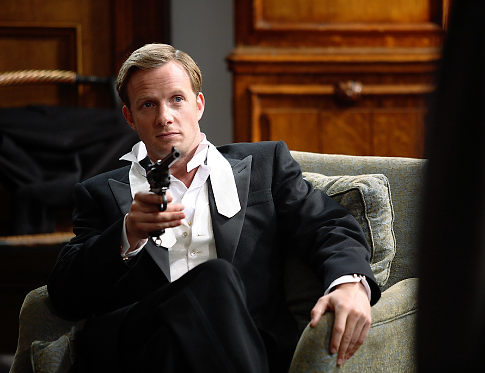
Rupert Penry-Jones in The 39 Steps

John Buchan wrote The 39 Steps in 1915, creating the genre of the espionage thriller, particularly that subset involving the upper-class gentleman spy. In the book, Richard Hannay, had recently returned to London after years of living in Africa, serving in the Boer War and then working as a mining engineer. It is late spring of 1914; he is bored blind by his present life, and ready for some action. He gets his wish when his neighbor, Scudder, entrusts a mysterious notebook and story of spies about to destroy the British Navy to Hannay and gets killed by German spies in his flat. Naturally, Hannay is assumed guilty of the murder, and, with both spies and police searching for him, he goes to Scotland to unravel the story and thus be found innocent. Like all stories of intricate and slightly implausible plot, the tale unfolds at breakneck speed. Buchan’s book is filled with chance encounters, plot twists, double crosses, chases across the Scottish moors, once with an airplane tracing his movements, and ends with Hannay back in England, uncovering the traitor and foiling the German plot. The book was a huge success.

In 1935, Alfred Hitchcock undertook the challenge of making The 39 Steps into a movie. It was a challenge because of the intricate details and large cast in the book, so Hitchcock developed a very different version: he kept Hannay’s name, the murder of the agent in Hannay’s apartment, and the trip to Scotland to discover whatever he could. But Hitchcock updated the time of the action to the mid-30s, made Hannay Canadian and the spies vaguer in nationality, incorporated a music hall performer named Mr. Memory, and changed the 39 steps from a physical location to a conjuring trick. He also brought in a woman to provide the requisite cinema love interest; they meet cute and dash across the moors of Scotland, handcuffed together for some of the time. Robert Donat played the hapless Canadian Hannay; he was the best part of the movie.

The 39 Steps, as broadcast by PBS Sunday night, is much truer to the original. Rupert Penry-Jones, who has the jaded upper class part down cold, plays Hannay, once again the bored Brit. He is aloof when Scudder barrels into his apartment, disbelieving of the story, until the milkman breaks in and Scudder is murdered. Penry-Jones, who previously appeared as Captain Wentworth in Masterpiece’s broadcast of Persuasion, plays a somewhat understated hero. He is quick off the mark, and, in the manner of such heroes, good looking in face and form. Lizzie Mickery, who adapted the novel for this screenplay, also added female interest: Victoria Sinclair, played with spirit by Lydia Leonard, is a suffragist and also a British agent. Again, there are a number of runs across the moors displaying some really splendid scenery. And once again, Hannay is chased by an airplane; although in a clear homage to Hitchcock, the folks in the plane don’t simply spot him, they shoot at him a la North by Northwest – another great Hitchcock spy caper.

Rupert Penry-Jones (Richard Hannay), Lydia Leonard (Victoria Sinclair)

Captain Maynard, my trustee co-viewer, was delighted to note that the cars and guns were all authentic to the 1914 date. He loves the wonderful Masterpiece productions for this reason. And in my fashion, I liked the accuracy of the costumes, both men and women. The story starts very quickly and tautly, and unwinds without a moment wasted; we were both drawn into it immediately.

We enjoyed the Hitchcock version of the movie, although I thought the addition of the music hall unnecessary, even while recognizing that this was a favorite Hitchcock device. (See also, The Man Who Knew Too Much.) And I could see no purpose to have Donat be Canadian; things were already difficult enough. Hitchcock also likes his hero to be pretty clueless, bumbling from one near-disaster to the next, until he finally adds up the pieces and solves the riddle. Over all, I like my hero to have a little more on the ball, and in this 2008 update, Penry-Jones is quick-witted and in charge; he solves the cipher, recognizes his foes, and works through the puzzle ahead of the Secret Service. He is a nice combination of James Bond and Lord Peter Wimsey: not so over the top or predatory as Bond, a little more physical than Wimsey. The love story is believable, not the comic relief of the Hitchcock version. Victoria is also sharp, has a photographic memory, runs without falling down in a swoon, and altogether plays an effective sidekick. One thing did strike a false note: Victoria calls herself a suffragette rather than suffragist, the less derisive term used always by those indomitable women. The story plays out against the beginning of World War I, building both tension and reality for the spy plot. The last scene shows Hannay, now an officer in the British Army, at St. Pancras station setting off for France. The tantalizing hope is that he and Victoria will have a future after the war. And at this point, Co-viewer and I have changed our allegiance: truer to the book, while building in a female character, this remake is by far the better 39 Steps.

Gentle Readers: My good friend, Lady Anne, an avid fan of Alfred Hitchcock’s The 39 Steps, wrote this review for my blog. I am, as always, ever so grateful for her learned insights. Watch The 39 Steps online at PBS until March 30. 2010.
Read Full Post »

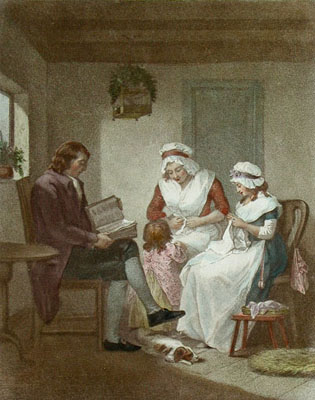
Domestic Happiness, after George Morland

We have come to associate the Regency period with fine white, high-waisted muslin dresses that were beautifully detailed and embroidered. Until quite recently in human history, a lady did not roam far from her sewing basket. She would mend, sew, and embroider whenever she had spare time. (Even the finest lady in the land could be found plying her needles.) During the day she would sit near a well lit window or even outdoors, and during the long evening hours she would sit by the fireside in a room with other family members, sharing the light from expensive candles (sometimes a single one). For entertainment, one of the men would read aloud from a book, or other family members would play musical instruments. Jane Austen was well known for her sewing skills and examples of her needlework are shown in the Jane Austen Museum in Chawton.

Diamond shaped pattern with a flower in the center

White work is a broad term, one that may be said to encompass any white-on-white needlework, that is, needlework that uses a white yarn or thread on a white ground to create a pattern. Various techniques are employed to make these patterns stand out in high relief against their monochrome background, with the result that many white work pieces have an intensely sculptural quality

All over the country, women carried their needlework with them on visits, and traded patterns among friends.

These techniques include embroidery, drawn work, pulled-fabric work, stump work, stuffed work, cording, quilting, candlewicking, and, later, weaving, both by draw loom and machine. – From Lap to Loom: The transition of Marseilles white work from hand to machine

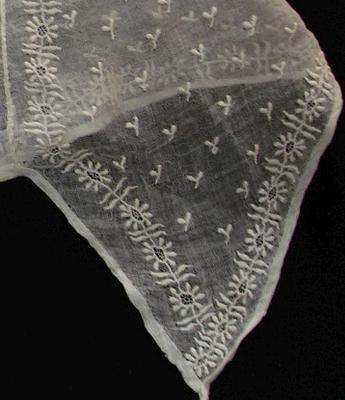
Detail of cap with twigs and flowers on a ladder motif

Whitework embroidery was frequently used on muslin dresses, fine lawn caps, handerkerchiefs, tablecloths, and bed linens. Patterns were featured in Ladies Periodicals, showing many different motifs, some fancier than others.

1815 La Belle Assemblee Wheat sheaf design

The finest whitework was done on cambric and fine muslin, or netting. This was called French embroidery, or French Hand Sewing. The most delicate threads and techniques were utilized to make gorgeous, lacy handkerchiefs, veils, bonnets, cuffs, collars and baby clothes, as well as gifts to very special friends…

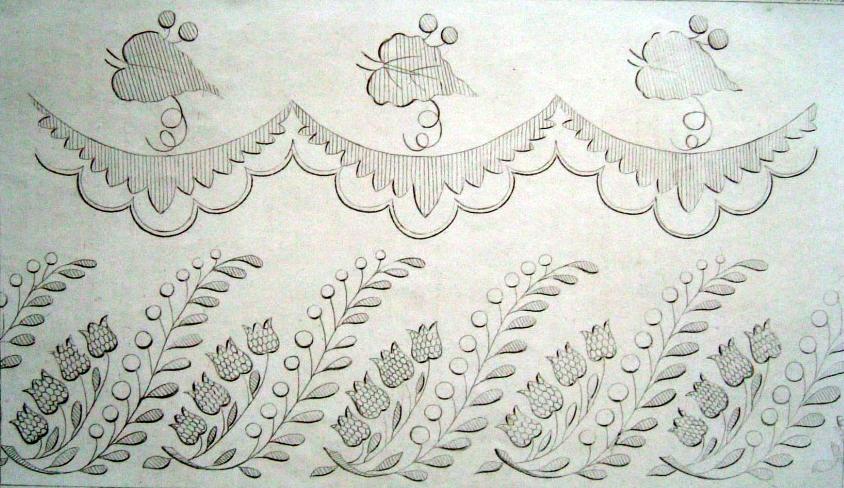
1823 Ackermann embroidery pattern

Christening gowns and robes of the time were very heavily embroidered and were most treasured by their owners. Lots of different patterns and stitches were used, with lots of feather stitching all over, leading to flowers made of satin stitch, eyelets, and buttonhole stitches so tiny as to be difficult to see, and almost all with matching bonnets and slips or petticoats. French knots decorated edges.

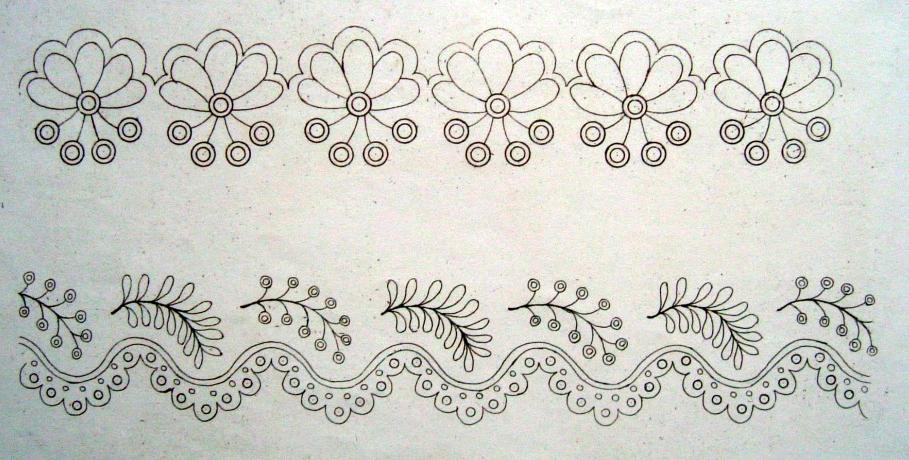
1825 Two simple muslin edging patterns

Wedding gowns, too, were embroidered with these techniques, and some of the grooms’ clothes, too, were embroidered to match! – Whitework embroidery

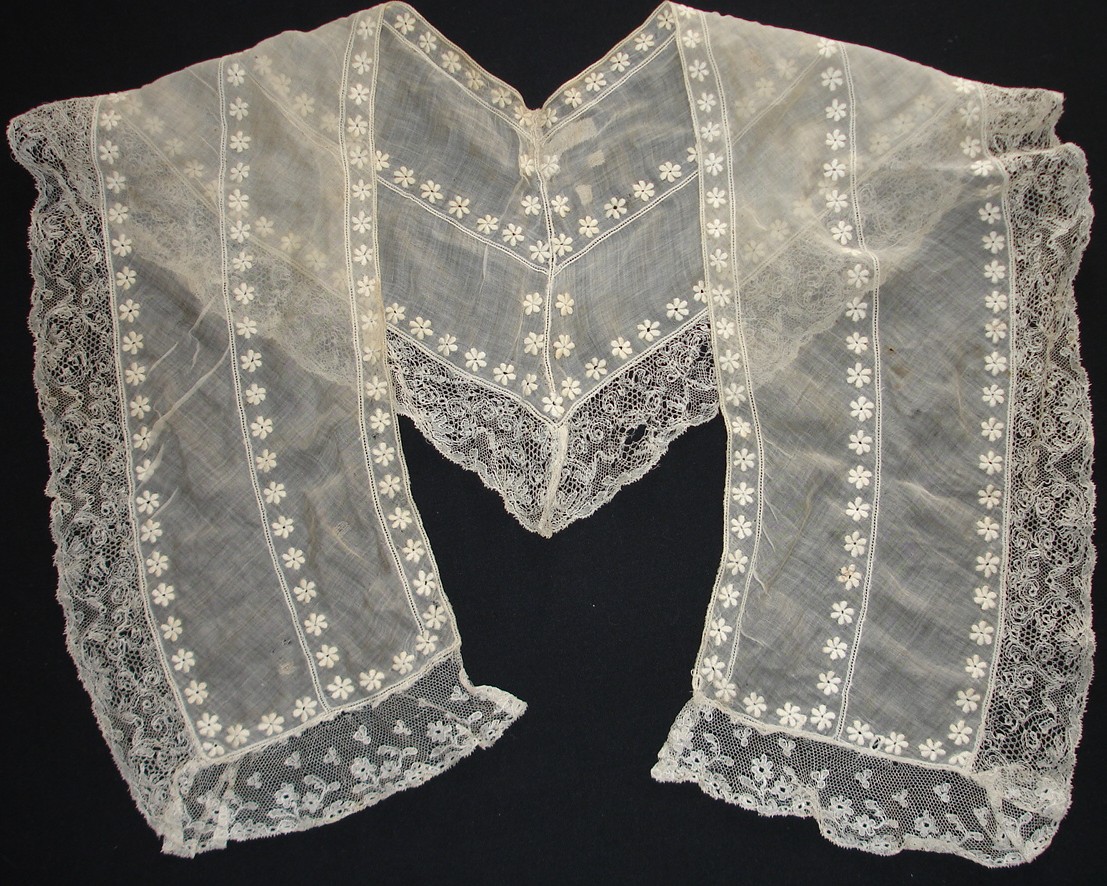
Embroidered collar with lace

More on the topic:

Detail of the hem of a muslin gown. Vintage Textiles.

Read Full Post »

Gentle Reader: This is Christine Stewart’s fifth post for this blog. Christine has embarked on a year-long journey on a Sense and Sensibility inspired project that she chronicles on Embarking on a Course of Study. Herewith are her impressions of Country Dancing, her interview with Rebecca Smith, writer in residence at the Jane Austen House Museum, and her chat with Juliette Wells, the Burke-Austen Scholar-in-Residence at Goucher College

I’m officially six months in to this project and, lately, many things have happened to move me forward, as well as set me back due to my own occasional tendency towards doubt that got the best of me!

The most exciting was a correspondence with Rebecca Smith, writer-in-residence at the Jane Austen House Museum. Ms. Smith is the great, great, great, great, great niece of Jane Austen and is installed there for six months (until May 2010) working on a novel (she has already written two, which can be found on Amazon).

In response to my question, “How has being in Jane Austen’s house affected your writing and your feelings about yourself as a writer?” Ms. Smith writes:

“Well, I think the first thing I have noticed is how 200 years now seems to be such a short time, and I think this has changed the way I feel about everything.
If 200 years isn’t so long, the past and its people are more present, and less seems to be lost. I find this comforting. One of the odd and lovely things about being here is that some of the objects in the Museum are things that were once owned by my great aunts. For instance, a box that was carved by Jane’s brother, Francis, was, until not that long ago, something that my Aunt Diana kept cereal box and cracker toys in for the amusement of visiting children; and some of the smaller portraits I recognize as having once hung on their walls. I only had vague ideas of who these various Austens were when I was growing up – I probably wasn’t paying attention – but here they are now. It is as though I am following them round and we have all ended up where we should be. I do have this feeling – probably quite misplaced – of coming home. And this is ridiculous – why should I pay more attention to this branch of my family tree than any others? I have some really interesting Scottish ancestors too, including a captain who was shipwrecked on an island and was rescued to tell the tale. I had an Indian grandmother who died when my father was tiny – we know close to nothing about her. These stories are what I’m interested in writing about at the moment. It will be fiction, but the novel I’m trying to finish follows the story of five generations of a family from Hampshire to Canada and India and back again. I’m only going as far back as the Edwardians and the novel isn’t to do with Jane Austen.
I’m interested in ideas about home and belonging (and not belonging). But I can see that it is rather convenient of me to feel the pull of Jane Austen’s cottage in Chawton, which happens to be gorgeous and only 27 miles from where I live, rather than the houses in Scotland or India or Canada or the north of England where other ancestors dwelt.”

The title of the novel she is working on is tentatively called The Home Museum, which sounds welcoming and intriguing all at the same time. I can only imagine how thrilling it must be to write in the same house in which one’s ancestor wrote so brilliantly. There’s a longer answer to other questions on my website.

I also hosted an English Country Dancing lesson that took place at the end of January in the ballroom of the Baltimore Hostel, a renovated 19th Century home in downtown Baltimore. There are pictures on my website of the room and the dance in progress. We had a wonderful professional, English, caller, Mr. Michael Barrelclough, who taught us five dances. We had eighteen people and by the end of the second dance, I could look down the set and see everyone becoming more comfortable and familiar with the style of English Country Dancing and the steps.

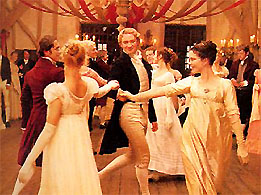
English Country Dancing, Emma with Kate Beckinsale

We still stumbled and Michael led us through some sections several times until we got it, and we laughed and laughed. It was one of the happiest evenings, and I felt so much more confident about my ability to remember steps and understand the calls. I worried less about messing up and just had a marvelous time. There’s something about these dances that is both down-to-earth and elegant and you feel both giddy and graceful at the same time. Everyone wants to have another dance so, we shall!

I’d like to say I’ve made progress on the dating ‘the Jane Austen way,’ but I have not. December – February is my busiest time of year at the arts council and I’m barely keeping my head above water – or should I say snow? The back-to-back snowstorms in the last few weeks set me back quite a bit and rescheduling meetings and Poetry Out Loud competitions completely took over.

There’s also the cost. I’m a state employee and due to our mess of a budget, state employees are required to take 8 furlough days, which is shredding my paycheck. I can’t afford a $30 or more fee for online dating services every month. Maybe in a few months, once the fiscal year ends and we, hopefully, have a balanced budget (or I have a decent tax return!).

In the meantime, I will do what practicing I can at any events I attend, of which there are many when one works in the arts!

Most recently I sat down with Juliette Wells, the Burke-Austen Scholar-in-Residence at Goucher College this year. Dr. Wells teaches at Manhattanville College in New York and was here for a week to give a talk, meet with faculty and students, and do research in Goucher’s Austen collection, donated in 1975 by alum Alberta Hirshheimer Burke (1928) at the time of her death. This nationally-recognized collection consists of Austen first editions, rare period publications related to the life and landscape of rural England, and Alberta Burke’s own notebooks of Austen-related memorabilia and correspondence with Austen collectors and scholars. The Burkes also donated letters to The Morgan Library in New York, where the current Austen exhbit is taking place.

A little trivia: apparently, her husband, Henry Burke, cofounded JASNA with Joan Austen-Leigh and J. David Gray just a few years later in 1979, so the first 25 years of JASNA’s archives are also housed at Goucher.

Dr. Wells was interested in, and supportive of, the project, and I’ll be posting more info about our meeting soon, along with a picture and a podcast of her talk at Goucher. She is writing a book called Everybody’s Jane: Austen in the Popular Imagination, and is exploring how Austen has been appropriated and absorbed by popular culture through film, television, and books. She completed a fellowship at the Chawton House Library last summer.

You can read one of her articles in Persuasion at this link.

and find a link to an interview on Penguin Classics On Air at my website. She was the editor of the recent electronic version of Pride and Prejudice published by Penguin Classics, that includes all sorts of wonderful extras about fashion, architecture, dancing, and etiquette.

You can also read about the mini-crisis I had about this project, mostly because people began asking me about whether or not I wanted a book deal and if so, what was the purpose of the project, and I realized I didn’t have a thesis and did I want a book deal like Lori Smith was angling for when she had her blog that turned into A Walk With Jane Austen ?!?!?!

Deep breath!

So then I became very overwhelmed and lost sight of the joys and the basics of what I was doing. I realized I did need to figure out the purpose of the project for myself, and let the rest fall where it may.

This led me to an examination of character through the unlikely source of Pamela Aidan’s trilogy Fitzwilliam Darcy, A Gentleman which was the only reading I could manage during the storms. It’s both cozy and anxiety-provoking to be caught in snowstorms, knowing you’re missing all your commitments and how much catch up there will be….Plus I had a dead battery and every day I left the car at the dealership they seemed to find something else wrong with the it!

But back to my crisis. Did I figure out that darned purpose? I did, with Dr. Wells’ indirect help.

Next weekend I’m off to NYC to visit The Morgan Library’s Jane Austen exhibit, “A Woman’s Wit.” Some friends are going and we’re taking a video camera, so watch out!

Share/Bookmark// More on the Topic

Read Full Post »

PBS Masterpiece Classic will show an encore presentation of Persuasion 2007 tonight. If you missed this 90-minute film the first time, you will have a chance to see it at 9 PM EST. (Check your local listing).

Sally Hawkins as Anne Elliot in Persuasion, 2007

Vic’s posts about Persuasion 2007:

Other blogger views of the Film

Rupert Penry Jones as Captain Wentworth and Sally Hawkins as Anne Elliot, Persuasion

Posts on this blog about Persuasion

The Elliots of Kellynch Hall, Persuasion 2007

Read Full Post »

In 1751, Denis Diderot and Jean le Rond d’Alembert edited the 17-volume Encyclopedia: the Rational Dictionary of the Sciences, commonly known as the Encyclopédie. These heavily illustrated volumes were designed to teach people to think critically and objectively about all matters in the 18th century. Diderot said he wanted to “change the general way of thinking.” His ambition created quite a stir.

Diderot Couturiere

The Encyclopedie aroused opposition from the outset. Its first volume, published in 1751, dealt with topics such as atheism, the soul, and blind people (all words beginning with “a” in French. As a result, the government banned publication and the pope placed it on the Index of Forbidden books. He threatened to excommunicate all who bought or read it. The publisher of the work watered down later volumes without the consent of the writers in an attempt to stay out of trouble. The Encyclopedie exalted knowledge, questioned religion and immortality (Diderot was a proclaimed atheist), and criticized legal injustices and intolerance. Diderot championed the cause of women, writing that laws which limited the rights of women were counter to nature. The work was widely read and published in Switzerland, but was extremely popular in France. Copies reached America where it was read by Benjamin Franklin and Thomas Jefferson. It was completely banned in Spain as were other enlightenment works by order of church authorities.- The Enlightenment

Onsite Review discusses Diderot’s mid-18th century tailors, or tailleurs, and offers several corresponding images:

This survey of French crafts and trades just before the Revolution, includes such things as how a bodice is made, a riding jacket, gloves, hats – all the patterns laid out flat. Included are the workrooms for glovemakers, tailors, hatmakers – the spaces of craft and trade: where is the dress cut and stitched? where does the dressmaker or the tailor sit as they fell a seam? what is the space like in which the hat is sold?

In the Encyclopédie they are austere rooms flooded with light from tall many-paned sash windows. These rooms are never deep and usually have windows on two facing sides. Because these are crafts and trades, furniture is the work bench, a sturdy work table, open shelves and sometimes a cabinet. Accompanying the plates illustrating the garment, and the plates showing the spaces, are the plates of tools, the instruments of the craft: a catalogue of needles, of stretchers, of hat presses, of shears.

Gants, or glove patterns

The illustrated plates and their topics are discussed by John Morley, who wrote about the Encyclopédie in 1905:

Diderot, as has been justly said, himself the son of a cutler, might well bring handiwork into honour; assuredly he had inherited from his good father’s workshop sympathy and regard for skill and labour.The illustrative plates to which Diderot gave the most laborious attention for a period of almost thirty years, are not only remarkable for their copiousness, their clearness, their finish—and in all these respects they are truly admirable—but they strike us even more by the semi-poetic feeling that transforms the mere representation of a process into an animated scene of human life, stirring the sympathy and touching the imagination of the onlooker as by something dramatic. The bustle, the dexterity, the alert force of the iron foundry, the glass furnace, the gunpowder mill, the silk calendry are as skilfully reproduced as the more tranquil toil of the dairywoman, the embroiderer, the confectioner, the setter of types, the compounder of drugs, the chaser of metals. The drawings recall that eager and personal interest in his work, that nimble complacency, which is so charming a trait in the best French craftsman. The animation of these great folios of plates is prodigious. They affect one like looking down on the world of Paris from the heights of Montmartre. To turn over volume after volume is like watching a splendid panorama of all the busy life of the time. Minute care is as striking in them as their comprehensiveness. The smallest tool, the knot in a thread, the ply in a cord, the curve of wrist or finger, each has special and proper delineation. The reader smiles at a complete and elaborate set of tailor’s patterns.-DIDEROT AND THE ENCYCLOPÆDISTS, BY JOHN MORLEY, 1905

Illustration from Onsite Review

The above illustration from Onsite Review shows how the pattern for a riding outfit is laid out on the cloth. The width of the cloth varied. Wool cloth was wider than brocade, for instance. With Diderot’s publication of these plates, the knowledge of how to lay out these patterns became standardized. Onsite Review’s article, Diderot: Cutting Your Coat to Fit the Cloth, is fascinating to read.

Share/Bookmark// More about the Encyclopédie and Diderot:

Read Full Post »

« Newer Posts - Older Posts »