• Home
  • Audio/Podcasts
  • Austensites
  • AV/E-Texts
  • History
  • JA Novels & Bio
  • Links
  • Original Sources/19th C. Texts
  • Social Customs During the Regency
  • Teacher/Student
  • Writer/Literature Resources

Jane Austen's World

This Jane Austen blog brings Jane Austen, her novels, and the Regency Period alive through food, dress, social customs, and other 19th C. historical details related to this topic.

Feeds:
Posts
Comments
« Brunswick House
Axminster Carpets: 18th and 19th Century British Interiors »

The Adelaide Mill

November 10, 2011 by Vic

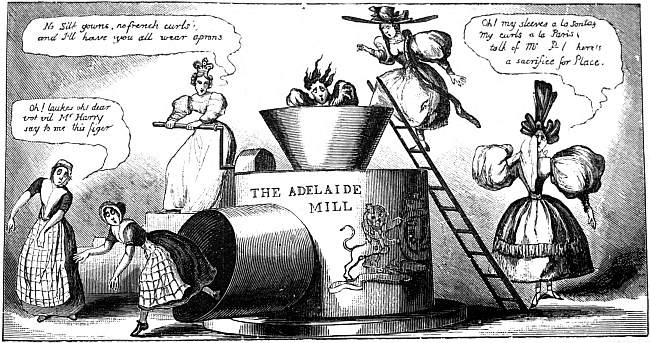
Caricature by Robert Seymour, 1830

After the death of Princess Charlotte in childbirth in 1817, the British Royal family was left without a legitimate heir to the throne. Since their marriage, King George IV had felt an overpowering physical and mental aversion to Queen Caroline, his consort, and the possibility of his begetting another child on her was less than zero.

None of the King’s brothers were married. The Dukes of York, Clarence, Kent, Cumberland, Sussex, and Cambridge all began to court potential brides in earnest.

In 1818 William Henry, Duke of Clarence, who would reign as King William IV, abandoned his 20-year relationship with Mrs. Jordan, with whom he had ten children, to marry Adelaide of Saxe-Meiningen, a rather plain lady half his age. In short time the strong-willed duchess managed to take her husband’s finances in hand and pay off his debts through economical living. Parliament voted to increase his allowance, which the Duke, who was angling for more, finally accepted.

William was crowned King in 1830. By all accounts he was faithful to his queen. They lived a sober, almost boring life,  but, sadly, their two infant children did not survive. Queen Adelaide’s strong influence throughout her marriage can be seen in this illustration.This cartoon of the Adelaide Mill, drawn by English caricaturist, Robert Seymour, shows Adelaide decreeing that the court domestics must dress more humbly:

From other contemporary pictorial skits by Seymour we learn that various changes were made in the royal establishment, and the new queen seems to have addressed herself specially to a reform in the dresses of the court domestics. On the 1st of October, 1830, Seymour represents her grinding an enormous machine, called the “Adelaide Mill,” into which the women servants, dressed in the outrageous head-gear and leg-of-mutton sleeves of the period, are perforce ascending, and issuing from the other side attired in plain and more suitable apparel. “No silk gowns,” says Her Majesty as she turns the handle. “No French curls; and I’ll have you all wear aprons.” The new queen seems also to have shown a disposition to encourage native manufactures and produce at the expense of French and continental importations. These changes were not particularly pleasing to the Conservative lady patronesses of Almack’s, who were celebrated at this time for their capricious exclusiveness. One of Robert Seymour’s satires, bearing date the 1st of November, 1830, shows us a conference of these haughty dames, who seriously discuss the propriety of admitting some lady (probably the queen) who proposed appearing at one of the balls “in some vulgar stuff made by the canaille at a place called Kittlefields” [Spitalfields].” – English Caricaturists and Graphic Humourists of the Nineteenth Century. How they Illustrated and Interpreted their Times, by Graham Everitt

The death of King William IV in 1837 led to the long and successful reign of Queen Victoria, daughter of Prince Edward, Duke of Kent.

Learn more about Mrs Jordan in this link: The Delectable Dora Jordan

Share with others:

  • Click to email a link to a friend (Opens in new window) Email
  • Click to print (Opens in new window) Print
  • Click to share on Facebook (Opens in new window) Facebook
  • Click to share on Reddit (Opens in new window) Reddit
  • Click to share on X (Opens in new window) X
  • Click to share on Pinterest (Opens in new window) Pinterest
  • Click to share on Tumblr (Opens in new window) Tumblr
  • Click to share on LinkedIn (Opens in new window) LinkedIn
Like Loading...

Related

Posted in 19th Century England, Georgian Life, Jane Austen's World, Regency society, Victorian Era | Tagged British caricature, King William IV, Queen Adelaide, Robert Seymour, The Adelaide Mill | 5 Comments

5 Responses

  1. on November 10, 2011 at 19:42 kester2's avatar kester2

    Interesting as usual, Vic. I looked at the Gutenberg “English Caricaturists…” and am wondering where the illustrations went. Copyright issues? Do you know a source for these caricatures in the commons, or perhaps useable for a small fee (like iStock pictures)?


    • on November 10, 2011 at 22:44 Vic's avatar Vic

      Kester2,

      Thanks for your comment. Look at this image at Wikimedia Commons. http://commons.wikimedia.org/wiki/File:English_Caricaturists,_1893_-_The_Adelaide_Mill.png

      I found the original image at Gutenberg. Am perplexed that you were stymied!


  2. on November 10, 2011 at 23:35 Karen Field's avatar Karen Field

    OK, that explained for me how Queen Victoria became Queen. That was really interesting. How in the world did one of those dukes who were so self interested lower himself to marry? Can you imagine the competition that must have been going on with each brother.

    Can you recommend a good book that I might read that explains the succession from George lll forward?


    • on November 11, 2011 at 10:46 Vic's avatar Vic

      Sadly, I can’t! I hope a reader can recommend one.


  3. on November 12, 2011 at 19:05 Debra Brown's avatar Debra Brown

    All the brothers were to find a royal bride, so I would think the competition would have been rough. They had to find younger princesses who were willing to marry old coots with a history of life with mistresses and illegitimate children.


Comments are closed.

  • Enter your email address to subscribe to this blog and receive notifications of new posts by email.

    Join 7,246 other subscribers
  • 2025 AGM in Baltimore

  • Items of Interest

  • Blog Stats

    • 18,382,940 hits
  • Follow Jane Austen's World on WordPress.com
  • RECOMMENDED BOOKS AND RESOURCES

  • Fashionable Goodness: Christianity in Jane Austen's England is now available! By JAW contributor Brenda S. Cox. See Review. Available from Amazon and Jane Austen Books.
  • We also recommend JAW contributor Rachel Dodge's devotionals based on Jane Austen's prayers and classic literature. Reviews:
    Praying With Jane: 31 Days Through the Prayers of Jane Austen
    The Anne of Green Gables DevotionalThe Little Women Devotional
    The Secret Garden Devotional
  • The Tour of Doctor Syntax. Edited by Ben Wiebracht. Read the review of the book at this link. Click to order the book on Amazon US or Amazon UK or Jane Austen Books
  • FREE Student Membership to JASNA

    Available through December 31st, 2025. Click on image for details, and share this poster with other teachers and students!

  • The Obituary of Charlotte Collins by Andrew Capes

    Click on image to read the story.

  • Comments

    “My idea of good company…is the company of clever, well-informed people, who have a great deal of conversation.” – Jane Austen, Persuasion


    Gentle readers: Please feel free to post your comments and continue the conversation! Due to SPAM, we will no longer accept comments on posts after 30 days of publication. In some instances, links will be removed from comments as well.

  • Administrators and Contributors

    Vic Sanborn, founder of this blog, is supported by a team of talented and knowledgeable writers about Jane Austen and the Regency era. They are:

    • Brenda Cox
    • Rachel Dodge and
    • Tony Grant, who now contributes his photos from London and England

    Click on their names to enter their own blogs.

    In addition, we thank the many experts and authors who frequently contribute their posts and opinions, and who continue to do so freely or at our request.

  • Pin It!

    Follow Me on Pinterest
  • Top Posts

    • Exploring Jane Austen's Prayers
      Exploring Jane Austen's Prayers
    • Cassandra Writes About Jane Austen's Death, July 18, 1817
      Cassandra Writes About Jane Austen's Death, July 18, 1817
    • Highclere Castle Floor Plan: The Real Downton Abbey
      Highclere Castle Floor Plan: The Real Downton Abbey
    • Regency Fashion: Men's Breeches, Pantaloons, and Trousers
      Regency Fashion: Men's Breeches, Pantaloons, and Trousers
    • Men's hair styles at the turn of the 19th century
      Men's hair styles at the turn of the 19th century
    • Happy 250th Birthday, Jane Austen!
      Happy 250th Birthday, Jane Austen!
    • More Birthday Events for Jane Austen!
      More Birthday Events for Jane Austen!
    • Sense and Sensibility, 1995 & 2008: Marianne’s Illness
      Sense and Sensibility, 1995 & 2008: Marianne’s Illness
    • In Jane Austen’s Own Words: Economic Sense and Sensibility
      In Jane Austen’s Own Words: Economic Sense and Sensibility
    • Social Customs During the Regency
      Social Customs During the Regency
  • Recent Posts

    • More Birthday Events for Jane Austen!
    • Happy 250th Birthday, Jane Austen!
    • Coming Soon: Birthday Tales for Jane Austen’s 250th
    • Book Review: The Austens, by Sarah Emsley
    • Praying with Jane Audiobook with Amanda Root
  • Links to Jane Austen Blogs

    Click here to enter the page. Topics include Regency fashion, historic foods, Jane Austen societies, British sites, related topics. Click on image.

  • May we suggest?

  • Unknown's avatarHello, my name is Vic and I live in Maryland, USA. I have adored Jane Austen almost all of my life. I am a proud lifetime member of the Jane Austen Society of North America. This blog is a personal blog written and edited by me and my team. We do not accept any form of cash advertising, sponsorship, or paid topic insertions. However, we do accept and keep books and CDs to review.

    If you would like to share a new site, or point out an error, please email us. (Yes, we are fallible. We'll own up to our mistakes and will make the corrections with a polite smile on our faces.) Write us at

    gmailbw

    Thank you for visiting this blog. Your comments and suggestions are most welcome.

  • Project Gutenberg: eBook of Stage-coach and Mail in Days of Yore, Volume 2 (of 2), by Charles G. Harper

    STAGE-COACH AND MAIL IN DAYS OF YORE: A PICTURESQUE HISTORY
    OF THE COACHING AGE, VOL. II, By CHARLES G. HARPER. 1903. Click on this link.


  • Top Posts & Pages

    • Exploring Jane Austen's Prayers
    • Cassandra Writes About Jane Austen's Death, July 18, 1817
    • Highclere Castle Floor Plan: The Real Downton Abbey
    • Regency Fashion: Men's Breeches, Pantaloons, and Trousers
    • Men's hair styles at the turn of the 19th century
    • Happy 250th Birthday, Jane Austen!
    • More Birthday Events for Jane Austen!
    • Sense and Sensibility, 1995 & 2008: Marianne’s Illness
    • In Jane Austen’s Own Words: Economic Sense and Sensibility
    • Social Customs During the Regency
  • Tour Chawton Cottage on YouTube

  • Disclaimer: Our team makes no profit from this blog. We may receive books (physical or digitized) for review purposes.

  • Copyright Statement: © Jane Austen's World blog, 2009-2024. Unauthorized use and/or duplication of this material without express and written permission from this blog’s author and/or owners is strictly prohibited. Excerpts and links may be used, provided that full and clear credit is given to Jane Austen's World with appropriate and specific direction to the original content.

Blog at WordPress.com.

WPThemes.


  • Reblog
  • Subscribe Subscribed
    • Jane Austen's World
    • Join 7,246 other subscribers
    • Already have a WordPress.com account? Log in now.
    • Jane Austen's World
    • Subscribe Subscribed
    • Sign up
    • Log in
    • Copy shortlink
    • Report this content
    • View post in Reader
    • Manage subscriptions
    • Collapse this bar
 

Loading Comments...
 

    %d

