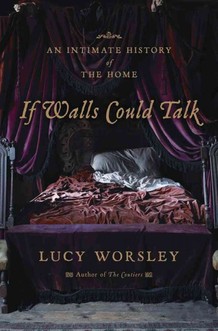
 I love to listen to Fresh Air when I am walking my dog. On March 13, I had a most delightful listen when Terry Gross interviewed Lucy Worsley, the author of If Walls Could Talk: An intimate History of the Home. This interview came almost a year after the book was introduced in the UK. The video series was also shown on BBC last fall. As is often the case, I am among the last to know.
I listened to Terry’s interview with Lucy and was mesmerized. First, a bit about Ms. Worsley and her work:
Lucy Worsley works as the chief curator in several palatial buildings in London, including Kensington Palace, Hampton Court Palace and the Tower of London. In contrast, she lives in what she calls a “normal, boring modern flat.”
The differences between her home and her workplace inspired Worsley to research the history of the home, which she details in her new book If Walls Could Talk. The book answers questions like: Why did the flushing toilet take two centuries to catch on? Why were kitchens cut off from the rest of a home? And did strangers really share beds as recently as a century ago? (Yes, they did.) – If Walls Could Talk
This video provides a perfect introduction to the book:
In Austenonly, Julie Wakefield discusses the evolution of the kitchen. Click here to read her excellent post, The Georgian Kitchen.
I was struck by the evolution of the bedroom. Until quite recently in historic terms, there were not enough rooms in a house to provide a separate room for sleeping. The bedroom was a crowded and semi-public space. A bed was for sleeping; people had sex elsewhere. In medieval times, the family often shared their bedroom with people they did not know. It wasn’t until Georgian times that a couple began to expect privacy as they slept. Even then, children were expected to share a bed.
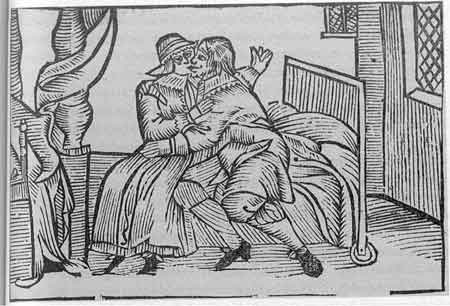
18th century woodcut of a bundling couple.
Parents were realistic about the hot blood coursing through a courting couple’s veins and their need to be together. Considering that a couple could not marry until they could afford to set up house, the average bride and groom to be had to wait years before they were wedded. Bundling was considered a sensible alternative to an amorous man and woman going off to a shed or field to follow their biological instincts. It was a custom followed by the lower levels (certainly not by the upper classes, where a woman’s chaste reputation was highly prized) and practiced in rural areas of England through the 18th century.
The practice was called “bundling” because the young man and young lady were each fully clothed, each had a separate set of linens, and the couple was usually separated by a board or bolster. Since all was done openly, with family members often helping the young woman by knotting her securely in her clothes, it was assumed that such courtships would remain chaste; and, quite often, they did.
But, youngsters then were no different from youngsters today, and temptation was not always fully resisted. As the numbers of premarital pregnancies rose in the 18th century, some people maintained that bundling was at least partially to blame. And, as homes were gradually being equipped with improved lighting, parlor stoves, and comfortable furniture, bundling gradually faded from practice. By the early 1800’s only couples in the most remote rural areas were still courting beneath a quilt. – The Curious Courtship Practice Known as Bundling
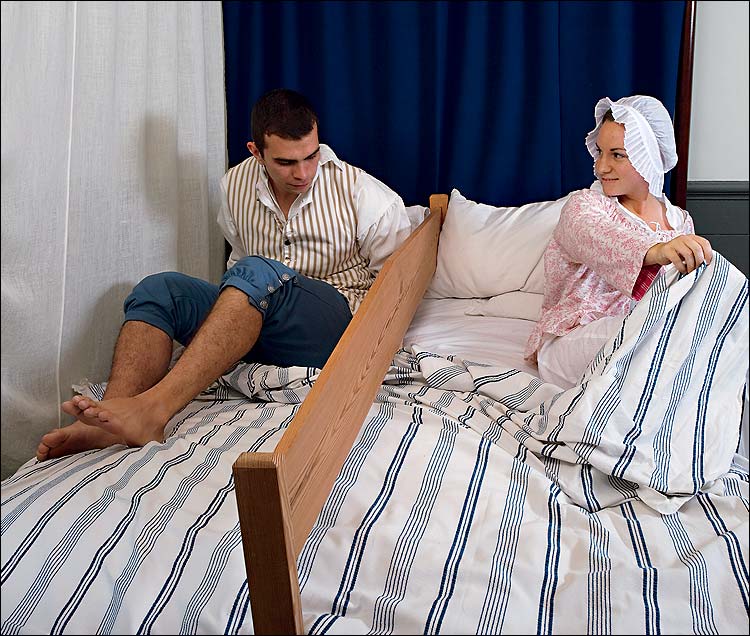
A bundling couple. He lies on top of the bed, she is under the covers. Image @History.org
After a night spent in bed together, the young couple did not have to marry (unless the woman somehow became pregnant). Bundling was a way of getting to know each other better and to see if they were compatible. Ms. Worsley identified the practice as a level of supervision by the family. This practice was not fool-proof, however.
Although sex was theoretically not involved, the practice coincided with a huge increase in premarital pregnancy. By the end of the century, 1/3 of all brides were pregnant by the time they reached the altar: The History of Courtship
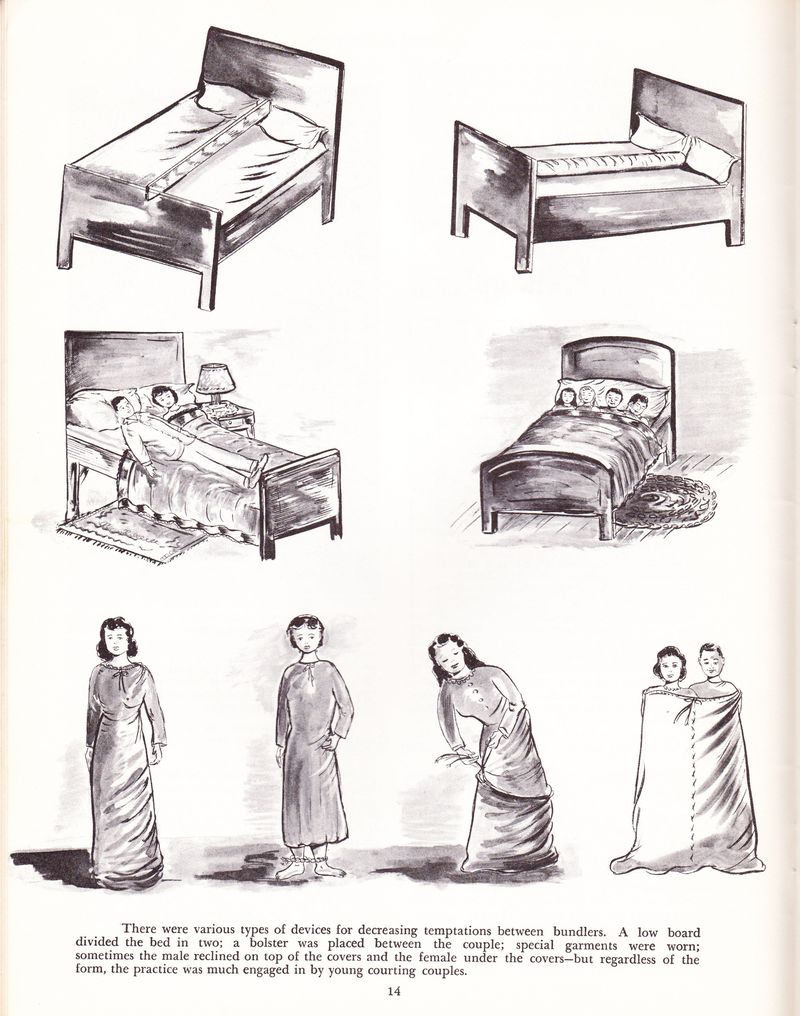
Image @Fresh Vintage. Bundling was practiced in the U.S. a long time after the custom died in the U.K. Click on image to enlarge.
As a means of saving money, travelers would opt to share a bed. In some inns, a bundling board was used to separate the strangers. This poem describes bundling in quite some detail. In the U.S., the Amish and Mennonites practiced bundling well into the 20th century and, it is said, even today.
THE BUNDLING BAG
Where might young lovers better be,
Than right at home in bed?
Some giddy youth might care disdain,
And occasionally break the enchanted chain;
But most kept faith, ’tis said.
Some folks think it quite a risk,
But others make calm reflection:
We have men as husbands for our girls to get,
That they then might have naught to fret.
So few youngsters raised objection.
The bundling bag was just the thing
For young folks “on the go;”
It made matters safe, for man and maid;
Old folks retired, quite unafraid.
All these things are truly so. – Little Known Facts about Bundling in the New World, by A. Monroe Aurand, Jr.
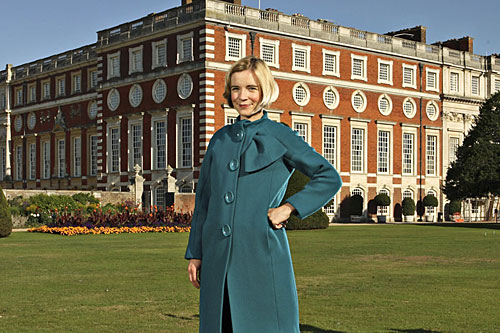
Lucy Worsley
More on the topic: If you are as fascinated with this topic as I am, click on the links below to learn more about this custom in both Great Britain and the U.S.
- Edwardian Promenade features the BBC videos on its YouTube site. Click here to see the first installment! You can find the other episodes in the sidebar.
- Click here to listen to Terry Gross’s interview with Lucy Worsley on Fresh Air.
- Nonfiction: If Walls Could Talk
- The Practice of Bundling in Courtship: Courtship, sex, and the single colonist, Colonial Williamsburg
- Let us tarry here a while: Advanced Courtship in Georgian London
- The Curious Courtship Practice Known as Bundling
- The History of Courtship
- The Social Practice of Bundling
- Fresh Vintage: Bundling image







 Jane Austen's World
This was really interesting. Have you heard of/seen Lucy Worsley’s three-part series on the Regency called ‘Elegance and Decadence’? It was shown in the UK around September last year so I’m not sure that it will have made it to the US yet but I would certainly recommend it. All things that you will know already, I should think, but a nicely-done programme and a great chance to see many of the sights of the Regency.
Love this! The things you never hear about! Looking forward to finding the book “If Walls Could Talk”!
I would love to see Lucy Worsley speak on anything to do with Georgian and Regency times, in particular. She looks like she’s game to try anything! I would be interested in finding her book. Amanda Vickery wrote a book called Behind Closed Doors and it was mostly Georgian and Regency. Fascinating! I’d like to read Lucy’s discoveries and take on things. I knew about bundling because I believe that the Puritans even practiced this here in the US.
Even my friend Lee who finds my interests in Austen and the Regency rather boring found the Fresh Air interview interesting. And if you look up edwardianpromenade as a YouTube contributor, you can find all three parts of Elegance and Decadence. Highly recommended.
My husband heard the same NPR report that you did, and promptly bought the book, so I am hungrily eyeing it, and even more so now that I’ve read your review.
It’s a wonder anyone ever through bundling would not result in pregnant brides!
[…] and Decadence: The Age of the Regency is a BBC production hosted by Lucy Worstley, the author of If Walls Could Talk: An Intimate History of the Home. The video is one hour long. So, sit back and enjoy. Share with […]