• Home
  • Audio/Podcasts
  • Austensites
  • AV/E-Texts
  • History
  • JA Novels & Bio
  • Links
  • Original Sources/19th C. Texts
  • Social Customs During the Regency
  • Teacher/Student
  • Writer/Literature Resources

Jane Austen's World

This Jane Austen blog brings Jane Austen, her novels, and the Regency Period alive through food, dress, social customs, and other 19th C. historical details related to this topic.

Feeds:
Posts
Comments
« A Delightful Interview with Diana Birchall, Author of The Bride of Northanger
Sanditon: A Review of Jane Austen’s Novel, published by Oxford World’s Classics »

18th Century Recipes for a 21st Century Thanksgiving

November 28, 2019 by Vic

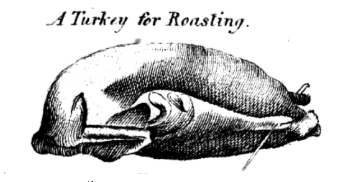
turkey for roasting

Image from The Frugal Housewife, 1796

Every November,  scores of American families sit down to Thanksgiving dinner, a tradition followed for almost 400 years in the New World. The main dish of this celebratory feast is a turkey, stuffed and roasted to perfection.

In the 18th century, The Frugal Housewife, or Complete Woman Cook, a cookery book written by Susannah Carter and published first in England and then in Philadelphia in 1796, must have influenced large numbers of colonial cooks, since Mrs. Carter’s books were hugely popular. Recipes back then were not given the precise directions modern cooks are accustomed to, but one can imagine that  Mrs. Carter’s contemporaries would have no trouble following her specifications.
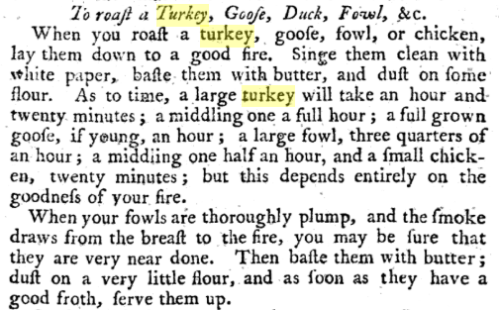
roast turkey-frugal housewife

American colonialists most likely used the following Carter recipe, when chestnut trees were abundant in the east and before a fungal blight decimated them. Chestnuts were used in the stuffing, as well as the gravy.
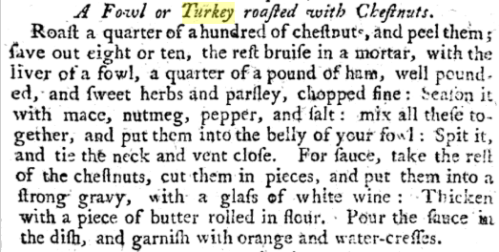
turkey with chestnuts

Dishes accompanying the turkey included fruits and vegetables plentiful in the new world – sweet potatoes, mashed potatoes, turnips, cabbage, tomatoes, corn, cranberry sauce, current jelly, pumpkin and peach pies, stewed apples, and more, such as fowl or fish, or anything seasonal that was at hand.
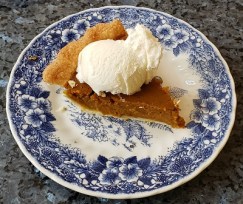
Photo of a slice of pumpkin pie and vanilla ice cream.

Pumpkin pie and vanilla ice cream. Image © Vic Sanborn.

My memory of a hot slice of pumpkin pie and a dollop of cold vanilla ice cream will always be tied to Thanksgiving.  Ices have had a long history in Europe and the New World Thomas Jefferson recorded his recipe for vanilla ice cream by hand. It is well known that he traveled to France, where ice cream recipes appeared in cookery books since the 17th century. While Jefferson did not introduce ice cream to the U.S. (it was consumed in England throughout the Georgian period), he helped to popularize the dessert by serving it during his presidency. (Ice Cream, an article courtesy of the Thomas Jefferson Encyclopedia, downloaded 11/28/2019 at https://www.monticello.org/site/research-and-collections/ice-cream)
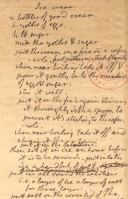
Jefferson Ice Cream Handwriting

T.J.’s recipe, Library of Congress

Thomas Jefferson’s Vanilla Ice Cream Recipe
(Recipe translation from the Thomas Jefferson Encyclopedia)

2. bottles of good cream.
6. yolks of eggs.
1/2 lb. sugar

mix the yolks & sugar
put the cream on a fire in a casserole, first putting in a stick of Vanilla.
when near boiling take it off & pour it gently into the mixture of eggs & sugar.
stir it well.
put it on the fire again stirring it thoroughly with a spoon to prevent it’s sticking to the casserole.
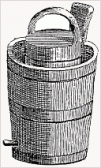
sabottiere

Sabottiere

when near boiling take it off and strain it thro’ a towel.
put it in the Sabottiere14
then set it in ice an hour before it is to be served. put into the ice a handful of salt.
put salt on the coverlid of the Sabotiere & cover the whole with ice.
leave it still half a quarter of an hour.
then turn the Sabottiere in the ice 10 minutes
open it to loosen with a spatula the ice from the inner sides of the Sabotiere.
shut it & replace it in the ice
open it from time to time to detach the ice from the sides
when well taken (prise) stir it well with the Spatula.
put it in moulds, justling it well down on the knee.
then put the mould into the same bucket of ice.
leave it there to the moment of serving it.
to withdraw it, immerse the mould in warm water, turning it well till it will come out & turn it into a plate.15

While at Godmersham (Edward Austen Knight’s estate), Jane Austen wrote:

But in the meantime for Elegance & Ease & Luxury . . . I shall eat Ice & drink French wine, & be above Vulgar Economy. 

I can’t help but think that the elegance and ease she experienced must have been similar to the scene below, where a side table is set to serve ices and wine to an assembled group. Our family had a lovely time together. We wish the same good time for all.
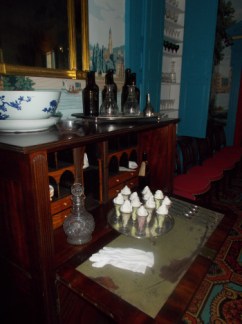
027

Georgian ices as served in early 19th c. America. Image © Vic Sanborn: Hampton Mansion, MD.

Top 14 images of Georgian ices in Google search.
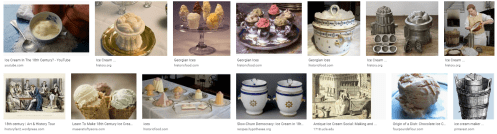
google search ice cream

This blog’s posts tagged Georgian Ices and ice cream

  • https://janeaustensworld.wordpress.com/tag/georgian-ices-and-ice-cream/
  • 18th Century Cookery Books: https://janeaustensworld.wordpress.com/2010/11/24/18th-century-cookery-books-and-the-british-housewife/

Share with others:

  • Click to email a link to a friend (Opens in new window) Email
  • Click to print (Opens in new window) Print
  • Click to share on Facebook (Opens in new window) Facebook
  • Click to share on Reddit (Opens in new window) Reddit
  • Click to share on X (Opens in new window) X
  • Click to share on Pinterest (Opens in new window) Pinterest
  • Click to share on Tumblr (Opens in new window) Tumblr
  • Click to share on LinkedIn (Opens in new window) LinkedIn
Like Loading...

Related

Posted in 19th Century England, 19th century food, 19th Century France, Jane Austen's World | Tagged Georgian food, Georgian ices, Historical vanilla ice cream recipe, Thanksgiving, Thomas Jefferson | 3 Comments

3 Responses

  1. on November 29, 2019 at 09:49 Patty S.'s avatar Patty S.

    Vic, Jefferson and Dolly Madison made ice cream popular. The origins are probably far older from China in the 7th century, with it traveling west on the silk road. In America the first to serve was here – “Ice cream began to appear in the American colonies during the first half of the eighteenth century. The first known instance of ice cream being served occurred in Maryland in 1744, when Governor Thomas Bladen put it on his dessert table.” – from the Colonial Williamsburg site.


  2. on November 29, 2019 at 09:58 Patty S.'s avatar Patty S.

    Vic, here’s the rest of the quote – from one of Bladen’s guests. “William Black of Virginia, wrote of it in a letter, which survives. Black mentions “a Dessert no less curious: Among the Rarities of which it was Compos’d, was some fine Ice Cream which, with the Strawberries and Milk, eat most Deliciously.”


  3. on December 2, 2019 at 00:20 Bonnie McCune's avatar Bonnie McCune

    Sounds wonderful. Isn’t it hysterical that today we have everything so easy (including getting our turkeys ready to bake or even ready to serve), and we move so little that we hardly dare have a piece of pie and ice cream.


Comments are closed.

  • Enter your email address to subscribe to this blog and receive notifications of new posts by email.

    Join 7,248 other subscribers
  • 2025 AGM in Baltimore

  • Items of Interest

  • Blog Stats

    • 18,363,064 hits
  • Follow Jane Austen's World on WordPress.com
  • RECOMMENDED BOOKS AND RESOURCES

  • Fashionable Goodness: Christianity in Jane Austen's England is now available! By JAW contributor Brenda S. Cox. See Review. Available from Amazon and Jane Austen Books.
  • We also recommend JAW contributor Rachel Dodge's devotionals based on Jane Austen's prayers and classic literature. Reviews:
    Praying With Jane: 31 Days Through the Prayers of Jane Austen
    The Anne of Green Gables DevotionalThe Little Women Devotional
    The Secret Garden Devotional
  • The Tour of Doctor Syntax. Edited by Ben Wiebracht. Read the review of the book at this link. Click to order the book on Amazon US or Amazon UK or Jane Austen Books
  • FREE Student Membership to JASNA

    Available through December 31st, 2025. Click on image for details, and share this poster with other teachers and students!

  • The Obituary of Charlotte Collins by Andrew Capes

    Click on image to read the story.

  • Comments

    “My idea of good company…is the company of clever, well-informed people, who have a great deal of conversation.” – Jane Austen, Persuasion


    Gentle readers: Please feel free to post your comments and continue the conversation! Due to SPAM, we will no longer accept comments on posts after 30 days of publication. In some instances, links will be removed from comments as well.

  • Administrators and Contributors

    Vic Sanborn, founder of this blog, is supported by a team of talented and knowledgeable writers about Jane Austen and the Regency era. They are:

    • Brenda Cox
    • Rachel Dodge and
    • Tony Grant, who now contributes his photos from London and England

    Click on their names to enter their own blogs.

    In addition, we thank the many experts and authors who frequently contribute their posts and opinions, and who continue to do so freely or at our request.

  • Pin It!

    Follow Me on Pinterest
  • Top Posts

    • Highclere Castle Floor Plan: The Real Downton Abbey
      Highclere Castle Floor Plan: The Real Downton Abbey
    • Men's hair styles at the turn of the 19th century
      Men's hair styles at the turn of the 19th century
    • Regency Hygiene: The Bourdaloue
      Regency Hygiene: The Bourdaloue
    •  A Triple Tragedy: How Princess Charlotte's Death in 1817 Changed Obstetrics
      A Triple Tragedy: How Princess Charlotte's Death in 1817 Changed Obstetrics
    • Cassandra Writes About Jane Austen's Death, July 18, 1817
      Cassandra Writes About Jane Austen's Death, July 18, 1817
    • Regency Fashion: Men's Breeches, Pantaloons, and Trousers
      Regency Fashion: Men's Breeches, Pantaloons, and Trousers
    • Characteristics of the Georgian Town House
      Characteristics of the Georgian Town House
    • Jane Austen’s Regency Women: A Day in the Life, Part 1
      Jane Austen’s Regency Women: A Day in the Life, Part 1
    • Sanditon, Season 3: Well, it's finally over
      Sanditon, Season 3: Well, it's finally over
    • George Austen: Jane Austen's almost forgotten, invisible brother
      George Austen: Jane Austen's almost forgotten, invisible brother
  • Recent Posts

    • Coming Soon: Birthday Tales for Jane Austen’s 250th
    • Book Review: The Austens, by Sarah Emsley
    • Praying with Jane Audiobook with Amanda Root
    • Book Review: The Worlds of Jane Austen: The Influences and Inspiration Behind the Novels
    • Books Purchased at the 2025 AGM in Baltimore
  • Links to Jane Austen Blogs

    Click here to enter the page. Topics include Regency fashion, historic foods, Jane Austen societies, British sites, related topics. Click on image.

  • May we suggest?

  • Unknown's avatarHello, my name is Vic and I live in Maryland, USA. I have adored Jane Austen almost all of my life. I am a proud lifetime member of the Jane Austen Society of North America. This blog is a personal blog written and edited by me and my team. We do not accept any form of cash advertising, sponsorship, or paid topic insertions. However, we do accept and keep books and CDs to review.

    If you would like to share a new site, or point out an error, please email us. (Yes, we are fallible. We'll own up to our mistakes and will make the corrections with a polite smile on our faces.) Write us at

    gmailbw

    Thank you for visiting this blog. Your comments and suggestions are most welcome.

  • Project Gutenberg: eBook of Stage-coach and Mail in Days of Yore, Volume 2 (of 2), by Charles G. Harper

    STAGE-COACH AND MAIL IN DAYS OF YORE: A PICTURESQUE HISTORY
    OF THE COACHING AGE, VOL. II, By CHARLES G. HARPER. 1903. Click on this link.


  • Top Posts & Pages

    • Highclere Castle Floor Plan: The Real Downton Abbey
    • Men's hair styles at the turn of the 19th century
    • Regency Hygiene: The Bourdaloue
    • A Triple Tragedy: How Princess Charlotte's Death in 1817 Changed Obstetrics
    • Cassandra Writes About Jane Austen's Death, July 18, 1817
    • Regency Fashion: Men's Breeches, Pantaloons, and Trousers
    • Characteristics of the Georgian Town House
    • Jane Austen’s Regency Women: A Day in the Life, Part 1
    • Sanditon, Season 3: Well, it's finally over
    • George Austen: Jane Austen's almost forgotten, invisible brother
  • Tour Chawton Cottage on YouTube

  • Disclaimer: Our team makes no profit from this blog. We may receive books (physical or digitized) for review purposes.

  • Copyright Statement: © Jane Austen's World blog, 2009-2024. Unauthorized use and/or duplication of this material without express and written permission from this blog’s author and/or owners is strictly prohibited. Excerpts and links may be used, provided that full and clear credit is given to Jane Austen's World with appropriate and specific direction to the original content.

Blog at WordPress.com.

WPThemes.


  • Reblog
  • Subscribe Subscribed
    • Jane Austen's World
    • Join 7,248 other subscribers
    • Already have a WordPress.com account? Log in now.
    • Jane Austen's World
    • Subscribe Subscribed
    • Sign up
    • Log in
    • Copy shortlink
    • Report this content
    • View post in Reader
    • Manage subscriptions
    • Collapse this bar
 

Loading Comments...
 

    %d

