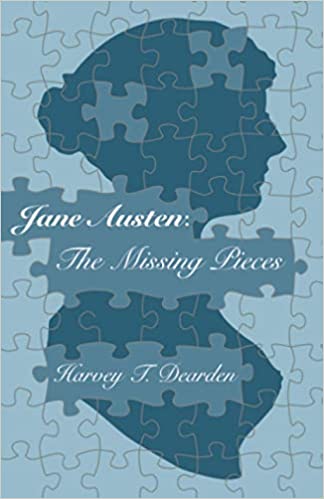
 Inquiring readers: Not only did I enjoy reading Jane Austen: The Missing Pieces, but spent many silent hours debating with its author, Harvey T. Dearden, agreeing or disagreeing with his points of view, and thinking back on my history of reading about and researching her life to find how I arrived at my own conclusions. This succinctly written book, only 168 pages long, including endnotes and bibliography, is packed with ideas and suppositions based on Jane Austen’s letters, novels, history, and the scholarly articles and books written about her.
Introduction:
Like me, author Harvey Dearden is an amateur Janeite with a keen interest in the topic, but whose area of expertise is in another subject area. In Mr. Dearden’s case, it is as an engineer; in mine it is as a professional development trainer. We do not pretend to be academics. Like amateur scientists in the 19th century who formed societies in pursuit of scientific knowledge, Mr. Dearden and I resemble Janeite enthusiasts the world over – those who study Austen’s novels and life to become well informed and are curious to learn more.
Mr. Dearden’s book, which examines questions regarding the many missing pieces in Jane Austen’s life and work, is divided into short chapters in a variety of topics, all of which pose questions or suppositions which readers and scholars have addressed about Austen for ages. Supporting evidence in these instances may be hard to find or might once have existed (such as in her letters to Cassandra and members of her family) but have either been destroyed or might be hiding undiscovered in an attic.


Jane’s Face:
Here’s how my reaction and silent debate with Mr. Rearden’s conjectures worked, and why I took longer to read this book than I at first anticipated:
One tantalizing question most of us have is: “What Did Jane Austen Look Like?” The author addresses this in a chapter titled “Jane’s Face.” (p.99.) He refers to Cassandra’s small watercolor portrait of her sister, (which, in my instance, I saw as an American tourist in the National Portrait Gallery) and which he (and most of us) characterizes as an amateurish attempt; the engraved image included in James Edward Austen-Leigh’s Memoir of his aunt, which was a supposed “improvement” upon Cassandra’s real life attempt; Jane’s engraved image on the 10 pound bank note; and recent forensic artists’ attempts at recreating her image in painting and sculpture according to family descriptions, family portrait resemblances, and physical traits that descendants have in common with the Austen bloodline. (Compare the images of actress Anna Chancellor, a direct descendent of the Austen family, [she played Caroline Bingley in P&P 1995] to Cassandra’s portrait of Jane and one of her father, and you will see a family resemblance in the dark eyes, long nose, and smallish, tight mouth.)
Mr. Dearden’s clear language, his engineer’s logic, and his talented wife, Linda’s, lovely pencil portrait of Jane Austen, based on a portrait bust by sculpturist Suzie Zamit, makes sense from his POV and logic. I respect his conclusion and the two artist’s representations, so why am I introducing my own interpretation? First, because Mr. Dearden invites inquiry and makes it clear that our informed guesses are as good as his.
Second, because I’ve been trained at the Maryland Institute College of Art and practiced as a successful local artist in Charlottesville for ten years. My experience painting a family member’s portrait places me in a unique position to discuss the difficulty of capturing a likeness of a stern-faced woman. Mom and Dad Sanborn (my in-laws) had their portraits captured by a local artist, a talented man who delineated their features perfectly. Dad’s face showed a kind, smiling man. Mom looked like a mirthless, tight-lipped school marm. She framed Dad’s portrait, hung it in his study, and tore her portrait up. She then commissioned me to paint her. Aaargh!
I could have fallen into a trap, for I considered her first portrait an accurate representation of her features. What the artist did not capture was her personality. So I asked the family how they viewed her, and thought about my relationship with her and her kindness, sweetness, and willingness to put family and friends above herself. The changes I made in her portrait were to enlarge her eyes slightly and soften her prim mouth into a half smile. I removed many of her wrinkles and worked on the pencil sketches a long time before embarking on the painting. She loved it. The family loved it. And none realized that I had cheated in favor of personality over feature accuracy. What they saw in my portrait was MOM.
This brings me to Cassandra’s watercolor of her sister. We Janeites have formed a personal connection to Jane Austen and have our own perceptions of how she might have looked. Cassandra’s watercolor, drawn and painted by an amateur, portrays a tight-faced woman with arms crossed in a protective, stay-away-from-me body language. The painting is extremely small and I would have used a smaller brush to paint her features, but it also lacks any semblance to the descriptions that Jane’s family gave us: her sparkling eyes, her liveliness and sense of humor, and one who enjoyed a loving relationship as a daughter, sister, and aunt.
I speculate that Jane felt comfortable to be totally herself in front of Cassandra, and that she might have been thinking about writing, editing, or correcting a particularly difficult passage she’d been working on, thus the “resting bitch face.” As for us, her fans, we are still searching for that illusive image that reflects our knowledge of her, our personal relationship with her, and our own interpretation of what she might have looked like.
I spent a long time on my reaction to this 7-page chapter to illustrate that, while Mr. Dearden’s book is succinct, well-thought out, and clearly written, his speculations inspired me to examine my knowledge of Austen and how and why I reacted the way I did to her many mysteries. At times I agreed with him completely, but at other times I paused to think back on how I came to a different conclusion.
I suspect Mr. Dearden would enjoy a healthy debate, as would I. I’d like to add that reading this book gave me great enjoyment and pleasure, and much food for thought.
Addendum: Denise Holcomb contributed her image of Austen portraits in a Will & Jane exhibit at the Folger Shakespeare Library in Washington D.C. in 2016. She took an image of the progression of 3 portraits of Austen, from Cassandra’s rendition to the Memoir engraving.
The book’s organization:
This book is organized in such a fashion as to facilitate how the author arrived at his conclusions. Sources are listed after each chapter. The bibliography lists most of the books and resources I’ve used, but a few are included from authors that I have not read before, such as Marian Veevers. Mr. Dearden backs up his arguments using Austen’s letters from Deirdre LeFaye’s excellent, fully inclusive edition, direct quotes from family and friends, evidence in Jane’s novels, and examples of her manuscripts digitized online at the Bodleian Library, for example.

Image taken by D. Holcomb at the Folger Exhibit, 2016.
I loved how the author used his engineer’s logic to consider the size and weight of the quatros of letters from Jane that Cassandra must have stored over the years, and the difficulty and the considerable time it would have taken her to burn those that she did not want to keep for posterity. He used both LeFaye’s information and his precise mathematical skills to calculate the sheer effort it would have taken Cassandra to burn those letters.
I feel that Mr. Dearden missed one opportunity when he introduced Charlotte Bronte’s three letters regarding her opinion about Austen’s talent and genius. I loved that he reproduced the letters in full, which placed some of her more controversial opinions in context. Bronte could not have known of Austen’s Juvenilia at this time, but it bears repeating that the lack of passion that she accuses Austen of not having was displayed in full in these exuberant scribblings of a young and budding genius.
For Janeites who are new to this conversation, this book will be a valuable addition. I see it as a great conversation starter for a book group who could use its list of topics for discussion over a year of meetings, or as a source of Austen resources that add value to any Janeite’s library collection. The bibliography for the neophyte Janeite, combined with Le Faye’s meticulous listing of all her known existing letters, provide an immediate resource for those who are only familiar with Austen’s novels and would like to know more about Austen’s conversational style and the missing information about her.
Riddles and word games abound in Emma. This book puzzles out the many mysteries in Austen’s life and continues that tradition. Dearden’s conclusion fits my assessment of Austen and why her novels attract readers with different political backgrounds, religions, sexes, and ages the world over.
“She is celebrated for the nicety of her language and, preferring the rapier to the bludgeon, she could use it in a most cutting manner. There is plenty of evidence for this in her private correspondence. There is with Jane no self-indulgent ornamentation beyond the immediate purpose of her stories. She would have wielded Occam’s razor with admirable zeal.”
Purchase the book:
About the author:

Author Harvey T. Dearden
Harvey T. Dearden is a Chartered Engineer who works as a consultant in the process industries (power, oil and gas, chemicals, etc.; basically those with something in a pipe)…He is married to an Anglesey girl and lives in north Wales. He has one child who is mum to Otts [to whom this book is dedicated.]
This book is a family affair and I wish to record my gratitude to my daughter, Lucy Dearden Jones for the editing, my wife, Linda Dearden, for the portrait sketch of Jane and first proofreading, and to my niece, Alexandra Parkinson, for the book cover.







 Jane Austen's World
Vic, this book sounds very interesting, and your reactions are equally so. I’ve ordered a copy.
Thank you, Ronald. Feel free to debate my reaction to this book. During this COVID experience, I enjoyed the debate that Mr. Dearden inspired in me. Your comment is much appreciated! Vic
This jogged a memory from the Will + Jane exhibit at the Folger in DC in 2016. They had three portraits of Jane, side by side, where it’s easy to see the similarities and differences in interpretation by the artists.
I just looked up my photo file to make sure my memory was correct, and it is.
I emailed it to you–it’s not the best quality photo.
denise
Thank you, Denise!! Please see my addition of your photograph. V
You’re welcome. Thanks for adding the photo.