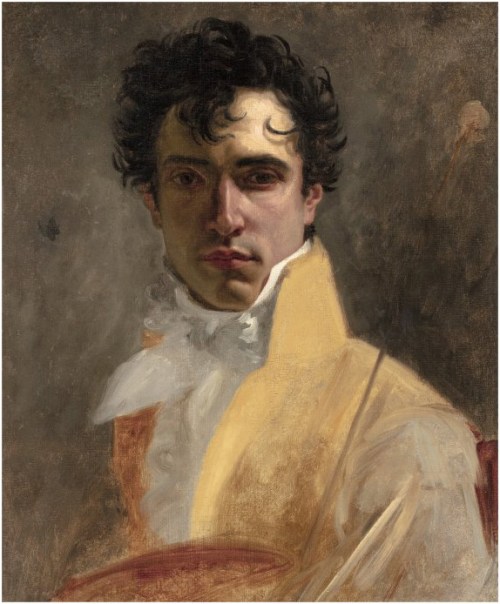
(Portrait of an Artist by Unknown Artist) is part of the collection of the Michele and Donald D’Amour Museum of Fine Arts, Springfield., MA. Image courtesy of theMichele and Donald D’Amour Museum of Fine Arts.
Inquiring readers,
In 2012, I included this fascinating portrait in a post entitled Men’s Hairstyles at the Turn of the Nineteenth Century. That post has been one of our most popular articles over the years. This image depicts the natural, romanticized and popular look of men living during the height of the regency era. In fact, when I look at this unknown man, I see Jane Austen’s most famous hero, Mr Darcy; the romantic poet, Byron; or a suffering Mr Rochester. The fact that both sitter and painter are unknown heightens the mystery of this painting. My sense is that it is a self portrait, for the man looks at us as if he was studying his image for posterity. The painting’s sitter reflects the same strong studied gazes in the self-portraits described in this Artmajeur article, Top 8 Most Famous Self-Portraits in the History of Art.


While the Men’s Hairstyles post has been up for 11 years, I just received a correction from the Springfield Museums. Mr Stephen Sullivan, the museum’s registrar, kindly sent the correct information, and also offered a higher resolution image. Ms Maggie North, the curator of the Springfield Museums, sent the following description of the painting:
The Springfield Museums’ striking portrait has intrigued and puzzled scholars for decades. Shortly after it was purchased by the Springfield Museums in 1954, Walter Pach (translator of the journals of Eugène Delacroix) attributed the painting to the Famous French romantic artist Delacroix and likened it to a portrait of Baron Louis-Auguste Schwiter at the National Gallery of Art. That attribution was accepted until the 1970s, when Robert Henning, a curator here in Springfield, determined that the piece could not be confidently attributed to Delacroix and suggested that the title of the work be changed from Portrait of Baron Schwiter to the more general Portrait of an Artist. Since then, several suggestions about the attribution, including artists Richard Parkes Bonington, Sir Thomas Lawrence, and even Baron Schwiter himself, have been made. However, none of these suggestions have been confirmed. Most recently, a scholar proposed that the painting could possibly be a self-portrait of the artist Pierre-Narcisse Guérin (an interesting idea when we compare the painting to Robert Lefèvre’s portrait of Guérin at the Musee des Beaux-Arts d’Orleans). Still, more research is needed!
As the title of the work indicates, we believe that the work is likely a portrait of an artist due to presence of a form presumed to be a palette which is visible in the foreground. Certainly, it may be a self-portrait, but of whom we cannot be certain. Even without attribution, this painting of a brooding, handsome young man is a wonderful example of the Romantic period in art, in which individual experience and was valued. The work is a visitor favorite here at the Springfield Museums, and as Stephen can attest, images of the work have been used in publications that range from fictional to scholarly. I think that the incredible magnetism of the sitter’s gaze, his effortlessly stylish sensibility, and the mystery of his identity make our artist a very compelling character!
The Springfield Museums in Massachusetts remind me of the various buildings that comprise the Walters Art Museum (WAM), in Baltimore, where I am a docent. Both museums were formed from private 19th century collections donated by wealthy families to their communities. The close connections that Americans felt towards their European ancestors are represented in these excellent collections.
This short history from the the D’Amour Museum of Fine Arts website states:
The Michele and Donald D’Amour Museum of Fine Arts, established in 1933 and housed in an Art Deco style building, includes a comprehensive collection of Americanand European paintings, prints, watercolors, and sculpture as well as a large collection of Japanese prints and representative examples of drawing, furniture, metalwork, textiles, glass and ceramics. The Museum houses a comprehensive collection of European Art (French, Dutch, and Italian) and the Currier & Ives (active 1834-1907) collection, one of the largest holdings of lithographs in the nation.”
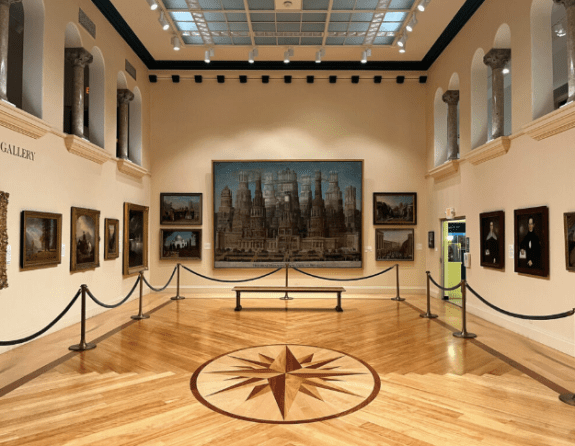
Blake Court, D’Amour Museum of Fine Arts, Springfield
Compare this history with WAM’s description:
The Walters Art Museum was established in 1934 “for the benefit of the public.” Originally called the Walters Art Gallery, the museum started when Henry Walters (1848–1931) bequeathed to the City of Baltimore an extensive art collection begun by his father, William T. Walters (1819–1894)..Henry built upon his father’s collection of European sculpture and Asian decorative arts, acquiring archaeological works from the ancient Mediterranean world—Mesopotamia, Egypt, Greece, and Rome—followed by medieval European and Islamic art and manuscripts, and European paintings and sculptures from the Renaissance through the 19th century.
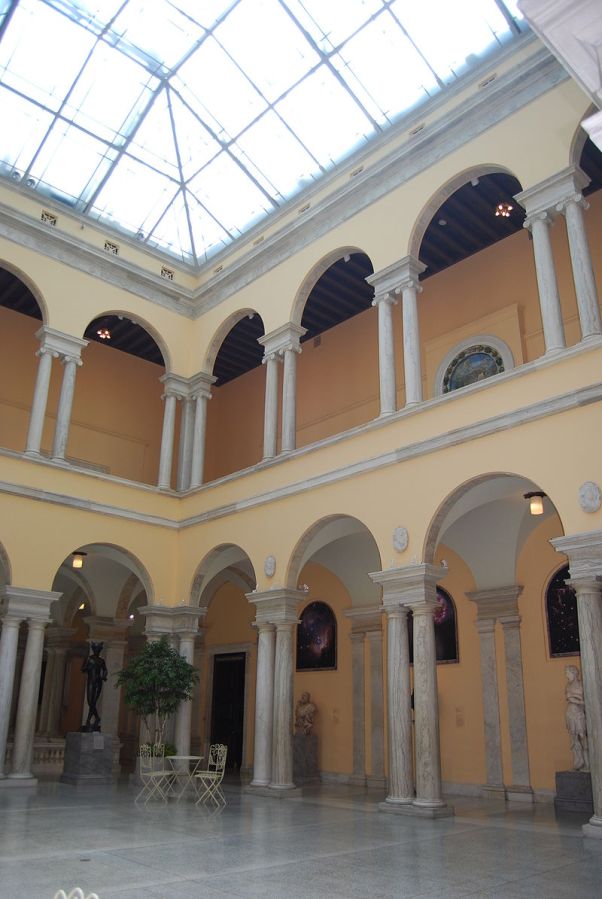
View of the palazzo’s sculpture court, Walters Art Museum. Notice how the courtyards in both museums echo each other – WAM’s is based on an Italian palazzo and D’Amour’s follows the Art Deco style popular during the 1930’s. Wikimedia image –palazzo building
These two museums are small and intimate compared to their much larger counterparts, like the Metropolitan Museum of Art in New York, Boston Museum of Fine Art, and the Art Institute of Chicago. Comparable “small” museums would be the Isabella Gardner Museum, Frick Gallery, and the Morgan Library & Museum, which held a memorable exhibit in 2009-2010 entitled A Woman’s Wit: Jane Austen’s Life and Legacy.
Both the D’Amour and Walters Art museums involve their local communities by featuring exhibits with contemporary artists and artisans:
- Just recently the D’Amour Museum of Fine Arts hosted a local fashion designer, Justin Haynes (Jus10H) presented his collection on February 15, 2023, during a New York Fashion Week CFDA Runway 360 Showcase.
- Around the same time, WAM concluded an exhibit entitled ‘Activating the Renaissance’ that featured 6 contemporary artists, most of whom lived in and around Baltimore. Class groups and adult visitors were able to compare and contrast the iconography of today’s paintings with centuries old masterpieces. This exhibit was among the most popular at WAM in a 12-month period. See this comparison of images of two mothers with child. Although separated by centuries, both are compelling. WAM’s facebook page (see image below.)
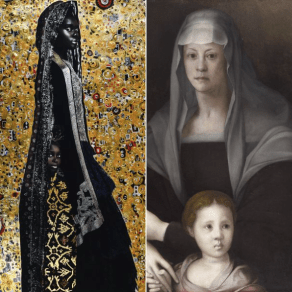
(1) Tawny, Chatmon, Covered/Vienna, 2017-19. Courtesy of the artist. (2) Pontormo (Jacopo Carucci), Portrait of Maria Salviati de’ Medici and Giulia de’ Medici, ca. 1539. Bequest of Henry Walters, 1931.
Private Collections:
Jane Austen was no stranger to viewing private collections in opulent houses. Her mother’s family lived in Stoneleigh Abbey, an ancient and impressive pile of stone. And her brother Edward Austen Knight inherited Godmersham Park, Chawton House, and Chawton Cottage, in which Austen, her sister Cassandra, and mother lived. One can imagine the grand rooms and salons she experienced as a visitor, especially in her brother’s dwellings. All of these houses are open to the public today for a fee.
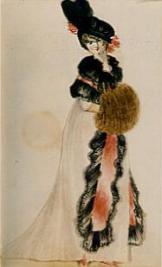
Watercolor of Jane Austen (?) 1816, by librarian, James Stanier Clarke
On the cusp of publishing Emma and at the invitation of the Prince Regent’s librarian, Austen visited Carlton House‘s impressive library. Although she felt disdain for the prince himself, she must have felt some awe walking through the legendary sumptuous hallways and public rooms. This house no longer exists, but many images and descriptions survive that attest to its magnificence.
As in Pride & Prejudice, owners who were often absent from their houses for weeks or months at a time, allowed their housekeepers (who expected a generous tip) to escort a party around the public rooms to view paintings, sculptures, and furniture. When Lizzy Bennet moved through Pemberley with the Gardiners and heard the housekeeper’s effusive compliments about Mr Darcy, and as she strolled around Pemberley’s extensive grounds, Lizzy realized that she could have been mistress “of all this.” At this juncture in the novel, she had begun to realize that her first impression of Mr Darcy might have been wrong: Mrs Reynolds provided even more information for her contemplation.
Private collections were not new. As trade and travel expanded around the world during the 16th, 17th, & 18th centuries, merchants, seafarers, and tourists, who embarked on lengthy grand tours, brought back artifacts, paintings, sculptures, jewelry, and the like. In many instances, historic artifacts were stolen from countries and churches, but that is a topic for another post
Seventeenth century Flemish merchants filled their houses with artifacts that were brought from their trade routes, and showed them to their friends. The Chamber of Wonders, WAM includes objects from the natural world (shells, butterflies, sea creatures) in each continent, as well as paintings, sculptures, and artifacts. This painting by Jan Brueghel the Elder and Hieronymus Francken II, title ‘The Archdukes Albert and Isabella Visiting a Collector’s Cabinet’ shows a room filled with one merchant’s collection. The archduke and his wife are at the center of the room. Other visitors are visible as well.
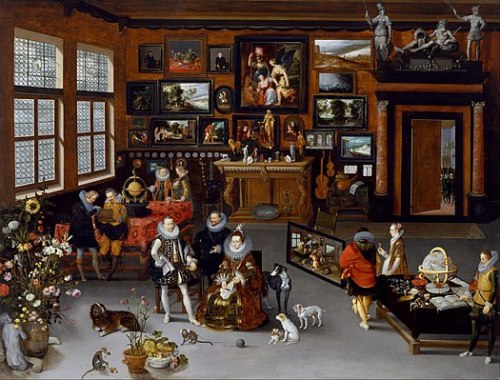
The Archdukes Albert and Isabella Visiting a Collector’s Cabinet, 1621-1623, public domain, Walters Art Museum
Jane Austen’s Visits to Public Exhibitions
Austen’s frequent travels around England – Brighton, Lyme Regis, Bath, London, Winchester, and the environs around Steventon and Basingstoke – belie her reputation as a spinster who lived a narrow, rural life. In her visits to London she attended public exhibits. Two were especially notable:
“the Sir Joshua Reynolds retrospective in 1813 or the Shakespeare Gallery as it looked in 1796. These two Georgian blockbusters took place, years apart, in the same London exhibition space at 52 Pall Mall (it no longer exists). When Austen visited in 1813, the building housed the British Institution, an organization promoting native artists. On her earlier London visit in 1796, it was the first-ever museum dedicated to William Shakespeare. – What Jane Austen Saw.
Interestingly, the exhibits Austen viewed also featured contemporary artists. Seeing Art the Way Jane Austen Saw It.
Conclusion:
Before institutional museums became a major way for the general public to view collections of past objects, paintings, sculptures and other artifacts (scientific or those from the natural world), private collections and homes were the means for the populace to view these precious objects. Who would have thought that a portrait shared by the Springfield Museums would prompt my imagination to wander down so many paths? This trip was delightful.
Find: More information about the Springfield Museums and the D’Amour Museum of Fine Arts can be found in the links. The Walters Art Museum provides images of the museum’s objects at this link. Type ‘online collections’ in the search bar. Entry to the museum is free; on street parking is free on Sundays.







 Jane Austen's World
Wonderful links to some handsome portraits and cultivated wild unruly men’s hairstyles in the Regency. I think the unknown self portrait could indeed be Mr Darcy or Rochester. And Colin Firth is my ideal Darcy look in the 1995 series. I also think the most recent Ross Poldark star has the liiks of a Mr Darcy. Thanks for sharing.
Yes, the recent Poldark has that dark brooding handsomeness. Well commented!
Enjoyed this post immensely.
Last time I was at the Walters, it was still known as Walters Art Gallery. Guess I need to visit again.
denise
Denise, you are invited to my next adult tour at the Walters Art Museum. Look for my invitation! You may park your car in my unit’s spot, and I shall take you there!
That’s so kind of you!
I so agree about Colin Firth looking the ideal Darcy in the 1995 P & P adaptation. And in the same production Adrian Lukus (hope that’s the correct spelling) looked exactly how I’d imagined the naughty Mr Wickham! The mention of Ross Poldark set me thinking and reminiscing – all these brilliant adaptations where the actors just become the character they are playing (I don’t think Colin Firth will ever lose the ‘Mr Darcy’ link). The portrait of an Unknown Artist is probably too handsome to have been Mr Rochester, but who knows for sure?
Adrian Lucas, the actor, has aged in quite a distinguished way. I liked his Wickham, naughty but not as nasty as in subsequent JA film adaptations. I’ve always thought of Mr Rochester as handsome in his youth, but that his expression and face were damaged from his life’s experiences. This image reminds me of him in his more optimistic youth.
I ardently agree! Some amazing portraits here and the men’s hairstyles too. I love the history behind these intimate features. These styles have greatly been shown in many of the regency films and series I’ve watchd. I have to also say Colin Firth is still my favourite Darcy, but Matthew does a splendid 2nd!
Matthew MacFadyen is indeed a close rival to Colin Firth. My first Mr Darcy love was the 1980 version by the actor David Rintoul. He was as stiff as Colin Firth’s character, but the production was old-fashioned and has been forgotten in time. https://www.imdb.com/title/tt0078672/
Oh yes! I have seen the 1980 film, but humbly admit it was put in the back of my mind, but agree his portral was stiffer than Colin and Matthew.
I found a really interesting article yesterday on Regency men’s hairstyles. Darcy’s hair from both Colin & Matthew completely different, but they both wore well in my opinion, and they were both true to the times. Fascinating stuff. I’ll post it on here later if you’re interested.
Indeed I am!
Cool! Will post the link soon!
Thanks for this Vic. I always appreciate the regency hairstyles, as that’s how my curly hair grows naturally. It worked great for me at 1812 re-enactments! We appreciate the smaller art museums also when we tour. The Springfield museum intrigues me as I’m also an admirer of Currier and Ives prints. I think that’s it’s nice that they contacted you on a post that’s been out there for a while and provided you with updated artwork and theories.
Kevin, their contact was so nice and classy. I recall visiting this beautiful museum when I was an art history student living in Boston, MA, and loved its intimate feel. As for curly hair – yeah, I’ve always envied it. My hair is as straight as an arrow. (:) smile)