• Home
  • Audio/Podcasts
  • Austensites
  • AV/E-Texts
  • History
  • JA Novels & Bio
  • Links
  • Original Sources/19th C. Texts
  • Social Customs During the Regency
  • Teacher/Student
  • Writer/Literature Resources

Jane Austen's World

This Jane Austen blog brings Jane Austen, her novels, and the Regency Period alive through food, dress, social customs, and other 19th C. historical details related to this topic.

Feeds:
Posts
Comments
« How I Shall Dine: A Short Annotation of ‘Mutton’, a Jonathan Swift Food Poem
Jane Austen and Rom Coms: Northanger Abbey (“The Meet-Cute”) »

Edmund’s Kindness in Sending Fanny’s Letter to Her Brother (Mansfield Park): The Cost of Correspondence in Regency England

July 28, 2023 by Vic

When Jane Austen wrote letters to her sister or brothers, she had the choice of sending them two ways: One was to assume her siblings would pay to receive her letters. The other was that Jane would pay to send the letter. As we know, Jane lived on a budget of a mere £50 per year, as did Cassandra, and so their letters were crossed to save money on weight and pages.

Letter to Godmersham

In the following passage from Mansfield Park, Jane writes about 10 year old Fanny Price’s dilemma: She wants to write to her brother William, the sibling she loves the most, but she has no paper on which to write him, and even if she had the paper, she has no funds to send the letter. Her cousin Edmund offers a solution. 

“My dear little cousin,” said he, with all the gentleness of an excellent nature, “what can be the matter?” And sitting down by her, he was at great pains to overcome her shame in being so surprised, and persuade her to speak openly. Was she ill? or was anybody angry with her? or had she quarrelled with Maria and Julia? or was she puzzled about anything in her lesson that he could explain? Did she, in short, want anything he could possibly get her, or do for her? For a long while no answer could be obtained beyond a “no, no—not at all—no, thank you”; but he still persevered; and no sooner had he begun to revert to her own home, than her increased sobs explained to him where the grievance lay. He tried to console her.

“You are sorry to leave Mama, my dear little Fanny,” said he, “which shows you to be a very good girl; but you must remember that you are with relations and friends, who all love you, and wish to make you happy. Let us walk out in the park, and you shall tell me all about your brothers and sisters.”

On pursuing the subject, he found that, dear as all these brothers and sisters generally were, there was one among them who ran more in her thoughts than the rest. It was William whom she talked of most, and wanted most to see. William, the eldest, a year older than herself, her constant companion and friend; her advocate with her mother (of whom he was the darling) in every distress. “William did not like she should come away; he had told her he should miss her very much indeed.” “But William will write to you, I dare say.” “Yes, he had promised he would, but he had told her to write first.” “And when shall you do it?” She hung her head and answered hesitatingly, “she did not know; she had not any paper.”

“If that be all your difficulty, I will furnish you with paper and every other material, and you may write your letter whenever you choose. Would it make you happy to write to William?”

“Yes, very.”

“Then let it be done now. Come with me into the breakfast-room, we shall find everything there, and be sure of having the room to ourselves.”

“But, cousin, will it go to the post?”

“Yes, depend upon me it shall: it shall go with the other letters; and, as your uncle will frank it, it will cost William nothing.”

“My uncle!” repeated Fanny, with a frightened look.

“Yes, when you have written the letter, I will take it to my father to frank.”

Screen Shot 2023-07-28 at 5.40.45 PM

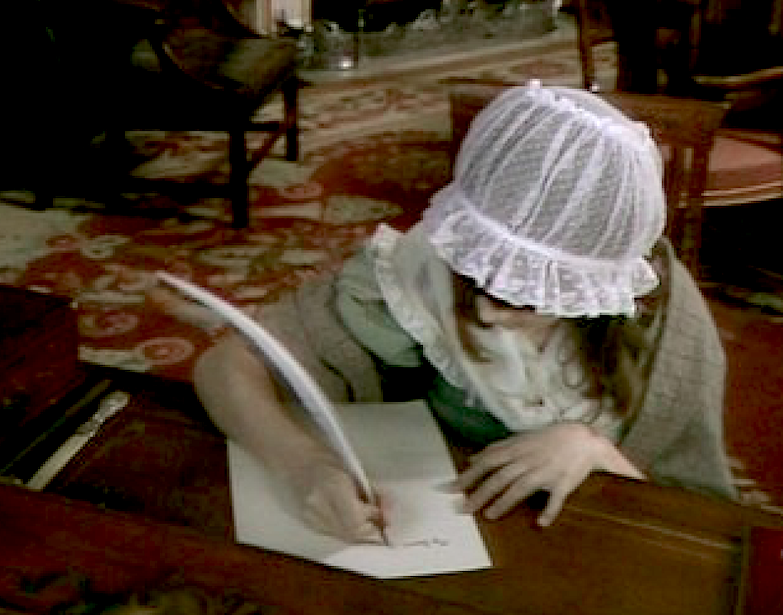
Fanny writes William a letter. (Mansfield Park, 1983)

Fanny thought it a bold measure, but offered no further resistance; and they went together into the breakfast-room, where Edmund prepared her paper, and ruled her lines with all the goodwill that her brother could himself have felt, and probably with somewhat more exactness. He continued with her the whole time of her writing, to assist her with his penknife or his orthography, as either were wanted; and added to these attentions, which she felt very much, a kindness to her brother which delighted her beyond all the rest. He wrote with his own hand his love to his cousin William, and sent him half a guinea under the seal. Fanny’s feelings on the occasion were such as she believed herself incapable of expressing; but her countenance and a few artless words fully conveyed all their gratitude and delight, and her cousin began to find her an interesting object. He talked to her more, and, from all that she said, was convinced of her having an affectionate heart, and a strong desire of doing right; and he could perceive her to be farther entitled to attention by great sensibility of her situation, and great timidity. He had never knowingly given her pain, but he now felt that she required more positive kindness; and with that view endeavoured, in the first place, to lessen her fears of them all, and gave her especially a great deal of good advice as to playing with Maria and Julia, and being as merry as possible.

From this day Fanny grew more comfortable. She felt that she had a friend, and the kindness of her cousin Edmund gave her better spirits with everybody else. The place became less strange, and the people less formidable; and if there were some amongst them whom she could not cease to fear, she began at least to know their ways, and to catch the best manner of conforming to them.”
Edmund’s solution was a third option not available to Jane or her family. Franking privileges were available to all peers and sirs, like his father, Sir Thomas Bertram, a baronet. He who would write his name diagonally across the sealed letter. This act automatically paid for the postage. — Regency Trivia: Franking Privileges, Ella Quinn

This scene sets the stage for the special relationship between the lonely, bewildered Fanny and her kind cousin, who has made her feel welcome and at home at a time when she felt adrift. Their connection would stand the test of time.

More on the Topic:

The Regency Post — A Pity We’ve Lost Letters, Shannon Donnely’s Fresh Ink

Jane Austen — Quills and Correspondence

Share with others:

  • Click to email a link to a friend (Opens in new window) Email
  • Click to print (Opens in new window) Print
  • Click to share on Facebook (Opens in new window) Facebook
  • Click to share on Reddit (Opens in new window) Reddit
  • Click to share on X (Opens in new window) X
  • Click to share on Pinterest (Opens in new window) Pinterest
  • Click to share on Tumblr (Opens in new window) Tumblr
  • Click to share on LinkedIn (Opens in new window) LinkedIn
Like Loading...

Related

Posted in Jane Austen's letters, Jane Austen's World, Mansfield Park | Tagged Edmund Bertram, Fanny Price | 6 Comments

6 Responses

  1. on July 29, 2023 at 01:20 dholcomb1's avatar dholcomb1

    Fascinating! Love these tidbits of knowledge.

    denise


  2. on July 29, 2023 at 06:38 Margaret Mills's avatar Margaret Mills

    Jane Austen’s depiction of the homesick, frightened little girl that is Fanny Price is so beautifully done.

    It must have been a huge shock for Fanny to find herself in this grand house, after living in the chaos and confusion of her overcrowded home with her loud and overpowering father – to live with relations with whom she’d had no previous contact. For the first time we begin to see the character of Edmund, and his kindness to his very timid little cousin, and although the character of Edmund is often derided as being pompous and priggish, but here he shows his heart.


  3. on July 29, 2023 at 15:14 Harriet Simons's avatar Harriet Simons

    Actually, Sir Thomas was not a peer, he was a Baronet, having an inheritable knighthood. A Baronet stood between a knight (a for lifetime honor) and a Baron (the lowest ranking peer). Although it is not actually stated, Sir Thomas must have been a Member of Parliament or a magistrate, since, besides peers, they also had franking privileges as government officials. Since Miss Austen surely knew the rules I have always assumed she just didn’t mention Sir Thomas’s status.


    • on July 30, 2023 at 12:40 Vic's avatar Vic

      Thank you, Harriet. Correction made. I depend on the knowledge and sharp eyes of our readers to keep me honest!


  4. on July 31, 2023 at 08:43 generalgtony's avatar generalgtony

    The cost of sending a letter! Do you remember the article I wrote about visiting The Vyne where the Chutes used to live, Vic? It was for this blog. James Austen became friends with Tom Chute. Jane often used the Chute frank to send letters. That was a freeby for her. In case you have forgotten, here is a link to that article. It mentions about franking letters.

    The Vyne, The Chute Family & The Austens, by Tony Grant

    Send my best wishes to Brenda. I was telling her about The British Pilgrimage Trust. I’ve written a post about pigrimage which i will post once once the world has got over my series of posts about walking in Hampstead. I’ve ,”threatened,” to send Brenda a link. Ha! ha!

    All the best, Tony


  5. on August 14, 2023 at 23:08 quig45's avatar quig45

    I really love your posts!! Thank you for them! Eliazbeth Quigley

    >


Comments are closed.

  • Enter your email address to subscribe to this blog and receive notifications of new posts by email.

    Join 7,246 other subscribers
  • 2025 AGM in Baltimore

  • Items of Interest

  • Blog Stats

    • 18,382,940 hits
  • Follow Jane Austen's World on WordPress.com
  • RECOMMENDED BOOKS AND RESOURCES

  • Fashionable Goodness: Christianity in Jane Austen's England is now available! By JAW contributor Brenda S. Cox. See Review. Available from Amazon and Jane Austen Books.
  • We also recommend JAW contributor Rachel Dodge's devotionals based on Jane Austen's prayers and classic literature. Reviews:
    Praying With Jane: 31 Days Through the Prayers of Jane Austen
    The Anne of Green Gables DevotionalThe Little Women Devotional
    The Secret Garden Devotional
  • The Tour of Doctor Syntax. Edited by Ben Wiebracht. Read the review of the book at this link. Click to order the book on Amazon US or Amazon UK or Jane Austen Books
  • FREE Student Membership to JASNA

    Available through December 31st, 2025. Click on image for details, and share this poster with other teachers and students!

  • The Obituary of Charlotte Collins by Andrew Capes

    Click on image to read the story.

  • Comments

    “My idea of good company…is the company of clever, well-informed people, who have a great deal of conversation.” – Jane Austen, Persuasion


    Gentle readers: Please feel free to post your comments and continue the conversation! Due to SPAM, we will no longer accept comments on posts after 30 days of publication. In some instances, links will be removed from comments as well.

  • Administrators and Contributors

    Vic Sanborn, founder of this blog, is supported by a team of talented and knowledgeable writers about Jane Austen and the Regency era. They are:

    • Brenda Cox
    • Rachel Dodge and
    • Tony Grant, who now contributes his photos from London and England

    Click on their names to enter their own blogs.

    In addition, we thank the many experts and authors who frequently contribute their posts and opinions, and who continue to do so freely or at our request.

  • Pin It!

    Follow Me on Pinterest
  • Top Posts

    • Exploring Jane Austen's Prayers
      Exploring Jane Austen's Prayers
    • Cassandra Writes About Jane Austen's Death, July 18, 1817
      Cassandra Writes About Jane Austen's Death, July 18, 1817
    • Highclere Castle Floor Plan: The Real Downton Abbey
      Highclere Castle Floor Plan: The Real Downton Abbey
    • Regency Fashion: Men's Breeches, Pantaloons, and Trousers
      Regency Fashion: Men's Breeches, Pantaloons, and Trousers
    • Men's hair styles at the turn of the 19th century
      Men's hair styles at the turn of the 19th century
    • Happy 250th Birthday, Jane Austen!
      Happy 250th Birthday, Jane Austen!
    • More Birthday Events for Jane Austen!
      More Birthday Events for Jane Austen!
    • Sense and Sensibility, 1995 & 2008: Marianne’s Illness
      Sense and Sensibility, 1995 & 2008: Marianne’s Illness
    • In Jane Austen’s Own Words: Economic Sense and Sensibility
      In Jane Austen’s Own Words: Economic Sense and Sensibility
    • Social Customs During the Regency
      Social Customs During the Regency
  • Recent Posts

    • More Birthday Events for Jane Austen!
    • Happy 250th Birthday, Jane Austen!
    • Coming Soon: Birthday Tales for Jane Austen’s 250th
    • Book Review: The Austens, by Sarah Emsley
    • Praying with Jane Audiobook with Amanda Root
  • Links to Jane Austen Blogs

    Click here to enter the page. Topics include Regency fashion, historic foods, Jane Austen societies, British sites, related topics. Click on image.

  • May we suggest?

  • Unknown's avatarHello, my name is Vic and I live in Maryland, USA. I have adored Jane Austen almost all of my life. I am a proud lifetime member of the Jane Austen Society of North America. This blog is a personal blog written and edited by me and my team. We do not accept any form of cash advertising, sponsorship, or paid topic insertions. However, we do accept and keep books and CDs to review.

    If you would like to share a new site, or point out an error, please email us. (Yes, we are fallible. We'll own up to our mistakes and will make the corrections with a polite smile on our faces.) Write us at

    gmailbw

    Thank you for visiting this blog. Your comments and suggestions are most welcome.

  • Project Gutenberg: eBook of Stage-coach and Mail in Days of Yore, Volume 2 (of 2), by Charles G. Harper

    STAGE-COACH AND MAIL IN DAYS OF YORE: A PICTURESQUE HISTORY
    OF THE COACHING AGE, VOL. II, By CHARLES G. HARPER. 1903. Click on this link.


  • Top Posts & Pages

    • Exploring Jane Austen's Prayers
    • Cassandra Writes About Jane Austen's Death, July 18, 1817
    • Highclere Castle Floor Plan: The Real Downton Abbey
    • Regency Fashion: Men's Breeches, Pantaloons, and Trousers
    • Men's hair styles at the turn of the 19th century
    • Happy 250th Birthday, Jane Austen!
    • More Birthday Events for Jane Austen!
    • Sense and Sensibility, 1995 & 2008: Marianne’s Illness
    • In Jane Austen’s Own Words: Economic Sense and Sensibility
    • Social Customs During the Regency
  • Tour Chawton Cottage on YouTube

  • Disclaimer: Our team makes no profit from this blog. We may receive books (physical or digitized) for review purposes.

  • Copyright Statement: © Jane Austen's World blog, 2009-2024. Unauthorized use and/or duplication of this material without express and written permission from this blog’s author and/or owners is strictly prohibited. Excerpts and links may be used, provided that full and clear credit is given to Jane Austen's World with appropriate and specific direction to the original content.

Blog at WordPress.com.

WPThemes.


  • Reblog
  • Subscribe Subscribed
    • Jane Austen's World
    • Join 7,246 other subscribers
    • Already have a WordPress.com account? Log in now.
    • Jane Austen's World
    • Subscribe Subscribed
    • Sign up
    • Log in
    • Copy shortlink
    • Report this content
    • View post in Reader
    • Manage subscriptions
    • Collapse this bar
 

Loading Comments...
 

    %d

