Last month I started a new month-by-month series titled “A Year in Jane Austen’s World,” wherein I began exploring important events and details that happened in Jane Austen’s novels, letters, and lifetime during each month of the year. Starting with January in Jane Austen’s World, my aim is to share my monthly finds every month this year, through December. My goal is simple: Glean as much as I can from Austen’s life, letters, and novels about what life was like for Jane Austen during her time and era.
We now turn our attention to February in Jane Austen’s novels. As I examined passages in her novels and letters that mention February, some of the information I found was an extension of what we learned last month: Mainly, that most of the British aristocracy went to the London (and some to Bath) during the winter months for “the season.” They enjoyed balls, parties, and other social gatherings in the bigger cities during the colder months and then moved back to their country homes by summer when the heat and stench of the cities became unendurable. You can read about it here.
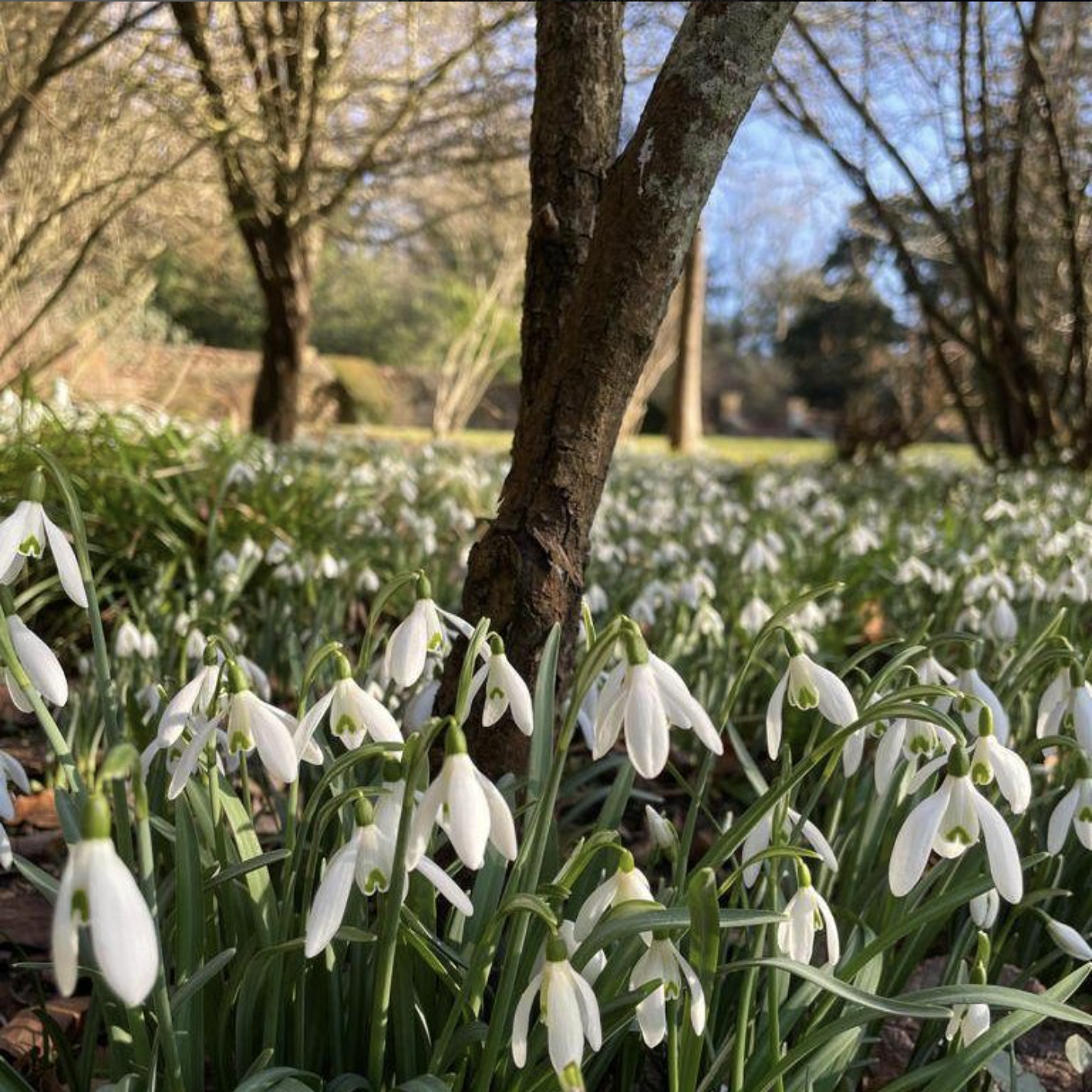
February in Hampshire
The snowdrops are in full bloom at Jane Austen’s House Museum and Chawton House this time of year. Chawton House even hosts “Snowdrop Sunday” tours, when guests can come visit the grounds and enjoy the stunning display of snowdrops and other bulbs that are starting to pop out.
I mention the snowdrops because they are everywhere on the grounds of Chawton House in the winter time, and it’s lovely to think that perhaps Jane Austen saw them for herself. These type of bulbs can spread and spread for years.

February in Jane Austen’s Letters
Several of Austen’s surviving letters were written in February. In them, she covers many topics, but the excerpts belows are especially intriguing.
8 February 1807 (Castle Square, Southampton):
These snippets are from Austen’s letters when the Austen women lived in Castle Square, Southampton. This first letter mentions the improvements they were making:
- Garden: “Our garden is putting in order by a man who bears a remarkably good character, has a very fine complexion, and asks something less than the first. The shrubs which border the gravel walk, he says, are only sweetbriar and roses, and the latter of an indifferent sort; we mean to get a few of a better kind, therefore, and at my own particular desire he procures us some syringas. I could not do without a syringa, for the sake of Cowper’s line. We talk also of a laburnum. The border under the terrace wall is clearing away to receive currants and gooseberry bushes, and a spot is found very proper for raspberries.”
- Interior: “The alterations and improvements within doors, too, advance very properly, and the offices will be made very convenient indeed. Our dressing table is constructing on the spot, out of a large kitchen table belonging to the house, for doing which we have the permission of Mr. Husket, Lord Lansdown’s painter — domestic painter, I should call him, for he lives in the castle. Domestic chaplains have given way to this more necessary office, and I suppose whenever the walls want no touching up he is employed about my lady’s face.”
- Beds: “The garret beds are made, and ours will be finished to-day. I had hoped it would be finished on Saturday, but neither Mrs. Hall nor Jenny was able to give help enough for that, and I have as yet done very little, and Mary nothing at all. This week we shall do more, and I should like to have all the five beds completed by the end of it. There will then be the window curtains, sofa-cover, and a carpet to be altered.”
- You must be very cold to-day at Godmersham. We are cold here. I expect a severe March, a wet April, and a sharp May. And with this prophecy I must conclude.
20 February 1807 (Castle Square):
In this letter, we hear a bit more about the weather there in Southampton and at Godmersham, where Cassandra was staying:
- “We could not pay our visit on Monday; the weather altered just too soon, and we have since had a touch of almost everything in the weather way; two of the severest frosts since the winter began, preceded by rain, hail, and snow. Now we are smiling again.”
- “You must have had more snow at Godmersham than we had here; on Wednesday morning there was a thin covering of it over the fields and roofs of the houses, but I do not think there was any left the next day. Everybody used to Southampton says that snow never lies more than twenty-four hours near it, and, from what we have observed ourselves, it is very true.”
- And one of Austen’s hilarious one-liners:”A widower with three children has no right to look higher than his daughter’s governess.”

4 February 1813 (Chawton, regarding PP):
In the following letters, we read a bit about Austen’s first beta readers for Pride and Prejudice and her reactions to their commentary:
- “My dear Cassandra,—Your letter was truly welcome, and I am much obliged to you for all your praise; it came at a right time, for I had had some fits of disgust. Our second evening’s reading to Miss B. had not pleased me so well, but I believe something must be attributed to my mother’s too rapid way of getting on: though she perfectly understands the characters herself, she cannot speak as they ought. Upon the whole, however, I am quite vain enough and well satisfied enough. The work is rather too light and bright and sparkling: it wants shade; it wants to be stretched out here and there with a long chapter of sense, if it could be had; if not, of solemn specious nonsense, about something unconnected with the story,—an essay on writing, a critique on Walter Scott, or the history of Buonaparte, or something that would form a contrast, and bring the reader with increased delight to the playfulness and epigrammatism of the general style…. The greatest blunder in the printing that I have met with is in page 220, v. 3, where two speeches are made into one. There might as well be no suppers at Longbourn; but I suppose it was the remains of Mrs. Bennet’s old Meryton habits.”
Dated soon after:
- “I am exceedingly pleased that you can say what you do, after having gone through the whole work, and Fanny’s praise is very gratifying. My hopes were tolerably strong of her, but nothing like a certainty. Her liking Darcy and Elizabeth is enough. She might hate all the others, if she would. I have her opinion under her own hand this morning, but your transcript of it, which I read first, was not, and is not, the less acceptable. To me it is of course all praise, but the more exact truth which she sends you is good enough.”
Garden Plans at Castle Square
As most gardeners (myself included) can attest, planning one’s spring garden is a happy prospect in the middle of February. Jane Austen was no different! With that in mind, let’s take a closer look at her descriptions of the plans for their garden from her 8 February 1807 letter to Cassandra:
Our garden is putting in order by a man who bears a remarkably good character, has a very fine complexion, and asks something less than the first. The shrubs which border the gravel walk, he says, are only sweetbriar and roses, and the latter of an indifferent sort; we mean to get a few of a better kind, therefore, and at my own particular desire he procures us some syringas. I could not do without a syringa, for the sake of Cowper’s line. We talk also of a laburnum. The border under the terrace wall is clearing away to receive currants and gooseberry bushes, and a spot is found very proper for raspberries.
Letter to Cassandra, 8 February 1807.
Austen’s Southampton Garden
With these lovely descriptions, we can paint a picture in our minds of what Austen was imagining as she planned the garden:
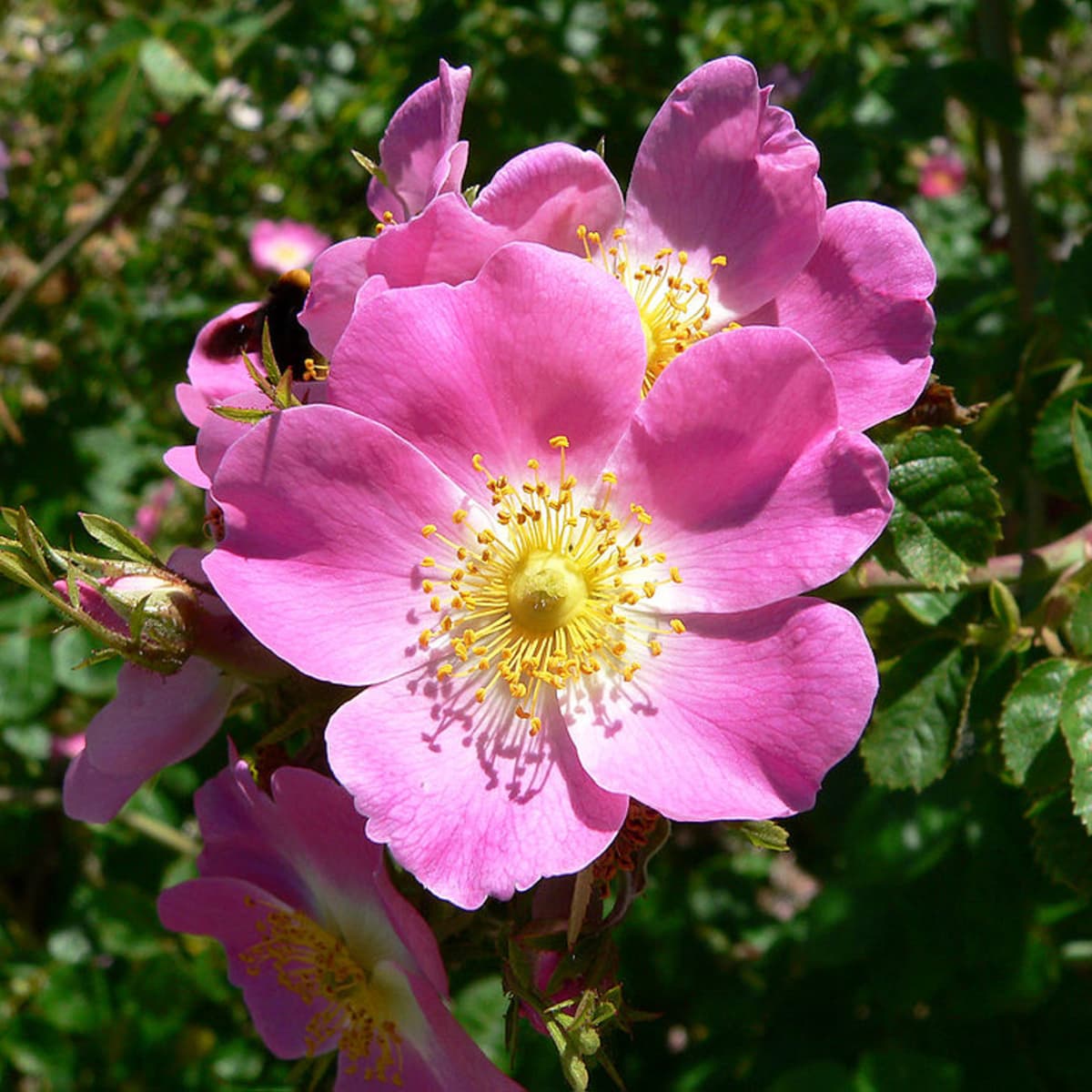
Sweet Briar
Austen wrote: “The shrubs which border the gravel walk, he says, are only sweetbriar and roses, and the latter of an indifferent sort; we mean to get a few of a better…”
On the blog From the Notebook of a Rosarian, you can read all about Sweet-Briar (or Eglantine Rose). I imagine Austen would have looked forward to seeing these blooms very much! Here is an example:
Regency Roses
Austen wrote: “roses . . . of an indifferent sort; we mean to get a few of a better…”
Perhaps the existing roses either weren’t uniform or weren’t as pretty as the Austen women wanted. Thus, they planned to add a few of “a better” sort. One can imagine a line of beautiful roses along their walkway come summer.
You can read a wonderful article about Regency Roses from Leeds University Library here: Regency Roses. Here is an example:

Syringa (Lilac)
Austen wrote: “I could not do without a syringa, for the sake of Cowper’s line. We talk also of a laburnum.” This is in reference to a line in William Cowper’s poem, “The Winter Walk at Noon” (Book VI, The Task, 1899).
In her article “‘With what intense desire she wants her home’: Cowper’s Influence on Jane Austen,” Jane Darcy provides the following commentary:
The house in Castle Square in Southampton feels more like a home [for Austen]; there is a garden which she energetically starts to plan. She insists on lilacs: ‘I could not do without a Syringa, for the sake of Cowper’s Line’, adding ‘We talk also of a Laburnum’, referring to the lines in ‘The Winter Walk at Noon’,
Jane Darcy, CowperandNewtonMuseum.org
Book VI of The Task:
… Laburnum rich
In streaming gold; syringa iv’ry pure (149-150)

Laburnum
Austen wrote: “We talk also of a laburnum.”
Laburnum, a flowering tree, also called golden chain or golden rain, is pictured below. One can imagine how lovely it would look in Austen’s garden in spring.

Austen wrote: “The border under the terrace wall is clearing away to receive currants and gooseberry bushes, and a spot is found very proper for raspberries.”
Here, we find an example of something pretty and edible for the garden come summer. Currants, gooseberries, and raspberries were all useful in a variety recipes. You can read more about the history of British food and Gooseberries here.

To read more about the trees and shrubs Austen would have recognized, the JASNA Eastern Washington/Northern Idado region provides this fascinating information regarding the “Trees and Shrubs Mentioned in Jane Austen’s Novels, Letters, and Minor Works with Historical Background: “Austen’s Trees and Shrubs A-K” and “Austen’s Trees and Shrubs L-Z.”
February in Jane Austen’s Novels
The following are a collection of interesting little tidbits and important moments from Austen’s novels:
Sense and Sensibility
- “[Mrs. Palmer] expects to be confined in February,” continued Mrs. Jennings.
- “[Edward] will be there in February, otherwise London would have no charms for me; I have not spirits for it.” (Lucy Steele)
- Colonel Brandon: “But last February, almost a twelvemonth back, [my little Eliza] suddenly disappeared.” […] “Good heavens!” cried Elinor, “could it be—could Willoughby!”—
- “[Mrs. Dashwood] had yet another reason for wishing her children to remain [in London]; a letter from her son-in-law had told her that he and his wife were to be in town before the middle of February, and she judged it right that they should sometimes see their brother.”
- “Early in February, within a fortnight from the receipt of Willoughby’s letter, Elinor had the painful office of informing her sister that he was married.”
Pride and Prejudice
- “With no greater events than these in the Longbourn family, and otherwise diversified by little beyond the walks to Meryton, sometimes dirty and sometimes cold, did January and February pass away.”
Mansfield Park
- “With such thoughts as these, among ten hundred others, Fanny proceeded in her journey safely and cheerfully, and as expeditiously as could rationally be hoped in the dirty month of February. They entered Oxford, but she could take only a hasty glimpse of Edmund’s college as they passed along, and made no stop anywhere till they reached Newbury, where a comfortable meal, uniting dinner and supper, wound up the enjoyments and fatigues of the day.”

Emma
- “In the summer it might have passed; but what can any body’s native air do for them in the months of January, February, and March? Good fires and carriages would be much more to the purpose in most cases of delicate health, and I dare say in her’s. I do not require you to adopt all my suspicions, though you make so noble a profession of doing it, but I honestly tell you what they are.”
- “Frank was here in February for a fortnight.”
- “When [Frank] was here before, we made the best of it; but there was a good deal of wet, damp, cheerless weather; there always is in February, you know, and we could not do half that we intended. Now will be the time.
- “Mr. Woodhouse was resigned. The time of year lightened the evil to him. May was better for every thing than February.”
Persuasion
- “It was the beginning of February; and Anne, having been a month in Bath, was growing very eager for news from Uppercross and Lyme.”
- Mary Musgrove sends a long, newsy letter to Anne from Uppercross.
Northanger Abbey
- “Catherine . . . gave herself up to all the enjoyment of air and exercise of the most invigorating kind, in a fine mild day of February, with the consciousness of safety.”

February Dates of Importance
This brings us now to several dates that would have been quite important to Austen personally:
Celebrations/Birthdays:
13 February 1765: James Austen (Jane’s brother) born at Deane.
Historic Dates:
1 February 1793: France declares war on England.
4 February 1794: France abolishes slavery in French colonies.
February 1811: George, Prince of Wales, becomes the prince regent of England.
Sorrows:
22 February 1794: Eliza de Feuillide’s husband is executed by guillotine in Paris.
February 1797: Tom Fowle (Cassandra’s fiancé), who was serving as a chaplain, dies in San Domingo of yellow fever.
Writing:
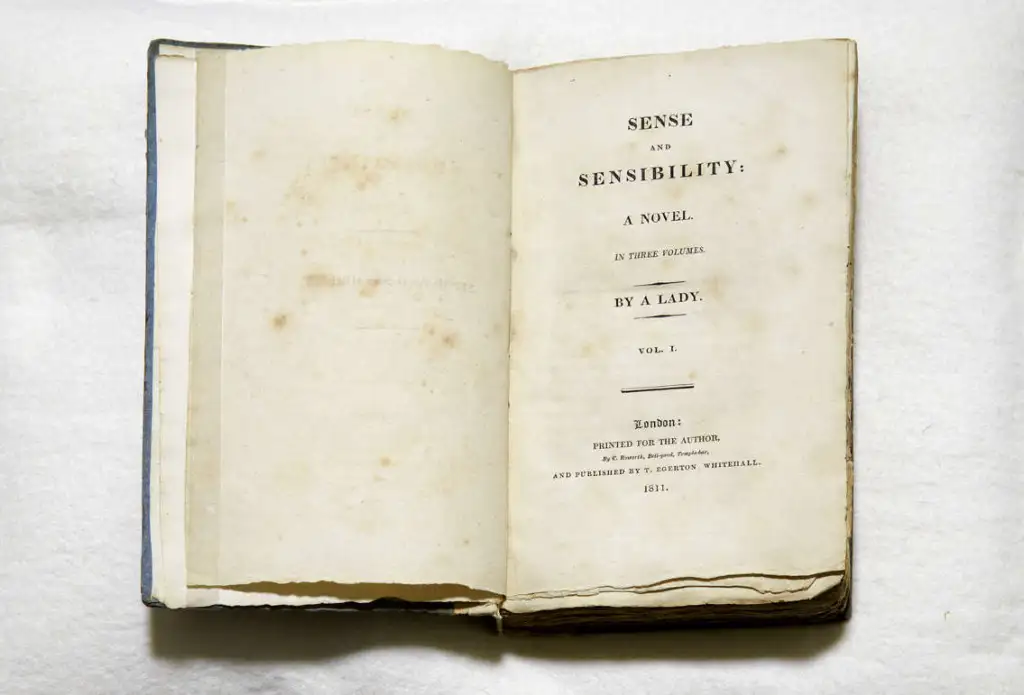
Winter 1810: Sense and Sensibility accepted for publication (Thomas Egerton).
February 1811: Jane Austen starts work on Mansfield Park.
February in the Life of Austen
I hope you enjoyed this tour of February in Jane Austen’s World as much as I enjoyed researching it and writing it. There is so much more to explore! I followed several intriguing trails and threads in this article, but I’m sure one might find many other avenues to research. Austen’s letters alone are a fount of information and charm. Here’s to what we’ll find in March in Jane Austen’s World next month!
RACHEL DODGE teaches college English classes, gives talks at libraries, teas, and book clubs, and writes for Jane Austen’s World blog. She is the bestselling author of The Little Women Devotional, The Anne of Green Gables Devotional and Praying with Jane: 31 Days Through the Prayers of Jane Austen. Now Available: The Secret Garden Devotional! You can visit Rachel online at www.RachelDodge.com.







 Jane Austen's World
I must tell you what pleasure your posts give me. I can’t quite explain it, but I end up smiling with either remembrance or discovery after each read. I’m looking forward to the rest of the year!
A great idea, Rachel. Who knew so much was happening in February in Austen’s life and novels?
I thoroughly enjoyed this post.
denise